

You cannot control whether a trade wins or loses. You cannot control market direction, volatility, or the behaviour of other participants. What you can control — completely and entirely — is how much you risk, how you manage open positions, and what you do when things go wrong. Risk management is the only domain of pure trader agency. These ten commandments form the complete framework.
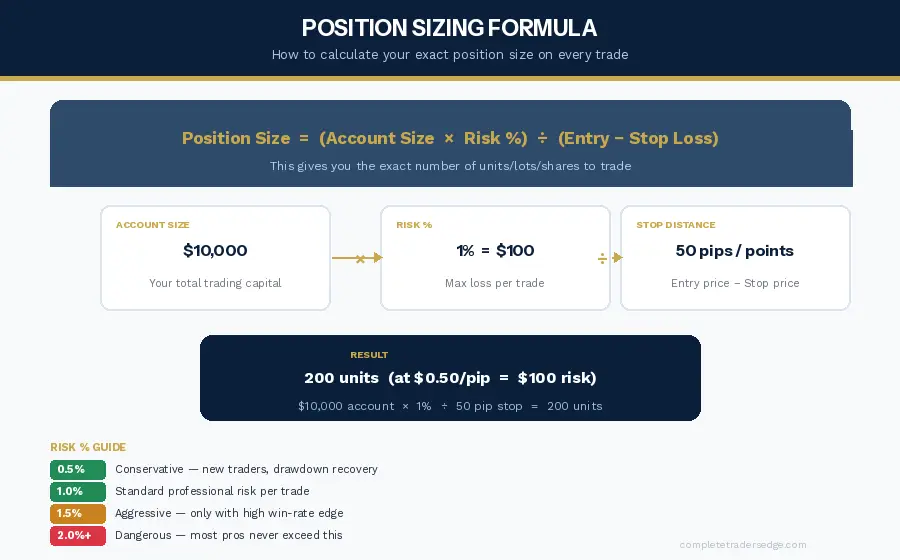
1. Never risk more than 1-2% of your account on a single trade
This is the foundation. At 1% risk, you need 100 consecutive losing trades to lose your account. No well-designed strategy loses 100 in a row. This rule alone prevents most catastrophic account failures.
2. Always use a stop loss — always
No exceptions. A trade without a stop loss is an unlimited-risk trade. Trading without stops is not conviction — it is recklessness.
3. Place stops based on market structure, not financial preference
Your stop goes where the trade is proven wrong by price behaviour — beyond a swing high, below a support level — not at a round number that “limits your loss to a comfortable amount.”
4. Never move a stop loss against your position
Moving a stop further away when price approaches it converts a defined loss into a potentially unlimited one. Set it, leave it.
5. Never add to a losing position
Averaging down into a loser means the market is telling you that you are wrong, and you are increasing your bet on being right. This is how small losses become account-destroying ones.
6. Define your daily loss limit and honour it absolutely
When you hit your daily loss limit, you are done for the day. No revenge trades. No “one more.” Close the platform.
7. Assess correlation before every new position
Multiple positions in the same direction on correlated instruments multiply your real risk. Treat correlated positions as a single trade for risk purposes.
8. Reduce size during drawdown
When your account is in drawdown, your position sizing should come down automatically. Smaller size during losing periods limits the damage and gives your edge room to reassert itself.
9. Keep a risk management log separate from your trading journal
Track every instance where you broke a risk management rule. Review it weekly. The patterns will reveal themselves.
10. Risk management is not optional on good setups
High conviction does not justify larger risk. Every trade gets the same percentage risk, regardless of how certain you feel. Certainty is not information — it is emotion.
The 10 Commandments Summary
| # | Commandment | What It Prevents |
|---|---|---|
| 1 | 1-2% max risk per trade | Account destruction from single trades |
| 2 | Always use a stop loss | Unlimited risk exposure |
| 3 | Structure-based stops | Arbitrary stops hit by normal market noise |
| 4 | Never widen stops | Converting defined losses into unlimited ones |
| 5 | Never average down | Small losses becoming catastrophic ones |
| 6 | Daily loss limit (2-3%) | Revenge trading spirals |
| 7 | Assess correlation | Hidden concentrated directional risk |
| 8 | Reduce size in drawdown | Accelerating losses during bad periods |
| 9 | Track rule breaches | Invisible patterns of self-sabotage |
| 10 | Same risk on every trade | Overconfidence inflating position sizes |
Key Lessons
- Risk management is the only domain of pure trader control. Master it completely.
- The ten commandments form a complete system: not suggestions, not guidelines, commandments.
- High conviction does not change risk percentage. Emotional certainty is not information.
- Track every rule breach in a dedicated log. The patterns will show you exactly where to improve.
Frequently Asked Questions
What if I break one of these rules?
Log it. Every breach goes in your risk management log with the date, which rule was broken, what triggered the breach (emotional state, market condition, missed stop), and what the financial cost was. After 20 logged breaches, review the data. You will find that 80% of your breaches cluster around 1 or 2 specific rules. Those are your priority fixes. This data-driven approach replaces vague intentions (“I need to be more disciplined”) with specific, actionable improvements.
Is 1% risk too conservative for a small account?
No. A $1,000 account at 1% risk means $10 per trade. The position will be small (micro lots on forex), but the learning is real and the account is protected. Traders who start with 5% or 10% risk to “grow faster” almost always blow the account and start over. The turtle wins this race. If you need more capital, prop firms provide it without requiring you to increase personal risk.
How do these rules apply to prop firm trading?
They become even more critical. Prop firms have hard drawdown limits (typically 5% daily, 10% total). Breaching these limits means losing the funded account. Many successful funded traders follow even stricter personal versions: 0.5% risk per trade, 1.5% daily limit, and a personal 5% total drawdown trigger that forces them to size down long before the firm’s limit is reached.
Can I ever break these rules?
No. That is what “commandment” means. The moment you allow exceptions (“just this once,” “this setup is different,” “I am certain about this one”), the rule ceases to be a rule and becomes a suggestion. Suggestions do not protect your capital. Rules do. Paul Tudor Jones and Stanley Druckenmiller have followed these principles for 40+ years without exceptions. If they do not make exceptions, neither should you.
Which commandment is the most important?
Commandment 1 (never risk more than 1-2%) is the foundation because it makes all other rules sustainable. But Commandment 6 (daily loss limit) is the one most commonly violated and most immediately destructive when broken. A trader who follows Commandment 1 but ignores Commandment 6 can lose 5 to 6 consecutive 1% trades in a revenge spiral, turning a manageable day into a devastating one. The commandments work as a system. Each one reinforces the others.
From The Book
This article covers concepts from Chapters 54-60 of The Complete Trader’s Edge.
 The Complete Trader's Edge
The full Mind · Method · Money framework. 70 chapters.
View on Amazon →
The Complete Trader's Edge
The full Mind · Method · Money framework. 70 chapters.
View on Amazon →
 Market Mayhem
400 years of bubbles, crashes, and the pattern that keeps repeating.
Buy on Amazon →
Market Mayhem
400 years of bubbles, crashes, and the pattern that keeps repeating.
Buy on Amazon →
 Greatest Companies
How the world's greatest companies were built — and what traders learn from them.
View on Amazon →
Greatest Companies
How the world's greatest companies were built — and what traders learn from them.
View on Amazon →