

Explore all 80 books in the Trader’s Library →
If you can name three trading books, one of them is probably about psychology, another is probably about technical analysis, and the third one is probably not about position sizing. That gap is exactly the gap Van Tharp spent his career trying to fill.
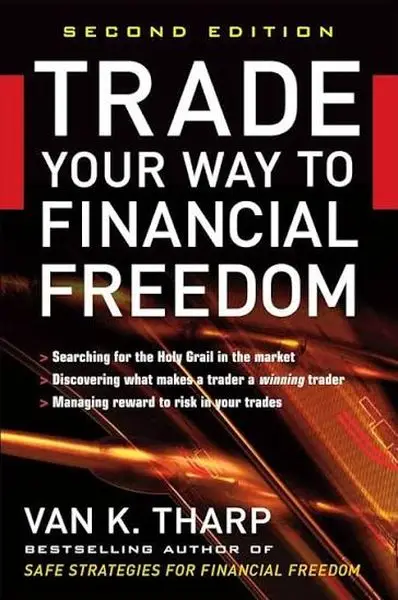
Trade Your Way to Financial Freedom is the most influential trading book ever written about Money. It is also the most underread of the canonical texts, because the topic is unglamorous and most traders would rather read about setups than expectancy. That is unfortunate, because the book contains the single most useful framework in trading literature for understanding why methods that backtest well still blow up accounts.
The book’s central claim is uncomfortable. Tharp argues that most of what new traders think matters — entries, setups, indicators — is actually the least important part of trading. Position sizing, exits, and the expectancy of the overall system matter far more, and they are precisely what most traders ignore.
This review breaks down what the book delivers, why its core ideas remain criminally underused in the retail trading world, where Tharp gets pushed back on by professionals, and how to use the book without falling into the equally common trap of treating his methodology as a complete system.
At a Glance
| Author | Van K. Tharp |
| First Published | 1998 (2nd edition 2006) |
| Pages | ~480 |
| Genre | Trading systems / risk and money management |
| Difficulty | Intermediate — conceptually accessible, mathematically demanding in places |
| Best For | Any trader who has a method that “should work” but is not producing consistent results |
| Skip If | You think entries and setups are the most important part of trading. You are not ready for this book. |
OVERALL RATING: 9.0 / 10
Who Should Read This Book
| Reader | Verdict | Why |
|---|---|---|
| New trader (0–1 year) | Read it after psychology and method | The book makes more sense once you have lived through a few losing streaks and started asking why your “good system” is not making money |
| Intermediate (1–3 years) | Read it immediately | This is the inflection point where Tharp’s ideas land hardest. You have the scar tissue. |
| Advanced / professional | Re-read every few years | The position sizing material rewards repeat reading as your account size grows |
| SMC / ICT trader | Required reading | Even the best entry framework needs proper risk-of-ruin discipline. Most SMC traders skip this and pay for it. |
| Algo / quant trader | Read it | Tharp’s R-multiple framework is one of the cleanest ways to standardise performance measurement across systems |
| Prop firm trader | Mandatory | Prop firm rules are essentially Tharp’s risk principles enforced by an external party. Internalise the principles and the rules stop feeling like constraints. |
The Book in Context
Van Tharp had an unusual background for a trading writer. He was a psychologist by training, with a PhD, who specialised in modelling expert performance. In the 1980s he turned that expertise on traders, conducting extensive research on what separated consistent winners from everyone else.
Tharp’s conclusion ran counter to almost everything sold in the trading education industry. He argued that the obsession with entries and setups was a distraction. The traders who consistently made money were not the ones with better setups. They were the ones with better understanding of position sizing, exits, and the statistical properties of their systems.
The book arrived in 1998, just as the retail trading boom was producing a generation of traders who had access to discount brokers and chart software but had no formal training in risk management. Tharp filled that gap. The 2006 second edition expanded the position sizing material and remains the definitive treatment of the topic.
The Core Argument: Position Sizing Is the Hidden Engine
The book’s central argument is uncomfortable for most readers because it inverts what they think they know. Tharp argues that the relative importance of trading variables runs almost exactly opposite to the order new traders assume.
Tharp’s Inverted Importance Hierarchy
| # | What New Traders Think Matters Most | What Actually Matters Most (Tharp) |
|---|---|---|
| 1 | The perfect entry / setup | Position sizing |
| 2 | Direction prediction | Exit strategy |
| 3 | Indicator combinations | Expectancy of the system |
| 4 | Win rate | Risk-of-ruin discipline |
| 5 | Risk management (sometimes) | Entries (the least important variable) |
Tharp’s research suggested that position sizing accounts for the majority of long-term performance variation between traders using the same method.
The implication is that trading education as it is usually sold has the priorities backwards. Two traders using identical entries and exits can have radically different results based on position sizing alone. Most retail courses do not teach this. Tharp’s book does, and that is why it remains required reading thirty years after the first version.
“Position sizing is the part of your trading system that tells you how much. It is the most important variable and the one almost nobody studies.”
— from Trade Your Way to Financial Freedom
R-Multiples: The Framework That Should Change How You Think
The book’s single most useful contribution is the R-multiple framework. Once you understand it, every trade you take and every system you evaluate fits into a cleaner mental model.
The idea is simple. R is the amount of money you put at risk on a trade. If you risk $200 to make $600, you are aiming for a 3R trade. If you stop out at $200, you have lost 1R. If you take half off at 2R and let the rest run to 5R, you have an average outcome of 3.5R on the trade.
Once you measure every trade in R, your performance becomes scale-independent. A 1R loss feels the same whether your account is $5,000 or $5 million. A 4R winner is a 4R winner. You can now compare systems, compare your own monthly performance, and evaluate your statistics without getting distracted by absolute dollar amounts.
This framework is the cleanest way to operationalise expectancy. Expectancy is the average R you make per trade across a large sample. A system that averages 0.5R per trade and trades 100 times a year produces 50R of expected outcome. Whether that turns into 5% returns or 50% returns depends on your position sizing, not on the entries.
How Tharp Built the Book
Tharp wrote as a researcher, not as a working trader. Three structural choices reflect that and account for both the strengths and weaknesses of the book.
Concept-first organisation. Each major idea is introduced theoretically, illustrated with examples, then applied to system design. The book reads more like a graduate course than a how-to guide. Some readers love this. Others find it slow.
Modelling, not memoir. Tharp interviewed traders extensively, but the book is not an interview collection. He synthesises the modelling work into general principles, which means readers get the lessons without the war stories. Some traders prefer the war stories. Others find the abstraction more useful.
Workbook-style exercises. The book includes worked examples, position sizing tables, and exercises throughout. Readers who do the exercises get far more out of the book than readers who only read the prose. Most retail readers skip the exercises and complain that the book is too abstract.
Five Passages Worth Carrying With You
“You do not trade the markets. You trade your beliefs about the markets.”
The line that ties Tharp’s psychology background to his trading work. Every system reflects the beliefs of the trader using it. Two traders with identical methods produce different results because they believe different things about what those methods mean.
“The goal of trading is not to be right. The goal is to make money. The two are not the same.”
The reframe that frees you from the desire to predict. You can be right 70% of the time and still lose money. You can be right 30% of the time and still get rich. The system properties matter, not the prediction count.
“Cut your losses short and let your profits run is meaningless without specifying how short and how long.”
The line that exposes the emptiness of most retail trading advice. Every adage you have heard sounds wise until you try to operationalise it. The book is, in many ways, an exercise in operationalising what other writers say abstractly.
“Position sizing is the only variable that has the same impact on a winning system and a losing system: it accelerates whatever expectancy you have.”
The line that should be taped to every trader’s monitor. Aggressive position sizing on a losing system blows accounts faster. Disciplined position sizing on a winning system compounds them faster. The lever is symmetric.
“Most traders fail because they cannot define their system precisely enough to determine whether it has positive expectancy.”
The hardest line in the book. If you cannot state your system’s entry, exit, stop, position sizing, and trade frequency in a way another person could execute, you do not have a system. You have a vibe.
Common Misreadings of the Book
Misreading #1: “Tharp says entries do not matter”
He says entries matter less than people think, not that they do not matter. There is a real difference. Entries set the R, the expectancy, and the win rate of the system. Tharp’s point is that improvement in those variables is harder and less productive than improvement in position sizing and exits, which most traders ignore entirely.
Misreading #2: “Just use 1% risk per trade and you will be fine”
The book explicitly says fixed-fractional sizing is one option among many, not a magic number. 1% is a reasonable default for beginners, but Tharp’s framework is much richer than that. Treating “1% risk per trade” as the whole of his methodology is reductive.
Misreading #3: “The R-multiple framework only works for swing traders”
R-multiples are timeframe-agnostic. They work on the 1-minute chart, the daily chart, and the weekly chart. The math is identical. The only thing that changes is the size of R and the frequency of trades.
Misreading #4: “Position sizing is too mathematical for me”
The book has math, but the core ideas do not require it. If you can divide your account by 100, you can calculate 1% risk. If you can multiply, you can compute R. Anyone who can use a trading platform has the arithmetic skills to use Tharp’s framework. The “too mathematical” complaint is usually code for “I do not want to think about losing.”
Misreading #5: “Tharp’s research is just opinion”
Tharp is one of the few trading writers with a research background, and his work has been validated by subsequent academic studies on system design and money management. The position sizing claim in particular has been tested in the literature and consistently holds up. Dismissing his work as opinion ignores the methodology behind it.
Where the Book Falls Short
- The book is long for the core ideas. The fundamental message about position sizing, expectancy, and R-multiples could be delivered in 100 pages. The other 380 pages add depth and examples but also dilute the central thesis for readers who would benefit from a tighter treatment.
- Some self-promotion. Tharp frequently references his own consultancy, his courses, and his other products. This is not unusual for a trading book but can feel heavy by the second reading.
- Limited coverage of modern instruments. Crypto, prop firm rules, options, and modern retail derivatives are not in scope. The principles port, but readers have to do the translation themselves.
- The “trading types” framework feels dated. Tharp’s classification of trading styles is interesting but has aged less well than the position sizing material. Treat it as suggestive rather than definitive.
- Mathematical sections vary in quality. Some of the position sizing formulas are presented in ways that obscure their elegance. A more careful editor could have made the math feel less intimidating without losing rigour.
- Limited integration with technical analysis. Tharp treats entries as somewhat interchangeable for the sake of his argument. In practice, technical context affects expectancy in ways the book does not fully explore.
How the Book Fits the Mind · Method · Money Framework
This is the cleanest Money-pillar book in the entire canon. It is also one of the very few books that explicitly addresses Money as a primary topic rather than treating it as an appendix.
| Pillar | Contribution | What the Book Delivers |
|---|---|---|
| MIND | SECONDARY | Beliefs as the substrate of every trading system; how traders model themselves; why the same method produces different results in different hands |
| METHOD | SECONDARY | System design as a structured process; how to think about entries, exits, and the interaction between them |
| MONEY | PRIMARY | Position sizing models, R-multiples, expectancy calculation, risk-of-ruin analysis, drawdown management, the relationship between sizing and survival |
If you have read The Complete Trader’s Edge, Tharp provides the deepest treatment of the Money pillar that exists in print. Reading both alongside the Mind · Method · Money framework gives you the structure and the depth in the area most traders neglect. Pair this book with Mark Douglas for Mind and John Murphy or Steve Nison for Method, and you have the most complete framework available in the literature.
Read This Instead Of / Read This After
| Relationship | Book | Why |
|---|---|---|
| Read after | Trading in the Zone by Mark Douglas | Douglas gives you the psychological foundation. Tharp gives you the operational framework. Without psychology, the framework gets overridden in the heat of trading. |
| Read after | Technical Analysis of the Financial Markets by John Murphy | Murphy gives you the method. Tharp shows you how to size and exit whatever method you choose. |
| Read alongside | The Mathematics of Money Management by Ralph Vince | Vince is the rigorous mathematical treatment. Tharp is the accessible operational treatment. Both together are powerful for serious system traders. |
| Read instead of | Most “money management” YouTube tutorials | The free content on position sizing is overwhelmingly shallow. Tharp’s book remains the canonical treatment that everyone else summarises (badly). |
| Read after | Van Tharp — Definitive Guide to Position Sizing | Tharp’s follow-up book that goes far deeper on position sizing alone. Read this after the introductory volume. |
Final Verdict: Should You Read This Book in 2026?
Yes. And if you are honest with yourself, you should have read it five years ago.
This book remains the most important treatment of the Money pillar in trading literature. The principles are not optional. They are not negotiable. They are the difference between traders who grind through drawdowns and come back stronger and traders who quietly blow up accounts after a “great run.” The math does not care about your conviction. The position sizing math is the same whether you are right or wrong.
The caveat is that the book rewards engagement. Readers who skim it learn vocabulary. Readers who do the exercises and apply the framework to their own systems get the transformation. Treat this as a textbook with a workbook, not a casual read, and the book pays back the time investment many times over.
CTE Rating Breakdown
9.0/10
Essential Reading
| Readability | 8 | |
| Actionability | 10 | |
| Timelessness | 10 | |
| Beginner-Friendly | 7 | |
| Modern Relevance | 10 |
Frequently Asked Questions
What is Trade Your Way to Financial Freedom actually about?
The book is about trading systems with a particular emphasis on position sizing, expectancy, and risk management. Tharp argues that these variables matter more than entries and that most retail trading education has the priorities backwards.
Is it still relevant in 2026?
Yes. The principles are mathematical and instrument-agnostic. They apply identically to stocks, futures, forex, crypto, options, and any other tradable instrument. The book has aged better than almost any other text in this category.
Is the book good for complete beginners?
Partially. The conceptual material is accessible. The position sizing material is more demanding and lands harder once you have some live trading experience. Most readers benefit from re-reading the book after their first year of trading.
What is an R-multiple?
R is the amount of money you put at risk on a trade. If you risk $200, then a 1R loss is $200, a 2R win is $400, and a 5R win is $1000. Measuring all trades in R makes performance scale-independent and lets you compare different systems and different time periods on a single scale.
What is expectancy?
Expectancy is the average R you make per trade across a large sample. A system that averages +0.5R per trade has positive expectancy. A system that averages -0.2R per trade has negative expectancy. Positive expectancy is necessary but not sufficient. Position sizing determines what happens to that expectancy in dollar terms.
How long does it take to read?
Around 20 to 25 hours for the full 480 pages. The book rewards reading slowly and doing the exercises, so plan for a longer engagement rather than a quick pass.
Should I read the 1st or 2nd edition?
The 2nd edition (2006). It includes substantially expanded position sizing material and is now the standard reference. The 1st edition is mostly of historical interest.
Is there an audiobook?
Yes, but the book has math, tables, and exercises that do not translate well to audio. Read the physical or Kindle version. If you want audio for review, use it after first reading in print.
Does the book apply to prop firm trading?
Yes, and arguably it is more relevant to prop firm trading than to retail trading. Prop firm rules on maximum daily drawdown and overall drawdown are essentially Tharp’s risk principles externally enforced. Internalising the principles makes the rules feel natural rather than restrictive.
What is the single most important takeaway from the book?
Position sizing is the most important variable in your trading and almost nobody pays attention to it. Get the position sizing right and a mediocre method can produce good results. Get the position sizing wrong and an excellent method will eventually blow up the account.
About the Author
Van K. Tharp (1945–2022)
Van Tharp held a PhD in psychology and built his career modelling expert performance, eventually applying the methodology to trading. He founded the Van Tharp Institute, conducted research on what separated consistent winners from struggling traders, and was one of the few figures interviewed in Jack Schwager’s Market Wizards who was profiled as a coach rather than as a trader.
Other notable works: The Definitive Guide to Position Sizing (2008), Super Trader (2009), The 13 Greatest Trading Lessons of All Time (multiple editions), Safe Strategies for Financial Freedom (2004, co-authored). The body of work centres on system design and money management at varying levels of depth.
Tharp died in 2022 but his institute continues to operate and his frameworks remain canonical in the small but serious community of traders who take position sizing seriously.
Continue Learning
- The Three Pillars: Mind, Method, Money
- The Mind · Method · Money Framework
- Trading in the Zone Book Review (2026)
- Technical Analysis of the Financial Markets Book Review (2026)
- Japanese Candlestick Charting Techniques Book Review (2026)
- The Complete Trader’s Edge — The Book
 The Complete Trader's Edge
The full Mind · Method · Money framework. 70 chapters.
View on Amazon →
The Complete Trader's Edge
The full Mind · Method · Money framework. 70 chapters.
View on Amazon →
 Market Mayhem
400 years of bubbles, crashes, and the pattern that keeps repeating.
Buy on Amazon →
Market Mayhem
400 years of bubbles, crashes, and the pattern that keeps repeating.
Buy on Amazon →
 Greatest Companies
How the world's greatest companies were built — and what traders learn from them.
View on Amazon →
Greatest Companies
How the world's greatest companies were built — and what traders learn from them.
View on Amazon →
 Greatest Traders
Eighty-six lives that explain the markets — Livermore to Madoff, told with the losses left in.
View on Amazon →
Greatest Traders
Eighty-six lives that explain the markets — Livermore to Madoff, told with the losses left in.
View on Amazon →