Explore all 80 books in the Trader’s Library →
Most traders who fail do not fail because they cannot read a chart. They fail because of what happens between their ears the moment money is on the line.
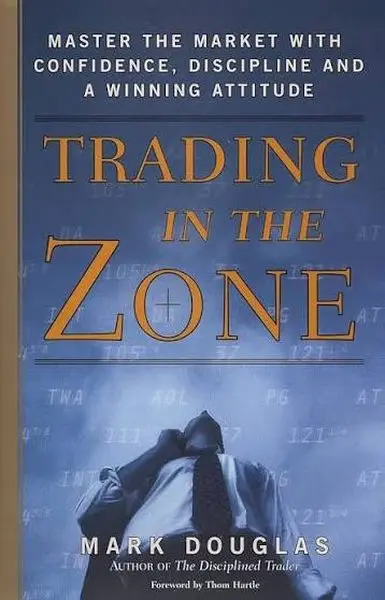
That is the entire argument of Trading in the Zone, and it is the reason Mark Douglas‘s 2000 book remains the most quoted psychology text in trading literature twenty-six years after publication.
The book is not about charts. It is not about setups. It is not about indicators or systems or risk management calculators. It is about the single hardest problem in trading, which is how to think clearly when you do not yet know whether you are about to win or lose. Douglas spent twenty years working with professional traders and identified a small set of beliefs that separate the consistent winners from everyone else. The book is his attempt to install those beliefs in the reader.
This review breaks down what the book actually delivers, where it falls short, why so many readers misread its central argument, and how to use it as the psychology layer underneath whatever method you trade.
At a Glance
| Author | Mark Douglas |
| First Published | 2000 |
| Pages | ~240 |
| Genre | Trading psychology |
| Difficulty | Beginner-friendly — accessible, repetitive on purpose |
| Best For | Every trader, at every level, before and after every major drawdown |
| Skip If | You believe the problem is the system, not the trader |
OVERALL RATING: 9.5 / 10
Who Should Read This Book
| Reader | Verdict | Why |
|---|---|---|
| New trader (0–1 year) | Read it first | The book gives you a mental framework before bad habits set in |
| Intermediate (1–3 years) | Read it now | You have the scar tissue to recognise what Douglas is describing |
| Advanced / professional | Re-read after every drawdown | The book reads differently when you are losing money |
| SMC / ICT trader | Required reading | No method works without the probabilistic mindset this book installs |
| Algo / quant trader | Read for context | Even with execution automated, you still have to live through the equity curve |
| Anyone in a drawdown | Read it today | The book is more useful when you have just been punched in the face by the market |
The Book in Context
Mark Douglas was not a celebrity trader. He was a futures trader turned trading coach who spent twenty years working with thousands of clients across every market and timeframe. His earlier book, The Disciplined Trader (1990), planted the seeds. Trading in the Zone is the refined, distilled, second pass at the same problem with a decade more evidence behind it.
The book arrived at the start of the retail trading boom, when online brokers were proliferating and a new generation was discovering that having a good system was not enough. Douglas was the first writer to give this audience a coherent vocabulary for what was actually going wrong. The terminology he introduced — the probabilistic mindset, the trading edge as a thought process not a setup, the five fundamental truths — has become standard across the entire industry.
The Core Argument: One Idea, Repeated Until It Sticks
The book has one central argument, and Douglas spends 240 pages making sure you cannot escape it.
The argument: consistent results come from a probabilistic mindset, not from a better system. Any edge with a positive expectancy will produce profits over a large sample of trades, but only if the trader can execute it without flinching. Most traders cannot. They override their own rules because each individual trade feels personal, and they confuse the outcome of a single trade with the validity of the method.
Douglas’s solution is to install a different belief structure. If you genuinely believe that any single trade is statistically meaningless and that your edge only plays out across a large sample, you stop caring about the outcome of any specific trade. You execute mechanically. You let the edge work. You become consistent.
That is the whole book. Everything else is variations on this theme, repeated from different angles until you cannot un-see it.
“Anything can happen. You don’t need to know what is going to happen next to make money.”
— from Trading in the Zone
The Five Fundamental Truths
If the book has a single famous artefact, it is the Five Fundamental Truths. Douglas argues that internalising these five statements is what separates a struggling trader from a consistent one. They sound simple. They are not. Each one targets a specific cognitive bias that wrecks most traders.
Douglas’s Five Fundamental Truths
| # | The Truth | What It Defeats |
|---|---|---|
| 1 | Anything can happen | Certainty bias, the urge to predict, attachment to a specific outcome |
| 2 | You don’t need to know what is going to happen next to make money | Analysis paralysis, indicator stacking, the search for the perfect setup |
| 3 | There is a random distribution between wins and losses for any given set of variables that define an edge | Confidence after wins, despair after losses, abandoning systems too early |
| 4 | An edge is nothing more than an indication of a higher probability of one thing happening over another | Belief that an edge is a guarantee, frustration when valid setups fail |
| 5 | Every moment in the market is unique | Pattern projection from the last trade onto the next, revenge trading |
If you can hold all five as operating beliefs, not just intellectual concepts, the book argues you have already won.
The catch is that intellectual agreement with these statements is not the same as believing them. You can read them, nod along, and still get sucked into wanting the next trade to work. Douglas’s central claim is that the gap between intellectual agreement and operational belief is exactly where most traders get destroyed.
How Douglas Built the Book
The book’s structure is part of its method. Douglas was a coach before he was an author, and the book reads like an extended coaching conversation rather than a textbook. Three craft choices give it staying power.
Repetition as installation. Douglas says the same things multiple times in slightly different words. This is not poor editing. It is the entire pedagogical strategy. He is not trying to inform you. He is trying to install a belief structure, and beliefs are installed through repetition, not through single exposures. Readers who complain that the book is repetitive have missed that the repetition is the point.
Reader-as-subject framing. The book is structured as a series of provocations directed at the reader. “You probably think this. You probably do that. Notice what happens when…” This places the reader inside the experiment rather than reading about other people’s failures. The effect is uncomfortable, which is exactly what Douglas wants.
Concepts before exercises. Most psychology books give you techniques. Douglas gives you concepts and trusts you to derive the techniques yourself. This is why the book frustrates some readers and changes others. If you want a checklist, it is not here. If you want a worldview, it is on every page.
Five Passages Worth Carrying With You
Five quotes that capture what the book is doing, each with a 2026 reading.
“The best traders aren’t afraid. They aren’t afraid because they have developed attitudes that give them the greatest degree of mental flexibility.”
The mental-flexibility frame is the book’s most underrated contribution. The opposite of fear is not confidence. It is the ability to update without ego, which is what flexibility actually means.
“When you really believe that trading is simply a probability game, concepts like right and wrong or win and lose no longer have the same significance.”
The line that breaks most traders’ framing. In a probability game, individual outcomes are noise. The trader’s job is to execute the edge, not to be right.
“You don’t need to know what’s going to happen next to make money.”
The most liberating sentence in the entire book. Prediction is a trap. Execution is the actual job.
“Your potential to experience emotional pain is what you need to manage, not the market.”
The reframe that turns risk management into psychological management. You are not managing risk on the chart. You are managing the version of yourself that wants to break the rules when the chart moves.
“There is a random distribution between wins and losses for any given set of variables that define an edge.”
The line that frees you from interpreting individual results. A losing trade does not mean the system is broken. A winning trade does not mean you are a genius. Distributions reveal themselves only at scale.
What the Book Tells You to Do (and Why Most Readers Skip It)
Buried in the back third of the book is the practical exercise that Douglas argues will actually rewire your beliefs. Most readers skim it. Most readers fail to implement it. Most readers then complain that the book is too theoretical.
The exercise is mechanical and unglamorous. Pick a simple edge with clearly defined rules. Trade it exactly twenty times. No deviations, no overrides, no analysis between trades. Record what happens. Notice the urges to break the rules. Notice what you tell yourself when a trade fails. Notice what you want to do after three losses in a row.
The exercise is designed to create direct, lived experience of the gap between an edge and an outcome. Reading about probability does not change beliefs. Sitting through twenty mechanical trades and watching your mind try to escape the rules does. The book makes this point repeatedly, and most readers ignore it repeatedly.
Common Misreadings of the Book
Misreading #1: “Just be more disciplined”
The book argues the opposite. Discipline is downstream of belief. If you genuinely believe that anything can happen on the next trade, discipline is automatic because there is nothing to fight against. The book is not asking you to white-knuckle your way through bad impulses. It is asking you to install beliefs that make those impulses disappear.
Misreading #2: “The book is just repetitive filler”
The repetition is the method. Beliefs do not change through single exposures to ideas. They change through repeated exposure with felt experience attached. Douglas knew this and structured the book accordingly. Readers who find it repetitive are usually still operating at the level of intellectual agreement rather than belief.
Misreading #3: “It is too American / too pop-psychology”
This is style criticism dressed up as substance criticism. The arguments hold regardless of tone. If you find the prose grating, skim faster. The ideas underneath have survived decades of scrutiny by professional traders for a reason.
Misreading #4: “I already know all this”
The most dangerous misreading. Intellectual familiarity with these concepts is exactly what prevents most traders from doing the work to internalise them. If you genuinely already operated from the book’s framework, you would not be reading reviews of trading books. You would be trading.
Misreading #5: “Psychology is overrated; you just need a better system”
This is the misreading that produces an entire generation of traders chasing new setups, new indicators, new methods, and never asking why none of them stick. Douglas’s argument is that the system question is downstream of the trader question. The book exists to make that case, and the case has been validated by every professional trader who has ever switched from method-hunting to belief-work.
Where the Book Falls Short
An honest review names the weaknesses.
- The exercises are buried. The most useful practical content is in the back third of the book and easy to miss. Douglas could have structured the book to make the implementation clearer earlier.
- No method content. The book gives you a mental framework but assumes you already have an edge. New traders who read this without a method to apply it to will not get the full benefit.
- Limited engagement with risk-of-ruin mechanics. Douglas talks about expectancy but not in detail. Position sizing, risk-of-ruin, and capital preservation get less attention than the topic deserves.
- The prose can feel dated. The book was written in 2000, and some of the framing feels closer to self-help than modern behavioural finance. Readers who like crisp prose may find it loose.
- No coverage of crypto, options, or modern derivatives. Douglas was a futures trader. The examples reflect that. The principles port, but the instruments do not appear.
- The repetition wears down some readers. Even if the repetition is intentional, it remains the most common complaint. Some readers genuinely need a more concise treatment to get the ideas to stick.
How the Book Fits the Mind · Method · Money Framework
This is the purest Mind-pillar book in trading literature. The other two pillars get acknowledged but not developed.
| Pillar | Contribution | What the Book Delivers |
|---|---|---|
| MIND | PRIMARY | Probabilistic mindset, the Five Fundamental Truths, the belief-installation process, the difference between edge and outcome, mental flexibility, fear as a sign of unfinished work |
| METHOD | LIGHT TOUCH | Recognises that an edge must exist, but does not teach how to build one |
| MONEY | LIGHT TOUCH | References expectancy but does not develop position sizing or risk-of-ruin frameworks |
If you have read The Complete Trader’s Edge, you will recognise that Douglas’s probabilistic mindset is the foundation we build the Mind pillar on. Reading Trading in the Zone alongside the Mind · Method · Money framework gives you the psychology layer first, then the structure for everything that sits on top of it. For more on the psychology pillar specifically, see our complete guide to trading psychology.
Read This Instead Of / Read This After
| Relationship | Book | Why |
|---|---|---|
| Read instead of | The Disciplined Trader by Mark Douglas | Douglas’s earlier book. The same arguments, less refined. Trading in the Zone is the better version of the same project. |
| Read after | Reminiscences of a Stock Operator | Lefèvre gives you the worldview through story. Douglas gives you the mechanics through explanation. They are the same lessons in different registers. |
| Read after | The Complete Trader’s Edge | The M·M·M framework gives you the structure to integrate Douglas’s psychology with method and money management |
| Read alongside | Thinking, Fast and Slow by Daniel Kahneman | Kahneman gives you the academic foundation for the cognitive biases Douglas describes operationally. They complement each other. |
| Read after | The Mental Game of Poker by Jared Tendler | A more recent and structured treatment of the same emotional-management problems Douglas describes. Built on poker but applies directly to trading. |
Final Verdict: Should You Read This Book in 2026?
Yes. And then read it again.
This is the book most professional traders cite when asked which one psychology text new traders should read. There is a reason for that. The arguments are unusually portable across markets, instruments, and timeframes, and the framework holds up decades after publication because it addresses problems that are properties of the human nervous system rather than the markets of any specific era.
The caveat is that reading the book once does almost nothing. Douglas himself says this. The work is in the repetition, the lived experience of trying to operate from the five truths under real pressure, the slow realisation that you do not actually believe them yet. Most readers experience the book as a series of slowly compounding insights spread across multiple readings and several years of trading. That is not a flaw. That is how belief actually changes.
CTE Rating Breakdown
9.5/10
Essential Reading
| Readability | 8 | |
| Actionability | 8 | |
| Timelessness | 10 | |
| Beginner-Friendly | 8 | |
| Modern Relevance | 10 |
Frequently Asked Questions
What is Trading in the Zone actually about?
The book argues that consistent trading results come from a probabilistic mindset, not from a better system. It teaches how to install the beliefs that make disciplined execution automatic, with the Five Fundamental Truths as the central framework.
Is it still relevant in 2026?
Yes, more so. The book addresses cognitive biases that are properties of the human nervous system, not of any specific market or era. If anything, the rise of retail trading apps and 24/7 markets has made the psychological challenges Douglas describes more acute, not less.
Is the book good for complete beginners?
Yes. It is one of the rare trading books that works for absolute beginners and seasoned professionals equally well. New traders get a mental framework before bad habits set in. Experienced traders get a mirror for habits they have already developed.
How long does it take to read?
The book is about 240 pages, around 6 to 8 hours of reading time. Most traders re-read it multiple times. The first read gets you the concepts. Subsequent reads, especially during drawdowns, get you the actual insights.
What are the Five Fundamental Truths?
(1) Anything can happen. (2) You don’t need to know what is going to happen next to make money. (3) There is a random distribution between wins and losses for any given set of variables that define an edge. (4) An edge is nothing more than an indication of a higher probability of one thing happening over another. (5) Every moment in the market is unique.
Should I read Trading in the Zone or The Disciplined Trader first?
Trading in the Zone, by a wide margin. It is the refined, second pass at the same project with a decade more evidence behind it. The Disciplined Trader is mainly of interest if you want to see how Douglas’s thinking evolved.
Is there an audiobook?
Yes. The audiobook is well-narrated and works for repeat listening, which suits a book designed around repetition. Many traders listen to it during commutes and re-listen during drawdowns.
Does the book work for crypto or forex traders?
Yes. The book is instrument-agnostic. The arguments apply identically whether you trade stocks, futures, forex, options, or crypto. The instrument changes. The psychology does not.
Why do some readers say the book is repetitive?
The repetition is intentional and is the mechanism by which Douglas tries to install beliefs rather than just inform readers. Whether the repetition is a feature or a flaw depends on whether you are reading for information or for transformation.
What is the single most important takeaway from the book?
That you do not need to predict the market to make money. You only need an edge with positive expectancy and the psychological capacity to execute it without flinching. Everything else in the book is in service of that single point.
About the Author
Mark Douglas (1948–2015)
Mark Douglas was an American futures trader turned trading coach who spent over twenty years working with retail and institutional traders. He founded Trading Behavior Dynamics, a consultancy focused exclusively on the psychological dimensions of trading. His work introduced concepts — the probabilistic mindset, the trading edge as a thought process, the Five Fundamental Truths — that became standard vocabulary across the entire industry.
Other notable works: The Disciplined Trader: Developing Winning Attitudes (1990), the precursor to Trading in the Zone, plus a body of audio and video coaching material developed through Trading Behavior Dynamics.
Douglas died in 2015. His work continues to influence every serious treatment of trading psychology written since.
Continue Learning
- The Three Pillars: Mind, Method, Money
- Trading Psychology: The Complete Guide
- Reminiscences of a Stock Operator Book Review (2026)
- The Complete Trader’s Edge — The Book
- The Mind · Method · Money Framework
 The Complete Trader's Edge
The full Mind · Method · Money framework. 70 chapters.
View on Amazon →
The Complete Trader's Edge
The full Mind · Method · Money framework. 70 chapters.
View on Amazon →
 Market Mayhem
400 years of bubbles, crashes, and the pattern that keeps repeating.
Buy on Amazon →
Market Mayhem
400 years of bubbles, crashes, and the pattern that keeps repeating.
Buy on Amazon →
 Greatest Companies
How the world's greatest companies were built — and what traders learn from them.
View on Amazon →
Greatest Companies
How the world's greatest companies were built — and what traders learn from them.
View on Amazon →
 Greatest Traders
Eighty-six lives that explain the markets — Livermore to Madoff, told with the losses left in.
View on Amazon →
Greatest Traders
Eighty-six lives that explain the markets — Livermore to Madoff, told with the losses left in.
View on Amazon →