

Two traders sit side by side at the same desk, trading the same strategy, with the same starting capital. One grows the account steadily over two years. The other blows up three times, refunds, and blows up again. Same strategy. Same market. Same rules written in the same trading plan. The difference is not knowledge, talent, or luck. The difference is their money blueprint.
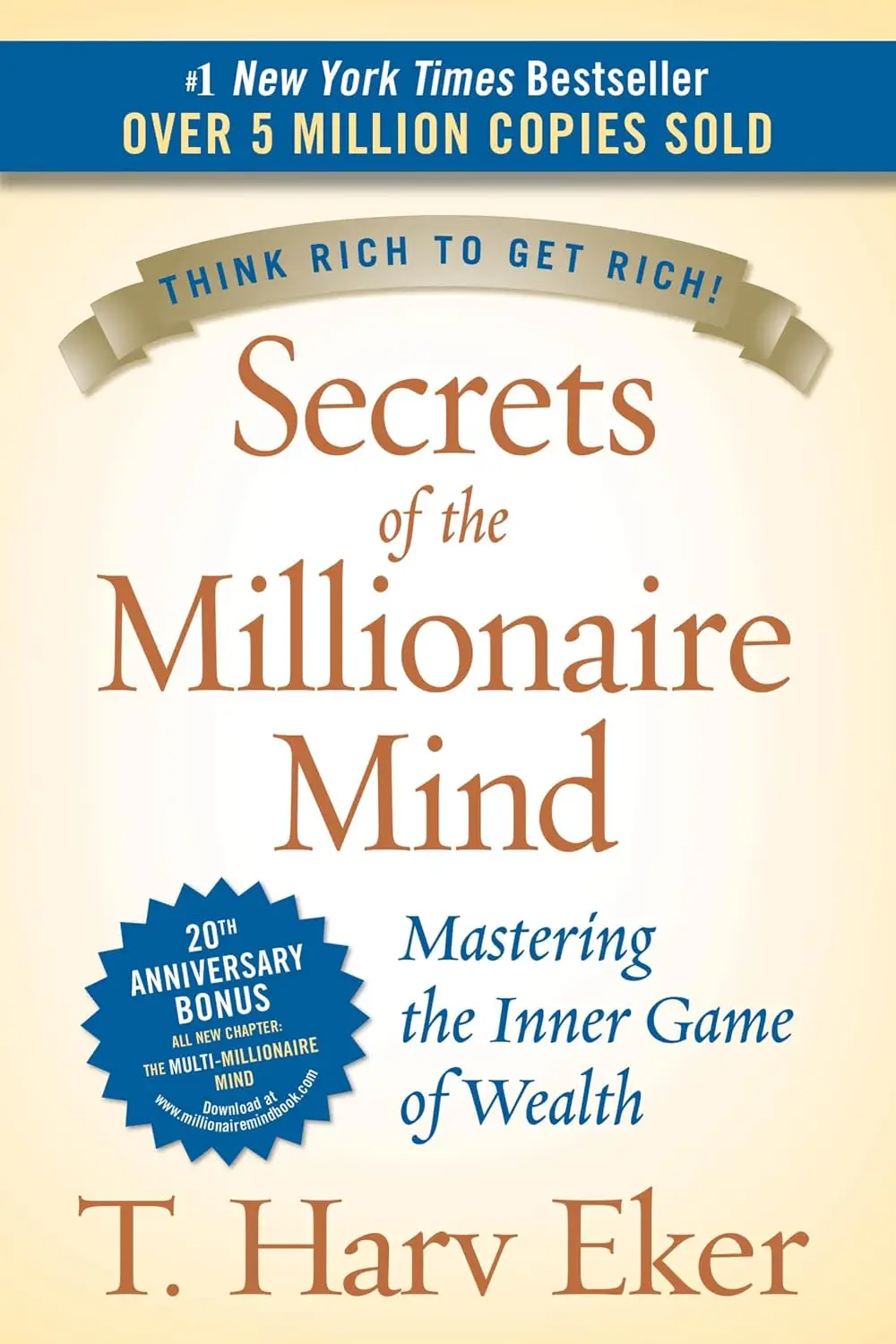
T. Harv Eker is the author of Secrets of the Millionaire Mind, one of the most influential books ever written on the psychology of wealth. His central thesis is brutally direct: your financial life is a direct expression of your subconscious programming about money. He calls this programming your “money blueprint,” and he argues that until you identify and change it, no amount of strategy, education, or effort will produce different results. You will always default to the financial level your blueprint allows.
For traders, this is not theory. It is the explanation for the most maddening pattern in trading psychology: the trader who knows what to do, has proven they can do it, and then repeatedly undermines themselves at precisely the moments when consistency would produce a breakthrough. Eker’s framework reveals why this happens and, more importantly, what to do about it.
The money blueprint idea and the wealth files come from Eker’s book. This article maps them onto account size and position sizing.
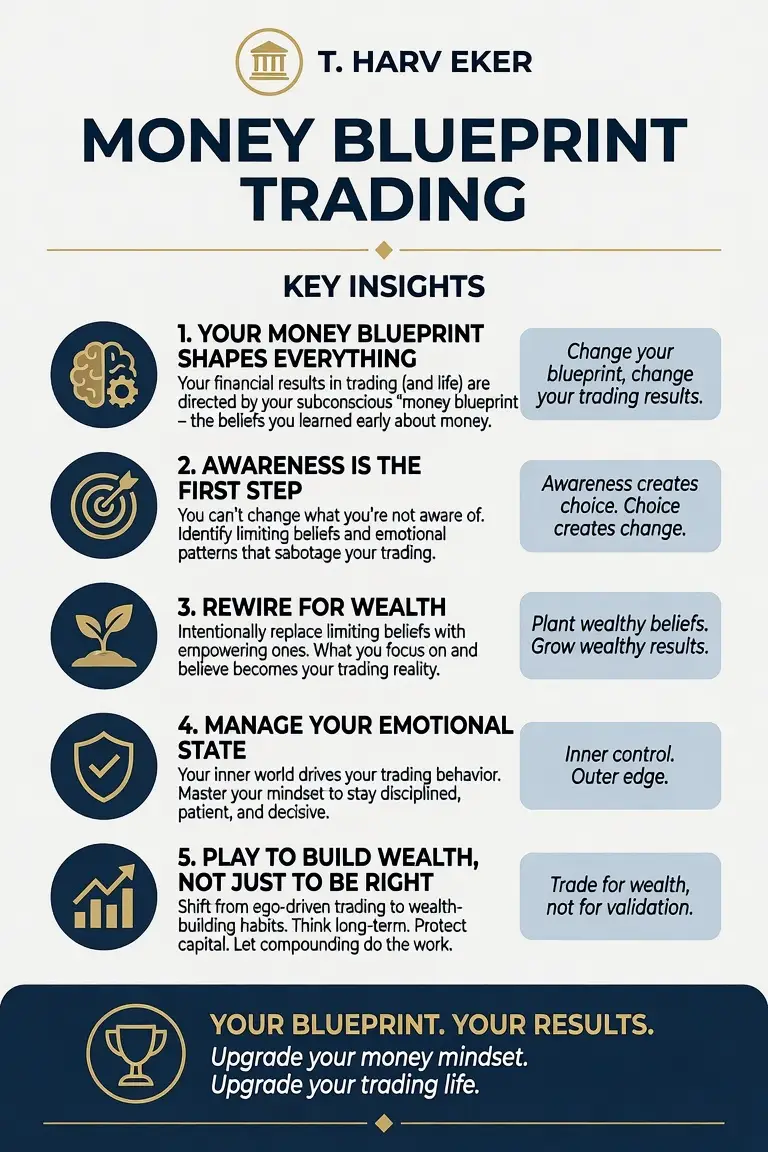
The Money Blueprint Explained
Eker defines the money blueprint as the preset programme you have for how you relate to money. It is formed primarily in childhood through three sources: verbal programming (what you heard about money), modelling (what you saw your parents do with money), and specific incidents (emotional experiences related to money that left lasting impressions).
| Key Concept | Original Context | Trading Translation |
|---|---|---|
| Money blueprint | Your subconscious relationship with money determines your financial ceiling | Traders who grew up believing “money is evil” or “rich people are greedy” will sabotage profitable trades unconsciously. |
| Thoughts lead to feelings lead to actions | The chain from belief to behaviour is automatic | The thought “I do not deserve this winner” leads to the feeling of anxiety leads to the action of closing too early. |
| Rich people think big | Abundance mindset vs scarcity mindset affects risk tolerance | A scarcity mindset sizes too small, exits too early, and avoids valid setups. Abundance sizes correctly and lets winners run. |
| Manage your money | Financial literacy requires active management systems | Trading account as a business: track KPIs monthly, review performance quarterly, allocate capital deliberately. |
Your blueprint operates like an internal thermostat. Bob Proctor calls it the money thermostat; Eker calls it the blueprint. The concept is identical: your subconscious has a set point for how much money you are comfortable having, earning, and managing. When your actual financial situation deviates significantly from the set point, your subconscious generates behaviours that return you to the programmed level.
For traders, the blueprint manifests with frightening precision. The trader whose blueprint is set to “$40,000 per year” will unconsciously produce approximately $40,000 in trading income regardless of their strategy’s theoretical capacity. They will overtrade in good months (giving back excess profits), undertrade in bad months (missing recovery opportunities), and find remarkably creative ways to keep their income hovering around the set point.
Verbal Programming: What You Heard
Every statement you heard about money as a child became a potential belief. “Money is the root of all evil.” “Rich people are dishonest.” “We can’t afford that.” “Money doesn’t grow on trees.” “You have to work hard for every penny.” These statements, repeated by authority figures during your formative years, installed beliefs that now operate as default assumptions.
A trader who absorbed “money doesn’t come easy” will unconsciously make trading harder than it needs to be. They will add unnecessary complexity. They will overtrade because the idea of making money from two clean setups per day feels “too easy” and therefore suspicious. They will struggle to hold winning trades because the profits feel unearned. The belief demands that money require suffering, so the trader creates the suffering.
Modelling: What You Saw
If your parents fought about money, your blueprint associates money with conflict. If they avoided discussing it, your blueprint associates money with shame or secrecy. If one parent was a spender and the other a saver, you likely adopted one of those patterns as your default, often whichever one was more emotionally charged.
In trading, modelling shows up in your relationship with risk. If your parents treated financial risk as dangerous and irresponsible, you carry that association into every trade entry. The intellectual knowledge that your 1% risk per trade is mathematically sound does not override the emotional programming that says “risking money is irresponsible.” The hesitation you feel at the entry button is not about the trade. It is about a thirty-year-old programme running in the background.
Specific Incidents: What You Experienced
A single emotionally charged experience with money can install a belief that lasts a lifetime. A parent losing a job. A family business failing. An investment that went wrong and caused visible stress. A moment of financial humiliation. These incidents create associations: money loss equals pain, financial risk equals family suffering, wealth equals vulnerability.
Traders who have experienced a significant financial loss outside of trading (or within it, like a catastrophic early blowup) often carry the emotional residue of that experience into every subsequent trade. The fear they feel is not proportional to the current risk. It is proportional to the original trauma. Until that incident is processed and the association is updated, it will contaminate every trading decision with fear that belongs to the past.
Eker’s “17 Wealth Files”: The Beliefs That Matter
In Secrets of the Millionaire Mind, Eker presents seventeen contrasting belief patterns that distinguish wealthy thinkers from poor thinkers. Several of these map directly to trading psychology with remarkable precision.
Wealth File #1: “Rich people believe ‘I create my life.’ Poor people believe ‘Life happens to me.'”
This is Jordan Peterson’s radical responsibility expressed in financial terms. The trader who says “the market took my money” is operating from the victim blueprint. The trader who says “I made a decision that did not work, and I am responsible for the outcome” is operating from the creator blueprint. Only the creator can improve, because only the creator has agency. The victim is waiting for the market to change. The creator is changing themselves.
Wealth File #3: “Rich people are committed to being rich. Poor people want to be rich.”
Wanting to be profitable is not the same as being committed to it. Wanting is passive. Commitment means doing the work that profitability requires: maintaining the trading journal every single day, completing the pre-session routine even when you do not feel like it, honouring the stop loss even when it hurts, and reviewing your performance every week without fail.
Eker would say: most traders want to be profitable. Very few are committed to it. The difference shows up in their behaviour, not their aspirations.
Wealth File #6: “Rich people admire other rich and successful people. Poor people resent them.”
The trader who sees a consistently profitable trader and thinks “they must be cheating” or “they got lucky” or “they have advantages I don’t have” is operating from a resentment blueprint. This blueprint makes it psychologically impossible to become the thing you resent. If you unconsciously believe that profitable traders are dishonest, your subconscious will prevent you from becoming one, because becoming profitable would make you (in your own subconscious model) dishonest.
The fix is admiration rather than resentment. Study the Legendary Traders with genuine respect for what they built. When you encounter a consistently profitable trader, your internal response should be “that is possible, and I am on the path to achieving it,” not “that is easy for them and impossible for me.”
Wealth File #10: “Rich people are excellent receivers. Poor people are poor receivers.”
This is one of Eker’s most counterintuitive insights. Many traders have difficulty receiving profits. They feel uncomfortable when the account grows. They take profits too early because holding a winning trade feels greedy or undeserved. They apologise for their success. They downplay good months.
Eker teaches that the ability to receive is a skill, and it must be developed deliberately. In trading, this means allowing your winning trades to reach their targets without cutting them short out of guilt. It means accepting that a winning month is the result of your process, not luck, and that you deserve it. It means expanding your capacity to hold a growing account without the discomfort that triggers self-sabotage.
Wealth File #15: “Rich people have their money work hard for them. Poor people work hard for their money.”
This file distinguishes between active income (trading for dollars) and passive or compound growth (letting the account grow and the percentage returns compound). The trader who withdraws every profit is working for money. The trader who lets the account compound, reinvesting returns and increasing position sizes proportionally, is making money work for them.
This connects directly to Warren Buffett’s compounding principle: the power of compound returns is only available to those who leave the capital in the account long enough for the mathematics to work. Eker’s blueprint addresses why so many traders cannot do this: their subconscious blueprint says “take the money before it disappears,” a scarcity programme that prevents wealth accumulation.
The “Declaration” Practice
Eker’s primary tool for changing the money blueprint is the declaration: a specific, emotionally charged statement made while touching your head (to engage kinaesthetic memory) and spoken with full conviction. He teaches several declarations throughout the book, but the underlying principle is the same one Bob Proctor and Tony Robbins use: repetition of a new belief, delivered with emotion and physical engagement, reprogrammes the subconscious over time.
For traders, useful declarations might include:
“I am committed to being a consistently profitable trader. I follow my rules because my rules create my results.”
“I am comfortable managing a six-figure account. My discipline expands to match my capital.”
“I release all childhood programming about money that no longer serves me. I create my own financial reality through skill and discipline.”
“Losses are the cost of doing business. I take them quickly and move forward without emotional attachment.”
These are not casual affirmations. Eker prescribes saying them with physical intensity, touching your forehead, and genuinely feeling the emotion of the person described. Done daily for sixty to ninety days, this practice begins to overwrite the old programming with new beliefs that support the trading results you want.
The “Millionaire Mind” Process for Traders
Eker outlines a four-step process for changing any element of your money blueprint. Applied to trading:
Step 1: Awareness. Identify the specific belief that is producing your current results. “I always give back my profits” or “I can’t hold winning trades” or “I freeze at the entry button.” Be specific. Name the pattern.
Step 2: Understanding. Trace the belief to its source. Where did you learn this? Was it verbal programming, modelling, or a specific incident? Understanding the source does not change the belief, but it separates the belief from your identity. You can say: “This is not who I am. This is a programme I absorbed.”
Step 3: Disassociation. Consciously decide that this belief is not yours. It was installed by someone else, in a different context, for different reasons. You can acknowledge it without being governed by it. “My parents’ fear of financial risk was valid for their circumstances. It is not valid for mine.”
Step 4: Reconditioning. Install a new belief through repetition, declaration, and behaviour. This is where the daily practice lives. Write the new belief. Declare it with emotion. Then act in accordance with it, one trade at a time, until the new belief becomes the default.
Why This Is the Money Pillar’s Missing Piece
Most trading education covers position sizing, risk-reward ratios, and drawdown management as technical disciplines. And they are. But the reason traders violate these technical rules is almost never technical. It is psychological. And the reason the psychology is broken is almost never about trading. It is about money programming that was installed decades before the trader ever opened a chart.
Eker’s work fills the gap between knowing the risk management rules and being psychologically capable of following them. The trader who understands their money blueprint and has done the work to update it does not need willpower to risk 1% per trade. It feels natural. They do not need to force themselves to honour the stop. The stop is not threatening because the loss is not triggering a childhood association with financial catastrophe.
This is the deepest layer of the Money pillar, and it is the one that most trading education never touches.
Eker and the Mind · Method · Money Framework
Mind: Eker’s money blueprint framework reveals the subconscious programming that determines trading behaviour. His four-step process (Awareness, Understanding, Disassociation, Reconditioning) provides a practical path for identifying and replacing the beliefs that produce self-sabotage. This is the archaeological layer beneath the tactical psychology of Douglas, Robbins, and the other Inner Edge authors.
Method: Your method is only as effective as your ability to execute it without interference from subconscious money programming. The trader whose blueprint says “I don’t deserve to make money easily” will add unnecessary complexity, overtrade, and undermine the simplicity that effective methods require. Clearing the blueprint allows the method to function as designed.
Money: Eker IS the Money pillar at its psychological root. His work explains why traders violate their own risk rules, why accounts hit ceilings, and why profits are given back with predictable regularity. The money thermostat, the receiving capacity, and the scarcity-versus-abundance distinction are the foundations on which all technical money management operates. Fix the blueprint, and the rules become followable.
Continue Reading: The Inner Edge
▶ Bob Proctor: Why Your Money Thermostat Controls Your Account
▶ Tony Robbins: Peak Performance Principles for Traders
▶ Jordan Peterson: 12 Rules for Trading Discipline
The Complete Trader’s Edge
This article is part of The Inner Edge series. The psychology principles explored here are covered in depth across the 22 chapters of the Mind pillar in The Complete Trader’s Edge.
Frequently Asked Questions
What is the money blueprint and how does it affect trading?
The money blueprint is your subconscious programming about money, formed through childhood verbal messages, parental modelling, and emotional incidents. It determines your comfort zone for earning, managing, and keeping money. In trading, the blueprint creates invisible ceilings on account growth and drives self-sabotaging behaviour when results exceed what the subconscious considers “normal” for someone like you.
How does childhood programming affect trading performance?
Messages like “money doesn’t come easy” or “rich people are greedy” install beliefs that actively interfere with trading execution. A trader who absorbed “money doesn’t come easy” will unconsciously make trading harder, overcomplicating strategies and overtrading because simple profits feel suspicious. These programmes run automatically beneath conscious awareness and override deliberate trading decisions at critical moments.
What are Eker’s Wealth Files and how do they apply to traders?
The 17 Wealth Files contrast how wealthy and poor thinkers approach money. Key files for traders include taking responsibility for results versus blaming the market, being committed versus merely wanting profitability, admiring successful traders versus resenting them, and being able to receive profits versus cutting winners short out of discomfort. Each file reveals a specific belief pattern that either supports or undermines trading success.
How do you change your money blueprint for trading?
Eker’s four-step process: become aware of the specific limiting belief, understand where it came from (childhood programming), consciously disassociate from it (“this programme is not mine, it was installed by others”), and recondition through daily declarations spoken with physical and emotional intensity. This practice, sustained for sixty to ninety days, begins to overwrite old programming with beliefs that support consistent trading results.
Why do traders give back profits after good months?
Giving back profits is the money thermostat correcting an “overheating” account. When profits exceed the subconscious set point, the trader experiences anxiety and discomfort that manifests as overtrading, oversizing, or rule-breaking, all of which return the account to the level the blueprint considers normal. The solution is raising the thermostat through conscious reprogramming before the account reaches the new level.
 The Complete Trader's Edge
The full Mind · Method · Money framework. 70 chapters.
View on Amazon →
The Complete Trader's Edge
The full Mind · Method · Money framework. 70 chapters.
View on Amazon →
 Market Mayhem
400 years of bubbles, crashes, and the pattern that keeps repeating.
Buy on Amazon →
Market Mayhem
400 years of bubbles, crashes, and the pattern that keeps repeating.
Buy on Amazon →
 Greatest Companies
How the world's greatest companies were built — and what traders learn from them.
View on Amazon →
Greatest Companies
How the world's greatest companies were built — and what traders learn from them.
View on Amazon →
 Greatest Traders
Eighty-six lives that explain the markets — Livermore to Madoff, told with the losses left in.
View on Amazon →
Greatest Traders
Eighty-six lives that explain the markets — Livermore to Madoff, told with the losses left in.
View on Amazon →