

Most traders spend years hunting for the perfect strategy. They test indicators, back-test setups, switch between ICT and price action and volume profiling, convinced the answer lives somewhere inside the charts. And yet the traders who finally break through almost never credit a strategy for the shift. They credit a change in themselves.
Tony Robbins has spent four decades teaching millions of people how to achieve peak performance, and his core message has never changed: your state determines your results. Not your circumstances. Not your tools. Your internal state, the emotional and physiological condition from which you make every decision. That principle applies to business, relationships, health, and with striking precision, to trading.
This article maps Robbins’ most powerful frameworks directly onto trading psychology. Not as a motivational exercise, but as a practical toolkit for the trader who knows their strategy works and cannot understand why they keep failing to execute it. If you have ever moved your stop, revenge traded after a loss, frozen at the point of entry, or overtrade after a winning streak, the answer is almost certainly not technical. It is psychological. And Robbins has spent a lifetime building systems to solve exactly this kind of problem.

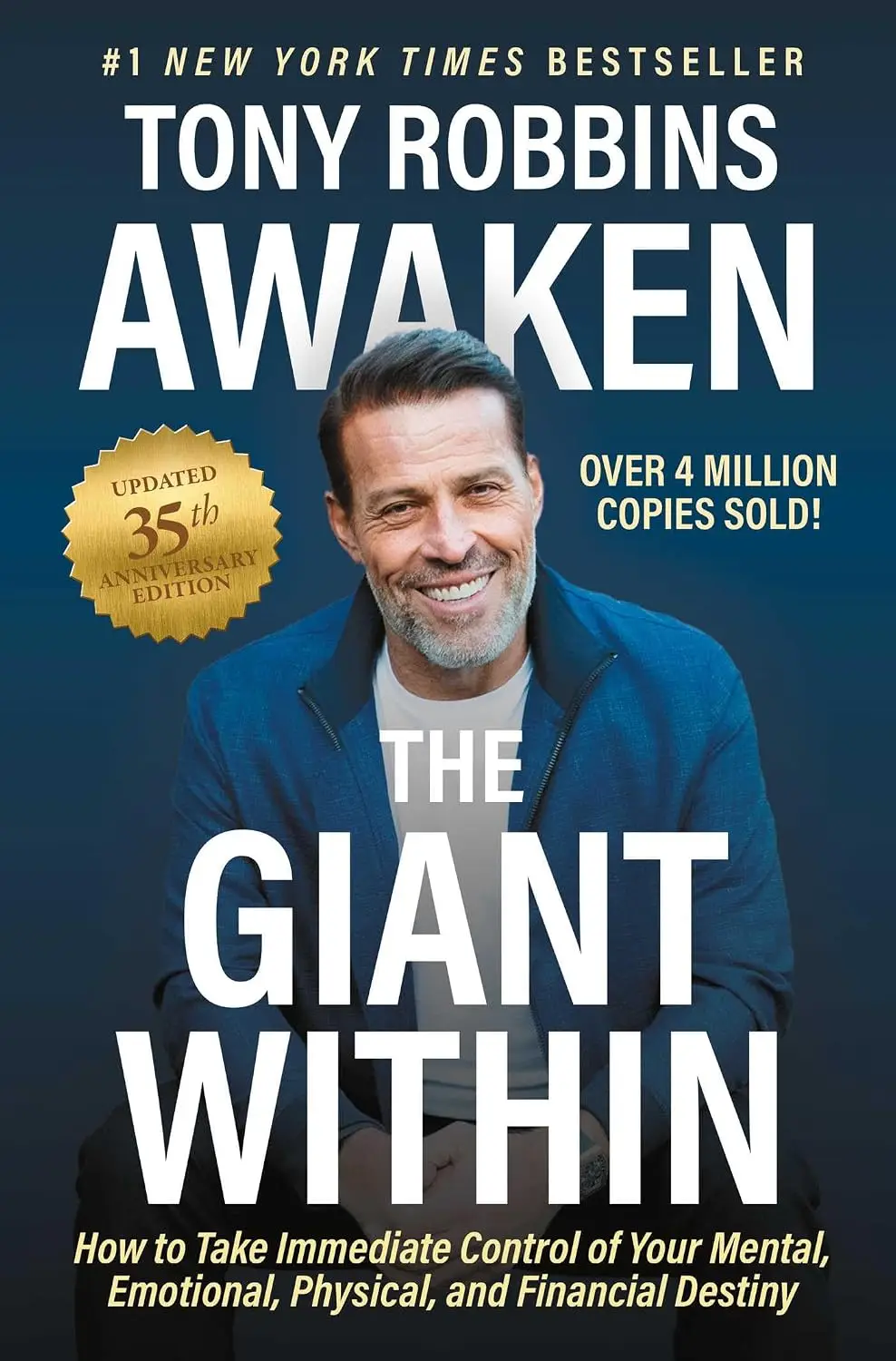
Priming, the Six Human Needs, the Triad and the RPM framework all come from this book. The updated edition is the one currently in print.
State Management: The Foundation of Every Trading Decision
Robbins teaches that human beings operate from three pillars of state: physiology (how you use your body), focus (what you pay attention to), and language (the meaning you assign through internal dialogue). Change any one of these three, and your emotional state shifts. Change all three deliberately, and you can move from fear to confidence, from hesitation to decisive action, in minutes.
For traders, this is not abstract. Think about the last time you sat at your desk after a losing trade. Your shoulders were probably hunched. Your breathing was shallow. Your focus was locked onto the loss, the money, the frustration. And your internal language was running something like: “I always do this. I knew I should have waited. I’m never going to make this work.”
In that state, what is the probability of your next trade being well-executed? Near zero. You are operating from the worst possible physiological, focus, and language configuration for decision-making. And yet most traders simply press on, taking the next setup from that compromised state, then wondering why the losses compound.
Robbins’ framework says: stop trading and fix your state first. Change your physiology by standing up, walking, or doing 30 seconds of rapid breathing. Shift your focus from what went wrong to what you can control in the next decision. Rewrite your language from self-criticism to process evaluation: “That trade was a valid setup, the stop was correct, and the market moved against me. That is the cost of doing business.”
This maps directly to the concept of the professional trader mindset: professionals evaluate process, not outcomes. But Robbins gives you the mechanism for how to actually shift into that evaluation mode when your emotions are screaming otherwise.
Priming: The Trader’s Ultimate Pre-Session Ritual
Of all Robbins’ tools, priming may be the single most valuable for traders. Priming is a 10-minute exercise designed to reset your neurological state before the demands of the day begin. Robbins himself performs this ritual every single morning, and he credits it as the foundation of his ability to perform at the highest level for hours on end.
The exercise has three components, each lasting roughly three minutes:
Step 1: Energising breath work. Robbins uses a rapid breathing pattern (sometimes called “breath of fire”) with coordinated arm movements. Thirty cycles of powerful inhales and exhales. The purpose is physiological: flood the brain with oxygen, activate the sympathetic nervous system, and snap the body into a state of alert energy. For traders, this replaces the groggy, half-present state that most people bring to their screens after rolling out of bed and checking their phone.
Step 2: Gratitude and connection. With eyes closed, you spend three minutes feeling three specific moments you are grateful for. Not thinking about them abstractly, but placing yourself back in those moments and re-experiencing the emotion. Robbins emphasises that gratitude and fear cannot coexist neurologically. A trader who enters the session from a place of genuine gratitude is physiologically incapable of trading from fear or scarcity. This eliminates the “I need to make money today” desperation that drives overtrading and poor risk decisions.
Step 3: Visualisation and intention. The final minutes are spent visualising three outcomes you want to create, as though they have already happened. For a trader, this might be: executing your pre-session plan with complete discipline, honouring your stop losses without hesitation, and closing the session having followed your rules regardless of P&L.
Now consider how this maps to your existing trading routine. Chapter 16 of The Complete Trader’s Edge describes the pre-session routine as the most important ritual in professional trading. What Robbins’ priming does is give that routine a specific, tested neurological mechanism. It is not enough to “review your levels” before the session. You need to arrive at those levels in the right state, the state from which disciplined execution becomes the default rather than the struggle.
A Trader’s Adapted Priming Protocol
Here is a practical 10-minute priming routine designed specifically for traders, adapted from Robbins’ framework:
Minutes 1-3: Breath work. Sit upright. Perform 30 rapid breath cycles: inhale sharply through the nose while raising arms overhead, exhale forcefully while pulling elbows down. Rest for 30 seconds with palms up. Repeat for a second set. You should feel physically alert and energised.
Minutes 4-6: Gratitude reset. Eyes closed. Recall three moments of genuine gratitude. One from your personal life. One from a trade you executed well (regardless of outcome). One from a moment where you showed discipline. Sit in each memory for 60 seconds. Feel it fully.
Minutes 7-9: Session visualisation. See yourself executing today’s session. Visualise reviewing your key levels calmly. See yourself waiting patiently for your A+ setup. See the entry, the stop placement, the position size calculated correctly. Visualise a trade moving against you and yourself accepting the stop without flinching. Then visualise a winning trade where you hold to target without cutting early.
Minute 10: Intention statement. Say your trading rules out loud. Three sentences, spoken with conviction: “I trade my plan. I honour my stops. I protect my capital.” Then open your eyes and begin your technical pre-session review.
This protocol addresses the three things that destroy most traders: fear at the point of entry, emotional attachment to outcomes, and impulsive deviation from the plan. All three are state problems, not strategy problems.

The Six Human Needs: Why Traders Self-Sabotage
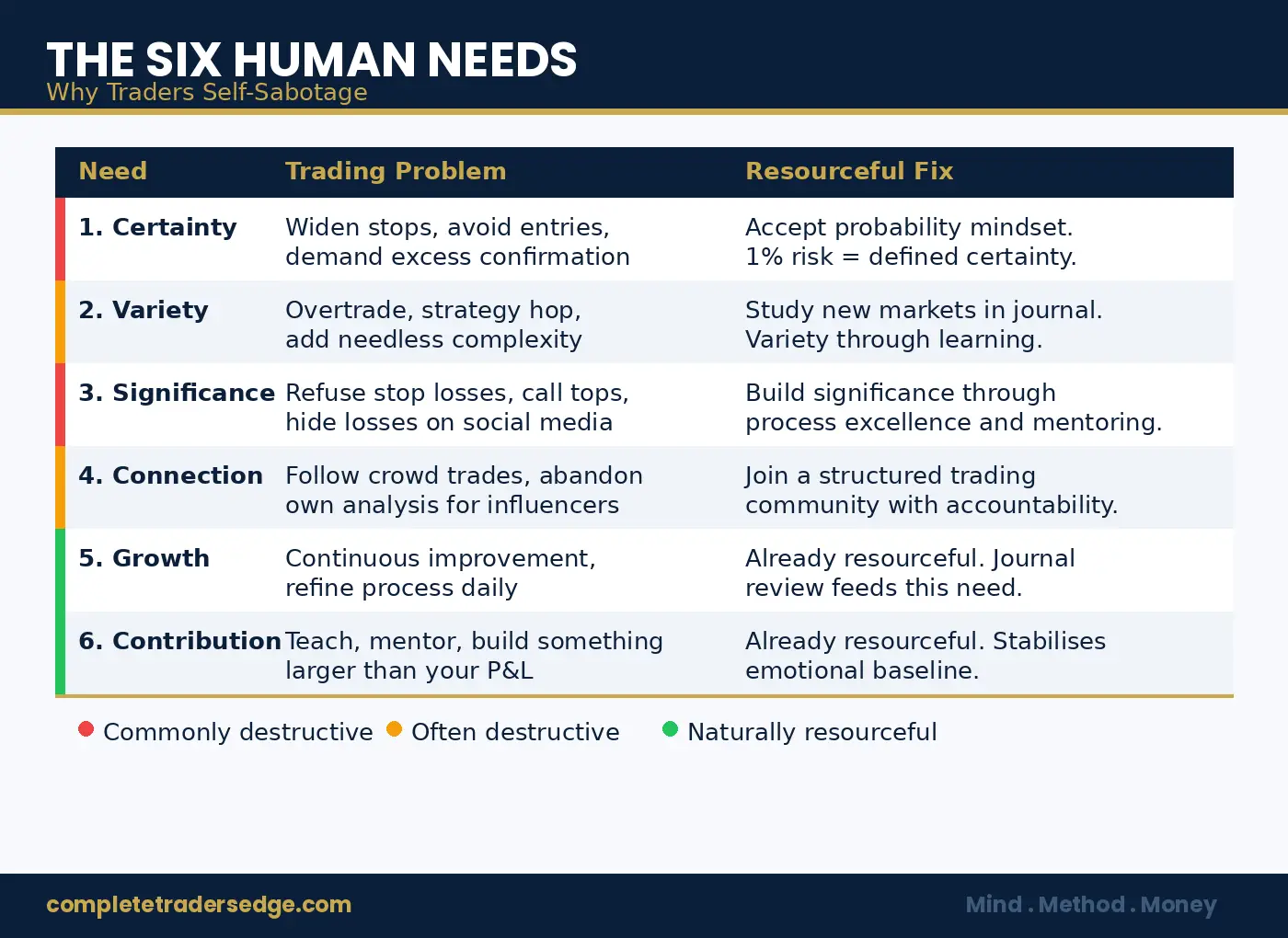
Robbins’ Six Human Needs framework is one of his most powerful diagnostic tools, and it explains trader self-sabotage better than almost any traditional psychology model. The six needs are:
1. Certainty — the need for security, comfort, and predictability.
2. Variety/Uncertainty — the need for change, surprise, and stimulation.
3. Significance — the need to feel important, unique, and validated.
4. Love/Connection — the need for belonging, closeness, and being understood.
5. Growth — the need to learn, develop, and expand.
6. Contribution — the need to give, serve, and add value beyond yourself.
Every human being prioritises these needs differently, and critically, we develop strategies to meet each need. Those strategies can be resourceful or destructive. This is where it gets interesting for traders.
How Each Need Creates Specific Trading Problems
Certainty-driven traders cannot tolerate the inherent uncertainty of markets. They widen stops to avoid being “wrong.” They avoid taking trades that meet their criteria because “what if it loses?” They demand confirmation on top of confirmation until the move has already happened. Their need for certainty directly conflicts with what the probability mindset requires: accepting that any individual trade can lose, and that this is not only acceptable but mathematically expected.
Variety-driven traders get bored sitting on their hands. The market is quiet, but they need stimulation. So they take trades outside their plan, switch between strategies, or add complexity to their approach. These are the overtraders, the strategy hoppers, the traders who blow accounts not from bad analysis but from restlessness. Every one of them is unconsciously meeting their need for variety through destructive trading behaviour.
Significance-driven traders are among the most dangerous to themselves. They need to feel special, to be right, to prove something. This shows up as refusing to take a stop loss (because taking a loss means being “wrong”), calling tops and bottoms to impress others, posting winning trades on social media while hiding losses, and doubling down on losing positions to avoid the ego hit of admitting the trade failed. The need for significance turns losses from a cost of business into a personal attack on identity.
Connection-driven traders follow the crowd. They take trades because everyone in their Discord group is in the trade. They abandon their own analysis when a popular influencer posts an opposing view. They need to feel part of the trading community more than they need to follow their own rules. The result is a trader with no independent edge, running other people’s ideas through their own account.
The Path to Growth and Contribution
The first four needs are what Robbins calls the “needs of the personality.” Everyone meets them, but meeting them does not create lasting fulfilment. The final two, growth and contribution, are the “needs of the spirit.” Robbins teaches that genuine, lasting satisfaction comes only from meeting these higher needs.
For traders, this is transformative. When your primary motivation shifts from significance (“I need to prove I’m a good trader”) to growth (“I need to improve my process every day”), your relationship with losing changes completely. A loss is no longer a threat to your identity. It becomes data, feedback, fuel for improvement. This is the exact shift described in The Psychology of Losing.
When you add contribution (teaching what you learn, helping other traders, building something larger than your P&L), your emotional baseline becomes even more stable. You are no longer a person whose mood is determined by today’s trading result. You are someone building a body of knowledge, a community, a legacy. The daily fluctuations of equity become less significant when they exist within a larger purpose.
Diagnosing Your Dominant Need
Ask yourself honestly: which need is driving your trading behaviour right now?
If you overtrade when bored, you are meeting your need for variety destructively.
If you refuse to take stops, you are protecting your need for certainty or significance.
If you post every winner but hide every loser, significance is running your account.
If you follow every guru’s trade alert, connection is overriding your own edge.
If you revenge trade after losses, you are trying to restore certainty and significance simultaneously.
Once you identify the need, Robbins’ solution is not to suppress it. You cannot eliminate a core human need. Instead, you find a resourceful strategy to meet the same need. Need variety? Meet it through studying new markets in your journal, not through taking random trades. Need significance? Build it through process excellence and mentoring, not through being “right” on every trade.
The Triad of Change: Physiology, Focus, Language
Robbins teaches that emotional states are not random. They are produced by the combination of how you use your body, what you focus on, and the language you use internally. He calls this the “Triad,” and it is the fastest intervention tool available to any trader.
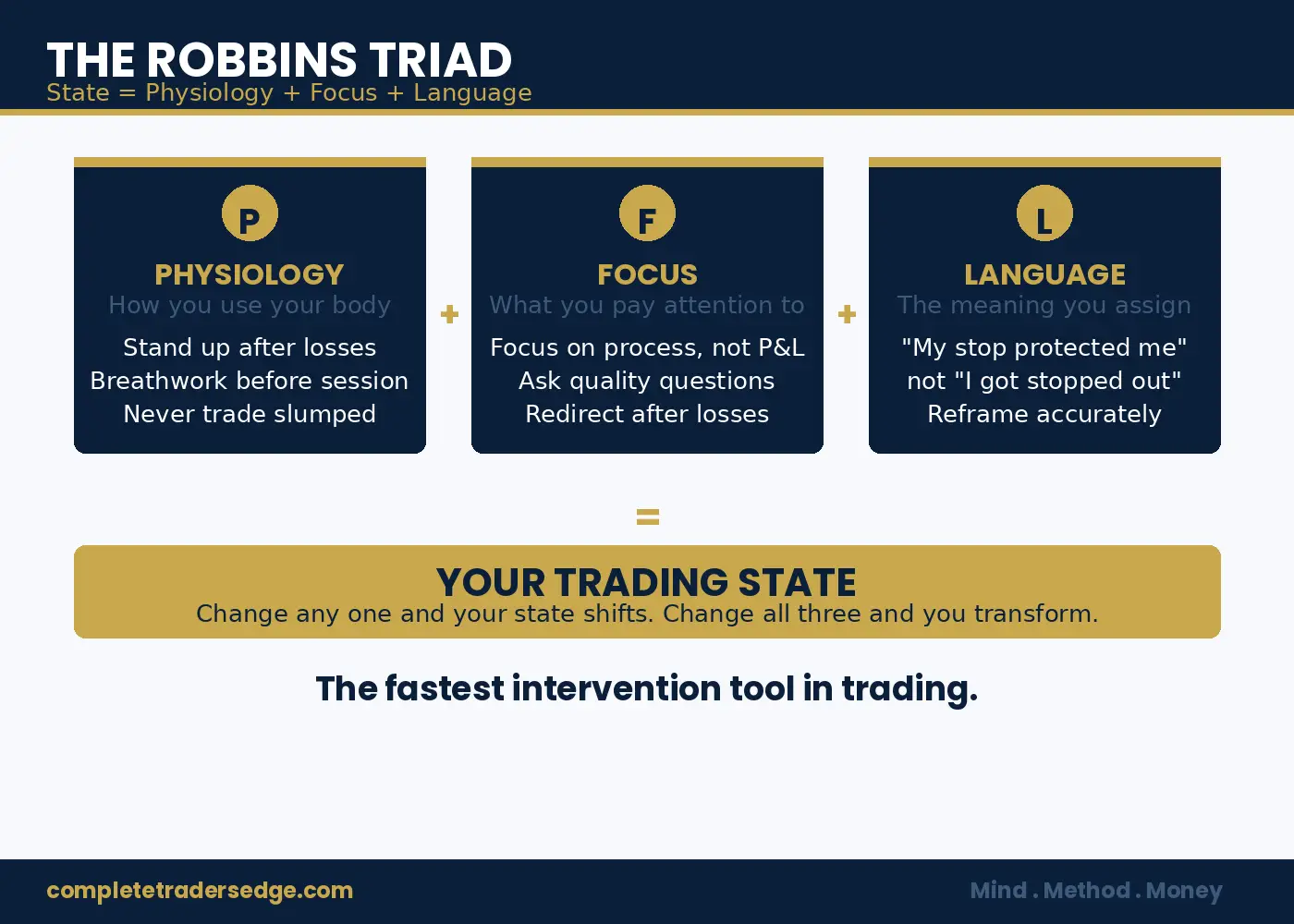
Physiology for traders: Stand up between trades. Walk for two minutes after a loss. Never take a new position while slumped in your chair with shallow breathing. Your body position literally changes the cortisol-to-testosterone ratio in your blood, which affects risk assessment and decision confidence. Chapter 14 of The Complete Trader’s Edge covers this in depth: the trader’s physical state directly drives cognitive performance.
Focus for traders: After a losing trade, your focus defaults to the money lost, the mistake, the frustration. Robbins would say: redirect focus to a quality question. Not “Why do I always lose?” (which your brain will answer with evidence of failure), but “What did I do right in that trade, and what is the one adjustment I can make?” Questions control focus, and focus controls emotion.
Language for traders: The words you use internally matter enormously. “I got stopped out” versus “My stop protected my capital and I can trade again tomorrow.” Same event, completely different neurological impact. “I’m in a drawdown” versus “My system is in a normal statistical variance period, and my rules will bring me through it.” Robbins insists that changing language is not positive thinking; it is accurate framing. And accurate framing produces better decisions than catastrophic framing every single time.
The RPM Framework: Results, Purpose, Massive Action
Robbins’ RPM (Rapid Planning Method) framework is a goal-achievement system built on three questions:
R — What is the Result you want?
P — What is your Purpose? Why do you want it?
M — What is the Massive Action Plan to get there?
Most traders start with action. They open charts, look for setups, place trades. They have no clearly defined result beyond “make money,” and their purpose is vague at best. This is why building a trading business requires the same kind of strategic planning that any serious enterprise demands.
Applied to trading, RPM looks like this:
Result: “I will be a consistently profitable trader who averages 4% monthly return on a $50,000 account within 18 months, following a defined system with a 55% win rate and minimum 1:2 risk-to-reward.”
Purpose: “Financial freedom for my family. The ability to work from anywhere. Proof to myself that I can master a skill through discipline and process. Building something I can eventually teach to others.”
Massive Action Plan: “Execute my ICT + Volume Profile strategy during London and New York Kill Zones only. Risk 1% per trade, maximum 2 trades per day. Journal every trade within one hour. Weekly review every Sunday. Monthly performance audit. Zero deviation from rules for 100 consecutive trades before making any system changes.”
Notice how different this is from the typical trader’s approach: “I’ll see what looks good on the charts today.” RPM forces clarity. And clarity, as Robbins says, is power. When you know exactly what you want, why you want it, and what actions produce it, consistency becomes a natural output rather than a constant struggle.
Identity and Beliefs: The Invisible Ceiling on Your Trading
Perhaps Robbins’ most important teaching for traders is this: you will never consistently outperform your identity. If you believe, at a deep level, that you are “not the kind of person who makes money consistently,” no strategy on earth will save you. You will find ways to give back profits, take impulsive trades, or sabotage your own results until your account balance matches your internal self-image.
Robbins teaches that beliefs are not permanent. They are references, supported by evidence you have accumulated over time. You formed a belief (“I can’t hold winners”) by stacking experiences that confirmed it. The way to change the belief is to deliberately stack new references that support a different identity.
This is exactly what building your trader identity is about. You do not become a disciplined trader by wishing for discipline. You become a disciplined trader by executing one disciplined trade, then another, then another, until the evidence overwhelms the old belief. Robbins calls this the “identity shift,” and he considers it the single most powerful lever for lasting change.
Incantations vs Affirmations
Robbins makes a sharp distinction between affirmations and what he calls incantations. An affirmation is a thought: “I am a disciplined trader.” You say it quietly, maybe half-believing it, then go about your day. An incantation is a full-body commitment: you say it out loud, with physical intensity and total emotional engagement. You do not just think the words; you embody them.
For traders, this distinction matters. Standing up before the session and saying with genuine conviction, “I am a patient, disciplined, process-driven trader who follows rules and protects capital,” is a different neurological event than thinking it passively. The physiology of speaking with conviction activates the same brain regions involved in making decisions under pressure. You are literally rehearsing the state you need to be in when the market tests you.
Combine this with the priming ritual described earlier, and you have a complete pre-session protocol that addresses physiology, focus, language, identity, and intention before you ever look at a chart.
The Robbins Concept of “Raising Your Standards”
Robbins famously teaches that lasting change begins with raising your standards, not setting goals. Goals are things you want. Standards are things you demand of yourself, the minimums below which you refuse to fall.
Most traders set goals: “I want to make $5,000 this month.” Then they miss the goal and feel like failures. Robbins would reframe this entirely: set a standard instead. “I will follow my trading plan on every single trade. No exceptions. No rationalising. If I deviate, I stop trading for the day.”
The difference is profound. Goals are outcome-focused and largely outside your control (the market decides whether you make $5,000). Standards are process-focused and entirely within your control. When you raise your standard, you eliminate the behaviours that produce poor results. The outcomes follow naturally.
This aligns perfectly with what the best traders already know: risk management rules are not guidelines. They are non-negotiable standards. The 1% risk rule is not something you follow when you feel like it. It is a standard below which you refuse to operate. Period.
Fear Is Physical: Breaking the Fear-Hesitation Loop
Robbins’ understanding of fear is deeply physical, and this is where his work becomes uniquely valuable for traders. He teaches that fear is not an intellectual problem. It is a physiological pattern: shallow breathing, tightened muscles, narrowed focus, catastrophic internal language. The pattern fires automatically when you perceive a threat, and in trading, even placing a valid order can trigger it.
The standard advice, “just manage your emotions,” misses the point entirely. You cannot manage an emotion you are already in the grip of. Robbins says: interrupt the pattern before it completes. Change your physiology immediately (stand up, clap your hands, take five explosive breaths). Then redirect focus (“What does my plan say?”). Then reset language (“This is a valid setup with defined risk. My job is to execute, not to predict.”).
This approach treats fear in trading not as something to overcome through willpower, but as a pattern to interrupt through deliberate state change. It is faster, more reliable, and infinitely more sustainable than trying to “think your way” out of an emotional hijack.
The Hour of Power: Building Your Trading Morning
Beyond priming, Robbins advocates for a broader morning routine he calls the “Hour of Power,” which includes movement, learning, and intention-setting. For traders, this concept maps onto the complete pre-session protocol:
First 20 minutes: Physical activation. Exercise, cold shower, or even a brisk walk. This is not optional. Your body’s state when you sit at the desk determines the quality of every decision you make for the next several hours. A trader who rolls out of bed, grabs coffee, and opens charts at 8:25 for an 8:30 London open is trading from the worst possible state.
Next 10 minutes: Priming. The breathing, gratitude, and visualisation protocol described above. This sets your neurological baseline for the session.
Next 15 minutes: Learning. Read one chapter of a trading book. Review a lesson from your journal. Watch one educational chart breakdown. This feeds the growth need and keeps you in development mode rather than gambling mode.
Final 15 minutes: Technical preparation. Mark your key levels. Identify your bias. Write your A+ setups for the day. Define your maximum loss for the session. This is the pre-session routine you already know, but now it sits on top of a foundation of optimised physiology, clear focus, and deliberate identity reinforcement.
The difference between a trader who does this and one who does not is the difference between a surgeon who scrubs in, reviews the chart, and visualises the procedure, and one who rushes into the operating room. The preparation is not separate from the performance. It is the performance.
Putting It All Together: Your Robbins-Inspired Trading Protocol
Here is the complete framework, combining Robbins’ peak performance principles with trading-specific application:
Daily (before the session):
- 10-minute priming routine (breathwork, gratitude, visualisation)
- Identity incantation spoken aloud (“I am a disciplined, process-driven trader…”)
- Physical activation (exercise or movement for 15-20 minutes)
- State check: Am I in a resourceful state? If not, do not open charts until I am
- Technical pre-session review from a calm, centred baseline
During the session:
- Triad check after every trade (physiology, focus, language — all three optimal?)
- Pattern interrupt after any loss (stand up, breathe, redirect focus to process)
- Quality questions instead of blame: “What can I learn?” instead of “Why does this always happen?”
- If state deteriorates below your standard, stop trading. No exceptions.
Weekly:
- Identify which of the Six Needs drove your worst trade this week
- Design one resourceful alternative for meeting that need
- Review journal for state-quality correlation (did your best trades come from your best states?)
- RPM review: Am I on track toward my defined Result? Is my Purpose still clear? What Massive Action adjustments are needed?
Monthly:
- Identity audit: Do I still believe the same things about myself as a trader? What new references (evidence) have I stacked?
- Standards review: Did I maintain my non-negotiable standards every session?
- Raise one standard higher for the next month
Why This Matters More Than Your Next Strategy
The trading industry is obsessed with strategies, indicators, and setups. Robbins’ work reminds us that the most sophisticated strategy in the world is worthless when operated by a human being in a compromised state. You do not need a better moving average. You need a better internal operating system.
The traders who last are not the ones with the best entries. They are the ones who have built the psychological infrastructure to execute consistently, day after day, through wins and losses, through drawdowns and breakthroughs. That infrastructure is what the Mind pillar of the Mind, Method, and Money framework is all about.
Tony Robbins may never have placed a trade in his life. But his understanding of what drives human behaviour, what creates peak performance, and what separates those who succeed from those who don’t is directly applicable to every trader reading this. The tools are here. The framework is proven. The only question is whether you will do the work.
Start tomorrow morning. Ten minutes. Breathe. Feel grateful. Visualise the trader you are becoming. Then go trade like that person.
Continue Reading: Trading Psychology
| Key Concept | Original Context | Trading Translation |
|---|---|---|
| State management | Control your physiology to control your emotions | Pre-session routine resets your state. Physical posture, breathing, and focus rituals before trading. |
| Modelling excellence | Study and replicate what successful people do | Study legendary traders, backtest their approaches, adapt their principles to your system. |
| Massive action | Take decisive, committed action toward goals | Execute your plan without hesitation. Paralysis kills more trades than bad analysis. |
| The power of decisions | Your life changes the moment you make a real decision | Commit to 1% risk, hard stops, and daily journalling. Decide once, execute forever. |
▶ The Professional Trader Mindset: How the Best Think Differently
▶ Fear in Trading: Identifying and Overcoming the Fear of Loss
▶ Revenge Trading: The Cycle That Destroys Accounts
▶ Building Your Trader Identity: Who You Are Shapes How You Trade
The Complete Trader’s Edge
This article is part of the Mindset Masters for Traders series. The psychology principles explored here are covered in depth across the 22 chapters of the Mind pillar in The Complete Trader’s Edge.
Frequently Asked Questions
How can Tony Robbins’ priming technique help with trading?
Robbins’ priming technique combines breathwork, gratitude, and visualisation to reset your neurological state in 10 minutes. For traders, this eliminates the fear, desperation, and emotional reactivity that cause impulsive decisions. A trader who primes before each session enters the market from a state of calm focus rather than anxiety, which directly improves execution quality and rule adherence.
What are the Six Human Needs and how do they affect trading?
The Six Human Needs are certainty, variety, significance, love/connection, growth, and contribution. Every trader unconsciously uses trading to meet one or more of these needs. When the strategy for meeting a need is destructive (for example, overtrading to meet the need for variety, or refusing stop losses to protect significance), the trader self-sabotages. Identifying which need drives your worst behaviour is the first step toward replacing the destructive strategy with a resourceful one.
What is the best morning routine for day traders?
The most effective morning routine for day traders combines physical activation (exercise or cold exposure), a priming ritual (breathwork, gratitude, and visualisation), a brief learning period (reading or journal review), and a structured technical preparation session. This sequence ensures you arrive at the charts in an optimal physiological and psychological state, which is the single biggest predictor of execution quality during the trading session.
How does state management improve trading performance?
State management improves trading performance by ensuring decisions are made from a resourceful physiological and emotional baseline rather than from fear, frustration, or overconfidence. Research shows that cognitive performance, risk assessment, and decision speed all improve when the body is in an alert but calm state. Traders who manage their state before and during sessions consistently outperform those who trade from whatever emotional condition they happen to be in.
Can personal development principles from Tony Robbins really apply to financial trading?
Yes. Trading is a performance discipline, like professional sport, surgery, or military operations. The technical skill (strategy) accounts for only part of the outcome; the psychological and physiological state of the operator determines whether the skill is applied correctly under pressure. Robbins’ frameworks for state management, identity change, and peak performance address exactly the gap that causes technically competent traders to fail: the inability to execute what they know under real market conditions.
 The Complete Trader's Edge
The full Mind · Method · Money framework. 70 chapters.
View on Amazon →
The Complete Trader's Edge
The full Mind · Method · Money framework. 70 chapters.
View on Amazon →
 Market Mayhem
400 years of bubbles, crashes, and the pattern that keeps repeating.
Buy on Amazon →
Market Mayhem
400 years of bubbles, crashes, and the pattern that keeps repeating.
Buy on Amazon →
 Greatest Companies
How the world's greatest companies were built — and what traders learn from them.
View on Amazon →
Greatest Companies
How the world's greatest companies were built — and what traders learn from them.
View on Amazon →
 Greatest Traders
Eighty-six lives that explain the markets — Livermore to Madoff, told with the losses left in.
View on Amazon →
Greatest Traders
Eighty-six lives that explain the markets — Livermore to Madoff, told with the losses left in.
View on Amazon →