

Consistency in trading does not come from trading harder or wanting it more. It comes from building a routine robust enough that you execute your process correctly even on days when you are tired, distracted, or emotionally compromised. The routine carries you when motivation fails, and motivation will fail.
Ask any consistently profitable trader what separates them from the majority who struggle, and they will not say a secret indicator or a special strategy. They will say routine. The daily structure, the pre-session preparation, the post-session review. These habits, compounded over hundreds of trading days, build the consistency that produces results. This article gives you a complete routine template you can adapt to your schedule and trading style.
Why Routine Matters More Than Strategy
A great strategy executed inconsistently will produce mediocre results. A good strategy executed with perfect consistency will produce excellent results. The difference is the routine that wraps around the strategy and ensures it gets executed the same way every session.
Routines work because they reduce cognitive load. Every decision you make during a trading session depletes mental energy. A trader who starts their day by deciding when to trade, what to look for, and how to manage risk is spending cognitive resources before a single tick of price moves. A trader whose routine has already answered those questions arrives at the session with full mental capacity directed at one task: executing the plan.
The Three-Phase Trading Day
A professional trading day has three distinct phases, each with a specific purpose. Skipping any phase degrades performance.
| Phase | Purpose | Time | Key Activities |
|---|---|---|---|
| Pre-Session | Prepare the plan and mental state | 30-45 min before session | Calendar check, level marking, bias, scenarios, no-trade conditions |
| In-Session | Execute the plan without deviation | Your defined Kill Zone window | Watch for setups, execute, manage, stay off chart between checks |
| Post-Session | Review, learn, and reset | 15-30 min after session | Journal entries, emotional debrief, screenshot charts, action items |
Phase 1: The Pre-Session Routine
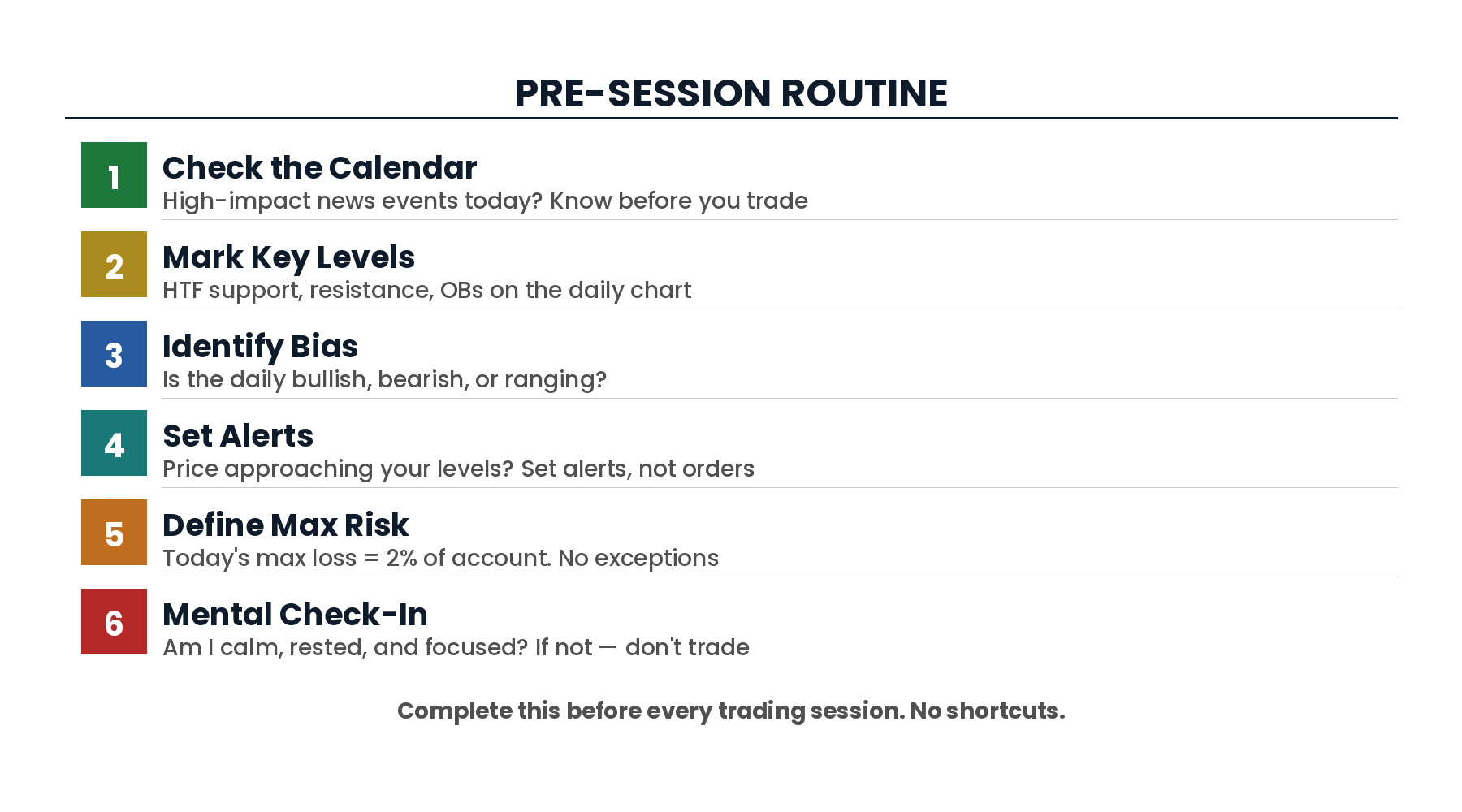
The pre-session routine is the most important phase because it determines the quality of everything that follows. Complete this 30 to 45 minutes before your trading session begins.
Step 1: Check the economic calendar. Open the calendar and identify any red-folder events during your session. NFP, CPI, FOMC, and central bank rate decisions are no-trade windows. Mark the times. If a major release falls during your Kill Zone, plan to either trade around it or sit out the session entirely. This takes 2 minutes and can save your entire day.
Step 2: Mark your key levels. On your primary instruments, identify the levels that matter for today. Market structure swing highs and lows. Order Blocks and Fair Value Gaps from the daily and 4-hour charts. Volume Profile levels: VAH, VAL, POC. Previous day high, low, and close. These levels are your battlefield. Mark them once, then stop drawing.
Step 3: Define your bias. Based on higher timeframe analysis (daily and 4-hour), determine whether you are looking for longs, shorts, or staying flat today. A clear directional bias before the session starts means you are not making that decision under pressure during the session.
Step 4: Write your “if-then” scenarios. “If price sweeps the Asian low and reclaims above the FVG at 2,340, I enter long with a stop below 2,335 and a target at 2,355.” These pre-written scenarios convert real-time decisions into pre-committed executions. You are not reacting to the market. You are implementing a plan you already made calmly.
Step 5: Define your no-trade conditions. This is underappreciated but essential. Some days, the right decision is to not trade. Write the conditions that will keep you flat: “No trades if daily structure is unclear.” “No trades after two losses.” “No trades within 15 minutes of NFP.” A routine that includes no-trade conditions protects you from forcing setups on days when your edge is absent.
Phase 2: The In-Session Routine
During the session, the routine is simple: watch for your setup criteria, execute when they appear, manage according to your plan, and stay off the chart between setups.
Execute your pre-written scenarios. When one of your if-then conditions triggers, run through your entry checklist: Does this meet my criteria? Is my position size calculated? Is my stop defined? Is the R:R at minimum 1:2? If all yes, enter. The checklist does the thinking. You do the clicking.
Manage according to plan. Once in a trade, follow your pre-defined management rules. Do not move your stop further away. Do not take profit early because you are scared. If your plan says trail to breakeven at 1R profit, do that. If it says hold to target, hold to target. Deviation during trade management is where most edge is leaked.
Stay off the chart between setups. Compulsive chart-watching creates emotional noise without improving outcomes. If you are a day trader watching the 15-minute chart, check in every 15 minutes. Between checks, step away from the screen. Read. Exercise. Do anything except stare at candles. The market will still be there when you come back.
Respect your trade limit. If your plan says maximum 3 trades per session, close the platform after trade 3. This prevents the overtrading spiral that turns good sessions into bad ones.
Phase 3: The Post-Session Routine (Shutdown Ritual)
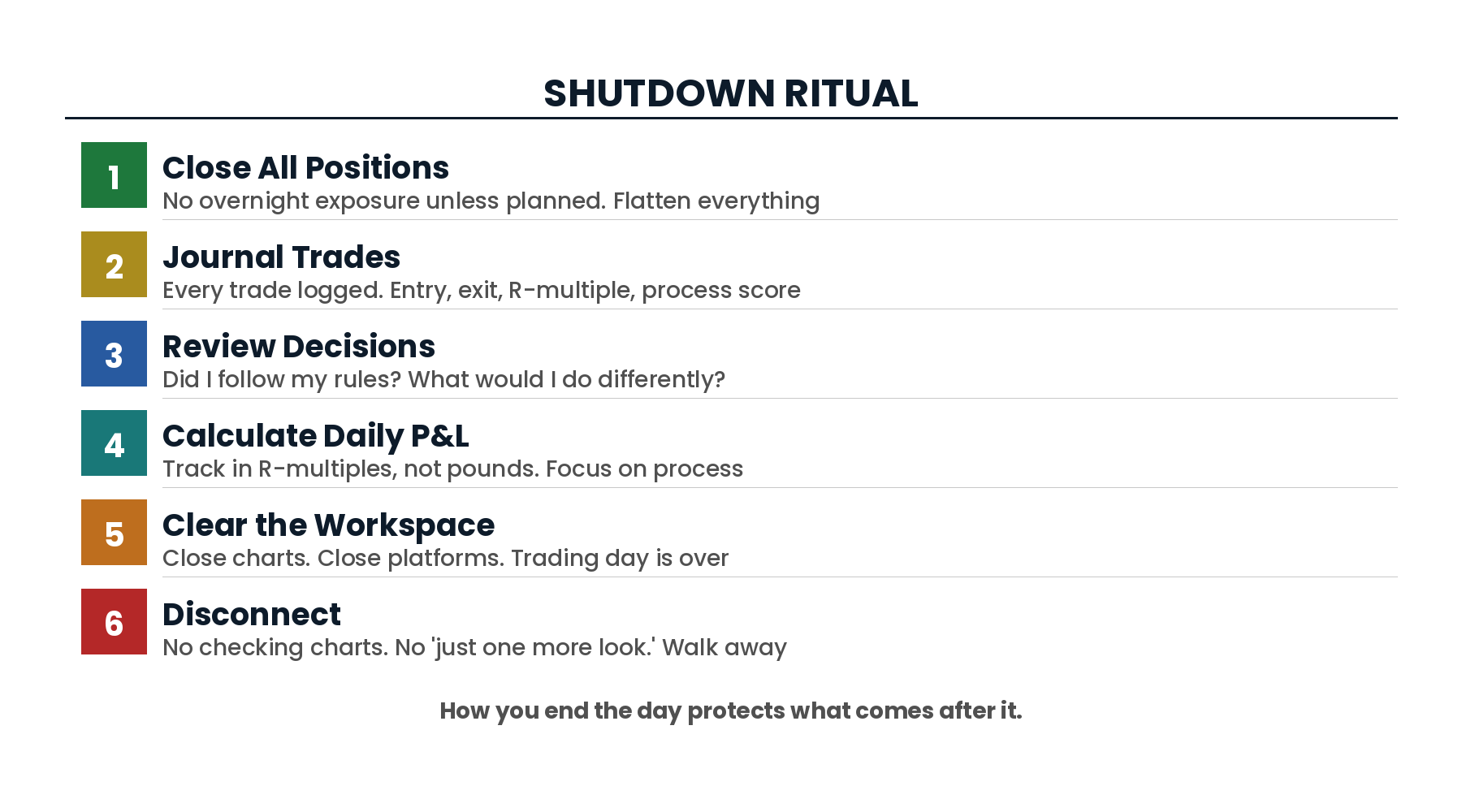
The post-session routine is where long-term improvement compounds. Spend 15 to 30 minutes after every session completing these steps.
Close all positions you do not intend to hold overnight. No “I will check it later” trades left open.
Log all trades in your journal. Entry, exit, setup type, emotional state, process score. Screenshot your charts at entry and exit. This takes 3 to 5 minutes per trade.
Emotional debrief. How did you feel today? Were there moments of fear, revenge impulses, or greed? Did you manage them or give in? Writing this down externalises the emotion and prevents it from carrying over into tomorrow.
Close the platform. This is the literal shutdown. Close your charts, close your broker, close TradingView. The trading day is over. Mental separation between trading and the rest of your life is critical for long-term sustainability. Traders who check charts at 11 PM are not dedicated. They are burning out.
Key Lessons
- Routine carries you when motivation fails. And motivation always fails eventually.
- A professional trading day has three phases: pre-session preparation, in-session execution, and post-session review.
- The pre-session routine defines your bias, key levels, if-then scenarios, and no-trade conditions.
- In-session discipline means executing pre-written plans and staying off the chart between setups.
- The shutdown ritual (journal, debrief, close platform) protects your psychology and builds long-term improvement.
Frequently Asked Questions
How long should a trading routine take?
Pre-session: 30 to 45 minutes. In-session: the duration of your Kill Zone (typically 2 to 4 hours for day traders). Post-session: 15 to 30 minutes. Total daily time commitment for a day trader: roughly 3 to 5 hours. For swing traders, the routine is compressed: 15 to 20 minutes of chart review in the evening, order placement, and a quick journal entry. The time investment is not the barrier. The consistency of doing it every single session is.
What if I trade multiple sessions (London and New York)?
Each session gets its own mini-routine. Do a brief pre-session review before New York even if you already traded London. Market conditions change between sessions. New levels form. News releases shift the landscape. A 10-minute pre-session reset before your second Kill Zone ensures you are trading today’s market, not this morning’s market.
I work a full-time job. How do I fit a trading routine around my schedule?
Swing trading is the natural fit. Your pre-session routine happens in the evening: 20 minutes reviewing daily charts, marking levels, setting orders. Your “in-session” is the market executing your orders while you work. Your post-session is a quick check after market close and a journal entry. Total time: 30 to 45 minutes per day, mostly in the evening. This is enough to trade a professional, structured approach.
Should I have a routine on days I do not trade?
Yes, but a lighter one. On non-trading days, spend 15 to 20 minutes reviewing charts to maintain pattern recognition. This keeps your “eye in” without the pressure of live execution. The weekend is for your weekly review: 30 to 60 minutes analysing the week’s data, identifying patterns, and setting action items for the coming week.
What is the most commonly skipped part of the routine?
The post-session review. Traders are exhausted or emotionally charged after the session and want to walk away without reflecting. This is the most destructive skip because the post-session review is where learning is consolidated. Without it, mistakes are repeated indefinitely. If you can only do one part of the routine, do the post-session review. It has the highest return on time invested of any activity in trading.
Continue Reading
▶ How to Build an Unbreakable Trading Routine
▶ Building a Trading Journal That Actually Improves Performance
From The Book
This article covers concepts from Chapter 16 of The Complete Trader’s Edge.
 The Complete Trader's Edge
The full Mind · Method · Money framework. 70 chapters.
View on Amazon →
The Complete Trader's Edge
The full Mind · Method · Money framework. 70 chapters.
View on Amazon →
 Market Mayhem
400 years of bubbles, crashes, and the pattern that keeps repeating.
Buy on Amazon →
Market Mayhem
400 years of bubbles, crashes, and the pattern that keeps repeating.
Buy on Amazon →
 Greatest Companies
How the world's greatest companies were built — and what traders learn from them.
View on Amazon →
Greatest Companies
How the world's greatest companies were built — and what traders learn from them.
View on Amazon →
 Greatest Traders
Eighty-six lives that explain the markets — Livermore to Madoff, told with the losses left in.
View on Amazon →
Greatest Traders
Eighty-six lives that explain the markets — Livermore to Madoff, told with the losses left in.
View on Amazon →