


Explore all 80 books in the Trader’s Library →
Most trading psychology books are written for the trader who is losing. This one is written for the trader who is winning and does not know why, which is a far more dangerous position and a far smaller market.
Brett Steenbarger’s premise is that the standard psychology curriculum has been solving the wrong problem. Discipline, patience, emotional control: these are the things traders ask about, and Steenbarger’s answer is that they are downstream symptoms of a missing operating system. You are not undisciplined. You have no process, so discipline has nothing to hold onto.
Then he goes further, into the claim that gives the book its title and its edge over everything else on this shelf. Even a good process is not enough, because the market will kill it. Your edge has a half-life. The skill that matters is not finding an edge. It is the capacity to notice that yours has stopped working and to build the next one before your account discovers it for you.
That is a book about adaptation dressed as a book about psychology, and it is why this one has aged better than almost anything published alongside it.
At a Glance
| Author | Brett N. Steenbarger, PhD |
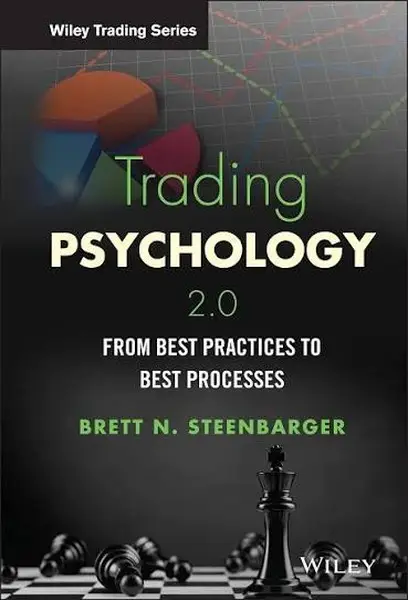
| Full Title | Trading Psychology 2.0: From Best Practices to Best Processes |
| First Published | 2015 (Wiley) |
| Pages | ~350 |
| Difficulty | Advanced — assumes a method, a track record, and data to review |
| Best For | Traders whose strategy just stopped working and who suspect it is not coming back |
| Skip If | You have no track record yet. There is nothing here you can act on without data. |
OVERALL RATING: 8.5 / 10
Who Should Read This Book
| Reader | Verdict | Why |
|---|---|---|
| New trader (0–1 year) | Not yet | The whole book runs on reviewing your own data. You do not have any. Come back with 200 trades. |
| Intermediate (1–3 years) | The core audience | You have a method, some results, and a growing suspicion that effort alone is not compounding. This is the book for that moment. |
| Advanced / professional | Read it every 18 months | The adaptation argument is the one that gets you through the regime change that ends most professional careers |
| Trader in a long slump | Read it now | Steenbarger will ask an unwelcome question: is this a slump, or did your edge simply expire and you have not admitted it? |
| Prop firm / funded trader | Highly relevant | Structured review under a drawdown limit is exactly the discipline this book systematises |
| Part-time trader with a job | Read, then scale down | The workload Steenbarger describes assumes something close to a full-time research operation. Take the principles, cut the volume. |
The Book in Context
Steenbarger is a clinical psychologist and an academic, an associate professor of psychiatry and behavioural sciences, who spent years embedded inside proprietary trading firms and hedge funds as a performance coach. That embedding matters enormously. He is not theorising about traders from a consulting room. He sat next to them, saw their numbers, and watched which ones survived.
This is his fourth trading book, and the numeral in the title is doing deliberate work. The Psychology of Trading (2003) was the clinical one. Enhancing Trader Performance (2006) imported deliberate practice from the expertise literature. The Daily Trading Coach (2009) was the practical field manual. Trading Psychology 2.0 (2015) is the one where he essentially revises his own field, arguing that the entire discipline, including his own earlier contributions to it, had been aimed slightly off-target.
Its place in the canon is as the anti-Trading in the Zone. Douglas says the market is random, your beliefs are the problem, install better ones. Steenbarger says the market is not random, it is regime-dependent, and no amount of belief work saves you when the regime turns and your edge quietly stops existing. One book asks you to change your mind. The other asks you to change your research. They are both right about different failures, and a trader who reads only one will eventually be ambushed by the other.
The Core Argument: Practices Are Not Processes
The distinction in the subtitle is the whole book, and most readers slide past it in the first ten pages without registering what it costs them.
A best practice is a good thing you do. Journalling your trades. Sizing to a fixed percentage. Reviewing the tape at the weekend. Traders collect these the way people collect gym memberships, and with similar results. Each one is genuinely good. Each one is also discrete, isolated, and dependent on you feeling like doing it on a given Tuesday.
A best process is a system that reliably produces best practices without requiring you to feel like it. The journal is not a thing you do when motivated; it is an input to a weekly review with a fixed slot, which generates a hypothesis, which gets tested against the next thirty trades, which updates the plan, which changes what you journal. The practices become components in a loop rather than items on a list.
The consequence is the sharp end. Best practices are additive and produce linear returns, so a trader accumulating them improves slowly and then plateaus, which is the observed career arc of the vast majority of serious retail traders. A process compounds, because its output is not just better trades but better information about your trading, which improves the process itself.
Practice vs Process
| Dimension | Best Practice | Best Process |
|---|---|---|
| Trigger | You remember. You feel motivated. | A fixed slot in the calendar. Motivation is not consulted. |
| Output | A better individual trade | A better trade and data about your trading |
| Returns | Linear, then plateau | Compounding, because the loop improves itself |
| Failure mode | Quietly stops happening in week six. Nobody notices. | A missed slot is visible immediately |
| When the regime turns | Keeps producing good executions of a dead edge | Detects the decay, because measurement is built in |
The last row is the one that ends careers. A collection of excellent practices will execute a dead strategy flawlessly, all the way down.
Adaptation: The Argument That Makes This Book Matter
Steenbarger’s central and least comfortable claim is that trading edges decay. Not because you got sloppy. Because the market changed, other participants found the same thing, volatility regimes shifted, and the statistical relationship you were harvesting stopped existing.
Follow that through and it wrecks the standard model of trader development. The received story is a staircase: learn a strategy, master it, execute it with discipline, collect. Steenbarger’s story is a treadmill. Learn a strategy, master it, harvest it while it lasts, detect its decay early, build the next one. The skill that persists across a career is not any particular edge. It is the renewal cycle.
Your discipline problem may be that you are disciplined about something that no longer works.
— The book’s most unwelcome implication
This is where Steenbarger diverges from every other author on the psychology shelf, and it is the reason he ranks this high despite the book’s real flaws. Everyone else’s answer to a losing streak is to look inward. Steenbarger’s first question is empirical: has the edge decayed, or have you? Those require opposite responses, and the trader who cannot tell them apart will grind himself down trying to fix his psychology when the actual problem is that a statistical relationship expired eight months ago.
It also explains the ugliest pattern in professional trading: the veteran who was genuinely excellent, who did nothing wrong, who kept executing his proven process with total discipline, and who bled out over three years because his market stopped being his market. He was not undisciplined. He was loyal.
The Strengths Move: Study Your Best, Not Your Worst
Steenbarger’s clinical background surfaces in a methodology that is genuinely counterintuitive and, in our experience, the single most immediately useful thing in the book.
Traders review losses. It feels responsible and rigorous. Steenbarger argues it is largely a waste, because losses are contaminated by noise, because a good decision can lose, and because reviewing failure produces shame rather than information. His alternative, imported from solution-focused work in clinical psychology, is to study your best trades with the same forensic attention you currently reserve for your worst.
The question changes from “what went wrong?” to “what was true on the days I traded well?” And the answers turn out to be concrete and repeatable in a way that the failure analysis never is: what time you woke up, how much you had slept, whether you had prepared, what the market was doing, which setup it was, how you felt at the open. You are not looking for inspiration. You are reverse-engineering the conditions that produce your best work so you can manufacture more of them.
The reframe is powerful because it converts an unanswerable question into an engineering one. “Why am I undisciplined?” has no useful answer. “What were the six conditions present on my twenty best trading days, and how many of them can I schedule?” has a very useful answer, and it is usually sitting in data you already have.
How Steenbarger Built the Book
Three structural choices, and honesty requires saying that one of them damages the book.
He crowdsources. Scattered through the text are contributed best practices from working traders and coaches. The intent is to ground the theory in field reports from people other than the author. It partially works, and the range of voices is genuinely valuable. But the contributions are wildly uneven, some are near-platitudes, and they interrupt the argument at close to random intervals.
He writes like a researcher, not a storyteller. There is no narrative pull here. Where Douglas builds slow psychological pressure and Coates gives you a character to watch, Steenbarger gives you claims, evidence and lists. That is why readability scores a 7 rather than a 9. The compensation is density: the ratio of usable ideas per page is among the highest on this shelf, and there is almost no padding.
He revises himself in public. The “2.0” is not marketing. Steenbarger’s earlier work sits squarely in the tradition he is now criticising, and he says so. An author willing to publish a correction to his own life’s work is telling you something about how seriously to take the correction.
Five Ideas Worth Carrying With You
Five of the book’s load-bearing ideas, stated plainly, each with a 2026 reading.
Every edge has a half-life, and yours is shorter than you think.
The strategy that funded you last year is being arbitraged toward zero by everyone who found it. This does not mean you should abandon a method at the first bad month. It means the possibility of genuine decay must be a live hypothesis you actively test, rather than a heresy you refuse to consider until the account forces it.
A practice that depends on motivation is not a practice. It is a mood.
The journal you keep when you feel like it produces data only from the days you felt like it, which is the most biased sample imaginable. Sunday 18:00, ninety minutes, whether or not the week was good, is a process. Everything else is a habit waiting for a bad week to kill it.
Study your best days. Your worst days are mostly noise wearing a lesson.
Loss review feels rigorous and mostly produces shame. Your best trades contain the reproducible conditions: the sleep, the prep, the setup, the regime. Reverse-engineer those and you get a checklist you can schedule. Reverse-engineer a loss and you usually get a resolution to try harder.
Creativity is a risk-management function, not a luxury.
Traders treat finding new setups as optional enrichment for when things are going well. Steenbarger’s framing inverts it: if edges decay, then a pipeline of new ideas is the only thing standing between you and an expiry date. The research you do in a good month is what pays for the regime change you have not seen yet.
You are running a business, and it has a research department whether you staff it or not.
A trading operation with no R&D is harvesting a finite resource until it runs out. Most retail traders spend one hundred percent of their hours executing and zero percent developing, then wonder why a career that was working stopped. Firms do not make this mistake, because a firm that stops researching visibly dies.
What the Book Tells You to Do (and Why Most Readers Skip It)
Unlike most psychology books, this one is genuinely prescriptive, which is why actionability scores a 9. Compressed, the instruction is: build a review loop, run it on a schedule, aim it at your strengths, and treat the output as hypotheses to be tested rather than resolutions to be felt.
Concretely, that means keeping records structured enough to answer questions rather than just narrate feelings. It means a fixed review slot that survives bad weeks. It means separating the question “did I execute my plan?” from “is my plan still valid?”, because conflating those two is how traders end up doing psychological work on a statistical problem. It means allocating real hours to developing what is next while the current thing is still paying.
Readers skip it for a reason worth naming honestly: it is a large amount of unpaid work. Steenbarger is describing something close to a one-person hedge fund, with a research function, a review function and an execution function, run by a person who also has a job and a family. The principles survive being scaled down. The volume he implies does not survive contact with most readers’ actual lives, and the book never really acknowledges this.
Common Misreadings of the Book
Misreading #1: “So I should change my strategy when it stops working”
This is the dangerous inversion, and it turns Steenbarger into a licence for the exact behaviour that destroys accounts. A run of losses is the expected behaviour of a working edge, not evidence of decay. Steenbarger is asking for a tested hypothesis with data behind it, not a vibe. The trader who reads “edges decay” and hops strategies every drawdown has taken a book about rigour and used it to justify its opposite.
Misreading #2: “The best practices list is the point”
Readers mine the contributed practices, assemble a list, and skip the argument that the list is precisely what does not work. The title says from best practices to best processes. Harvesting the practices and ignoring the processes is a near-perfect demonstration of the failure the book was written to describe.
Misreading #3: “Focus on strengths means ignore my losses”
No. It means change what you extract from them. Losses should be checked for rule violations and risk breaches, which is a two-minute audit. What they should not be is the primary site of your development work, because the signal-to-noise ratio there is terrible and the emotional cost is high.
Misreading #4: “This is for hedge fund guys, not me”
The scale is wrong for a retail trader; the logic is not. A one-hour Sunday review with fifty trades in a spreadsheet is a real process. It is smaller than what Steenbarger describes, and it is categorically different from having none. The failure is not doing less than a hedge fund. It is doing nothing and calling it discipline.
Misreading #5: “Trading Psychology 2.0 replaces trading psychology 1.0”
It does not, and Steenbarger does not claim it does. Emotional control still matters; a trader in a rage will destroy the finest process ever built in about ninety seconds. The argument is that the process layer was missing, not that the psychological layer was imaginary. You need both, and the reader who arrives at this book without having done the Douglas work will build an excellent process and then override it.
Where the Book Falls Short
- Organisation is genuinely poor. Ideas repeat across chapters, the argument doubles back, and the contributed practices land at arbitrary points. The blog origins are visible on nearly every spread. A firmer editor would have produced a shorter and much better book.
- Assumes resources most readers do not have. The implied workload approximates a full-time research operation. Steenbarger coached professionals with time, data infrastructure and colleagues. He rarely writes for the person doing this at 21:00 after a shift.
- Dry. Little narrative, few characters, no momentum. Many readers who would benefit most stall around the halfway mark and never return.
- Overlaps his own back catalogue. If you have read The Daily Trading Coach, a meaningful fraction of the practical material will feel familiar.
- Edge decay is asserted more than measured. The claim is central and largely plausible, but the book offers no rigorous way to distinguish decay from variance, which is exactly the discrimination the reader most needs and the place where getting it wrong is most expensive.
- Predates the current retail environment. Written in 2015, before prop-firm challenges, before the phone became the terminal, before retail algorithmic tooling was commonplace. The framework extends to these; the book does not extend it for you.
How the Book Fits the Mind · Method · Money Framework
Filed under Mind, but it is the rare psychology book that reaches decisively into Method, which is precisely what makes it valuable.
| Pillar | Contribution | What the Book Delivers |
|---|---|---|
| MIND | PRIMARY | Process over willpower, strengths-based review, structured journalling, the trader as their own researcher |
| METHOD | STRONG | Edge decay, regime dependence, the R&D pipeline, testing hypotheses against your own trade data |
| MONEY | SECONDARY | Implied throughout via sizing to conviction and surviving long enough to complete the renewal cycle, but never treated directly |
The book that best explains why Mind and Method cannot be studied separately. Steenbarger’s process loop is the machinery underneath the Mind · Method · Money framework, and his review methodology is the direct ancestor of the structured journalling we teach in The Complete Trader’s Edge. See also the complete guide to trading psychology.
Read This Instead Of / Read This After
| Relationship | Book | Why |
|---|---|---|
| Read after | Trading in the Zone | Douglas gets your beliefs straight so you can execute. Steenbarger gives you something worth executing and a way to know when it has died. |
| Read alongside | Enhancing Trader Performance | His own earlier book on deliberate practice. Together they cover how to build skill and how to know when the skill has stopped paying. |
| Read instead of | Any book promising a permanent edge | The central claim here is that permanence is the fantasy doing the most damage. A book selling you a forever-setup is selling you the thing Steenbarger warns about. |
| Read alongside | Thinking in Bets | Duke gives you the decision-quality lens. Steenbarger gives you the review loop to apply it in. Duke diagnoses resulting; Steenbarger builds the machine that prevents it. |
| Read after | Market Wizards series | Schwager shows you traders who adapted across decades without explaining the mechanism. This is the mechanism. |
Final Verdict: Should You Read This Book in 2026?
Yes, if you have a track record. No, if you do not, and the distinction is absolute rather than a matter of taste.
This is the most useful trading psychology book of the last decade and one of the worst-organised. Both things are true simultaneously and the rating splits the difference: a 9 for actionability, a 7 for readability, and an overall that sits below its ideas because the reader has to do meaningful work to extract them.
What earns the 8.5 is that Steenbarger is the only author on the psychology shelf who takes seriously the possibility that your problem is not psychological. That single move rescues traders who would otherwise spend years journalling about discipline while their edge quietly expired underneath them. It is a genuinely different diagnosis, it is correct often enough to matter, and nobody else is making it.
Read it with a pen and the expectation of doing the editing yourself. The book will not carry you. But the trader who extracts the practice-to-process distinction and the strengths-based review, and who genuinely internalises that edges expire, has acquired something that compounds for a career. Very few books on this shelf can make that claim.
CTE Rating Breakdown
8.5/10
Highly Recommended
| Readability | 7 | |
| Actionability | 9 | |
| Timelessness | 8 | |
| Beginner-Friendly | 5 | |
| Modern Relevance | 9 |
Frequently Asked Questions
What is Trading Psychology 2.0 about?
It argues that trading psychology has focused too narrowly on emotional control and not enough on process. Steenbarger’s case is that traders need structured, repeatable systems for review, research and adaptation, and that trading edges decay over time, making the ability to renew your edge the skill that actually persists across a career.
What does “from best practices to best processes” mean?
A best practice is a discrete good habit, like journalling your trades. A best process is an organised system that reliably produces those practices without depending on motivation, and that generates information which improves the system itself. Practices are additive and plateau. Processes compound.
Who is Brett Steenbarger?
A clinical psychologist and academic in psychiatry and behavioural sciences who has spent years as a performance coach embedded in proprietary trading firms and hedge funds. He writes the long-running TraderFeed blog and has authored several books on trading psychology, of which this is the fourth.
Do I need to read his earlier books first?
No. This one stands alone. If you have read The Daily Trading Coach, some practical material will feel familiar, but the central argument about process and adaptation is new to this volume and is the reason to read it.
Is it good for beginners?
No, and this is the clearest “not yet” on the whole shelf. The methodology runs on reviewing your own trading data and detecting decay in your own edge. A trader with no method and no track record has nothing to feed it. Get 200 trades on the board first.
What is edge decay?
The idea that a profitable strategy loses its profitability over time as markets change regime and other participants find and arbitrage the same relationship. The uncomfortable implication is that a losing streak might not be a psychological problem at all. Your edge may simply have stopped existing.
How do I tell edge decay from a normal drawdown?
This is the book’s hardest question and, honestly, the place it helps least. Steenbarger’s direction is to treat it as a testable hypothesis against data rather than a feeling: has the market’s behaviour changed structurally, or are these losses inside the historical distribution of your strategy? A run of losses is the expected behaviour of a working edge, so the default assumption should be variance until evidence says otherwise.
Why does he say to study winning trades instead of losses?
Because losses are noisy, a good decision can lose, and reviewing failure tends to generate shame rather than information. Your best trades contain reproducible conditions: sleep, preparation, setup quality, market regime. Those can be identified and deliberately recreated. Losses should still get a quick audit for rule violations, but they are a poor site for development work.
Is this book worth it for a part-time retail trader?
Yes, provided you scale the workload down deliberately. Steenbarger writes for professionals with time and infrastructure, and the volume he implies is unrealistic for someone trading around a job. A one-hour weekly review of a trade spreadsheet is a real process and is categorically different from having none.
What is the single most important takeaway from the book?
That before you treat a losing period as a discipline problem, you should check whether it is a decay problem. Those two diagnoses call for opposite responses, and a trader who cannot distinguish them will spend years fixing a psychology that was never broken.
About the Author
Brett N. Steenbarger, PhD
Brett Steenbarger is a clinical psychologist and an academic in psychiatry and behavioural sciences who found his way into trading through an unusual door: he was brought inside proprietary trading firms and hedge funds to coach working traders, and stayed for years. That access is what separates his work from the rest of the field. He was not interviewing traders about their feelings. He was sitting on the desk with their numbers in front of him.
Other books: The Psychology of Trading (2003), Enhancing Trader Performance (2006), and The Daily Trading Coach (2009). He has written the TraderFeed blog for many years, and its influence on this book’s structure is unmistakable, for better and for worse.
His defining quality as an author is intellectual honesty about his own field. The “2.0” is a public correction of work he himself helped establish, which is a rarer thing in trading publishing than it should be.
Continue Learning
- Trading Psychology: The Complete Guide
- Trading in the Zone Book Review (2026)
- Thinking in Bets Book Review (2026)
- The Top Trading Books Explorer
- The Mind · Method · Money Framework
- The Complete Trader’s Edge — The Book
 The Complete Trader's Edge
The full Mind · Method · Money framework. 70 chapters.
View on Amazon →
The Complete Trader's Edge
The full Mind · Method · Money framework. 70 chapters.
View on Amazon →
 Market Mayhem
400 years of bubbles, crashes, and the pattern that keeps repeating.
Buy on Amazon →
Market Mayhem
400 years of bubbles, crashes, and the pattern that keeps repeating.
Buy on Amazon →
 Greatest Companies
How the world's greatest companies were built — and what traders learn from them.
View on Amazon →
Greatest Companies
How the world's greatest companies were built — and what traders learn from them.
View on Amazon →
 Greatest Traders
Eighty-six lives that explain the markets — Livermore to Madoff, told with the losses left in.
View on Amazon →
Greatest Traders
Eighty-six lives that explain the markets — Livermore to Madoff, told with the losses left in.
View on Amazon →