Explore all 80 books in the Trader’s Library →
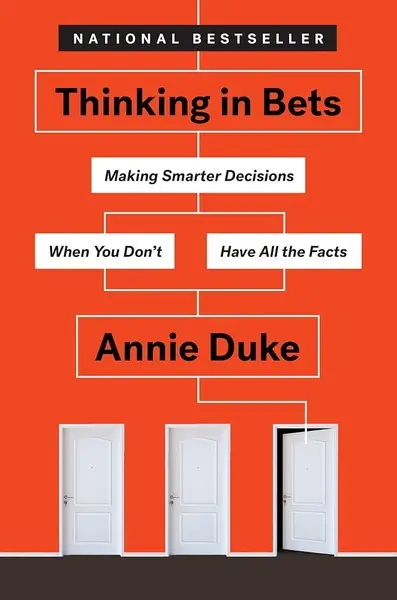
Your best trade this year might have been a terrible decision. Your worst loss might have been the right call, executed perfectly, that simply lost.
If that sentence makes you uncomfortable, you have found the reason this book belongs on a trading shelf despite containing no charts, no markets, and no mention of trading at all.
Annie Duke opens with the most criticised coaching decision in modern American sport. Super Bowl XLIX, February 2015. Seattle on the New England one-yard line, twenty-six seconds left, down by four. Pete Carroll calls a pass. It is intercepted. Seattle loses. The next morning, the entire sporting press agreed it was the worst play call in the history of the game.
Duke’s question is simple and it detonates the whole conversation: was it a bad decision, or a bad outcome? Because those are different things, and almost nobody, in sport or in markets, can tell them apart. Poker players have a name for the failure to distinguish them. They call it resulting, and it is the single most expensive habit a trader can carry.
At a Glance
| Author | Annie Duke |
| First Published | 2018 |
| Pages | ~270 |
| Genre | Decision science, behavioural psychology |
| Difficulty | Beginner-friendly — conversational, well-paced, no maths required |
| Best For | Any trader who reviews their trades by looking at the P&L column first |
| Skip If | You want trading content. There is none. The transfer is entirely on you. |
OVERALL RATING: 8.8 / 10
Who Should Read This Book
| Reader | Verdict | Why |
|---|---|---|
| New trader (0–1 year) | Read it early | It stops you building a journal that grades outcomes instead of decisions, which is the habit that takes years to unlearn |
| Intermediate (1–3 years) | Read it now | This is where traders start rewriting history after every result. Duke gives you the tools to stop. |
| Advanced / professional | Read for the group chapters | The truthseeking-pod material is the most useful content anywhere on building a trading peer group that is not just mutual reassurance |
| Journalling traders | Required reading | Your journal is a decision-quality instrument or it is a diary. This book is the difference. |
| Algo / quant trader | Read it, then apply it to yourself | You already separate signal from noise in the backtest. You almost certainly do not do it when deciding whether to switch the system off. |
| Anyone who just had a big winner | Read it before you size up | A win is not a verdict. Duke explains exactly why your brain is about to tell you it is. |
The Book in Context
Annie Duke’s route to this book is the reason it works. She was a PhD candidate in cognitive psychology at the University of Pennsylvania, holding a National Science Foundation fellowship, when illness pulled her out of academia before she finished her dissertation. She went to play poker instead, at her brother’s suggestion, and spent roughly two decades doing it professionally. She won a World Series of Poker bracelet in 2004 and the WSOP Tournament of Champions the same year.
That biography matters because it produces a rare combination. Most decision-science books are written by academics who have never had to act under uncertainty with their own money and no time to think. Most poker books are written by players with no theoretical apparatus. Duke has both, and the book is essentially her taking the cognitive-psychology training she never got to finish and applying it to twenty years of decisions made at a table with money on it.
Its place in the trading canon is peculiar. It is not a trading book and it never pretends to be. But the problem it solves, how to evaluate a decision when luck sits between the choice and the result, is a more precise statement of the problem Trading in the Zone circles for 240 pages. Douglas tells you to accept that anything can happen. Duke tells you what to do on Monday morning when it did.
The Core Argument: Separate the Decision From the Outcome
Duke’s argument runs in three moves, and each one is load-bearing.
First: life is poker, not chess. Chess contains no hidden information and no luck. If you lose at chess, you made a mistake, and if you look hard enough you will find it. Poker contains both hidden information and luck, which means you can play a hand perfectly and lose, or play it terribly and win. Most people run chess logic on a poker world. They see a bad result and go looking for the mistake, and because the human mind is very good at finding patterns, they always find one, whether or not it exists.
Second: every decision is a bet. Not metaphorically. Structurally. When you choose one action you are wagering the resources you commit against the futures you gave up, under uncertainty, with incomplete information. Duke’s point is that framing decisions as bets forces two questions you would otherwise skip: what am I actually risking, and how sure am I really?
Third: therefore, grade the decision, not the result. The quality of a decision is determined entirely by the information available and the process applied at the moment it was made. The outcome arrives later, contaminated by luck, and tells you almost nothing about the decision on a single instance. Judging backwards from outcomes, resulting, feels like learning. It is the opposite. It teaches you to repeat lucky mistakes and abandon unlucky good decisions.
A good decision that loses is still a good decision. A bad decision that wins is still a bad decision. Your brain refuses to accept either sentence.
— The book’s argument, compressed
The Four Quadrants: Where Every Trade Actually Lands
The book’s most portable artefact is the grid that falls out of separating the two axes. Once you see it, you cannot review a trading journal the same way again, because you realise your journal has only ever recorded one of the two dimensions.
Decision Quality vs Outcome
| Quadrant | At the screen | What it does to you |
|---|---|---|
| Good decision, good outcome | Followed the plan, it worked | Harmless, and rarer than your journal suggests |
| Good decision, bad outcome | Followed the plan, stopped out | The dangerous one. You go looking for a fix to a system that was not broken, and you find one, because you always do. |
| Bad decision, good outcome | Broke the rules, made money | The lethal one. The market just paid you to break your own system, and it will invoice you later. |
| Bad decision, bad outcome | Broke the rules, got punished | The cheapest lesson available. The only quadrant where feedback is honest. |
Two of the four quadrants actively teach you the wrong lesson. Your P&L cannot tell them apart. That is the problem.
Sit with the third row. A trader who moves a stop, survives, and books a winner has just been rewarded for the exact behaviour that will eventually destroy the account, and has received that reward in the most persuasive currency available. No amount of reading about discipline competes with money arriving after an act of indiscipline. Duke’s grid is the only defence, because it lets you record the trade as a loss even though the money says otherwise.
Why Being Smart Makes It Worse
The book’s most unwelcome finding, and the one traders need most, concerns motivated reasoning.
The intuitive model of belief goes: we hear a claim, we evaluate it, then we accept or reject it. Duke walks through the research suggesting the actual order is different. We hear a claim and we believe it, immediately and by default, and only sometimes do we go back and vet it. Belief is the default state. Scepticism is an effortful second step that frequently never happens.
Then it gets worse. When we are motivated to reach a particular conclusion, greater intelligence and greater numeracy do not protect us. They arm us. The better you are at working with information, the better you are at constructing a sophisticated case for the thing you already wanted to believe. Duke cites work indicating that on identity-charged questions, the most numerate people become more polarised, not less, because they are more capable of torturing the data into confessing.
Apply that to a trader holding a loser. He is not failing to analyse. He is analysing brilliantly, with full command of the chart, the fundamentals and the order flow, in service of a conclusion he committed to before the analysis began. His skill is the delivery mechanism. This is the most useful paragraph in the book for anyone who has ever wondered how intelligent people blow up.
How Duke Built the Book
Three craft choices explain why this book converts where similar books bounce off.
She leads with a decision you have already judged. Almost every reader arrived at the book with a settled opinion about the Pete Carroll call, formed from the outcome, held with confidence, and never examined. Duke does not tell you about resulting. She catches you doing it, on page one, using a judgement you made years ago and thought was analysis. You cannot argue with the demonstration because you are the demonstration.
She borrows the vocabulary from a domain where it was forced to work. Poker did not develop the decision-versus-outcome distinction because it was philosophically elegant. It developed it because players who conflated the two went broke, quickly and visibly, and the ones who survived needed a word for the error. Resulting is field-tested language from an environment with a brutally short feedback loop. That provenance is worth more than any laboratory result.
She refuses to make it about being right. The book’s ethos is that certainty is a bug. Duke pushes hard on the idea that saying “I’m not sure” is a strength rather than a weakness, and that expressing beliefs as probabilities rather than binaries changes the social cost of updating them. If you never said you were certain, you never have to defend a position you no longer hold. That is not humility as a virtue. It is humility as risk management.
Five Ideas Worth Carrying With You
Five of the book’s load-bearing ideas, stated plainly, each with a 2026 reading.
Resulting: judging the quality of a decision by the quality of its outcome.
One word for the error that governs almost every trading review ever conducted. You open the journal, you sort by P&L, and you have already made the mistake before you have read a single note. The fix is mechanical and nobody does it: grade the decision in a separate column, filled in before the result is known.
Life is poker, not chess. Hidden information and luck are permanent features, not temporary gaps.
The trader who believes markets are chess is on an endless hunt for the missing indicator, because he thinks a complete picture exists and he simply has not found it. He will search forever. The trader who accepts poker stops trying to eliminate uncertainty and starts pricing it, which is the only move that was ever available.
Say a number, not a word. “I’m about 60% on this” beats “I think this is a good setup.”
Attaching a probability does three things at once. It exposes overconfidence to yourself in the moment. It creates a record you can calibrate against over a hundred trades. And it removes the ego cost of being wrong, because you never claimed certainty in the first place. It is the cheapest upgrade available to any trading journal, and it takes four seconds per trade.
A group that agrees with you is not a group. It is an amplifier.
Duke’s truthseeking material borrows Robert Merton’s norms of science: share the data including the parts that hurt, judge a claim without reference to who made it, keep the outcome you want out of the evaluation, and make dissent an obligation rather than a betrayal. Measure your trading Discord against that list. Most retail trading communities fail all four, and they fail them enthusiastically.
Move regret to before the decision, where it can still do some work.
Regret arrives after the outcome, when it is pure cost and buys nothing. Duke’s tools, the premortem and backcasting, drag it forward: stand in a future where this has already failed and write the autopsy now. Done before entry, that exercise produces your stop, your size, and your invalidation. Done after, it produces a bad mood.
What the Book Tells You to Do (and Why Most Readers Skip It)
Duke is more prescriptive than most writers in this genre, and the prescriptions are unglamorous enough that readers nod at them and implement none.
Put a probability on it before you act. Not a feeling, a number. Write it down where you cannot revise it afterwards, which is the entire point, because you will want to.
Run a premortem. Before entry, assume the trade has already failed and write down why. This is not pessimism. It is the only reliable way to surface the invalidation level, because a mind that has already committed to the trade cannot see the failure case, and a mind instructed to imagine the failure has already happened can see it immediately.
Build a decision group with rules. Two or three people, an explicit agreement to challenge rather than console, and permission to say the unwelcome thing without it being read as an attack. Duke is clear that this cannot be improvised. The norms have to be stated out loud at the start, or the group defaults to reassurance within a fortnight.
Recruit your future self. Duke uses temporal discounting to explain why the version of you at 2am who has just been stopped out for the third time is not the version who wrote the rules. The counter is precommitment: decisions made in advance by the calm version, binding on the tilted version, with the mechanism outside your reach in the moment. A hard daily loss limit at the platform level is a precommitment device. A daily loss limit in your head is a suggestion.
The reason readers skip all of this is that none of it feels like an edge. It feels like admin. Duke’s whole thesis is that the admin is the edge, because everyone else is busy being certain.
Common Misreadings of the Book
Misreading #1: “It’s just a poker book”
Poker is the source of the vocabulary, not the subject. Duke uses maybe a handful of hands in the entire book, and every one is there to illustrate a decision-theory point rather than to teach poker. If anything the book underuses her poker career. Readers hoping for war stories from the table will be disappointed, which is a mark in its favour.
Misreading #2: “So outcomes don’t matter”
They matter enormously, in aggregate. Duke’s argument is about sample size, not about ignoring reality. A single outcome carries almost no information about a single decision. Two hundred outcomes carry a great deal of information about a process. Traders who take this book as licence to dismiss every loss as variance have inverted it into a tool for never updating, which is the exact failure mode it was written to prevent.
Misreading #3: “I already separate process from outcome”
Everyone believes this. Test it: open your journal and check whether the decision-quality grade exists as a field, recorded before the result was known. If it does not, you do not separate them. You believe you separate them, which is a different thing and considerably more dangerous, because it means the bias is running unobserved.
Misreading #4: “The uncertainty stuff is just intellectual humility”
It is a position-sizing instrument. If you genuinely hold a view at 60% rather than as a conviction, the size follows automatically and so does your tolerance for the trade going against you. Traders who cannot express uncertainty numerically end up sizing every trade the same regardless of confidence, which is a risk-management failure that arrived dressed as a communication style.
Misreading #5: “The truthseeking group thing doesn’t apply to solo traders”
Solo traders need it most and have it least. The retail trader’s default peer environment is a chat room where everyone posts winners, nobody posts the sizing, and dissent reads as hating. That is not a neutral absence of a group. It is an actively harmful one, running the precise dynamics Duke identifies, and it is where most retail traders get their reality-testing. Two honest peers beats a room of five thousand.
Where the Book Falls Short
An honest review names the weaknesses.
- No markets, anywhere. Every transfer to trading is left to the reader. For a book this useful to traders, the absence of a single financial example means the least experienced readers, the ones who need the transfer most, are least likely to make it.
- Heavily American, heavily sports. The Pete Carroll opener is superb if you know American football and inert if you do not. Several other anchors assume the same cultural furniture. Non-US readers lose some of the force.
- It is one idea, stretched. The core distinction is established inside forty pages. The remaining two hundred are elaboration, and the middle sags. This is a very good long essay wearing a book’s clothes.
- The group chapters assume peers you may not have. The truthseeking-pod advice is excellent and quietly presumes a professional context with colleagues of comparable seriousness. A retail trader in a small town has no obvious route to assembling one, and Duke does not help with that problem.
- It leans on contested research. Parts of the behavioural literature the book cites sit in areas that have faced replication scrutiny since 2018. The core argument does not depend on any single study, but readers should treat the supporting citations as illustration rather than proof.
- Nothing on execution under time pressure. Duke’s tools are deliberative and assume you have a minute to think. A scalper deciding in four seconds cannot run a premortem. The book has little to say about the compressed timeframes where most retail damage actually occurs.
How the Book Fits the Mind · Method · Money Framework
A Mind-pillar book with an unusually direct line into Money, and no interest whatsoever in Method.
| Pillar | Contribution | What the Book Delivers |
|---|---|---|
| MIND | PRIMARY | Resulting, the decision-outcome grid, motivated reasoning, calibrated uncertainty, truthseeking groups, premortems, precommitment against your future self |
| METHOD | ABSENT | Nothing. No markets, no setups, no instruments. The book is domain-agnostic by construction. |
| MONEY | SECONDARY | Calibrated probability is a sizing input, and precommitment is a loss-limit architecture. Neither is developed in financial terms, but both are structurally about risk. |
If you have read The Complete Trader’s Edge, this is the book that upgrades the journal from a record into an instrument. Our Mind pillar argues that the trader is the variable being measured. Duke supplies the measurement: a decision-quality field, filled in before the outcome is known, which is the only column in a trading journal that is not contaminated by hindsight. Pair it with the Mind · Method · Money framework and the complete guide to trading psychology.
Read This Instead Of / Read This After
| Relationship | Book | Why |
|---|---|---|
| Read after | Trading in the Zone | Douglas installs the belief that outcomes are noise. Duke gives you the procedure for acting on that belief when the outcome has just cost you money. |
| Read alongside | Fooled by Randomness by Nassim Taleb | Same target from the opposite end. Taleb is contemptuous and statistical, Duke is practical and generous. Taleb tells you that you are fooled. Duke tells you what to do about it on Tuesday. |
| Read after | Thinking, Fast and Slow by Daniel Kahneman | Kahneman is the source material and it is heavy going. Duke is the field application, and considerably more usable. If you only read one, read Duke and skim Kahneman. |
| Read instead of | Most trading journal templates | Nearly every journal on the market records outcomes with a feelings box attached. Duke tells you the one field that actually matters, and it is not in any of them. |
| Read before | Duke’s later work on quitting | Her follow-up applies the same apparatus to the exit decision specifically, which is arguably the more useful half for traders. Start here for the foundations. |
Final Verdict: Should You Read This Book in 2026?
Yes, and read it with your journal open beside you.
This is the most immediately actionable psychology book in the library, and the reason is that it does not ask you to change who you are. Douglas asks you to install new beliefs, which takes years. Steenbarger asks you to build new processes, which takes months. Duke asks you to add one column to a spreadsheet and fill it in before you know the answer. That is a Tuesday afternoon’s work, and it changes what your entire trading history means.
The rating reflects a book that is unusually clear, genuinely useful, and slightly padded. It loses nothing on timelessness or modern relevance, because resulting is not a market condition, it is a feature of how brains process luck, and no amount of technology will fix it. It does not reach the top of the shelf because the core idea is delivered inside the first forty pages and the remaining two hundred are variations. That is a real cost for a busy reader.
But the forty pages are worth the book, and the one column is worth the forty pages.
CTE Rating Breakdown
8.8/10
Highly Recommended
| Readability | 9 | |
| Actionability | 9 | |
| Timelessness | 9 | |
| Beginner-Friendly | 9 | |
| Modern Relevance | 10 |
Frequently Asked Questions
What is Thinking in Bets actually about?
It argues that the quality of a decision and the quality of its outcome are separate things, and that judging one by the other, which poker players call resulting, is the central error in how people learn from experience. The book supplies tools for evaluating decisions on their own terms under uncertainty.
What does “resulting” mean?
It is poker terminology for judging a decision by how it turned out. Because luck sits between the decision and the result, a good decision can lose and a bad decision can win. Resulting means treating the outcome as a verdict on the process, which teaches you to repeat lucky mistakes and abandon unlucky good decisions.
Who is Annie Duke?
A former professional poker player who was a PhD candidate in cognitive psychology at the University of Pennsylvania before leaving academia to play. She won a World Series of Poker bracelet and the WSOP Tournament of Champions in 2004, and now works on decision-making as a writer and consultant.
Is it a trading book?
No. There are no markets, charts or instruments anywhere in it. It is a decision-science book whose central problem, evaluating choices when luck contaminates the feedback, happens to be the exact problem trading presents. The transfer is left entirely to the reader.
Do I need to know poker to read it?
No. Duke uses very few hands and explains each one. Poker supplies the vocabulary rather than the content. Knowing American football helps more than knowing poker, since the opening case study is a Super Bowl play call.
How long does it take to read?
Around 270 pages, roughly 6 to 7 hours. The core argument is established in the first forty pages, so a reader short on time can get most of the value from the opening third and skim the elaboration.
What is a premortem?
An exercise where you assume a decision has already failed and write down why, before you commit to it. For traders it is the fastest way to surface an invalidation level, because a mind already committed to a trade cannot see the failure case, while a mind told the failure has happened can see it immediately.
How do I apply this to my trading journal?
Add a decision-quality field and a confidence percentage, and fill both in before the trade resolves. Then review by decision grade rather than by P&L. If your journal only records outcomes and feelings, it is a diary. This turns it into an instrument.
Is it better than Thinking, Fast and Slow?
Different jobs. Kahneman is the academic foundation and is dense and comprehensive. Duke is the field application and is far more usable. For a trader with limited reading time, Duke delivers more per hour, though Kahneman is the deeper work.
What is the single most important takeaway from the book?
That two of the four possible combinations of decision and outcome will teach you the wrong lesson, and your P&L cannot tell you which one you are in. The only defence is to grade the decision separately, in writing, before the result is known.
About the Author
Annie Duke
Annie Duke studied cognitive psychology at the University of Pennsylvania as a National Science Foundation fellow, and was close to completing her doctorate when illness ended her academic track. She turned to poker, where her brother was already a professional, and played at the highest level for roughly two decades. She won a World Series of Poker bracelet in 2004 and took the WSOP Tournament of Champions in the same year, before retiring from the game to work on decision-making full time.
Other notable works: she has continued the project in later books, including work applying the same decision apparatus to the problem of quitting, which is the mirror image of this book and arguably the more useful half for anyone whose job involves knowing when to exit.
Her value to traders comes from the unusual pairing. The theory is real, the fellowship was real, and so were the twenty years spent making decisions under uncertainty with her own money on the table and a clock running.
Continue Learning
- The Three Pillars: Mind, Method, Money
- Trading Psychology: The Complete Guide
- Trading in the Zone Book Review (2026)
- The Top Trading Books Explorer
- The Complete Trader’s Edge — The Book
 The Complete Trader's Edge
The full Mind · Method · Money framework. 70 chapters.
View on Amazon →
The Complete Trader's Edge
The full Mind · Method · Money framework. 70 chapters.
View on Amazon →
 Market Mayhem
400 years of bubbles, crashes, and the pattern that keeps repeating.
Buy on Amazon →
Market Mayhem
400 years of bubbles, crashes, and the pattern that keeps repeating.
Buy on Amazon →
 Greatest Companies
How the world's greatest companies were built — and what traders learn from them.
View on Amazon →
Greatest Companies
How the world's greatest companies were built — and what traders learn from them.
View on Amazon →
 Greatest Traders
Eighty-six lives that explain the markets — Livermore to Madoff, told with the losses left in.
View on Amazon →
Greatest Traders
Eighty-six lives that explain the markets — Livermore to Madoff, told with the losses left in.
View on Amazon →