

Explore all 80 books in the Trader’s Library →
There is a French expression for dusk. L’heure entre chien et loup, the hour between dog and wolf, the moment when the light fails and you can no longer tell whether the shape approaching is your dog or something that will kill you.
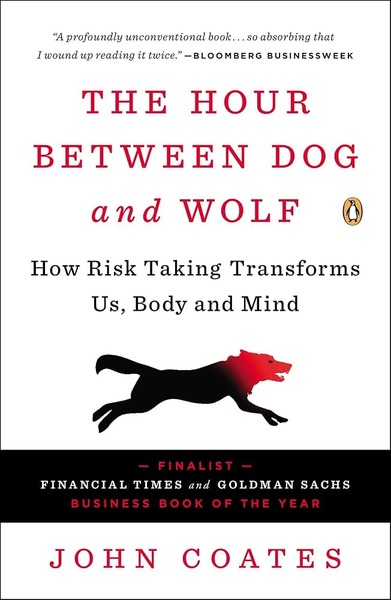
John Coates uses it as the title of a book about what happens inside a trader’s body when the same ambiguity appears on a screen. His central claim is one that trading psychology has spent forty years quietly stepping around: that the decision to take risk is not primarily made in your mind. It is made in your bloodstream, and by the time your conscious brain gets involved, most of the work is done.
This matters because Coates is not a psychologist speculating about traders. He ran a derivatives desk. He traded through the dot-com bubble, watched intelligent colleagues transform into people he did not recognise, and concluded that the standard explanations were inadequate. So he left, retrained in neuroscience and endocrinology at Cambridge, went back onto a City of London trading floor with saliva swabs, and measured them.
What he found is the most physically uncomfortable idea in the trading canon: the thing that makes you good at this is the same thing that eventually destroys you, and it is a molecule.
At a Glance
| Author | John Coates |
| First Published | 2012 |
| Pages | ~300 |
| Genre | Neuroscience, endocrinology, behavioural finance |
| Difficulty | Intermediate — readable science, but genuinely science |
| Best For | Traders who have noticed they are a different person in week three of a drawdown |
| Skip If | You want something to do tomorrow morning. This book explains; it barely prescribes. |
OVERALL RATING: 8.3 / 10
Who Should Read This Book
| Reader | Verdict | Why |
|---|---|---|
| New trader (0–1 year) | Read it second | Get a method first. But read this before your first winning streak, because that is when it starts applying to you |
| Intermediate (1–3 years) | Read it now | You have felt the winner effect and blamed it on your personality. Coates tells you it was your endocrine system. |
| Advanced / professional | Read it during a drawdown | The cortisol chapters explain the specific paralysis you feel at the bottom, and why it arrives precisely when opportunity does |
| Full-time / high-frequency trader | Required reading | The physiological load scales with screen time and decision count. You are the population Coates measured. |
| Algo / quant trader | Read for the override problem | Automation removes the entries. It does not remove the human deciding whether to keep the system on during a losing month. |
| Anyone chasing discipline | Read it and reconsider | If your discipline problem is partly hormonal, no amount of reading about discipline will touch it. Sleep and training might. |
The Book in Context
Coates’s biography is the entire reason this book exists and the reason nobody else could have written it. He worked as a derivatives trader in New York and London before leaving the industry to retrain, and he ended up as a research fellow in neuroscience and finance at the University of Cambridge, working across the business school and the medical faculty. That crossing is almost unheard of. Traders do not become endocrinologists.
The book grew out of his own research. In work published with Joe Herbert in 2008, Coates sampled saliva from a group of male traders on a City of London floor twice a day across eight business days, and correlated their hormone levels against their profit and loss. The headline results are the spine of the book. Morning testosterone was significantly higher on days when a trader went on to make more than his own daily average. Cortisol tracked market volatility and the variance of returns rather than losses as such.
Its position in the canon is unique and slightly awkward. Every other book on this shelf treats the trader as a mind that occasionally has feelings. Coates treats the trader as an animal with a nervous system and a chemistry that predates markets by several hundred million years, and argues the mind is downstream. Nothing else in the literature makes that argument from primary data collected on an actual trading floor.
The Core Argument: Risk-Taking Is Physiological
Coates builds the case in three moves.
First: the mind-body split is a mistake we inherited from philosophy, not from biology. Economics models a rational agent processing information and choosing. Coates argues that no such creature exists. Your body is not a vehicle carrying your decision-maker around. It is part of the apparatus. When you look at a chart, your heart rate, your muscle tone and your hormone levels are already responding, and they are responding faster than your conscious awareness can form a thought about the chart.
Second: gut feelings are real signals, not folklore. The intuition an experienced trader reports is, on this account, genuine information. The body registers a pattern it has seen thousands of times and produces a physical signal before conscious recognition catches up. Coates is not being mystical. He is describing a pre-conscious processing system that is faster than deliberation because it has to be, and arguing that the reason experienced traders feel something before they can articulate it is that the feeling is the recognition, arriving early.
Third: those signals can be hijacked, and markets hijack them systematically. The same chemistry that sharpens you during a normal winning run does not stop at sharp. It keeps going, into overconfidence, into excessive size, into a person who would not recognise his own trading plan. And the chemistry of a prolonged drawdown does not stop at cautious. It goes to paralysed. Neither state is a character flaw. Both are dose-response curves.
You do not decide to take risk and then feel something. You feel something, and then you construct the reason.
— The book’s argument, compressed
The Winner Effect: Why Success Is the Dangerous Phase
The book’s signature artefact comes out of animal research and lands with real force when applied to a trading account.
In species after species, an animal that wins a contest experiences a rise in testosterone. That rise increases confidence, appetite for confrontation, and willingness to engage. Which improves its chances of winning the next contest. Which raises testosterone again. The loop is genuinely adaptive, up to a point, and it is why winners keep winning beyond what their underlying ability predicts.
Past that point the loop stops helping. The animal becomes reckless. It picks fights it cannot win, roams into open ground, and gets killed. The mechanism that produced the winning streak is the same mechanism that ends it, and there is no signal inside the loop that tells the animal it has crossed over.
The Two Halves of the Cycle
| Phase | Driver | What it feels like | What it costs |
|---|---|---|---|
| Winning run, early | Testosterone rising | Sharp, quick, decisive. Reading the market well. | Nothing yet. This part is real and earned. |
| Winning run, late | Testosterone elevated and compounding | Certain. Impatient with the plan. Size feels small. | The account. There is no internal alarm at the crossover point. |
| Drawdown, early | Cortisol rising, acute | Alert, focused, energised. Attention narrows usefully. | Little. Acute stress is a performance aid. |
| Drawdown, prolonged | Cortisol chronic | Anxious. Every memory that surfaces is a loss. Cannot pull the trigger. | The recovery. You go risk-averse exactly when the opportunity arrives. |
Both halves are dose-response curves. Neither is a personality trait, and neither announces the moment it turns.
The fourth row is the one worth sitting with, because it inverts how most traders think about their worst period. The received wisdom says that after a bad run you become gun-shy and need to rebuild confidence. Coates’s account says something more specific and more useful: chronic cortisol biases memory retrieval toward negative material and shifts risk preference downward. You are not lacking confidence. Your chemistry is selecting which of your memories you get to access, and it is handing you the losses.
Which means the trader who freezes at the bottom of a drawdown, right at the point where his edge is about to pay, is not weak. He is correctly executing an ancient program designed for a famine that is not happening. And that program does not respond to being told about itself, which is the part most trading psychology gets wrong.
Bubbles as Collective Physiology
Coates then makes the move that gives the book its reach. If the winner effect runs in one trader, it runs in a floor of them simultaneously, because they are all winning at the same time for the same reason.
A rising market produces winning trades. Winning trades raise testosterone across the entire population of traders at once. Elevated testosterone raises risk appetite across that population at once. Higher collective risk appetite pushes the market higher, producing more winning trades. The bubble is not merely a story people believe. It is a synchronised endocrine event with a price chart attached.
The bust runs the same logic in reverse. Volatility raises cortisol across the floor. Elevated cortisol collapses risk appetite. Nobody bids. The market falls further, raising cortisol further. Coates’s argument is that this is why crashes overshoot so violently on the downside and why liquidity vanishes exactly when it is needed. It is not that participants have become rational and cautious. It is that an entire market’s worth of nervous systems has gone into shutdown at the same moment.
Whether you find this persuasive as a full explanation of market cycles is a fair question, and Coates arguably pushes it further than his evidence carries. But as a partial mechanism sitting underneath the narrative explanations, it is genuinely novel, and it is the reason this book has outlasted most of the 2012 behavioural-finance cohort.
How Coates Built the Book
Three structural choices, one of which is the book’s greatest strength and its most common complaint simultaneously.
He interleaves a fictional trader with the science. The book alternates between chapters following Martin, a composite trader, through a boom and bust cycle, and chapters explaining what is happening inside him. The intent is clear and largely works: the neuroscience arrives attached to a body you have been watching. Readers who wanted a straight science book find Martin an intrusion. Readers who wanted a narrative find the science an interruption. Coates is writing for the reader who wants both, and that reader is rarer than his publisher hoped.
He earns the right to the argument before making it. Coates does not open with hormones. He opens with the trading floor, because he was on one, and the credibility of everything that follows rests on the reader accepting that this man knows what a bad month feels like from the inside. A neuroscientist making these claims from a laboratory would be dismissed by every trader who read them. Coates cannot be dismissed on those grounds, and he knows it.
He refuses the comfortable conclusion. The obvious way to end a book like this is with a chapter of tips. Coates largely declines. His actual recommendations are about physical conditioning, sleep and stress exposure, which is not what a reader who has just been told his bloodstream is trading for him wants to hear. It is, however, the honest implication of his own argument, and he follows it rather than the market for it.
Five Ideas Worth Carrying With You
Five of the book’s load-bearing ideas, stated plainly, each with a 2026 reading.
The winner effect has no off switch and no warning light.
Nothing inside the loop tells you when the sharpness became recklessness, because the sharpness and the recklessness are produced by the same rising curve. This is the argument for external limits set in advance: a maximum size, a maximum daily risk, enforced by the platform rather than by a man in month two of a hot streak. You cannot feel the crossover. You can only pre-commit before you get there.
Acute stress helps. Chronic stress is a different substance entirely.
The spike of cortisol before a news release sharpens you. The same hormone, elevated for three weeks of drawdown, narrows your risk appetite and biases what you can remember toward losses. Traders treat stress as one thing to be minimised. It is two things with opposite signs, separated by duration, and the intervention that matters is not avoiding stress but recovering from it.
Your gut feeling is not mysticism. It is recognition arriving before language.
This cuts both ways and the book is careful about it. In an experienced trader, the pre-conscious signal is real pattern recognition and worth listening to. In a novice, the same physical sensation is fear or greed wearing the same clothes, and is worth nothing. The signal feels identical from the inside. Only the screen time behind it determines whether it is information or noise.
A bubble is a synchronised endocrine event with a chart attached.
Every trader on the floor wins at once, so every trader’s testosterone rises at once, so risk appetite rises across the whole market at once, which pushes price up and produces more winners. The narrative that everyone later blames, the new paradigm, the this-time-is-different, arrives afterwards as justification. The chemistry moved first.
You cannot think your way out of a hormonal state. You have to train your way out.
This is the book’s real conclusion and the one readers resist hardest. If your risk-taking is partly endocrine, then journalling about discipline is aimed at the wrong system. Coates points toward physical conditioning, sleep, and controlled exposure to stress with recovery, on the grounds that a body which handles stress well produces a trader who handles drawdowns well. Not a metaphor. A mechanism.
What the Book Tells You to Do (and Why Most Readers Skip It)
Coates’s prescriptions are thin, and this is the book’s biggest structural weakness. But what is there is coherent and follows directly from the argument.
The core concept is toughening. The idea is that stress-response systems, like muscles, adapt to load followed by recovery. A body repeatedly exposed to manageable physical stress and then allowed to recover develops a stress response that fires faster, peaks lower, and returns to baseline sooner. That is precisely the profile you want in a trader sitting through a bad month. The system that gets you through a drawdown is not built during the drawdown. It is built beforehand, in a gym, in cold water, in a properly slept night.
Readers skip this for an obvious reason. They came to a book about trading and got told to sleep and exercise, which sounds like a wellness cliché rather than an edge. The difference is the causal chain. This is not “exercise is good for you generally.” It is: your risk appetite is set by hormones, your hormone response is trainable, therefore your risk appetite is trainable, and the training happens in your body rather than your journal.
If you want the operational version of Coates’s implications rather than the theory, our breath work episode on the fastest cortisol lever you own and the exercise dosing episode are the direct application. Coates supplies the mechanism. The Physical Edge series supplies the protocol.
Common Misreadings of the Book
Misreading #1: “So it’s all just testosterone”
Coates never claims hormones are the whole story, and readers who reduce him to that are attacking a position he does not hold. His claim is narrower and harder to dismiss: that physiology is a real input which economics and trading psychology have both ignored entirely, and that ignoring it leaves a gap where the most dramatic behaviour lives. That is a claim about incompleteness, not about determinism.
Misreading #2: “This is an excuse”
The opposite. If your blow-up was a character flaw, there is nothing to do but feel bad. If it was partly a trainable physiological response, there is a gym, a bedtime and a pre-committed size limit, all of which are actionable and none of which require you to become a better person. Coates moves the problem from the moral register into the engineering register, which is where problems get solved.
Misreading #3: “The gut-feeling stuff validates my intuition”
Only if you have the screen time. Coates’s argument is that the somatic signal encodes pattern recognition built from thousands of repetitions. A trader with six months of experience has a body producing signals from a nearly empty pattern library, which means his gut is generating confident noise. The felt sensation is identical either way. That is the trap, and readers who quote this book to justify a hunch have inverted it.
Misreading #4: “It doesn’t apply to me, I trade small”
The endocrine response scales to the stakes as you perceive them, not to their absolute size. A funded challenge that represents your route out of a job you hate will produce a physiological response comparable to a professional’s, because your body is not pricing the position in dollars. It is pricing it in status and survival, which is the only currency it has ever understood.
Misreading #5: “The science is settled”
It is not, and Coates is more careful than his readers. The trading-floor studies are small. The broader literature linking testosterone to behaviour has faced serious replication scrutiny in the years since publication. The mechanism is plausible, partially evidenced, and genuinely useful as a working model. It is not proven, and readers who cite it as established fact are doing the book no favours.
Where the Book Falls Short
An honest review names the weaknesses.
- Very little to do. This is the big one, and it drives the actionability score down to 5. The book explains your drawdown paralysis beautifully and then largely leaves you holding the explanation. The prescriptive content is a fraction of the diagnostic content.
- Small samples carrying heavy conclusions. The London trading floor studies involve a handful of traders across a handful of days. Coates builds a theory of market cycles on top of them. The direction of travel is interesting; the evidentiary base is thinner than the argument’s confidence implies.
- The Martin sections divide readers. The fictional composite trader is either the device that makes the science land or a novel you did not ask for, depending entirely on the reader. Many abandon the book in these chapters.
- Replication has not been kind to parts of the field. Sections of the behavioural endocrinology literature the book relies on have been challenged since 2012. The core physiological claims about cortisol are on firmer ground than some of the testosterone material.
- The trading-floor demographics argument is contested. Coates suggests floors with more women and older traders would show a dampened winner effect and smaller bubbles. Whatever its merits, it rests on an essentialist premise doing a lot of unexamined work, and it is the section most likely to age badly.
- Nothing about the modern retail environment. Written before the phone became the primary trading terminal. A device engineered for dopamine, in your pocket, at 2am, is a physiological input Coates never considered, and it is arguably the most important one now operating.
How the Book Fits the Mind · Method · Money Framework
A Mind-pillar book that argues the Mind pillar has been standing on the wrong foundation the entire time.
| Pillar | Contribution | What the Book Delivers |
|---|---|---|
| MIND | PRIMARY | The winner effect, acute versus chronic cortisol, gut feelings as pre-conscious recognition, the physiological basis of drawdown paralysis, bubbles as collective endocrinology |
| METHOD | ABSENT | No setups, no markets as such. The trading floor is the laboratory, not the subject. |
| MONEY | SECONDARY | The winner effect is the strongest physiological case ever made for hard external position limits, though Coates never frames it as risk management |
This book is the scientific spine underneath The Trader’s Physical Edge. Our argument across that series is that the body is trading equipment and most traders maintain their charting software better than their nervous system. Coates is where that claim gets its evidence. Read alongside the Mind · Method · Money framework, the complete guide to trading psychology, and The Complete Trader’s Edge.
Read This Instead Of / Read This After
| Relationship | Book | Why |
|---|---|---|
| Read after | Trading in the Zone | Douglas tells you to install better beliefs. Coates explains why belief installation keeps failing in month three of a hot streak, and what else you would need to change. |
| Read alongside | The Mental Game of Trading by Jared Tendler | Tendler is the practical counterweight. Coates gives you the mechanism and no protocol. Tendler gives you a protocol and no mechanism. Together they are one complete book. |
| Read before | Manias, Panics and Crashes by Kindleberger | Kindleberger documents four centuries of the same cycle without ever explaining why humans keep running it. Coates offers a candidate mechanism underneath the history. |
| Read after | Thinking, Fast and Slow by Kahneman | Kahneman’s fast system is cognitive. Coates argues it is not even that: it is bodily, and it starts below the level where Kahneman’s model begins. |
| Read instead of | Any book promising to help you control your emotions | Coates’s whole point is that the control model is aimed at the wrong system. You do not talk a hormone down. You train the response that produces it. |
Final Verdict: Should You Read This Book in 2026?
Yes, with your expectations set correctly. This is an explanation, not an instruction manual, and the rating reflects that split precisely.
Nothing else in the literature does what this book does. Every other title on the psychology shelf treats the trader as a mind with an unfortunate emotional attachment. Coates treats the trader as a mammal, brings primary data from a real trading floor, and offers a mechanism for the two behaviours that trading psychology has never adequately explained: why competent people become reckless during success, and why they freeze at the exact moment the opportunity appears. Both have always been described. Coates is the first to propose what is actually driving them.
The cost is that he then hands you the mechanism and largely stops. Actionability scores a 5 because the book’s honest conclusion, that you should sleep properly and train your stress response, occupies a handful of pages and feels anticlimactic after 250 pages of physiology. Readers who want a protocol will finish frustrated.
Read it anyway, and read it for the reframe rather than the recipe. Once you understand that your risk appetite has a chemistry and that the chemistry is trainable, the whole category of advice that begins with “just be more disciplined” reveals itself as aimed at a system that was never listening.
CTE Rating Breakdown
8.3/10
Highly Recommended
| Readability | 8 | |
| Actionability | 5 | |
| Timelessness | 9 | |
| Beginner-Friendly | 7 | |
| Modern Relevance | 9 |
Frequently Asked Questions
What is The Hour Between Dog and Wolf actually about?
It argues that financial risk-taking is a physiological event rather than a purely cognitive one. Testosterone rises during winning runs and drives escalating risk appetite, while cortisol rises during prolonged volatility and drives risk aversion. Coates suggests these mechanisms operating across a whole trading floor help explain booms and busts.
What does the title mean?
It comes from the French expression for twilight, the hour when the light is poor enough that you cannot tell a dog from a wolf. Coates uses it for the state of ambiguity and transformation that traders inhabit, where the familiar and the dangerous become indistinguishable.
Who is John Coates?
A former derivatives trader who worked in New York and London before leaving the industry to retrain in neuroscience and endocrinology at the University of Cambridge, where he became a research fellow working across finance and medicine. He is one of very few people to have worked seriously in both fields.
What is the winner effect?
A pattern observed across many species where winning a contest raises testosterone, which raises confidence and risk appetite, which improves the chances of winning again. The loop is adaptive up to a point, past which it produces recklessness and defeat. Applied to trading, it means a winning streak chemically produces the overconfidence that ends it.
Why do traders freeze during long drawdowns?
Coates’s account is that chronically elevated cortisol shifts risk preference downward and biases memory retrieval toward negative material. The trader is not lacking confidence in any ordinary sense. His physiology is selecting which memories he can access and lowering his appetite for risk, right at the point where his edge is about to pay.
Is it good for beginners?
Reasonably. The science is explained rather than assumed and the prose is good. But it is real neuroscience and endocrinology, and a beginner with no trading experience will find the physiology abstract because there is no felt experience to attach it to. Get a method and one drawdown behind you first.
How long does it take to read?
Around 300 pages, roughly 8 to 10 hours. Slower than the page count suggests because of the science, though the narrative chapters following the composite trader move quickly.
Does the book tell you what to do about any of this?
Only briefly, and this is its main weakness. The central recommendation is toughening: building stress resilience through physical training, sleep and controlled exposure to stress with adequate recovery, so the stress response fires faster, peaks lower and returns to baseline sooner. That occupies a small fraction of the book.
Is the science reliable?
Treat it as a plausible and partially evidenced working model rather than settled fact. The trading-floor studies involve small samples over short periods, and parts of the wider behavioural endocrinology literature have faced replication scrutiny since publication. The cortisol material is on firmer ground than some of the testosterone claims.
What is the single most important takeaway from the book?
That the mechanism producing your best trading and the mechanism producing your blow-up are the same curve, with no internal signal marking where one becomes the other. Since you cannot feel the crossover, the only defence is a limit set in advance by a version of you who was not yet winning.
About the Author
John Coates
John Coates traded derivatives in New York and London, running a desk through the period that produced the dot-com bubble and its collapse. Watching colleagues undergo what he described as a personality change during the boom convinced him that the available explanations, greed and irrationality, were not explanations at all. He left the industry and retrained in neuroscience and endocrinology at the University of Cambridge.
Notable research: with Joe Herbert, he published work in 2008 measuring steroid hormones in traders on a City of London floor and correlating them against trading performance, finding that morning testosterone predicted above-average daily profit and that cortisol tracked market volatility. That study is the empirical core this book is built on.
His value is the crossing itself. Neuroscientists writing about traders are ignored by traders. Traders writing about themselves have no instruments. Coates is one of the only people who has been both, and the book could not have been written by anyone standing on one side of that line.
Continue Learning
- Breath Work for Traders: The Fastest Cortisol Lever You Own
- Exercise for Traders: The Right Dose, Type, and Timing
- Hydration, Cortisol, and Caffeine for Traders
- Trading Psychology: The Complete Guide
- The Top Trading Books Explorer
- The Complete Trader’s Edge — The Book
 The Complete Trader's Edge
The full Mind · Method · Money framework. 70 chapters.
View on Amazon →
The Complete Trader's Edge
The full Mind · Method · Money framework. 70 chapters.
View on Amazon →
 Market Mayhem
400 years of bubbles, crashes, and the pattern that keeps repeating.
Buy on Amazon →
Market Mayhem
400 years of bubbles, crashes, and the pattern that keeps repeating.
Buy on Amazon →
 Greatest Companies
How the world's greatest companies were built — and what traders learn from them.
View on Amazon →
Greatest Companies
How the world's greatest companies were built — and what traders learn from them.
View on Amazon →
 Greatest Traders
Eighty-six lives that explain the markets — Livermore to Madoff, told with the losses left in.
View on Amazon →
Greatest Traders
Eighty-six lives that explain the markets — Livermore to Madoff, told with the losses left in.
View on Amazon →