

Explore all 80 books in the Trader’s Library →
A concert pianist does not practise by giving concerts. A surgeon does not learn to operate by operating. Every serious performance field on earth separates training from performing, because the conditions that make you better are not the conditions that make you perform.
Trading is the exception, and almost nobody notices. Traders practise by trading. They put on real risk, in real time, with real money, and call the resulting scar tissue experience. Then they wonder why ten years of it produced a trader who is not meaningfully better than he was at year three.
Brett Steenbarger’s 2006 book is where he first asked the question the rest of the field had skipped: not what is wrong with traders, but how does anyone get good at anything, and why would trading be exempt? The answer he imports from athletics, chess and medicine is that expertise is built through deliberate practice, and that most traders have never done a single hour of it in their lives.
Then, about a third of the way in, he says something that undercuts the entire training argument and turns out to be the most valuable idea in the book: some of you are not undertrained. You are in the wrong sport.
At a Glance
| Author | Brett N. Steenbarger, PhD |
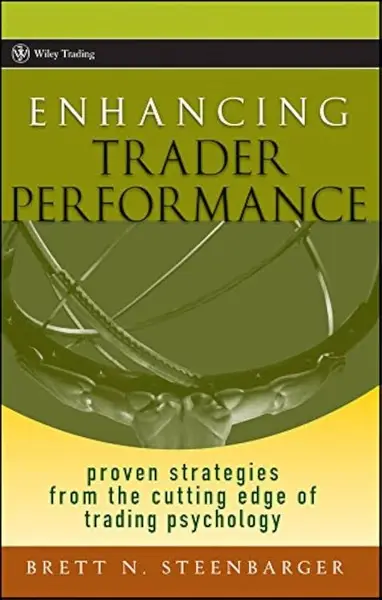
| Full Title | Enhancing Trader Performance: Proven Strategies From the Cutting Edge of Trading Psychology |
| First Published | 2006 (Wiley) |
| Pages | ~300 |
| Difficulty | Intermediate |
| Best For | Traders who have put in the hours and are not improving, and cannot work out why |
| Skip If | You have already read Trading Psychology 2.0 and want new material rather than its foundations |
OVERALL RATING: 8.0 / 10
Who Should Read This Book
| Reader | Verdict | Why |
|---|---|---|
| New trader (0–1 year) | Read it early | This is the rare Steenbarger book a beginner can use, because it tells you how to train before you have anything to review |
| Intermediate (1–3 years) | The core audience | You are plateauing. The niche chapters will ask whether the problem is your effort or your fit. |
| Advanced / professional | Skim it | You have solved fit by surviving. Take the deliberate-practice architecture and go to 2.0 for the rest. |
| Trader who keeps switching styles | Read it carefully | Cuts both ways. It may reveal you are searching for fit, or that you keep quitting before any fit could show up. |
| Part-time trader with a job | Genuinely useful | Simulation and replay are how you train without market hours. This is the best argument for that you will read. |
| Already read 2.0 | Read for the niche chapters | Real overlap elsewhere. The fit argument does not appear in the later book and is the reason this one survives. |
The Book in Context
This is Steenbarger’s second trading book, and it is where he stopped being a psychologist writing about traders and became a performance researcher writing about expertise.
The Psychology of Trading (2003) came from the consulting room: a clinician applying therapeutic thinking to a new population. Enhancing Trader Performance came from somewhere else entirely. By this point Steenbarger was embedded inside a proprietary trading firm as director of trader development, which meant his job was not to counsel traders but to manufacture them, on a deadline, from raw recruits. That job changes the question you ask. You stop asking what is wrong with this person and start asking what the training pipeline should look like.
The intellectual import is from the expertise literature: the research tradition, most associated with Anders Ericsson, arguing that elite performance across domains comes not from talent but from an enormous volume of a very specific kind of practice. Steenbarger’s move was to ask why trading, alone among performance disciplines, had no equivalent training architecture, and to try to build one.
Its position on the shelf is as the foundation layer beneath Trading Psychology 2.0. That book asks how you stay good as markets change. This one asks how you get good in the first place. They are the same project separated by nine years, and reading them in order is worth doing because the later book assumes this one without restating it.
The Core Argument: Screen Time Is Not Practice
The book’s foundational claim is deceptively plain: hours do not produce expertise. A particular kind of hour produces expertise, and trading hours are almost never that kind.
Deliberate practice, in the sense the research means it, has specific properties. It targets a defined weakness rather than exercising what you can already do. It operates at the edge of your ability, where failure is frequent. It generates immediate, unambiguous feedback. It repeats the difficult component in isolation, at high volume. And it is effortful and unenjoyable, which is why people avoid it in favour of the parts they are good at.
Now hold live trading against that list. It is not aimed at a defined weakness; it is aimed at making money. The feedback is delayed by hours or weeks, and it is catastrophically noisy, because a good trade loses and a bad trade wins. Repetition is limited by how many setups the market offers, which may be three a week. And the emotional cost of failure is so high that you are learning under conditions of threat, which is close to the worst state for skill acquisition there is.
Why Live Trading Is Terrible Practice
| Deliberate practice needs | Live trading delivers | The workaround |
|---|---|---|
| A targeted weakness | A P&L target. The weakness is whatever the market happened to punish. | Isolate one skill per training block. Entries only. Or exits only. |
| Immediate clean feedback | Delayed, noisy feedback where good decisions lose | Replay with the outcome hidden. Judge the decision, then reveal. |
| High repetition | Three or four setups a week if you are lucky | Compressed replay of archived sessions. A year of setups in a weekend. |
| Safe failure | Failure costs money, so you avoid the edge of your ability | Simulation. The whole point is that being wrong is free. |
| Effortful discomfort | You gravitate to the setups you already read well | Deliberately drill the conditions you handle worst |
Every row is a reason that ten years of screen time can produce almost no skill growth. The hours were real. They were just the wrong hours.
This is why the sim gets dismissed by exactly the traders who need it. “Sim isn’t real, there’s no emotion in it.” Correct, and that is the feature. You do not train a pilot in a simulator because it feels like crashing. You train him there because he can crash two hundred times before Tuesday. The emotional realism is what you add last, once the skill exists to be executed under pressure.
Finding Your Niche: The Idea That Outlived the Book
Then Steenbarger complicates his own thesis, and this is where the book earns its place.
If expertise were purely a function of training volume, then anyone who trained correctly for long enough would become an elite trader. Steenbarger, who was in the business of actually producing traders and therefore had to watch some of them fail while training properly, did not believe it. His observation was that performance emerges from a fit between a specific person and a specific way of trading. Athletes do not simply become athletes. They find the sport their body and temperament suit, and the finding is not a detail. It is most of the outcome.
A sprinter who trains for the marathon with total discipline for a decade is not lazy. He is lost.
— The niche argument, applied
The trading application is uncomfortable and specific. A trader who is patient, analytical, and slow to decide will be destroyed by scalping and may be genuinely excellent on a weekly chart. A trader who thrives on rapid pattern recognition and gets bored holding will bleed out swing trading, not because he lacks discipline but because his temperament is fighting the timeframe every single day. Both traders will be told to be more disciplined. Both will believe it. Both are being misdiagnosed.
What makes this idea land is that it offers a second explanation for the plateau. The first explanation, the one everyone reaches for, is that you did not want it enough. Steenbarger’s alternative is that you may be training hard in a discipline that does not suit you, and that no volume of training fixes a fit problem. It just makes you tired.
The danger, which Steenbarger flags and readers ignore, is that “finding my niche” is the most respectable excuse ever invented for quitting things at the eighteen-month mark. Fit is real. It is also indistinguishable, from the inside, from an unwillingness to sit through the incompetence phase. The test is not whether it feels bad. Everything feels bad at the start. The test is whether, after real training volume, the work is still fighting your grain.
How Steenbarger Built the Book
He goes outside trading for his evidence. The book draws on athletics, chess, medicine and the performing arts, and the choice is strategic rather than decorative. Trading literature is a closed loop of traders quoting traders. By importing a research tradition from fields where expertise is measurable and training is solved, Steenbarger gets to make an argument that trading’s own literature could not have generated.
He writes from inside the pipeline. His role developing traders at a proprietary firm gives the book a specific kind of authority. He is not speculating about how traders should be trained. He was responsible for training them, and had to watch the results, and the book carries the texture of someone who has seen the same failure enough times to stop being surprised by it.
He undermines his own thesis on purpose. A lesser author writes the training book and stops. Steenbarger writes the training book and then devotes a substantial section to the possibility that training is not your problem. That is intellectually honest and structurally awkward, and the book is both better and messier for it.
Five Ideas Worth Carrying With You
Trading is the only performance field where people expect to perform without training.
No pianist would attempt a concert having only ever played concerts. Traders do the equivalent as a matter of course and call the wreckage experience. If you cannot point to an hour this month that was training rather than performing, you are not building skill. You are just paying tuition to the market at retail rates.
Screen time is not practice. Most of it is not even attention.
Ten years of watching charts while waiting for something to happen produces a very experienced spectator. Practice requires a targeted weakness, clean feedback and volume. Live markets supply none of the three, which is why the ten-year plateau is the norm rather than the exception.
Fit beats effort, and no amount of effort fixes a fit problem.
Your timeframe, market and style should suit your temperament and cognitive tempo. The trader failing at scalping who would flourish on a daily chart is not undisciplined; he is misassigned. But this idea is also the finest excuse for quitting ever devised, and the difference between poor fit and ordinary incompetence is invisible from the inside until you have put in real volume.
Simulation is not weak practice. It is the only practice.
The complaint that sim lacks emotional stakes is a description of its purpose. Skill is built where failure is free and repetition is cheap, then transferred to conditions with stakes. Replaying archived sessions gives you a year of setups in a weekend, which is a volume live trading will never offer you at any price.
You cannot get feedback from an outcome that is mostly noise.
Skill acquisition requires the environment to tell you the truth about your decision. Markets tell you about variance. This is why trading expertise develops so much more slowly than expertise in chess or surgery, and why a review process that separates decision quality from outcome is not a nicety. It is the only way feedback exists at all.
What the Book Tells You to Do (and Why Most Readers Skip It)
The prescription is more concrete than most psychology books manage, which is why actionability sits at 8.
Build a training regime that is separate from your trading. Use simulation and market replay for volume, because the market will not supply enough repetitions of your setup in real time to build anything. Isolate single skills rather than practising “trading” as an undifferentiated blob: one block on entries, one on exits, one on sizing under pressure. Engineer feedback that is faster and cleaner than P&L, which usually means judging the decision before revealing the outcome. Seek a coach or a structured mentor relationship, because every other performance field considers self-coaching an obvious handicap and only trading pretends otherwise. And run the fit question honestly, in daylight, rather than as a fantasy you entertain during drawdowns.
Readers skip it because it is unglamorous and it is invisible. Nobody posts their replay session. There is no dopamine in drilling exits on archived tape for ninety minutes on a Saturday, and no audience for it either. The market pays for skill but rewards the appearance of activity, and training looks like nothing at all while it is happening.
Common Misreadings of the Book
Misreading #1: “So it’s 10,000 hours and I’ll be a great trader”
Both halves are wrong. The hours figure was always a rough average from specific domains, never a threshold, and Steenbarger is not making that claim. More importantly, the research it rests on has taken serious fire since 2006, and trading is precisely the domain where it holds up worst. See the weaknesses section, because this is not a small caveat.
Misreading #2: “I’ve been trading five years, so I’ve done the practice”
Five years of trading is five years of performing. If none of it targeted a defined weakness with clean feedback at the edge of your ability, then by the book’s own definition you have accumulated experience and no practice. This is the distinction the entire book exists to make, and it is the one readers most reliably fail to apply to themselves.
Misreading #3: “The niche thing means I should switch styles”
The most expensive misreading on this page. Fit is real, and it is also the perfect alibi for abandoning things at the exact point where competence would have started. Steenbarger’s fit argument applies after meaningful training volume, not to your third month. A trader who reads this book and changes style every quarter has converted a subtle idea into a mechanism for never being bad at anything long enough to get good at it.
Misreading #4: “Simulation doesn’t work because there’s no emotion”
An objection that concedes the point. Sim is not for practising emotional control; it is for building the skill that emotional control will later have to protect. You cannot execute a plan under pressure that you cannot execute without pressure. Sim builds the second thing, which is a prerequisite for the first.
Misreading #5: “This is just Trading Psychology 2.0 with less in it”
There is genuine overlap, and the later book is the better one. But the fit argument does not appear in 2.0, and it is the idea from this book most likely to change what a stuck trader does next. 2.0 assumes you are in the right sport and asks how you keep winning at it. This one asks whether you are.
Where the Book Falls Short
- The science underneath it has been seriously challenged. This is the big one and honesty requires putting it first. Since 2006, meta-analytic work has found that deliberate practice explains far less of the variance in performance than the original claims implied, and that its explanatory power collapses in domains that are unpredictable and poorly structured. Markets are the textbook example of such a domain. Related work on when intuitive expertise can develop at all argues it requires an environment regular enough to contain valid cues and enough feedback to learn them. Whether markets qualify is a genuinely open question, and if they do not, the book’s foundation is weaker than it appears.
- Dated in its texture. Written before modern replay software, before retail algorithmic tooling, before the current prop-firm ecosystem. The principles port; the specific technology and market examples read like a period piece.
- The two theses never reconcile. Train harder and you might be in the wrong sport are both argued well and left sitting next to each other. The reader is handed the hardest diagnosis in the book and no instrument for making it.
- Superseded by his own later work. Trading Psychology 2.0 is sharper, more current and more ambitious. This book survives on the niche chapters and the deliberate-practice architecture, and a reader with limited time should start with the later one.
- Dry, and structurally loose. Steenbarger has never been a stylist. The argument wanders, the domain analogies run long, and there is no narrative pull to carry a reader through the slow middle.
- Little on the training-versus-earning conflict. The book asks for substantial unpaid training hours from people who are usually trading because they need the money. That tension is the practical reason most readers never implement any of this, and the book barely registers it.
How the Book Fits the Mind · Method · Money Framework
| Pillar | Contribution | What the Book Delivers |
|---|---|---|
| MIND | PRIMARY | Deliberate practice, skill acquisition, the niche and temperament fit, coaching and structured feedback, training as distinct from performing |
| METHOD | SECONDARY | No setups, but a strong case that your method must be selected to fit you rather than adopted because it worked for someone else |
| MONEY | ABSENT | Risk and position sizing are essentially outside the book’s scope |
The clearest statement anywhere of why the Mind pillar is a training discipline rather than a set of attitudes. Pairs directly with the Mind · Method · Money framework, the complete guide to trading psychology, and The Complete Trader’s Edge.
Read This Instead Of / Read This After
| Relationship | Book | Why |
|---|---|---|
| Read before | Trading Psychology 2.0 | This is how you get good. That is how you stay good when the market changes underneath you. In that order. |
| Read instead of | Any book promising a shortcut | The central finding is that there is no substitute for structured volume, and that most people avoid it because it is boring rather than because it is hard |
| Read alongside | Thinking in Bets | Steenbarger says you need clean feedback and markets do not give it. Duke explains exactly why the feedback is corrupted, and how to decontaminate it. |
| Read after | Peak by Anders Ericsson | The source literature, from the researcher himself, with the caveats intact. Read the critiques of it too. Steenbarger is importing a contested body of work. |
| Read after | Trading in the Zone | Douglas assumes you have a skill and your beliefs are sabotaging it. Steenbarger asks the prior question of where the skill was supposed to come from. |
Final Verdict: Should You Read This Book in 2026?
Yes, but second, and with the science held at arm’s length.
Two things keep this book alive twenty years on. The first is the training/performing distinction, which remains the single most useful reframe available to a trader who has put in years and not improved. Once you see that your ten years contained no practice, the plateau stops being a mystery and becomes a schedule problem. The second is the niche argument, which does not appear in Steenbarger’s better later book and which rescues traders who are grinding away in a style that was never going to suit them.
What holds it to an 8.0 is that the research foundation has weakened considerably since publication, and weakened most precisely in domains like this one. Deliberate practice explains less than the book assumes, and markets may be too noisy an environment for the mechanism to operate the way it does in chess or surgery. Steenbarger is not at fault for the state of the literature in 2006, but a reader in 2026 should treat the framework as a useful working model rather than a proven law.
Read it if you are stuck. Read 2.0 first if you can only read one. And take the training architecture while remaining sceptical about the guarantee, because the honest position is that structured practice is clearly better than unstructured screen time and still may not be sufficient to manufacture an edge in a market that is actively trying to erase yours.
CTE Rating Breakdown
8.0/10
Recommended
| Readability | 7 | |
| Actionability | 8 | |
| Timelessness | 7 | |
| Beginner-Friendly | 6 | |
| Modern Relevance | 7 |
Frequently Asked Questions
What is Enhancing Trader Performance about?
It applies the research on expertise and deliberate practice, drawn from athletics, chess and medicine, to trading. Steenbarger argues that trading skill is trained rather than innate, that screen time is not practice, and that performance also depends on finding a niche where your temperament fits the market and style you trade.
What is deliberate practice?
Structured, effortful training aimed at a specific weakness, performed at the edge of your ability, with immediate and unambiguous feedback, repeated at high volume. It is not enjoyable and it is not the same as doing the activity. Live trading fails almost every one of these criteria.
Why isn’t screen time practice?
Because it lacks a targeted weakness, offers delayed and extremely noisy feedback, provides few repetitions, and makes failure so costly that you avoid the edge of your ability. You can watch charts for a decade and accumulate experience while building very little skill.
What does “finding your niche” mean?
That performance emerges from a fit between a specific person and a specific way of trading, in the same way an athlete finds the sport that suits their body and temperament. A patient, analytical trader may fail at scalping and excel on higher timeframes. The failure is one of assignment rather than discipline.
Isn’t “finding my niche” just an excuse to quit?
It can be, and this is the book’s most misused idea. Poor fit and ordinary early incompetence feel identical from the inside. The fit argument only applies after real training volume. Applied at month three, it becomes a mechanism for never staying with anything long enough to get good.
Does simulation actually help?
Yes, and the standard objection misses the point. Sim lacks emotional stakes, which is exactly why it works for skill-building: failure is free and repetition is cheap. Replaying archived sessions gives you a volume of setups live markets will never supply. Emotional realism is added afterwards, once there is a skill worth protecting.
Should I read this or Trading Psychology 2.0?
Trading Psychology 2.0 if you can only read one. It is sharper, more current and more ambitious. Read this one as well if you are plateauing, mainly for the niche chapters, which do not appear in the later book and are its most durable contribution.
Is the 10,000-hour rule real?
Not as a rule. It was a rough average from specific, highly structured domains, later popularised well beyond what the research supported. Subsequent meta-analytic work found deliberate practice explains far less of performance variance than originally claimed, especially in unpredictable domains. Trading is about as unpredictable as domains get.
Does the deliberate practice research still hold up for trading?
Partially, and this is the honest caveat the book cannot supply because it predates the critique. Expertise research suggests intuitive skill develops only in environments regular enough to contain valid cues, with feedback clear enough to learn them. Markets are noisy and shifting. Structured practice is still clearly better than unstructured screen time, but treat the framework as a working model rather than a guarantee.
What is the single most important takeaway from the book?
That training and performing are different activities, and almost every trader does only the second. If you cannot identify an hour this month that was training rather than trading, your years of experience are not compounding into skill, and no amount of additional screen time will change that.
About the Author
Brett N. Steenbarger, PhD
Brett Steenbarger is a clinical psychologist and academic in psychiatry and behavioural sciences who spent years inside proprietary trading firms and hedge funds as a performance coach and director of trader development. This book comes from that second role specifically. His job was not to counsel traders but to build them, which is why it reads as a training manual rather than a therapy text.
Other books: The Psychology of Trading (2003), The Daily Trading Coach (2009), and Trading Psychology 2.0 (2015), which is the better book and the one to read first if you are choosing. He has written the TraderFeed blog for many years.
What distinguishes him from the rest of the field is that he was accountable for outcomes. A writer can theorise about trader development indefinitely. A director of trader development has to produce traders, and gets to watch which methods actually worked.
Continue Learning
- Trading Psychology 2.0 Book Review (2026)
- Trading in the Zone Book Review (2026)
- Trading Psychology: The Complete Guide
- The Top Trading Books Explorer
- The Mind · Method · Money Framework
- The Complete Trader’s Edge — The Book
 The Complete Trader's Edge
The full Mind · Method · Money framework. 70 chapters.
View on Amazon →
The Complete Trader's Edge
The full Mind · Method · Money framework. 70 chapters.
View on Amazon →
 Market Mayhem
400 years of bubbles, crashes, and the pattern that keeps repeating.
Buy on Amazon →
Market Mayhem
400 years of bubbles, crashes, and the pattern that keeps repeating.
Buy on Amazon →
 Greatest Companies
How the world's greatest companies were built — and what traders learn from them.
View on Amazon →
Greatest Companies
How the world's greatest companies were built — and what traders learn from them.
View on Amazon →
 Greatest Traders
Eighty-six lives that explain the markets — Livermore to Madoff, told with the losses left in.
View on Amazon →
Greatest Traders
Eighty-six lives that explain the markets — Livermore to Madoff, told with the losses left in.
View on Amazon →