

Explore all 80 books in the Trader’s Library →
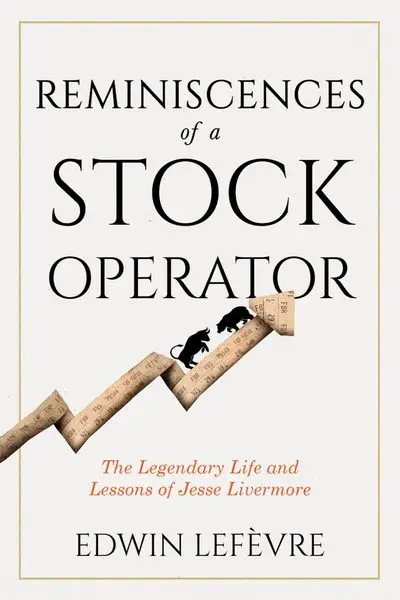
A hundred and three years after Edwin Lefèvre published Reminiscences of a Stock Operator, hedge funds running billion-dollar algorithms are still buying copies for their analysts.
That alone should tell you something about the book.
Reminiscences is a thinly fictionalised biography of the most feared speculator of his era, written by a journalist who understood that the lessons mattered more than the protagonist. The result is a book that reads like a novel and teaches like a textbook, without ever sounding like one.
The question for any modern trader is whether a book written before the SEC existed, before circuit breakers, before high-frequency trading and dark pools and central bank quantitative easing, still earns the shelf space it asks for. The answer is yes, and not by a small margin. The mechanics in the book are dated. The arguments are not. This review breaks down why the book still works, where it falls short, and how to read it through a modern lens.
At a Glance
| Author | Edwin Lefèvre |
| First Published | 1923 |
| Pages | ~400 (varies by edition) |
| Genre | Trading memoir / market philosophy |
| Difficulty | Intermediate — accessible prose, advanced concepts |
| Best For | Discretionary traders, swing traders, anyone serious about psychology |
| Skip If | You want backtested rules, formulas, or step-by-step setups |
OVERALL RATING: 9.0 / 10
Who Should Read This Book
| Reader | Verdict | Why |
|---|---|---|
| New trader (0–1 year) | Read it second | Read Trading in the Zone first, then this for the historical depth |
| Intermediate (1–3 years) | Read it now | This is when the book’s arguments start landing because you have context for them |
| Advanced / professional | Re-read annually | New layers reveal themselves with experience |
| SMC / ICT trader | Read it now | Every concept ICT teaches has an ancestor in this book |
| Algo / quant trader | Read for psychology | The mechanics are outdated, the behavioural argument is not |
| Long-term investor | Read selectively | The book centres on speculation, not investing |
The Book in Context
The book was published in 1923, before the SEC, before registered exchanges in their modern form, in an era when stock prices ticked across telegraph wires onto paper tape. Bucket shops were the off-exchange equivalent of today’s CFD brokers, and the protagonist made his first fortune in them. The narrative ends in 1923, before the great bull market peaked and six years before the 1929 crash. For deeper biographical context on the trader behind the book, see our Greatest Traders profile of Jesse Livermore. This review focuses on the book itself.
The Core Argument: Three Principles That Define the Book
Strip the book to its skeleton and three arguments hold it up.
1. The market is never wrong; opinions often are
The book returns to this idea constantly. The market does not care what you think, what you have predicted, what your analysis says should happen. Your job is to read what it is doing and align yourself with it. Fighting the tape is framed as the most expensive habit in finance, and the prose hammers the point until it sticks.
2. Big money is made by sitting, not trading
The book’s most quoted line is also its most misunderstood: “It was never my thinking that made the big money for me. It always was my sitting.” The book is clear that sitting is not inactivity. It is active patience that depends on a thesis and a non-negotiable invalidation point. Strip either of those out and the argument falls apart, which is exactly what the book warns about repeatedly.
3. The market repeats because human nature does not change
The single most useful sentence in the book, paraphrased across many passages: people are driven by greed, fear, hope, and ignorance, and these forces produce the same patterns again and again. The instruments change. The participants do not. This is the argument that ages best, because every decade since 1923 has confirmed it.
“There is nothing new in Wall Street. There can’t be because speculation is as old as the hills.”
— from Reminiscences of a Stock Operator
How Lefèvre Built the Book
The reason this book has outlasted every other trading memoir of its era is not the trader. It is the journalist who wrote it. Lefèvre was a magazine writer for The Saturday Evening Post with a feel for how to structure a long-form narrative, and that craft is what carries the book.
Three structural choices make it work.
First-person voice, third-person distance. Lefèvre writes in Larry Livingston’s first person, but the prose has the analytical detachment of a journalist. You get the immediacy of a memoir and the perspective of a profile at the same time. That tension is rare in trading literature.
Lessons embedded in story, never lectured. The book never stops to teach. Every principle is delivered through a trade that worked, a trade that failed, a mistake repeated, a conversation overheard. The reader extracts the lesson rather than receiving it. That is a deliberate craft choice and it is why the lessons land harder than they would in a textbook.
Repetition that compounds. The same arguments reappear in different settings throughout the book. By the fifth time you encounter the line of least resistance, you have seen it operate across markets, eras, and instruments. The repetition is not redundancy. It is reinforcement.
The combined effect is a book that teaches without seeming to teach. You finish it feeling like you have read a novel, then discover six months later that the lessons have rewired how you think about price.
Five Passages Worth Carrying With You
Five quotes that capture what the book is doing, each with a 2026 reading.
“It never was my thinking that made the big money for me. It always was my sitting.”
The most quoted line in trading literature, and the most misread. Note the word “sitting,” not “doing nothing.” The book is clear that sitting is an active decision repeated every minute the position remains valid. It is harder than trading.
“The market is never wrong, opinions often are.”
Carve this on every trader’s monitor. The market is not a fair judge of your analysis. It is the only judge of your P&L.
“A man must believe in himself and his judgment if he expects to make a living at this game.”
The book’s most underrated psychological note. Self-doubt does not make you a careful trader. It makes you an inconsistent one. Confidence is not the opposite of risk management. It is the foundation that lets risk management actually work.
“There is only one side to the stock market; and it is not the bull side or the bear side, but the right side.”
The single most useful frame in the entire book. You are not a bull or a bear. You are a participant looking for the right side, which changes.
“The desire for constant action irrespective of underlying conditions is responsible for many losses in Wall Street.”
The original critique of overtrading. Written before mobile trading apps, low-cost brokers, or zero commissions. The behaviour predates the technology that supposedly caused it.
The Modern Translation: Reading the Book Through an SMC Lens
This is the section that nobody else writes, and it is the reason this book is required reading for any serious SMC or ICT trader in 2026. The vocabulary of the book is a century old. The observations are not.
Lefèvre 1923 → SMC / ICT 2026
| Book Vocabulary (1923) | Modern Equivalent (2026) |
|---|---|
| Pivotal point | Break of structure (BOS) / Change of character (CHoCH) |
| Line of least resistance | Higher-timeframe directional bias |
| Proper action on a break | Displacement + Fair Value Gap (FVG) |
| Manipulation | Liquidity sweep / stop hunt |
| Reading the tape | Order-flow analysis / footprint reading |
| Inside information / insiders | Smart money / institutional positioning |
| The public | Retail / dumb money |
| A false move | Fakeout / failed breakout |
| Pyramiding | Scaling into a position |
| Tape acting “right” | Confirmation through order flow |
The vocabulary changed. The observations did not.
The point is not that the book predicted ICT. The point is that ICT, smart money concepts, Wyckoff, and every serious modern framework converged on the same observations the book put on paper in 1923. The vocabulary changes. The observations do not. If you are an ICT trader, read this book and translate as you go. Every page gives you a new way to articulate concepts you already use intuitively. For deeper coverage of how the modern frameworks actually work, see our complete guide to market structure and our breakdown of ICT for forex traders.
Common Misreadings of the Book
Misreading #1: “Just sit on your winners”
The book says the opposite. Sit on your winners while the thesis remains valid. The moment the line of least resistance shifts, you act. Reducing the book to “be patient” produces traders who hold losers because they confused conviction with stubbornness.
Misreading #2: “The book teaches chart trading”
It does not. The book argues for combining tape and fundamentals. Treating it as a pure technical text misses half the argument. The book always wants to know why the tape is doing what it is doing.
Misreading #3: “The book gives you a system”
It does not, and that is intentional. The book gives you principles. Systems are downstream of principles. Readers who finish the book and look for a checklist have read the words but not the substance.
Misreading #4: “The protagonist failed, so the lessons are wrong”
The laziest critique and the most common. The book itself warns repeatedly that knowing what to do and doing it are completely different problems. The protagonist’s later collapse is the proof of the warning, not a refutation of the lessons.
Misreading #5: “The book is too dated to be useful”
The mechanics are dated. The behaviour is not. Anyone who finishes the book and finds it irrelevant is reading the wrong layer.
Where the Book Falls Short
An honest review names the weaknesses.
- No specific entry or exit rules. The book talks about pivotal points and proper action without ever defining them precisely. You will not finish this book with a checklist. You will finish it with a sensibility.
- Sparse on risk management mechanics. Stop losses and position sizing appear in passing, but never with the rigour a modern trader needs. For risk frameworks, pair this with Van Tharp, Mark Douglas, or your own Money pillar.
- No options, no derivatives, no modern products. The instruments in the book are stocks and commodities. The principles port, but you have to do the translation work yourself.
- The narrative voice can drift. Lefèvre’s writing is beautiful but occasionally meanders. Some chapters tell tangential stories that add atmosphere without adding instruction. Read with patience for these passages.
- Dated language and references. Bucket shops, ticker tape, telegraph wires. None of these exist anymore. New readers sometimes get bogged down trying to picture them. Skim the mechanics and focus on the behaviour.
- The book stops in 1923. The narrative ends before the great bull market, the 1929 crash, and the protagonist’s final collapse. Readers should pair the book with knowledge of how the story actually ended to extract the full lesson about discipline failing under pressure.
How the Book Fits the Mind · Method · Money Framework
This is one of the rare trading books that contributes meaningfully to all three pillars, but its centre of gravity is firmly on Mind.
| Pillar | Contribution | What the Book Delivers |
|---|---|---|
| MIND | PRIMARY | Patience, conviction, the discipline to sit, the discipline to act, the relationship between ego and tape, the destructive role of tips and outside opinions |
| METHOD | SECONDARY | Pivotal points, line of least resistance, proper action on a break, reading the tape, understanding manipulation |
| MONEY | LIGHT TOUCH | Pyramiding into winners, sizing relative to conviction, the importance of capital preservation through cycles |
If you have read The Complete Trader’s Edge, you will recognise that the book arrived at many of the same conclusions framed in our three-pillar structure, just without the explicit scaffolding. Reading Reminiscences alongside the Mind · Method · Money framework gives you both the historical depth and the modern structure to actually apply the lessons.
Read This Instead Of / Read This After
| Relationship | Book | Why |
|---|---|---|
| Read instead of | How to Trade in Stocks by Livermore | Livermore’s own book is drier and less revealing than Lefèvre’s portrait. Most readers prefer Reminiscences. |
| Read after | Trading in the Zone by Mark Douglas | Get the modern psychology foundation first, then read this for the historical mirror |
| Read after | The Complete Trader’s Edge | The M·M·M framework gives you structure to organise what this book offers as intuition |
| Read alongside | Market Wizards by Jack Schwager | Many of the wizards explicitly cite Reminiscences. Reading them together creates a continuous lineage |
| Read after | Pit Bull by Marty Schwartz | A modern version of the same archetype. Less philosophical, more tactical. |
Final Verdict: Should You Read This Book in 2026?
Yes. Without hesitation. With one caveat.
This book is required reading for any trader who takes the craft seriously and wants to understand the lineage of every framework they now use. The vocabulary will have changed but the substance will be familiar in a way that feels almost uncanny. You will read a passage from 1923 and recognise yesterday’s trade.
The caveat is this: do not read it expecting a system. Read it expecting a worldview. If you finish the book and write down ten ideas about behaviour, sequencing, patience, and the relationship between price and people, you will have extracted everything the book has to offer. If you finish it looking for rules, you will be frustrated.
CTE Rating Breakdown
9.0/10
Essential Reading
| Readability | 9 | |
| Actionability | 7 | |
| Timelessness | 10 | |
| Beginner-Friendly | 6 | |
| Modern Relevance | 9 |
Frequently Asked Questions
Is Reminiscences of a Stock Operator based on a true story?
Yes. It is a thinly fictionalised biography of Jesse Livermore, with “Larry Livingston” as the alias used in the book. Lefèvre interviewed Livermore extensively and the events, trades, and quotes are drawn from Livermore’s life and career up to 1923.
Is the book still relevant in 2026 with algorithmic trading?
More relevant, not less. Algorithms have amplified the human behaviours the book describes by mechanising them at scale. The book is about how people respond to price, and algorithms are programmed by people responding to price.
How long is the book and how long does it take to read?
Roughly 400 pages depending on edition. Most readers finish in 8–12 hours of reading time. Plan to re-read passages, which is part of the experience.
Is this book good for beginners?
It works better as a second or third trading book. Read Trading in the Zone by Mark Douglas first if you have less than a year of trading experience. The arguments in Reminiscences need some context to land.
Which edition should I buy?
The Wiley Investment Classics edition is the most readable and well-formatted. Older public-domain editions exist for free but the typography can be rough. The annotated edition by Jon Markman adds historical context that some readers love and others find distracting.
Is there an audiobook version?
Yes, several. Pick the unabridged version. The prose voice is part of the book’s power and abridgements lose too much.
Should I read Reminiscences or How to Trade in Stocks first?
Reminiscences first, by a wide margin. Livermore’s own book is drier and more procedural. Lefèvre captures the voice and worldview better than Livermore did himself.
What makes this book different from other trading memoirs?
The craft of the writing. Lefèvre was a professional journalist, and the book reads like a novel rather than a how-to guide. The lessons are embedded in story rather than lectured, which is why they stick.
What is the book’s most famous lesson?
“It was never my thinking that made the big money for me. It always was my sitting.” Often misquoted as “sitting tight,” but the original is more precise. The book is clear that sitting is an active, disciplined practice, not passive holding.
How does the book compare to modern smart-money trading?
The vocabulary is different but the substance overlaps almost completely. What the book calls pivotal points are what ICT traders call breaks of structure. What it calls the line of least resistance is what we now call higher-timeframe bias. Anyone familiar with smart money concepts will recognise the underlying ideas immediately.
About the Author
Edwin Lefèvre (1871–1943)
Edwin Lefèvre was an American journalist, diplomat, and writer best known for his financial fiction and journalism for The Saturday Evening Post. Born in Colón, Panama, he wrote eight books and numerous short stories. His journalistic instinct for character and narrative is what elevates Reminiscences of a Stock Operator above every other trading memoir of its era.
Other notable works: Wall Street Stories (1901), Sampson Rock of Wall Street (1907), The Plunderers (1916), The Making of a Stockbroker (1925).
For the biographical story of Jesse Livermore, the trader at the centre of this book, see our full profile in Greatest Traders EP01: Jesse Livermore, the Boy Plunger of Wall Street.
Continue Learning
- The Three Pillars: Mind, Method, Money
- Market Structure: The Complete Guide
- Trading Psychology: The Complete Guide
- The Complete Trader’s Edge — The Book
- Greatest Traders EP01: Jesse Livermore, the Boy Plunger of Wall Street
 The Complete Trader's Edge
The full Mind · Method · Money framework. 70 chapters.
View on Amazon →
The Complete Trader's Edge
The full Mind · Method · Money framework. 70 chapters.
View on Amazon →
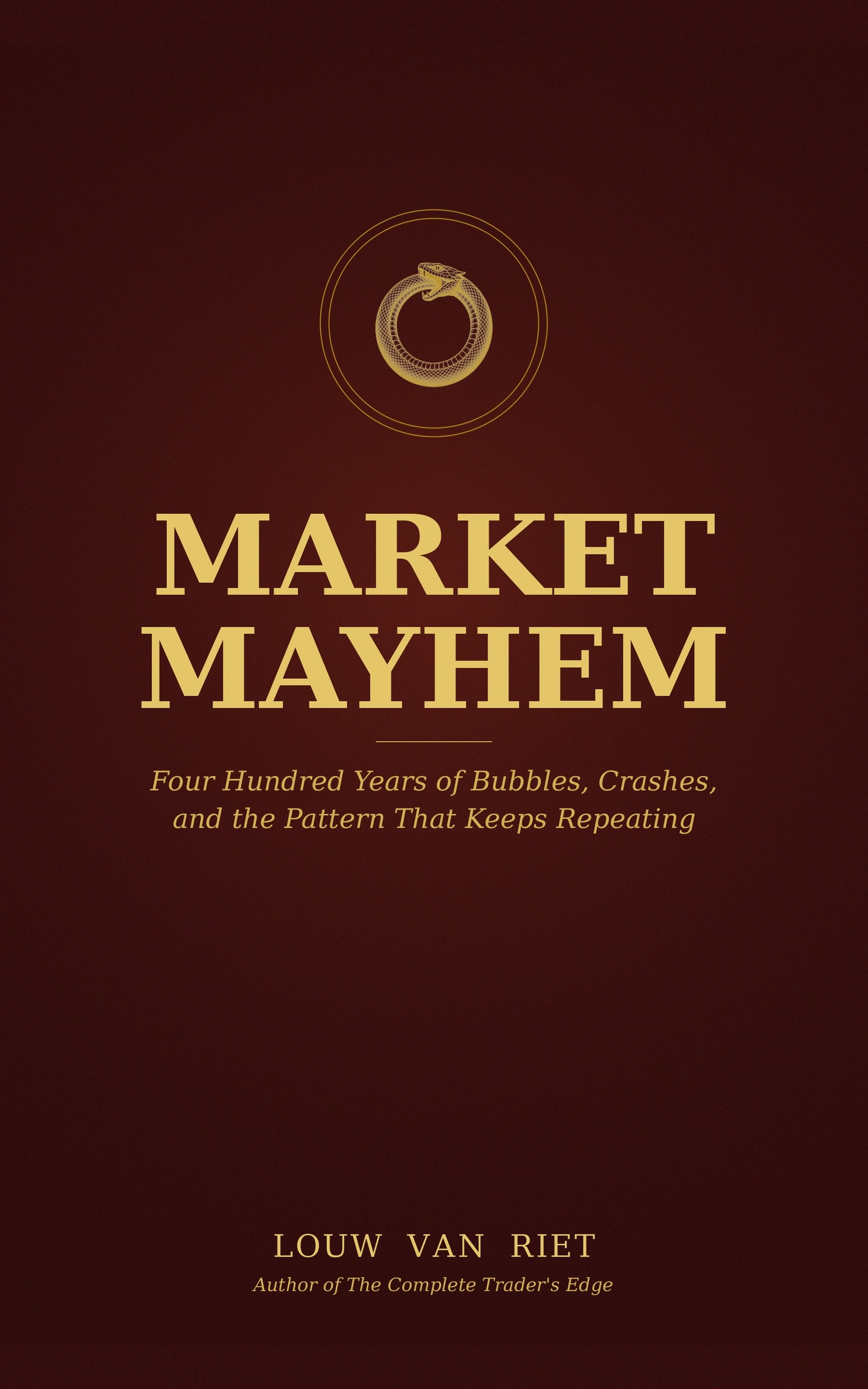 Market Mayhem
400 years of bubbles, crashes, and the pattern that keeps repeating.
Buy on Amazon →
Market Mayhem
400 years of bubbles, crashes, and the pattern that keeps repeating.
Buy on Amazon →
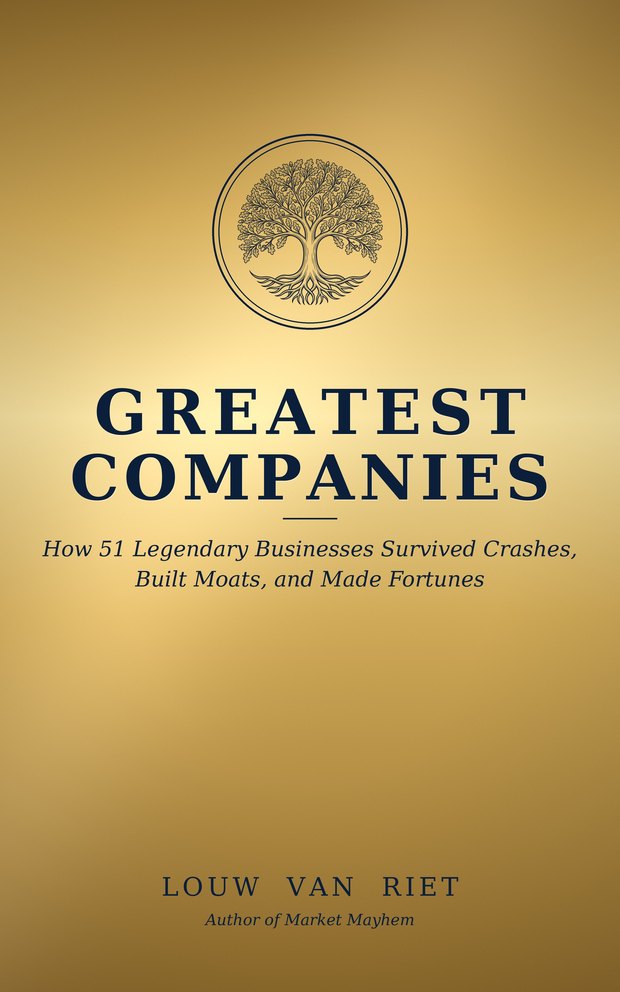 Greatest Companies
How the world's greatest companies were built — and what traders learn from them.
View on Amazon →
Greatest Companies
How the world's greatest companies were built — and what traders learn from them.
View on Amazon →
 Greatest Traders
Eighty-six lives that explain the markets — Livermore to Madoff, told with the losses left in.
View on Amazon →
Greatest Traders
Eighty-six lives that explain the markets — Livermore to Madoff, told with the losses left in.
View on Amazon →