

Two Australians make the same $20,000 profit on the same index over the same fourteen months. One bought the shares. One traded a CFD over them. The share investor halves their taxable gain. The CFD trader does not, and never will, no matter how long the position stays open.
That is not a loophole anyone is missing. It is structural, it comes from a taxation ruling written in 2005, and it is the single most misunderstood fact about trading in Australia. This guide sets out how the ATO actually treats CFDs and retail forex, what the treatment costs you, the one real advantage it hands back, and where the investor-versus-trader line sits.
This is the tax guide the Trading in Australia hub points at.
This is not tax advice.
The treatments below are drawn from ATO rulings and guidance current for the 2026–27 year. How they apply turns on facts specific to you. Before you lodge, speak to a registered tax agent who has handled active-trader returns. Treat this as a map of the terrain, not advice on your own situation.
Revenue account, and what that means
Under taxation ruling TR 2005/15, the ATO generally assesses CFD trading as a profit-making activity carried on with the intention of profit. That places it on revenue account rather than capital account, with two consequences that define everything else.
- Profits are ordinary income, taxed at your marginal rate, in the year they are derived.
- Losses are generally deductible against other ordinary income, subject to the non-commercial loss rules.
The reason is not arbitrary. A CFD is a derivative contract settled in cash against a reference price. You never acquire the underlying currency, share, index or commodity. Without an underlying capital asset there is nothing for capital gains treatment to attach to, and so no CGT discount can apply – the discount is a concession on the disposal of an asset you owned for more than twelve months, and you owned nothing.
| Share investor, held 14 months | CFD trader, held 14 months | |
|---|---|---|
| Gross profit | $20,000 | $20,000 |
| Treated as | Capital gain | Ordinary income |
| 50% discount | Applies | Does not apply |
| Amount assessed | $10,000 | $20,000 |
| Tax at a 37% marginal rate | $3,700 | $7,400 |
Illustrative only, ignoring the Medicare levy, other income, and any offsets. The point is not the exact figures. It is that the instrument, not the holding period, decided the outcome – and it decided it by a factor of two.
What the treatment gives back
Revenue account is not purely a penalty, and the compensation is genuinely valuable to a trader who is still learning.
A capital loss on shares can only be offset against capital gains, and carried forward until you have some. A CFD loss on revenue account is generally deductible against other ordinary income in the same year – salary included. A trader who loses $15,000 on CFDs and earns a salary may reduce assessable income by that amount, rather than banking a capital loss against gains that may never arrive.
The constraint is the non-commercial loss rules, which can defer a loss from an activity that does not meet certain tests of commerciality or scale. This is exactly the point where general guidance stops being useful and a tax agent starts, because the answer turns on your income, the structure and how the activity looks in aggregate.
The asymmetry, stated plainly.
Revenue account is worse for a winning year and better for a losing one. Given that every Australian CFD issuer is required to publish the percentage of its own retail accounts that lose money, and that those numbers are not close, the treatment most Australian CFD traders actually experience is the favourable half. That is not a reason to feel good about it.
Share trader or share investor?
The parallel question for anyone trading shares directly rather than derivatives, and the one where people assume the wrong answer is the better one.
The ATO weighs the whole activity: commercial purpose and character, intention to make a profit, repetition and regularity, organisation in a businesslike way with proper records, and the scale of the operation. There is no trade count, no holding period and no dollar figure that settles it.
Being assessed as a share trader means shares are trading stock, profits are ordinary income and losses are deductible – and the 50% CGT discount is gone. Being a share investor means capital treatment, the discount on assets held beyond twelve months, and capital losses quarantined against capital gains.
For a profitable long-horizon holder, trader status is a downgrade. People pursue it believing it sounds more professional, and pay for the privilege.
What changes on 1 July 2027
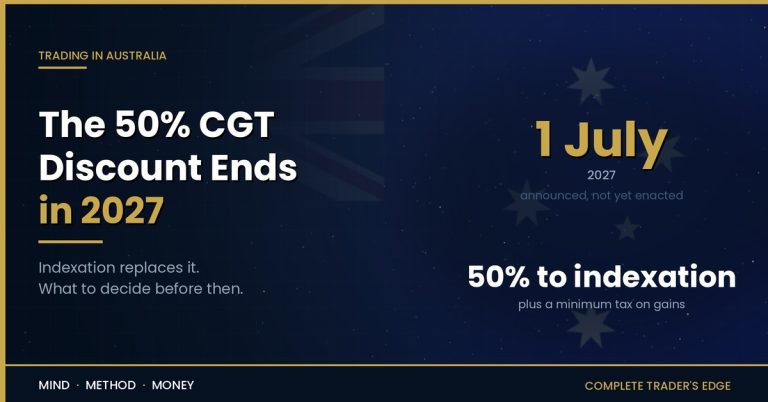
Changes announced in the 2026–27 Federal Budget replace the 50% CGT discount with cost base indexation plus a minimum tax on capital gains, from 1 July 2027. The ATO has confirmed the changes do not affect Tax Time 2026, and gains accrued before that date are reported as keeping the existing treatment.
The irony for readers of this page: CFD traders lose nothing, because they were never getting the discount in the first place. The change lands on long-term share investors, which narrows the gap between the two regimes from the other direction. Verify the legislated detail before acting on it – announced is not enacted, and the mechanism matters.
Records the ATO expects
- Every closed position with dates, amounts and the AUD value.
- Financing and commission charges, which form part of the calculation rather than a separate deduction.
- Platform, data and subscription costs, which are deductible against revenue-account income and which most traders forget to claim.
- Broker statements downloaded at the time. Platforms change and accounts close.
Where this sits in Mind, Method, Money
This is Money. A tax difference of that size dwarfs the edge most retail strategies produce, and it is decided before the first trade by a choice most people make on the basis of which tab the broker opened by default. The trader who spends six months on entries and no time on classification is optimising the small number.
Model the real after-tax outcome with the trading calculators, and read the rest of the picture – ASIC leverage caps, brokers and sessions in AEST – on the Australia hub.
Frequently asked questions
Do I pay CGT on CFD profits in Australia?
Generally no – CFD profits are normally assessed as ordinary income on revenue account under TR 2005/15, taxed at your marginal rate. Because there is no underlying asset, the capital gains rules and the 50% discount do not apply regardless of holding period.
Can I claim CFD losses against my salary?
Often yes, because revenue-account losses are generally deductible against other ordinary income in the same year, unlike capital losses. The non-commercial loss rules can defer that deduction, which is why this one deserves a registered tax agent rather than a forum.
How is retail forex taxed in Australia?
Retail forex trading through a CFD or margin product is treated the same way – ordinary income on revenue account. Holding actual foreign currency long term can fall under different rules, but that is uncommon for retail traders.
Is it better to be classified as a share trader?
Usually not, if you are profitable and hold positions beyond twelve months, because trader status converts discountable capital gains into fully taxed ordinary income. It helps when losses need to be deductible against other income.
Does the 2027 CGT change affect CFD traders?
No, because CFD traders never had the 50% discount. The announced change from 1 July 2027 affects investors holding capital assets beyond twelve months.
The instrument is a tax decision.
Before choosing the product, model what the profit and the loss are each worth after tax with the calculators, then read the regulatory side on the Australia hub.
Sources: ATO taxation ruling TR 2005/15 on the tax consequences of financial contracts for differences; ATO guidance on share investing versus share trading and on the CGT discount, which requires ownership of a CGT asset for at least 12 months; non-commercial loss rules; capital gains tax changes announced in the 2026–27 Federal Budget, effective 1 July 2027, which the ATO has confirmed do not apply to Tax Time 2026. Figures are illustrative and exclude the Medicare levy and other income. Last reviewed 26 September 2026.
Not tax, legal or financial advice. Verify with the ATO and a registered tax agent before acting.
 The Complete Trader's Edge
The full Mind · Method · Money framework. 70 chapters.
View on Amazon →
 Market Mayhem
400 years of bubbles, crashes, and the pattern that keeps repeating.
Buy on Amazon →
 Greatest Companies
How the world's greatest companies were built — and what traders learn from them.
View on Amazon →
 Greatest Traders
Eighty-six lives that explain the markets — Livermore to Madoff, told with the losses left in.
View on Amazon →