

After a losing trade, two traders sit at their desks with identical results. One thinks: “I am bad at this. I do not have the talent for trading.” The other thinks: “That did not work. What can I learn from it?” Same loss, same chart, same market. Entirely different futures. The first trader has what Stanford psychologist Carol Dweck calls a fixed mindset. The second has a growth mindset. And that distinction, more than any indicator or strategy, determines who survives in markets.
Dweck’s research, spanning decades and summarised in her landmark book Mindset: The New Psychology of Success, demonstrates that your beliefs about whether ability is fixed or developable change everything about how you perform, learn, and respond to failure. For traders, where failure is a daily event and the ability to learn from it is the only sustainable edge, this research is not just relevant. It is essential.
Dweck’s book is where the fixed and growth mindset research was first written up for a general audience.

Fixed Mindset vs Growth Mindset: The Trader’s Fork in the Road
Dweck’s core framework divides people into two belief systems about their own abilities:
| Key Concept | Original Context | Trading Translation |
|---|---|---|
| The obstacle is the way | Difficulties are opportunities for growth | Drawdowns reveal weaknesses in your process that winning streaks hide. Embrace them. |
| Memento mori | Remember you are mortal. Urgency without panic. | Your trading capital is finite. Protect it. Every reckless trade shortens your career. |
| Control the controllable | Focus only on what is within your power | You control risk, entries, and process. You do not control the market. Act accordingly. |
| Amor fati | Love your fate, including the losses | Accept that losing 45% of trades is part of a 55% win rate strategy. Love the process, all of it. |
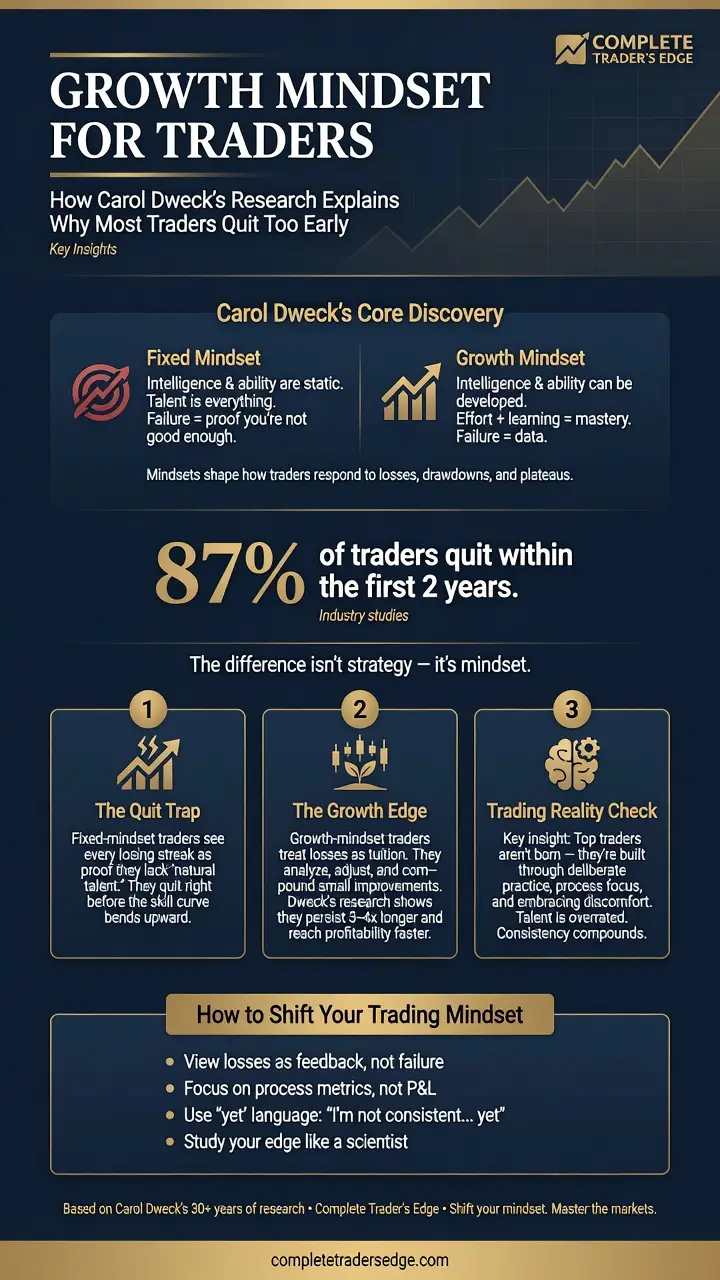
Fixed mindset: Intelligence, talent, and ability are innate qualities. You either have them or you do not. Effort is a sign that you lack natural talent. Failure is a permanent verdict on your capabilities. Feedback is threatening because it challenges your identity.
Growth mindset: Abilities are developed through effort, strategy, and learning from others. Challenges are opportunities to grow. Failure is information, not identity. Effort is the path to mastery. Feedback is valuable regardless of how it feels.
In trading, the fixed mindset sounds like this: “I keep losing, so I am not cut out for trading.” “Some people just have a feel for the market and I do not.” “If I were really good at this, it would not be this hard.” These beliefs produce a trader who avoids challenge, hides from feedback, gives up after losing streaks, and interprets every loss as evidence that they should quit.
The growth mindset sounds different: “I keep losing, so I need to review my process and find the gap.” “That trader is more successful because they have been doing this longer and have refined their system. I can do the same.” “This is hard because trading is hard. The difficulty is not a signal to stop; it is the terrain I need to cross.” This trader journals, reviews, adjusts, and persists.
How Your Mindset Shows Up in Every Trading Session
Response to Losses
The fixed mindset trader takes losses personally. Each loss chips away at their self-image as a competent person. After a series of losses, they either quit trading or engage in desperate behaviour (revenge trading, removing stops, increasing size) to “prove” they are still capable. The loss is not just financial. It is existential.
The growth mindset trader treats losses as data. They journal the trade, assess whether the setup was valid, check their execution, and identify one thing to improve. The loss has no bearing on their identity. It is a cost of business, a data point in a distribution, and a learning opportunity. This is the psychology of losing done right.
Response to Success
The fixed mindset trader attributes wins to talent: “I called that move perfectly. I just have a feel for the market.” This produces overconfidence, increased risk-taking, and the eventual blowup when the “talent” fails to predict the next move. They never examine why the trade worked because examining success might reveal it was luck, not skill.
The growth mindset trader attributes wins to process: “That worked because I waited for my A+ setup, sized correctly, and held to target. My preparation was good today.” They journal winning trades with the same rigour as losing ones, because understanding why something worked is just as important as understanding why something failed. This is the difference between a trader who gets lucky and a trader who builds an edge, as described in the professional trader mindset.
Response to Difficulty
The fixed mindset trader avoids difficult markets. They skip volatile sessions, avoid instruments they find confusing, and stay inside a narrow comfort zone. Growth has a ceiling because anything that challenges their current competence threatens their self-image.
The growth mindset trader deliberately seeks appropriate challenge. They study markets they do not understand. They analyse their worst trades with more attention than their best. They seek feedback from more experienced traders even when it is uncomfortable. Their comfort zone expands continuously because they define difficulty as the terrain of growth rather than the evidence of limitation.
The Effort Paradox
One of Dweck’s most counterintuitive findings: people with a fixed mindset view effort negatively. If you have to try hard, it means you are not naturally talented. This produces a devastating dynamic in trading, where the learning curve is long and effort without immediate results is the norm for years.
The fixed mindset trader sees a three-year journey to consistency and thinks: “If I had real talent, I would be profitable by now. The fact that I am still struggling proves I do not have what it takes.” They quit, often just before the breakthrough.
The growth mindset trader sees the same three-year journey and thinks: “Every month I trade, journal, and review, I am building something. My win rate is up 3% from six months ago. My average loss is smaller. The data shows improvement even if my equity curve does not reflect it yet.” This is the consistency mindset that separates survivors from casualties.
Chapter 2 of The Complete Trader’s Edge describes the four stages of a trader’s lifecycle. Understanding that every trader passes through extended periods of struggle, and that this struggle is the process working rather than evidence of failure, is a growth mindset applied to the trading journey itself.
Praise Process, Not Outcome
Dweck’s research showed that praising children for being “smart” (fixed trait) made them avoid challenges, while praising them for effort and strategy (growth process) made them seek challenges and persist longer. The implications for trading are direct.
If you evaluate your trading day by P&L (outcome), you are reinforcing a fixed mindset. Good P&L means you are talented. Bad P&L means you are not. This creates the emotional rollercoaster that destroys consistency.
If you evaluate your trading day by process adherence (did I follow my rules, did I journal, did I honour my stops, did I manage my state), you are reinforcing a growth mindset. A day where you lost money but followed every rule perfectly is a successful day. A day where you made money by deviating from your plan is a dangerous day that happened to end well.
This process-over-outcome evaluation is the trading journal used correctly. The journal should score process metrics, not just record profit and loss. Did you wait for your setup? Did you size correctly? Did you manage the trade according to plan? These are the questions that build a growth mindset in trading.
The Power of “Yet”
Dweck introduced a simple but powerful linguistic tool: adding the word “yet” to any statement about inability. “I cannot trade profitably” becomes “I cannot trade profitably yet.” “I do not understand order flow” becomes “I do not understand order flow yet.” The word reframes a permanent limitation as a temporary stage in a learning process.
For traders, “yet” is a psychological lifeline during the hardest phases of development. “I cannot hold my winners” becomes “I cannot hold my winners yet, but my journal data shows I am holding 15% longer than three months ago.” “I keep revenge trading” becomes “I still revenge trade sometimes, but I caught myself twice this week before acting on it.” The trajectory matters more than the current position.
Deliberate Practice vs Mindless Repetition
Dweck’s growth mindset is not about believing hard work alone guarantees success. It is about believing that deliberate, strategic effort leads to improvement. There is a critical difference between a trader who places 1,000 trades and a trader who places 1,000 trades while systematically reviewing, adjusting, and refining their approach after each one.
The first trader has one year of experience repeated 1,000 times. The second trader has 1,000 iterations of improvement. Same number of trades, completely different outcomes. This is why building a strategy requires structured development, not just screen time.
Deliberate practice in trading means: trading with a plan, journalling every trade with honest assessment, reviewing the journal weekly to identify patterns, making one specific adjustment, and measuring whether the adjustment improved results. This cycle, repeated consistently, is the compound interest of skill development.
Building a Growth Mindset Trading Culture
Dweck found that mindset is not purely individual. It is shaped by environment and culture. Trading communities that celebrate “big wins” and mock losses create a fixed mindset culture. Trading communities that celebrate process adherence, honest journal reviews, and learning from mistakes create a growth mindset culture.
If you are part of a Discord group, a prop firm community, or a mentorship programme, notice the culture. Do people share their losing trades for analysis, or only their winners? Do they discuss their psychological struggles, or pretend they trade without emotion? The environment you choose shapes the mindset you develop.
Building a growth mindset individually requires daily practice. Ask yourself after every session: “What did I learn today? What is one thing I can do better tomorrow? Where did I show improvement compared to last month?” These questions force growth-oriented processing regardless of the day’s financial result.
Putting It All Together: The Growth Mindset Trading Protocol
Daily language check: Replace “I can’t” with “I can’t yet.” Replace “I’m bad at this” with “I’m developing this skill.” Replace “That loss means I failed” with “That loss gave me data.”
Process scorecard: Score every session on five process metrics (preparation, entry quality, risk management, trade management, journalling) on a 1-5 scale. Track the average weekly. Your goal is to raise the process score, not the P&L.
Weekly review question: “What is one thing I do better now than I did four weeks ago?” Find the evidence in your journal. If you cannot find it, adjust your practice to be more deliberate next week.
Feedback seeking: Once a month, share your three worst trades with a mentor or trusted peer and ask for honest feedback. The growth mindset trader actively seeks the discomfort of honest assessment because they know it accelerates development.
Effort reframe: When trading feels hard, remind yourself: “This difficulty is the path. The traders who find this easy either have more experience than me or are about to learn a painful lesson about overconfidence. I am exactly where I should be.”
Carol Dweck’s research proves what the best traders already know intuitively: the belief that you can improve is not naive optimism. It is the prerequisite for improvement itself. The trader who believes they can develop their skills will invest the effort, seek the feedback, and persist through the setbacks. The trader who believes ability is fixed will interpret every setback as confirmation that they should quit. Same market, same tools, same information. Different belief, different outcome. Choose growth.
Continue Reading: Mindset Masters for Traders
▶ Tony Robbins & Trading Psychology: Peak Performance for Traders
▶ The Psychology of Losing: How to Process Drawdowns
▶ Building Your Trader Identity: Who You Are Shapes How You Trade
The Complete Trader’s Edge
This article is part of the Mindset Masters for Traders series. The growth mindset principles explored here are covered across the Mind pillar in The Complete Trader’s Edge.
Frequently Asked Questions
What is growth mindset in trading?
Growth mindset in trading is the belief that trading ability is developed through effort, strategy, and learning, not fixed at birth. Traders with a growth mindset treat losses as data, seek feedback, persist through drawdowns, and continuously refine their process. This contrasts with a fixed mindset, where traders interpret losses as proof they lack talent and either quit or engage in destructive behaviour.
How does Carol Dweck’s research apply to trading psychology?
Dweck’s research shows that beliefs about ability determine responses to failure, which is directly relevant to trading where losses are a daily event. Fixed mindset traders avoid challenge and interpret losses as identity threats. Growth mindset traders seek challenge and interpret losses as learning opportunities. The mindset you bring to the screen determines whether losses destroy your confidence or strengthen your process.
Why do some traders quit while others persist through drawdowns?
Dweck’s framework explains this directly. Traders with a fixed mindset view extended struggle as evidence they lack talent and quit. Traders with a growth mindset view the same struggle as the normal learning curve of a complex skill. Since consistent trading typically requires three to five years of development, mindset determines whether a trader persists long enough for their edge to materialise.
How can I develop a growth mindset for trading?
Replace outcome-based evaluation with process-based evaluation: score your sessions on rule adherence rather than profit. Add “yet” to statements of inability. Journal with curiosity rather than judgment. Seek honest feedback from experienced traders. Celebrate effort and improvement rather than individual trade results. These practices gradually rewire your belief system from fixed to growth-oriented.
Does a growth mindset guarantee trading success?
No. Growth mindset is necessary but not sufficient for trading success. You also need a valid strategy, proper risk management, and adequate capitalisation. What growth mindset does is ensure that you invest the effort, persist through setbacks, and continuously improve, which are the prerequisites for any strategy to produce long-term results. Without growth mindset, even the best strategy will be abandoned during the first extended drawdown.
 The Complete Trader's Edge
The full Mind · Method · Money framework. 70 chapters.
View on Amazon →
The Complete Trader's Edge
The full Mind · Method · Money framework. 70 chapters.
View on Amazon →
 Market Mayhem
400 years of bubbles, crashes, and the pattern that keeps repeating.
Buy on Amazon →
Market Mayhem
400 years of bubbles, crashes, and the pattern that keeps repeating.
Buy on Amazon →
 Greatest Companies
How the world's greatest companies were built — and what traders learn from them.
View on Amazon →
Greatest Companies
How the world's greatest companies were built — and what traders learn from them.
View on Amazon →
 Greatest Traders
Eighty-six lives that explain the markets — Livermore to Madoff, told with the losses left in.
View on Amazon →
Greatest Traders
Eighty-six lives that explain the markets — Livermore to Madoff, told with the losses left in.
View on Amazon →