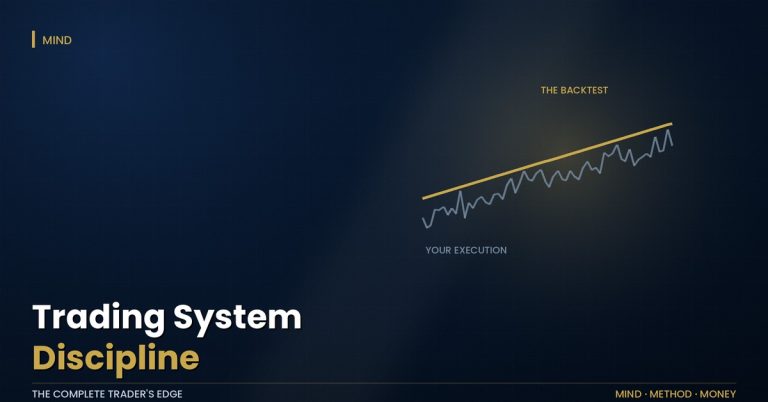


You had a very good month. The system clicked, the reads were clean, and something changed in how you see the market.
Next month will be worse. Not because you will do anything wrong. Because the month you just had was mostly not about you.
Twenty thousand traders, all of them slightly skilled
Give every trader in a population a genuine, positive edge. Their true monthly edge averages 0.10R and varies a little from trader to trader.
Now add the thing that actually determines a month: noise, with a standard deviation of 0.40R. Four times the size of the average edge, which is a fair description of monthly trading results.
Rank everybody by their month-one result. Then look at what those same people do in month two.
| Ranked by month 1 | Month 1 | Month 2 | Their actual skill |
|---|---|---|---|
| Top 10% | +0.806 | +0.112 | +0.109 |
| 2nd decile | +0.517 | +0.111 | +0.107 |
| Middle | +0.150 | +0.103 | +0.102 |
| Bottom 10% | −0.602 | +0.083 | +0.089 |
The best traders in the room made eight times the average. Next month they make an ordinary result, indistinguishable from everybody else’s.
And look at the last column, which is the one no trader ever gets to see. The top decile’s true skill is 0.109. The population average is 0.100. They are nine percent better than the median trader, and they outperformed him by a factor of five, and every scrap of that outperformance was luck.
The number that ends the argument
Correlation between a trader’s month-one result and his month-two result: 0.025.
Knowing how somebody did last month tells you essentially nothing about how they will do this month. Every trader you follow because of last month was selected on noise.
The bottom decile is the same story, inverted
They lost 0.602R in month one. Their true skill is 0.089, which is eleven percent below average. In month two they make +0.083R, which is fine.
They will not be around to collect it. They will have changed the system, reduced size, or stopped, because a −0.602R month does not feel like noise. It feels like a verdict.
The bottom decile’s real problem is not that they are worse. It is that they will respond to a random outcome by destroying a functioning process, and the top decile will respond to the mirror-image random outcome by increasing size into it.
Where this quietly ruins traders
Sizing up after a good run
The most expensive habit in retail trading, and it is regression to the mean weaponised against you. Your edge did not improve. Your last month was drawn from the right tail. You have now increased your exposure at the precise moment the sample is most likely to normalise.
Firing the strategy after a bad quarter
Same error, opposite sign, and it removes a positive-expectancy system from your life on the evidence of a sample too small to detect its expectancy.
Copying whoever won last year
Fund managers, prop traders, the account you found on X. Selection on an extreme past result guarantees you have selected on noise, because noise is what produces extreme results. The correlation is 0.025, and it does not improve because the person is charismatic.
The illusion that punishment works
Kahneman noticed this in flight instructors. Praise a cadet after an exceptional landing and the next one is worse. Shout at him after a terrible one and the next is better. The instructors concluded that criticism works and praise does not.
Nothing worked. Exceptional landings are followed by ordinary ones and terrible landings are followed by ordinary ones, because that is what exceptional and terrible mean. The instructors had learned a false lesson from a true observation, and every trader who “gets serious” after a bad week is learning the same false lesson.
Why it is so hard to feel
Because regression has no cause, and the mind cannot store an effect without one.
Ask a trader why his best month was followed by a worse one and he will produce an explanation immediately. He got complacent. The market changed character. He was trading too big. Every one of these is plausible, all of them may even be a little true, and none of them is necessary, because the model above contains no complacency, no regime change, and no error at all. It contains an average and some noise, and it reproduces the entire phenomenon.
The discipline this demands. When something reverts, resist the explanation. The explanation will be available, it will be persuasive, and it will lead you to change something that was never broken.
The sample size you actually need
With noise at four times the size of the edge, a month is not a measurement. It is a single draw.
To detect a 0.10R edge against a 0.40R monthly standard deviation with any confidence, you need years, not months. Which is uncomfortable, and it is also why every serious trading operation judges its people over horizons that feel absurd to a retail trader, and why every retail trader judges himself over horizons that would make a serious operation laugh.
The practical version is simpler. Do not update on a month. Do not size up, size down, switch, quit, or celebrate. Compute expectancy over your whole record, revise it slowly, and treat every extreme month as what it almost certainly is: a normal month, with a large error term attached.
Bernstein’s point
The history of risk, as he tells it, is a four-hundred-year struggle to separate skill from luck. Not to eliminate luck. To see it clearly enough that we stop mistaking it for ourselves.
Regression to the mean is the tool that struggle produced. It says something modest and devastating: the further an outcome sits from the average, the more of it was luck, and the less of it will repeat.
Your best month was mostly luck. So was your worst. The trader in between them is the only one who exists.
Correlation between last month and this month: 0.025.
Everything you concluded from your best month was concluded from a coin.
 The Complete Trader's Edge
The full Mind · Method · Money framework. 70 chapters.
View on Amazon →
The Complete Trader's Edge
The full Mind · Method · Money framework. 70 chapters.
View on Amazon →
 Market Mayhem
400 years of bubbles, crashes, and the pattern that keeps repeating.
Buy on Amazon →
Market Mayhem
400 years of bubbles, crashes, and the pattern that keeps repeating.
Buy on Amazon →
 Greatest Companies
How the world's greatest companies were built — and what traders learn from them.
View on Amazon →
Greatest Companies
How the world's greatest companies were built — and what traders learn from them.
View on Amazon →