
Two thousand years before the first stock exchange opened, a Roman emperor was writing advice that would have saved most retail traders from ruin. Marcus Aurelius, Seneca, and Epictetus built a philosophy designed for exactly the kind of chaos that markets deliver daily: uncontrollable external events, intense emotional pressure, and the constant temptation to react impulsively. Ryan Holiday has spent the last decade making Stoic philosophy accessible to a modern audience, and his core books map onto trading psychology with an accuracy that would surprise no Stoic and most traders.
This is not about suppressing emotions or becoming a robot at the screen. Stoicism, properly understood, is about separating what you can control from what you cannot, responding to adversity with clarity rather than panic, and building the kind of internal resilience that allows you to execute your process regardless of what the market does. If that sounds like the description of a professional trader, it should. The overlap is almost total.
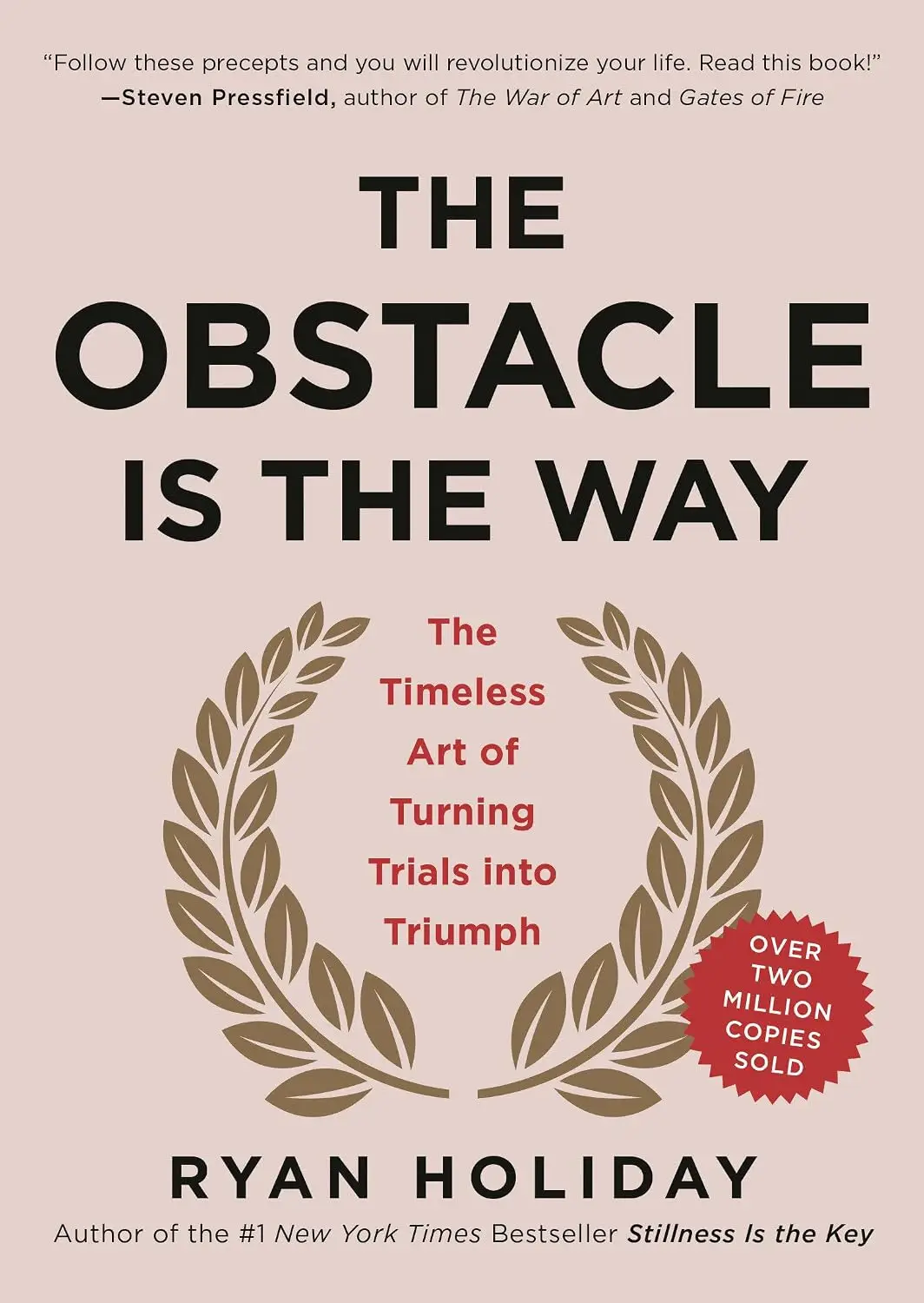
Holiday’s entry point into Stoicism, and the source of the obstacle-reframing method used throughout this article.
The Obstacle Is the Way: Turning Drawdowns Into Development
Holiday’s first major book borrows its title from Marcus Aurelius: “The impediment to action advances action. What stands in the way becomes the way.” The Stoics believed that obstacles are not problems to avoid but raw material to work with. Every difficulty is an opportunity to practise a virtue: patience, discipline, courage, wisdom.
| Key Concept | Original Context | Trading Translation |
|---|---|---|
| 1% better every day | Small improvements compound into massive results | One journal insight per week = 52 refinements per year. Skill compounds invisibly. |
| Identity-based habits | Become the type of person who does X, not someone who tries X | Say “I am a disciplined trader” not “I am trying to be disciplined.” Identity drives behaviour. |
| Habit stacking | Attach new habits to existing routines | After morning coffee (existing), review charts and mark levels (new trading habit). |
| Environment design | Make good habits easy and bad habits hard | Remove social media from trading screen. Set trade limits that auto-close the platform. |
| The two-minute rule | Start any habit by doing it for just two minutes | Start journalling with just 2 sentences per trade. The habit matters more than the depth initially. |
For traders, the obstacle is the drawdown. The losing streak. The missed entry. The stop that gets hit by one tick before price reverses. These are not interruptions to your trading career. They are your trading career. The question is never whether you will face adversity. The question is what you do with it.
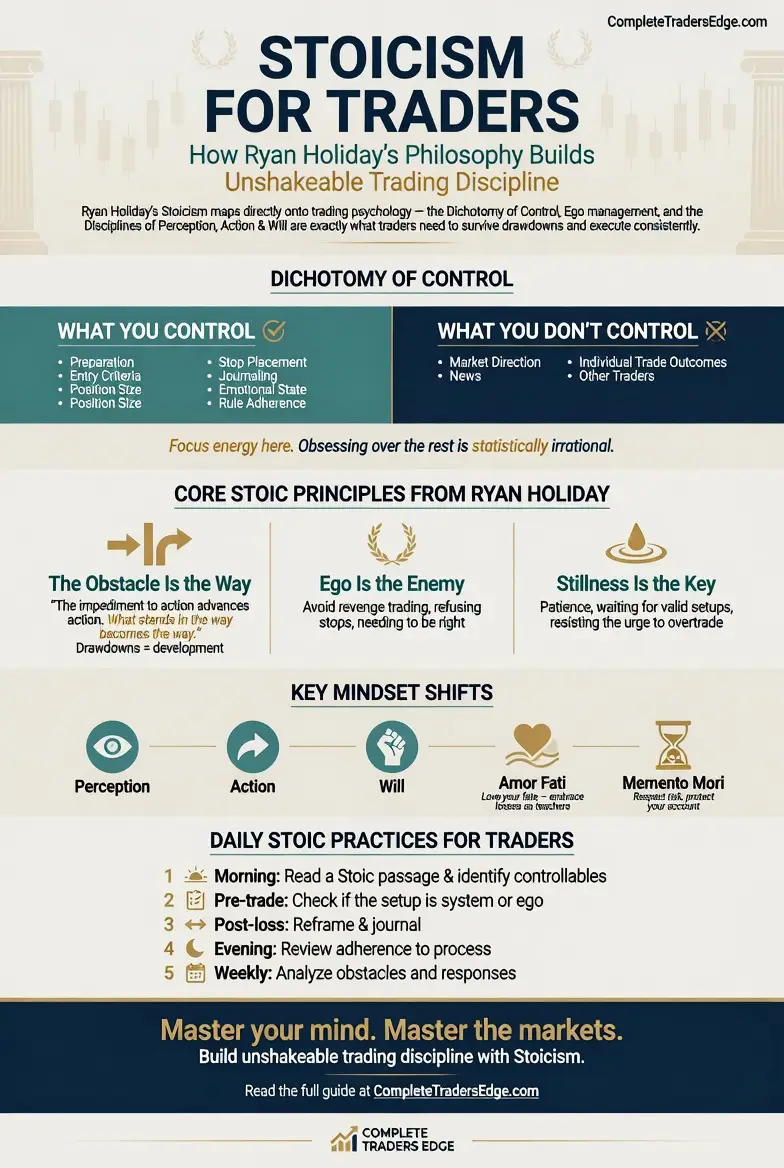
Holiday breaks the response to any obstacle into three disciplines: perception (how you see it), action (what you do about it), and will (how you endure what you cannot change). Each one maps directly onto trading.
Perception: Seeing the Market Clearly
The first discipline is controlling your perception. Most traders perceive a losing trade as a failure, a personal indictment, evidence that their strategy is broken. The Stoic trader perceives the same event differently: a probabilistic outcome within the expected parameters of a validated system. The trade was correct if the setup was valid and the execution was clean. The outcome is irrelevant to the quality of the decision.
This is the probability mindset expressed in Stoic terms. You cannot control the outcome of any individual trade. You can control whether your perception of that outcome is accurate or distorted. A loss perceived as catastrophe produces panic. A loss perceived as a cost of business produces calm assessment. Same loss, entirely different trajectory.
Action: Doing What You Can
The second discipline is taking right action within your sphere of control. After a loss, the Stoic trader does not freeze, does not revenge trade, does not spiral into self-criticism. They act within what they control: they journal the trade, they assess whether the setup was valid, they check their emotional state, and they prepare for the next setup with the same discipline as the first.
Holiday emphasises that action must be disciplined, not frantic. The worst response to a losing streak is to trade more, trade bigger, or trade differently. The correct response is to continue executing your process and let the statistics reassert themselves over a larger sample. This requires exactly the kind of persistent, measured action that Stoics trained for.
Will: Enduring What You Cannot Change
The third discipline is acceptance. Some things cannot be fixed, avoided, or controlled. The market will do what it does. News will drop at the worst moment. Your best setup will fail five times in a row. The Stoic response is not resignation but acceptance with inner strength: “This is the nature of the activity I have chosen. I accept it, and I will not let it break my process.”
This maps directly to managing drawdowns professionally. The drawdown itself cannot be controlled. Your response to it can. The traders who survive drawdowns are not the ones who feel no pain. They are the ones who feel the pain and continue executing their system anyway.
Ego Is the Enemy: Why Being “Right” Destroys Trading Accounts
Holiday’s second major book addresses the force that derails more trading careers than any technical deficiency: ego. The need to be right. The need to prove something. The need to feel significant through your trading results.
Ego shows up in trading in predictable patterns. The trader who refuses to take a stop loss because admitting the trade was wrong feels intolerable. The trader who doubles down on a losing position because they “know” they are right about the direction. The trader who posts winning trades on social media and hides the losses. Every one of these behaviours is ego protecting itself at the expense of the account.
Holiday’s prescription aligns perfectly with professional trading psychology: always remain a student. The moment you believe you have “figured out” the market is the moment you become dangerous to yourself. Markets evolve. Conditions change. The trader who approaches every session with the humility of a student is the trader who adapts and survives.
The Ego Audit for Traders
After your next losing trade, notice your internal reaction. If you feel defensive (“the market is wrong,” “that was manipulation,” “my analysis was perfect”), that is ego. If you feel curious (“what information was I missing?” “was this a valid setup that simply did not work, or did I misread the context?”), that is learning.
The Stoics practised daily self-examination. Seneca reviewed his day every evening, asking himself where he fell short and what he could do better. This is precisely what the trading journal is for. Not as a record of wins and losses, but as a tool for honest self-assessment. The journal works only if ego is left at the door.
Stillness Is the Key: The Case for Doing Nothing
Holiday’s third book argues that the ability to be still, to resist the urge to act, is one of the most valuable skills in any performance domain. For traders, this is the skill of patience, and it may be the rarest quality in retail trading.
Most traders lose money not because they take bad trades but because they take too many trades. The urge to be “in the market” is a form of restlessness that Stoics would recognise immediately. It is the inability to sit still, to wait, to tolerate the discomfort of inaction when the market offers no valid setup.
Holiday would say: the professional trader’s ability to sit at their desk for hours and take zero trades is not a failure. It is their highest-value skill. Every trade you do not take that would have been a loser is pure profit preserved. The discipline of stillness, of waiting for your setup and refusing to act until it appears, is the trading equivalent of what the Stoics called apatheia: not the absence of feeling, but the mastery of impulse.
The Dichotomy of Control: The Most Important Concept in Trading
Epictetus taught the most foundational Stoic principle: some things are within our control, and some things are not. Peace and effectiveness come from focusing exclusively on what you control and releasing attachment to everything else.
In trading, the dichotomy is sharp:
Within your control: Your preparation. Your entry criteria. Your position size. Your stop placement. Your journalling. Your emotional state management. Your decision to follow or break your rules.
Outside your control: Whether this trade wins or loses. What the market does next. What the news cycle delivers. How other participants behave. Whether your setup triggers today or not.
Most traders spend their emotional energy on the second list and neglect the first. The Stoic trader inverts this completely. They pour all their attention into the items they control and treat the items they cannot control with equanimity. This is not indifference. It is intelligence. It is recognising that your edge plays out over hundreds of trades and that obsessing over any single outcome is statistically irrational and psychologically destructive.
This principle underpins every chapter of the Mind pillar in The Complete Trader’s Edge. The 10 Commandments of Risk Management are all actions within your control. Position sizing, stop losses, daily limits: these are your circle of influence. Price direction is not.
Memento Mori and the Trading Account
The Stoics practised memento mori: the meditation on death. Not as morbid exercise but as a tool for clarity. When you remember that your time is finite, trivial concerns fall away and what matters comes into focus.
For traders, the equivalent is memento risci: remember that your account can die. Every trading account has a finite life if not protected. The trader who acts as though losses are impossible, who treats the account as inexhaustible, who takes risks without calculating their impact on survival, is the trader whose account will eventually reach zero.
The meditation on account mortality produces the same clarity that memento mori produces for life. It makes you serious about position sizing. It makes you religious about stop losses. It makes you ruthless about cutting exposure when conditions deteriorate. Not from fear, but from the clear-eyed recognition that survival is the prerequisite for everything else.
Amor Fati: Loving Your Trading Fate
The highest Stoic practice is amor fati: loving your fate. Not merely accepting what happens, but embracing it as necessary and useful. Holiday describes this as the ultimate competitive advantage: the person who can genuinely welcome adversity transforms suffering into fuel.
For the trader, amor fati means embracing the losing streak as the forge that builds psychological resilience. Welcoming the drawdown as the test that proves whether your process holds. Treating the stop loss not as punishment but as the mechanism that keeps you in the game. The trader who can genuinely say “I am grateful for this loss because it is teaching me something” has reached a level of psychological development that most traders never approach.
This is not toxic positivity. It is the recognition that trading will deliver pain, and that your relationship with that pain determines your trajectory. Fight it, and it destroys you. Accept it, and you survive. Embrace it, and you grow.
Daily Stoic Practices for Traders
Morning: Before the session, read one Stoic passage (Holiday’s The Daily Stoic is built for this). Then ask: “What is within my control today? What will I focus on? What will I accept regardless of outcome?”
Pre-trade: Before every entry, pause and ask: “Am I taking this trade because my system says to, or because my ego wants to?” If the answer is ego, do not take the trade.
Post-loss: After every loss, practise the perception discipline. Reframe: “This loss is a cost of doing business. My job is not to avoid losses but to manage them. Did I manage this one correctly?”
Evening: Like Seneca, review the day. Where did you act within your control? Where did you waste energy on things outside it? Where did ego interfere? Write it in your journal.
Weekly: Identify the biggest obstacle you faced this week. How did you respond? What would Marcus Aurelius have done? What will you do differently next time?
The Stoics built their philosophy for the hardest possible conditions: exile, imprisonment, warfare, plague. Trading is comfortable by comparison. But the psychological principles are identical. Master your perception, act within your control, endure what you cannot change, and leave your ego at the door. The market will teach you the rest.
Continue Reading: Mindset Masters for Traders
▶ Tony Robbins & Trading Psychology: Peak Performance for Traders
▶ The Professional Trader Mindset: How the Best Think Differently
▶ Fear in Trading: Identifying and Overcoming the Fear of Loss
The Complete Trader’s Edge
This article is part of the Mindset Masters for Traders series. The Stoic principles explored here align with the Mind pillar in The Complete Trader’s Edge.
Frequently Asked Questions
How does Stoic philosophy apply to trading?
Stoicism teaches the separation of what you can control from what you cannot, which is the foundational skill of professional trading. You can control your preparation, position sizing, stop placement, and rule adherence. You cannot control whether any individual trade wins. Stoicism trains you to focus energy exclusively on your controllables and accept outcomes with equanimity, which eliminates most emotional trading errors.
What is the dichotomy of control in trading?
The dichotomy of control divides everything into two categories: things within your power and things outside it. In trading, your process, risk management, and emotional responses are within your control. Price direction, news events, and individual trade outcomes are not. Professional traders who internalise this distinction stop wasting energy on uncontrollable outcomes and redirect it toward perfecting their process.
How can Ryan Holiday’s books help traders manage drawdowns?
Holiday’s “The Obstacle Is the Way” teaches three disciplines for facing adversity: perception (seeing the drawdown accurately as a statistical event), action (continuing to execute your process), and will (enduring the discomfort without abandoning your system). These three disciplines prevent the most common drawdown responses: panic, strategy switching, and account destruction through revenge trading.
What is amor fati and how does it apply to trading losses?
Amor fati means “love of fate,” the practice of embracing everything that happens as necessary and useful. For traders, this means welcoming losses as the cost of doing business and as opportunities to build psychological resilience. The trader who can genuinely accept losses as part of the process rather than fighting against them develops the emotional stability required for long-term profitability.
Can Stoicism really help with revenge trading?
Yes. Revenge trading is driven by the refusal to accept a loss (a rejection of what you cannot control) and the ego’s need to restore its sense of competence immediately. Stoicism directly addresses both: it trains acceptance of outcomes you cannot change and guards against ego-driven decision-making. A trader practising Stoic principles recognises the revenge impulse, applies the perception discipline to reframe it, and chooses right action instead.
 The Complete Trader's Edge
The full Mind · Method · Money framework. 70 chapters.
View on Amazon →
The Complete Trader's Edge
The full Mind · Method · Money framework. 70 chapters.
View on Amazon →
 Market Mayhem
400 years of bubbles, crashes, and the pattern that keeps repeating.
Buy on Amazon →
Market Mayhem
400 years of bubbles, crashes, and the pattern that keeps repeating.
Buy on Amazon →
 Greatest Companies
How the world's greatest companies were built — and what traders learn from them.
View on Amazon →
Greatest Companies
How the world's greatest companies were built — and what traders learn from them.
View on Amazon →
 Greatest Traders
Eighty-six lives that explain the markets — Livermore to Madoff, told with the losses left in.
View on Amazon →
Greatest Traders
Eighty-six lives that explain the markets — Livermore to Madoff, told with the losses left in.
View on Amazon →