

A trading strategy with a 40% win rate can be highly profitable. A strategy with a 70% win rate can be destroying your account. Most traders focus almost entirely on win rate — the percentage of trades that make money — without understanding that win rate alone tells you almost nothing about whether a strategy will make money over time. The number that matters is expectancy.
This guide explains trading expectancy in full: the formula, what it means in practice, how to calculate your own expectancy from your journal data, and how to use it as the primary metric for evaluating whether your strategy has a genuine edge.
What Is Trading Expectancy?
Trading expectancy is the average amount you expect to win or lose per unit of risk across a large sample of trades. It is expressed in R-multiples, where 1R equals one unit of risk (the amount you risked on the trade).
The formula:
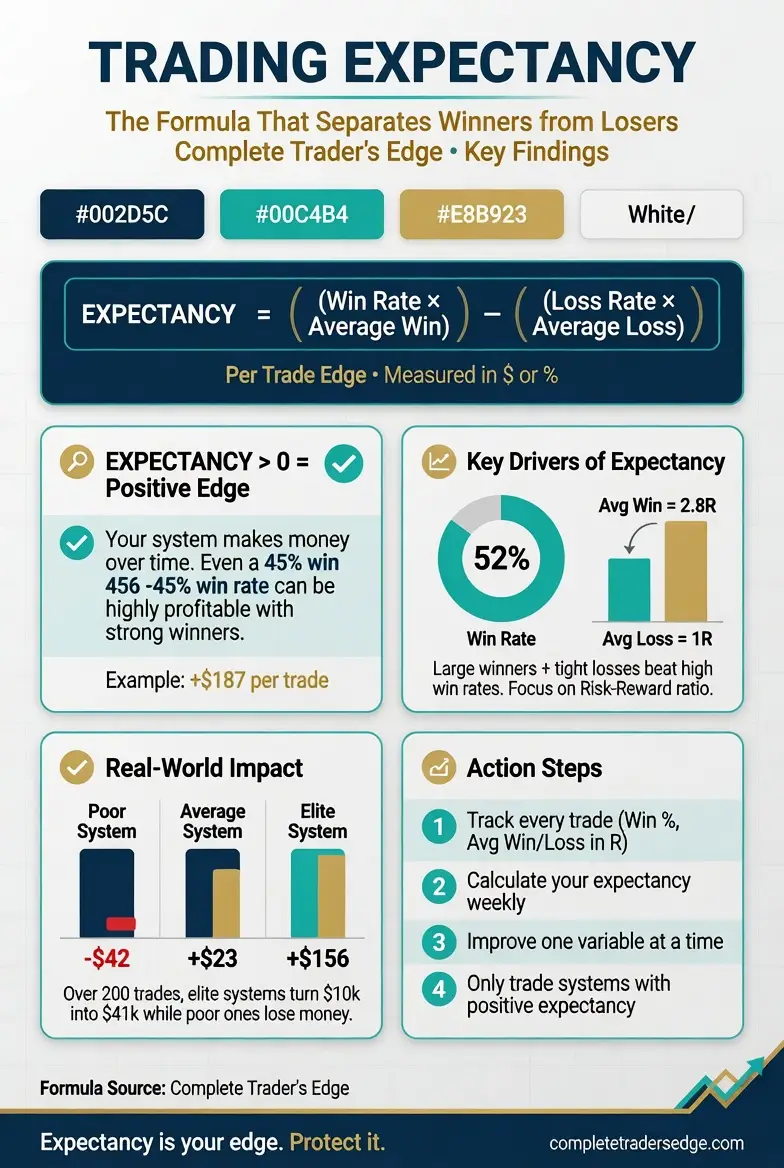
Expectancy = (Win Rate × Average Win in R) − (Loss Rate × Average Loss in R)
Where:
- Win Rate = percentage of trades that are profitable (e.g. 0.45 for 45%)
- Average Win in R = average size of winning trades measured in R-multiples (e.g. 2.1R)
- Loss Rate = 1 minus win rate (e.g. 0.55 for 55%)
- Average Loss in R = average size of losing trades in R (for most disciplined traders this is close to 1.0R)
A positive expectancy means the strategy produces more money than it loses over a large sample. A negative expectancy means the opposite — you are playing a losing game regardless of how many winning trades you have.
The Maths That Surprises Most Traders
Work through these examples and the implications will become clear immediately.
| Strategy | Win rate | Avg win | Avg loss | Expectancy per trade | Result on 100 trades |
|---|---|---|---|---|---|
| High win, poor R:R | 70% | 0.8R | 1.5R | (0.70 × 0.8) − (0.30 × 1.5) = −0.09R | −9R (losing) |
| Low win, good R:R | 40% | 2.5R | 1.0R | (0.40 × 2.5) − (0.60 × 1.0) = +0.40R | +40R (profitable) |
| Balanced | 55% | 1.5R | 1.0R | (0.55 × 1.5) − (0.45 × 1.0) = +0.375R | +37.5R (profitable) |
| High win, breakeven | 65% | 0.9R | 1.0R | (0.65 × 0.9) − (0.35 × 1.0) = +0.235R | +23.5R (profitable) |
| Moving stops (bad habit) | 50% | 1.2R | 1.8R | (0.50 × 1.2) − (0.50 × 1.8) = −0.30R | −30R (losing) |
The first row is the most important. A 70% win rate strategy sounds like a dream. But when winners average 0.8R and losers average 1.5R — which happens when you cut winners too early and let losers run — the strategy has negative expectancy. You will lose money over time, guaranteed, regardless of how good 70% feels psychologically.
The second row is the counterintuitive one. A 40% win rate — losing more than half your trades — still produces +40R over 100 trades because each win is 2.5 times larger than each loss. This is the mathematical proof that win rate is not what determines profitability. Expectancy is.
The Minimum Expectancy Thresholds
For a strategy to be worth trading, it needs a positive expectancy after accounting for transaction costs. Transaction costs (spread, commission, swap) typically cost between 0.05R and 0.15R per trade depending on the instrument and broker. A strategy with a calculated expectancy of +0.05R before costs may be breakeven or slightly negative after costs.
| Expectancy level | What it means | Action |
|---|---|---|
| Below 0R (negative) | You are losing money per trade on average. The strategy as executed has no edge. | Stop live trading. Identify why (rule violations? poor R:R? wrong market conditions?). Demo until fixed. |
| 0R to +0.10R | Marginally positive. After costs, likely breakeven or slightly negative. Edge exists but is thin. | Continue at current size while focusing on improving R:R. Do not scale up. |
| +0.10R to +0.25R | Solid positive edge. Profitable after costs on most instruments. | Continue building sample. Consider modest account growth or prop firm challenge once 100+ trades confirm. |
| +0.25R to +0.50R | Strong edge. Well above transaction costs. Consistent profitability over large samples. | Scale capital. Pursue funded accounts. Document and protect this edge carefully. |
| Above +0.50R | Exceptional edge. Either the sample size is too small (less than 100 trades) or the strategy is genuinely elite. | Verify with a larger sample before drawing conclusions. Exceptional expectancy rarely sustains over hundreds of trades without adjustment. |
How to Calculate Your Own Expectancy
You cannot calculate expectancy without a journal. This is why journaling is non-negotiable for any trader who wants to know whether their strategy is genuinely working.
The calculation process from your journal data:
Step 1: Gather your sample. Use a minimum of 50 trades, ideally 100+, all taken under broadly similar market conditions. Do not mix trades from a strongly trending market with trades from a choppy range without noting the distinction.
Step 2: Calculate your win rate. Count your profitable trades divided by total trades. If you had 23 winning trades out of 60 total, your win rate is 23/60 = 38.3%.
Step 3: Calculate your average win in R. Add up the R-multiple of every winning trade and divide by the number of winners. If your 23 winning trades produced R-multiples of 2.1, 3.0, 1.8, 1.5, 2.6… sum them all and divide by 23.
Step 4: Calculate your average loss in R. Same process for losing trades. In a disciplined trader’s journal this number should be close to 1.0R (because stop losses are honoured). If your average loss is significantly above 1.0R, that is direct evidence of stop losses being moved or held past the planned exit.
Step 5: Apply the formula. (Win Rate × Avg Win R) − (Loss Rate × Avg Loss R) = Expectancy per trade.
Step 6: Project over a sample. Multiply your expectancy by your typical monthly trade count to see your expected monthly R-output. At 1% risk per trade, multiply by your account size to convert R into dollars.
Expectancy vs Profit Factor
Profit factor is a related metric calculated as: Total Gross Profit ÷ Total Gross Loss. A profit factor above 1.0 indicates a profitable strategy. Most professional traders target a profit factor of 1.3 to 2.0 as a sustainable long-term range.
| Metric | What it measures | Target range |
|---|---|---|
| Expectancy | Average R earned per trade across the full sample | +0.20R or above for a sustainable strategy |
| Profit factor | Total gross profit divided by total gross loss | 1.3 to 2.0 for most professional traders |
| Win rate | Percentage of trades that close profitably | Only meaningful alongside average R figures |
| Average R:R achieved | Average win divided by average loss in R | 1:1.5 minimum; 1:2+ preferred |
Use both expectancy and profit factor together. Expectancy tells you the average per-trade return. Profit factor tells you the overall efficiency of the strategy — how much you earn for every unit of loss. A strategy with positive expectancy and a profit factor above 1.3 is a genuinely profitable approach worth scaling.
How Behavioural Patterns Destroy Expectancy
Most traders who are not profitable are not using a genuinely negative-expectancy strategy. They are using a marginally positive strategy and then destroying the expectancy through specific behavioural patterns. Understanding which patterns affect expectancy most severely shows you exactly where to focus your improvement effort.
| Behaviour | Effect on expectancy | How to fix it |
|---|---|---|
| Cutting winners early | Reduces average win R. A strategy designed for 2R average that consistently exits at 1.2R loses 40% of its theoretical profit. | Set take profit as a hard limit order at entry. Do not watch the trade once it is open. |
| Moving stop losses wider | Increases average loss R above 1.0. If average loss rises from 1.0R to 1.5R with no improvement in win rate, expectancy drops by 0.5 × loss rate. | Hard stop orders placed immediately on entry. Cannot be moved against the trade. |
| Overtrading (taking marginal setups) | Dilutes win rate by adding lower-quality trades to the sample. Reduces average win R as marginal setups produce smaller moves. | Maximum trade count per session. Entry checklist that cannot be partially completed. |
| Sizing up on “conviction” trades | Does not change expectancy per trade but dramatically increases variance. A 2R loss at 3% risk is a 6% account loss — three times worse than the standard 1% trade. | Fixed position size at 1% regardless of perceived conviction. Conviction does not improve win rate. |
Using Expectancy to Evaluate Your Trading Plan
Once you have calculated your expectancy from 100 or more journal trades, it becomes the primary metric for every strategic decision you make:
Should I change my strategy? Only if expectancy is negative after 100+ trades and the cause cannot be traced to behavioural factors (rule violations, stop moving). If expectancy is positive but lower than you would like, focus on behaviour before changing the strategy.
Should I scale up my position size? When expectancy is consistently +0.25R or above across at least 100 trades in similar conditions, you have statistical evidence of an edge worth scaling.
Should I attempt a prop firm challenge? A documented expectancy of +0.20R or above with a profit factor above 1.3, verified across 100+ trades, is the strongest possible preparation for a funded account challenge. The challenge tests the same metrics your expectancy calculation measures.
Is my losing streak variance or a strategy problem? If your expectancy was +0.30R over the first 80 trades and is now +0.20R after adding 20 more (a natural drift during a bad patch), it is almost certainly variance. If your expectancy has moved from positive to negative over a 50-trade period, investigate whether market conditions have changed or rule violations have increased.
Frequently Asked Questions
What is a good expectancy for a retail trader?
Any positive expectancy after transaction costs represents a genuine edge. Most professional retail traders operate in the +0.20R to +0.40R range per trade, which at 1% risk per trade and 40-60 trades per month produces a monthly return of 8% to 24% on capital — a very strong result. Expectancy above +0.50R is possible in certain strategies and market conditions but is difficult to sustain over hundreds of trades without adjustment. If your calculated expectancy is above +0.50R on a sample under 100 trades, verify it with a larger sample before drawing conclusions.
How many trades do I need for a reliable expectancy calculation?
A minimum of 50 trades gives you an initial signal. A sample of 100 trades under broadly similar market conditions is where the calculation becomes statistically meaningful. Below 30 trades, the variance is too high for any expectancy calculation to be reliable — a 5-trade winning streak or losing streak can swing the result dramatically. Most quantitative traders use 200+ trade samples for meaningful strategy evaluation, particularly before making significant capital allocation decisions.
Should I separate my expectancy by setup type?
Yes, once you have enough data. If you trade both FVG entries and OTE entries, calculating expectancy separately for each may reveal that one setup type is significantly more profitable than the other. This level of analysis requires at least 50 trades per setup type to be meaningful. Once you have that data, you can allocate more of your trade count to the higher-expectancy setup type and reduce or eliminate the lower-expectancy one.
What if my expectancy is positive but I am still losing money overall?
Two common causes. First, the sample used to calculate expectancy may include a period of unusually good performance that is not representative of the broader average — check whether the positive expectancy comes from the last 20 trades or the full sample. Second, position sizing may be introducing risk-of-ruin problems: even a positive-expectancy strategy can lose money if individual position sizes are large enough to produce account-ending drawdowns before the edge has time to show up. At 1% risk per trade, a +0.20R expectancy strategy will reliably profit over a 100-trade sample. At 5% risk per trade, the same strategy can blow the account during a 10-trade losing streak before the edge manifests.
Is expectancy the same as expected value?
They are the same concept expressed differently. Expected value (EV) is the standard term in probability theory. Trading expectancy is the application of EV to a trading strategy, measured in R-multiples rather than absolute dollar amounts. Using R-multiples rather than dollars is deliberate: it normalises the calculation across different account sizes and position sizes, making the metric comparable across traders and time periods regardless of how much capital is being risked per trade.
▶ ▶ ▶ Continue Reading
Build the complete Money framework
The Complete Trader’s Edge
The complete risk and expectancy framework is in the book
17 chapters covering the full Money pillar — position sizing, expectancy, profit factor, drawdown management, equity curve trading, and the complete system for building and protecting trading capital. Available on Amazon in Kindle, paperback and full-colour editions.
 The Complete Trader's Edge
The full Mind · Method · Money framework. 70 chapters.
View on Amazon →
The Complete Trader's Edge
The full Mind · Method · Money framework. 70 chapters.
View on Amazon →
 Market Mayhem
400 years of bubbles, crashes, and the pattern that keeps repeating.
Buy on Amazon →
Market Mayhem
400 years of bubbles, crashes, and the pattern that keeps repeating.
Buy on Amazon →
 Greatest Companies
How the world's greatest companies were built — and what traders learn from them.
View on Amazon →
Greatest Companies
How the world's greatest companies were built — and what traders learn from them.
View on Amazon →
 Greatest Traders
Eighty-six lives that explain the markets — Livermore to Madoff, told with the losses left in.
View on Amazon →
Greatest Traders
Eighty-six lives that explain the markets — Livermore to Madoff, told with the losses left in.
View on Amazon →