


Market Mayhem · Episode 01 · 1637 · Netherlands
Tulip Mania: A Single Bulb Worth More Than a Mansion
The World’s First Financial Bubble — Netherlands, 1637
At the peak of the mania, a single Semper Augustus bulb sold for more than a luxury Amsterdam canal house. Then, on February 3, 1637, at a routine auction in Haarlem, the buyers stopped showing up. Within days, prices fell roughly 99%.
▶ Watch on YouTube🎵 Listen on Spotify
Also available on Apple Podcasts · Amazon Music · iHeart Radio
It is February 1637, in a crowded tavern in Haarlem. The air is thick with pipe smoke and the shouting of men calling prices across wooden tables. One merchant has just agreed to pay five thousand five hundred guilders for a single tulip bulb. Not a bouquet. Not a garden. One bulb, about the size of an onion.
That price could buy a luxury canal house in Amsterdam, with a garden, a coach house, and change to spare. The bulb is a Semper Augustus, white petals streaked with crimson flames, and only twelve are known to exist in the world. Men are trading their houses, their livestock, and their entire life savings to hold one.
And the bulb is still in the ground. It will not bloom for months. What is changing hands is a promise, a piece of paper, a dream.
In eleven days, that dream will be worth less than the dirt it is planted in. This is the story of the world’s first financial bubble, and the beginning of a pattern humanity has never stopped repeating.
The Crisis at a Glance
| Data Point | Detail |
|---|---|
| Event | Tulip Mania — the world’s first recorded speculative bubble |
| Location | The Dutch Republic — Amsterdam, Haarlem, Leiden, Rotterdam |
| Peak Price | 5,500 guilders for a single Semper Augustus bulb — more than a luxury Amsterdam canal house |
| Modern Equivalent | Roughly $330,000 to $825,000+ for one bulb |
| Wages Comparison | An average Dutch worker earned about 150 guilders a year — one prized bulb equalled decades of wages |
| The Leverage | Windhandel (the “wind trade”) futures — a 2.5% deposit, with contracts changing hands up to 10 times a day |
| Crash Date | February 3, 1637 — a routine Haarlem auction where the bidding simply stopped |
| Price Decline | Roughly 99% within days |
| Government Response | An offer to let buyers void contracts for a 10% penalty — still a fortune most no longer had |
| Long-Term View | Modern research (Anne Goldgar) suggests the broader Dutch economy absorbed the shock and the Golden Age continued |
| M·M·M Lesson | Money — leverage via 2.5%-down futures. Method — no fundamental value behind the price. Mind — herd psychology and FOMO. |
The Dutch Golden Age: How Tulips Became Gold
To understand how flowers became more valuable than mansions, you have to understand where and when this happened. In the 1630s, the Dutch Republic was the wealthiest nation on the planet per capita. The Dutch East India Company was the most powerful corporation in the world. Amsterdam was the financial capital of Europe, and the Dutch had, in real time, invented the stock exchange, the central bank, and the joint-stock company. They were building modern capitalism as they went.
When a society gets that rich, that fast, something predictable follows: people start hunting for the next thing to own, the next status symbol, the next proof that they have arrived. Into that moment came the tulip. Tulips reached Europe from the Ottoman Empire in the mid-1500s. A diplomat named Ogier de Busbecq sent the first bulbs to Vienna, and the botanist Carolus Clusius brought them to the University of Leiden. The Dutch fell in love.
The most prized tulips were infected with the Tulip Breaking Virus, which caused their petals to display extraordinary patterns: flames of red on white, streaks of purple on cream, colours unique to each individual bulb and impossible to reproduce. Every broken tulip was, quite literally, a one-of-a-kind piece of living art.
The rarest was the Semper Augustus, white petals with blood-red flames. In 1623, only twelve bulbs existed in the entire world, and a single one sold for one thousand guilders, roughly seven years of wages for an average worker earning about 150 guilders a year. By 1625 the price had doubled to two thousand. The tulip had become the Dutch equivalent of a luxury car, a designer watch, and a blue-chip stock, all wrapped inside a single flower.
The Frenzy: Peak Madness
By 1634 the real madness began. For years it had mostly been wealthy collectors and professional growers trading among themselves. That changed when ordinary people noticed their neighbours getting rich, rapidly and obscenely. Word spread through Dutch cities like fire. A weaver in Haarlem turned fifty guilders into five hundred in a week. A brewer bought a single bulb and sold it three days later for double. Successful traders were reportedly earning sixty thousand florins a month, more than most people would see in several lifetimes.
And with that, the fear of missing out took hold. Brewers abandoned their brewing, weavers left their looms, and chimney sweeps put down their brushes. People mortgaged their homes and pawned their tools. One man offered twelve acres of prime building land for a single Semper Augustus. Another paid for an Admiral Von der Eyk bulb with four thousand six hundred florins, a brand-new carriage, two grey horses, and a full set of harness.
Then, in 1636, the Dutch invented something that changed everything: a futures market they called windhandel, the wind trade, because you were trading air. Bulbs could only be moved in summer, but traders wanted to deal year round, so they began trading contracts, paper promises to deliver bulbs in the future. A buyer put down just two and a half percent as a deposit. These contracts traded in taverns known as colleges, and they began changing hands ten times in a single day. Most buyers never intended to take delivery of an actual bulb. They were flipping paper.
By the winter of 1636 to 1637, the fever peaked. Prices for some common varieties rose twenty-fold in a single month. A bulb called the Viceroy was exchanged for a haul that staggers the imagination: four tons of wheat, eight tons of rye, four fat oxen, eight pigs, twelve sheep, hundreds of litres of wine and thousands of litres of beer, butter, a thousand pounds of cheese, a bed, a suit of clothes, and a silver drinking cup. The Semper Augustus reached five thousand five hundred guilders, more than a luxury canal house, more than an entire working brewery. And nobody questioned it, because everyone they knew was getting rich, and the one universal belief of every bubble was alive and well: prices can only go up.
The Crash: February 3, 1637
It is the morning of February the third, 1637, at a routine bulb auction in Haarlem. A trader lays out premium contracts, varieties that were fetching record prices just days earlier. He names his price. And for the first time in months, nobody bids.
He lowers the price. Still nothing. He lowers it again. The room goes quiet. Something has just cracked, not in the tulips themselves, but in the belief that these pieces of paper would always find a buyer willing to pay more. That shared faith evaporated in a single tavern, and faith, once broken, does not come back.
Within hours the news reached Amsterdam, Leiden, and Rotterdam. In every college the same scene played out. Sellers flooded the market, buyers vanished, and prices that had doubled the week before now halved, then halved again, then collapsed to nothing. Bulbs worth five thousand guilders sold for fifty, then five, then found no buyer at any price. A man who had traded his actual house for a contract was left holding paper worth less than the ink on it.
Buyers refused to honour contracts. Why pay four thousand guilders for bulbs now worth four? Sellers were furious; they had already spent money they no longer had. Courts across Holland were flooded with lawsuits overnight. The government tried to step in, offering buyers a way to void their contracts for a penalty of ten percent, but even ten percent of an insane price was a fortune most people no longer possessed.
The Aftermath: A More Complex Truth
The weeks that followed were brutal. Families who had mortgaged their homes were now in debt. Craftsmen who had pawned their tools had no way to earn a living. Trust between neighbours and trading partners, the foundation of Dutch commerce, shattered. Calvinist moralists seized on the disaster as proof of what happens when a society trades discipline for greed, and satirical prints flooded the country, painting speculators as fools and monkeys.
But here is the twist modern historians have uncovered. The actual economic damage may have been far smaller than the legend suggests. The research of economist Anne Goldgar found that most of the truly insane prices were concentrated among a relatively small circle of wealthy traders. The broader Dutch economy, still the richest in the world, absorbed the shock and kept growing. The Golden Age did not end in 1637; it continued for decades. The lasting damage was not primarily financial. It was psychological and reputational, and it was permanent, because Tulip Mania became the world’s first cautionary tale about speculative excess, invoked every time a new bubble inflates.
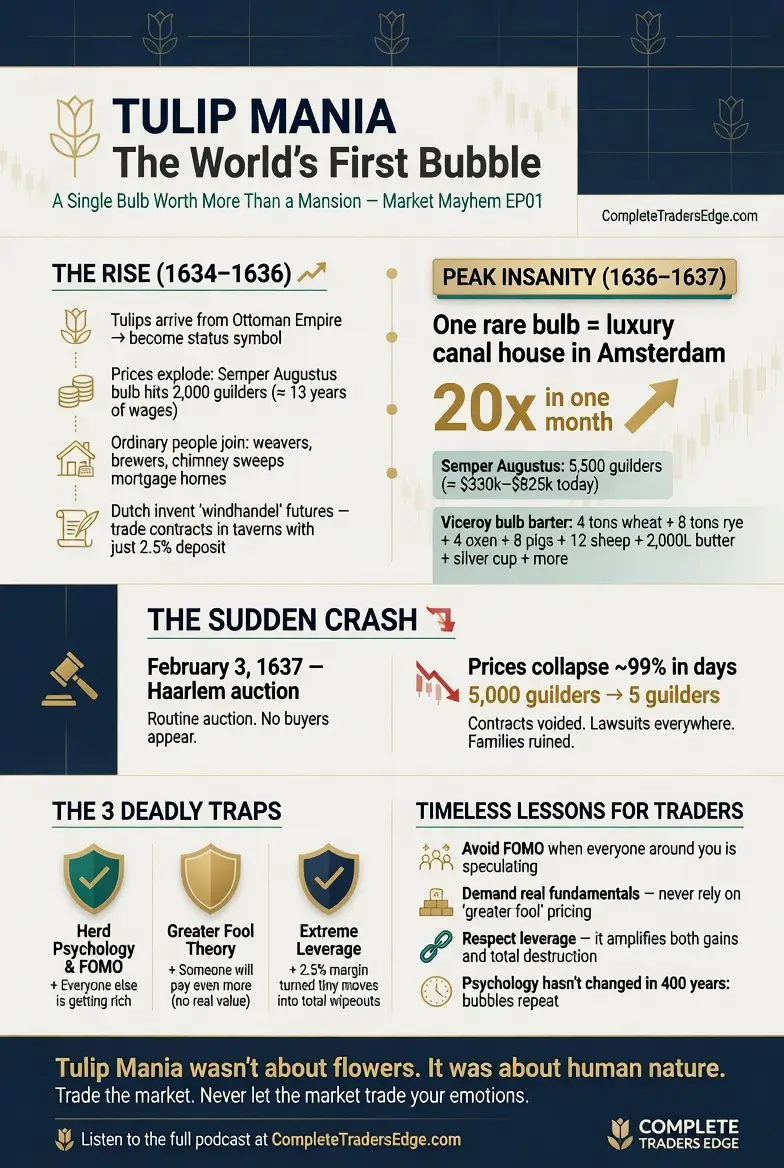
📄 Free Download · Episode Research Sheet
Tulip Mania Research Sheet (PDF)
Complete timeline, price data, the famous Viceroy barter list, and the Mind, Method, Money lessons from this episode. Free, no email required.
What This Means for You as a Trader
💰 MONEY — Leverage Amplifies Everything, in Both Directions
The wind trade was leverage in its purest and most dangerous form: two and a half percent down, contracts flipping ten times a day, exposure that vastly exceeded anyone’s ability to pay if the trade reversed. It is the same structure that blew up in 2008 and the same structure behind every leveraged liquidation since. The flower traders who put down 2.5% thought they were being clever. They were building a house of cards. Leverage amplifies gains on the way up and devastation on the way down, which is exactly why position sizing is the variable that decides whether you survive long enough to be right.
📊 METHOD — Stories Are Not Valuations
Not one person in the tulip colleges was doing fundamental analysis. Nobody asked what a bulb was actually worth or what cash flow it produced. The answer was nothing; a tulip produces a flower that blooms for a week. The entire price rested on the assumption that someone else would pay more, which is the greater fool theory, and it works perfectly right up until the moment it does not. If you cannot explain what an asset is worth without pointing to what the next buyer might pay, you are not investing. You are gambling.
🧠 MIND — The Crowd Is Loudest at the Peak
When brewers quit their trade, chimney sweeps mortgage their homes, and every person you know is making money while you stand on the sidelines, the pressure to jump in is almost unbearable. That is FOMO, and it was as real in 1637 as it is today when your feed is full of trading gains. The lesson has not changed in four hundred years: when everyone around you is getting rich from something they do not fully understand, that is not a signal to buy. It is a signal to be extremely careful.
Frequently Asked Questions
What was Tulip Mania?
Tulip Mania was the world’s first recorded speculative bubble, which peaked in the Dutch Republic in the winter of 1636 to 1637. Prices for rare tulip bulbs rose to extraordinary heights, with the most prized varieties selling for more than a house, before the market collapsed almost overnight in February 1637. It has served ever since as the archetypal example of speculative excess.
Was a single tulip bulb really worth more than a house?
At the peak, yes. A single Semper Augustus bulb reached around 5,500 guilders, which was more than the price of a luxury canal house in Amsterdam. To put that in context, an ordinary Dutch worker earned roughly 150 guilders a year, so a prized bulb represented decades of wages. These extreme prices applied to the rarest varieties; most bulbs traded for far less.
How did people trade tulips that were still in the ground?
Through an early futures market the Dutch called windhandel, or the wind trade. Because bulbs could only be dug up in summer, traders bought and sold contracts, paper promises to deliver bulbs later, and put down a deposit of just two and a half percent. These contracts were traded in taverns known as colleges and could change hands ten times in a single day. Most buyers never intended to take delivery of an actual bulb. It was speculation on leverage, three centuries before the term existed.
What caused the crash?
At a routine auction in Haarlem on February 3, 1637, a seller offered premium bulbs and, for the first time in months, received no bids. The shared belief that prices would keep rising simply broke. Once that faith was gone, sellers flooded the market, buyers vanished, and prices collapsed by roughly 99% within days. There was no single external trigger; the bubble collapsed under the weight of its own confidence.
Did Tulip Mania actually devastate the Dutch economy?
The popular legend overstates it. The research of economist Anne Goldgar found that the most extreme losses were concentrated among a relatively small group of wealthy traders, and the broader Dutch economy, still the richest in the world, absorbed the shock and continued to prosper. The Golden Age did not end in 1637. The most lasting damage was reputational: Tulip Mania became the cautionary tale invoked in every bubble that followed.
What is the most important lesson for a modern trader?
Two forces destroyed the tulip speculators, and both are permanent. The first is the greater fool theory: pricing an asset purely on the belief that someone else will pay more, with no underlying value to fall back on. The second is leverage that a normal reversal cannot survive. When those two combine, a modest wobble becomes a total wipeout. Recognising that pattern, whether the asset is a flower, a stock, or a digital token, is the practical lesson Tulip Mania offers across four centuries.
Continue the Market Mayhem Series
Next: The Wizard of the Mississippi
1720. France. John Law, a Scottish gambler and convicted murderer, talked the French Regent into handing him control of the entire economy. He printed paper money against imaginary Louisiana gold and turned Paris into the most frenzied trading floor in history. Then it all turned to ash. Episode Two.
⚡ Modern Echo · 2026
Tulip Mania was the first asset priced with no cash flow, no yield, and no use beyond what the next buyer would pay. Four centuries later, the same greater-fool structure reappears in every cycle of speculative digital assets, from meme coins to NFTs. The instrument changes. The psychology does not.
Read: The Next Market Crash — 5 Scenarios That Could End the Bull Run →
Market Mayhem is a historical education series produced by The Complete Trader’s Edge. All figures are sourced from historical records. Content is for educational purposes only and does not constitute financial or investment advice. Trading involves significant risk of loss.
 The Complete Trader's Edge
The full Mind · Method · Money framework. 70 chapters.
View on Amazon →
The Complete Trader's Edge
The full Mind · Method · Money framework. 70 chapters.
View on Amazon →
 Market Mayhem
400 years of bubbles, crashes, and the pattern that keeps repeating.
Buy on Amazon →
Market Mayhem
400 years of bubbles, crashes, and the pattern that keeps repeating.
Buy on Amazon →
 Greatest Companies
How the world's greatest companies were built — and what traders learn from them.
View on Amazon →
Greatest Companies
How the world's greatest companies were built — and what traders learn from them.
View on Amazon →
 Greatest Traders
Eighty-six lives that explain the markets — Livermore to Madoff, told with the losses left in.
View on Amazon →
Greatest Traders
Eighty-six lives that explain the markets — Livermore to Madoff, told with the losses left in.
View on Amazon →