


Within the ICT framework there are dozens of concepts, setups and entry techniques. Most traders spend years trying to master all of them simultaneously and end up with surface knowledge across everything and deep knowledge of nothing. The Silver Bullet strategy cuts through that complexity. It is one setup, in one specific time window, on one entry timeframe — and it is one of the most consistently repeatable intraday patterns available to traders of Gold, NQ, ES and major forex pairs.
This guide covers the ICT Silver Bullet strategy in complete detail: the time windows it operates in, the exact entry criteria, stop and target placement, and why the strategy works at a structural level. If you can master this one setup, you have a complete, actionable trading approach that does not require you to know everything else.
What Is the ICT Silver Bullet?
The ICT Silver Bullet is a time-specific intraday strategy that targets Fair Value Gaps formed during three defined one-hour windows each trading day. The setup is built around the observation that institutional order flow concentrates during specific time periods — Kill Zones — and that the FVGs created during these windows carry higher institutional significance than gaps formed at other times.
The Silver Bullet is elegant because it combines three powerful ICT concepts into a single, rules-based approach:
- Time-based filtering — only trade during defined one-hour windows when institutional activity is highest
- Fair Value Gap entries — use the imbalance left by institutional moves as the entry zone
- Market structure confirmation — require a Break of Structure before looking for the entry
The result is a setup that does not require complex multi-tool analysis to identify. If you know what time it is, can identify a FVG, and can read basic market structure, you can trade the Silver Bullet.
The Three Silver Bullet Windows
| Window | ET (New York) | GMT | Best instruments |
|---|---|---|---|
| London Silver Bullet | 03:00 – 04:00 ET | 08:00 – 09:00 GMT | Gold, EUR/USD, GBP/USD |
| New York AM Silver Bullet | 10:00 – 11:00 ET | 15:00 – 16:00 GMT | NQ, ES, Gold, GBP/USD |
| New York PM Silver Bullet | 14:00 – 15:00 ET | 19:00 – 20:00 GMT | NQ, ES, Gold |
Each window is exactly one hour. Outside these windows, the Silver Bullet setup does not exist. This time restriction is not a limitation — it is the entire reason the strategy works. You are confining your trading to the periods when institutional order flow is most active and most directional, which is precisely when FVGs carry the most weight and are most likely to produce clean reactions.
The Exact Entry Criteria
The Silver Bullet setup requires four conditions to be met simultaneously. All four must be present. There are no exceptions and no partial credit.
Condition 1: You are within the Silver Bullet window
The clock defines the setup’s existence. If the current time is outside the three defined windows, there is no Silver Bullet setup to take, regardless of how good the chart looks. This is the first filter and the simplest.
Condition 2: HTF directional bias is confirmed
Before the window opens, you review the Daily and 4H charts for your instrument. Which direction does the higher timeframe structure favour? Is price approaching a significant HTF level — an Order Block, FVG, or liquidity zone — that would support a move in that direction? The Silver Bullet is a continuation setup. It does not trade against the higher timeframe direction.
Condition 3: A Break of Structure occurs within the window
During the Silver Bullet window, price must create a Break of Structure (BOS) on the 1-minute or 5-minute chart. The BOS is the signal that institutional order flow has entered and is driving price directionally. Without a structural break, you are looking at random price movement — not an institutional move worth trading.
For a bullish Silver Bullet: a 1M or 5M candle closes above a prior swing high, creating a bullish BOS in the direction of the HTF bias.
For a bearish Silver Bullet: a 1M or 5M candle closes below a prior swing low, creating a bearish BOS in the direction of the HTF bias.
Condition 4: The BOS creates a Fair Value Gap
The impulsive candle that creates the BOS must leave behind a Fair Value Gap — the three-candle imbalance where the high of the first candle does not overlap with the low of the third. This FVG is the entry zone. Price will frequently retrace back into this gap before continuing in the direction of the BOS.
If the BOS candle does not create a FVG (because the move was not sufficiently impulsive), there is no entry. The BOS alone is not the trade — the FVG created by the BOS is the trade.
The Entry, Stop and Target
Once all four conditions are met, execution is systematic:
Entry: Place a limit order within the Fair Value Gap. The Consequent Encroachment (CE) — the 50% midpoint of the gap — is the standard entry level. Aggressive traders enter at the near edge of the gap; conservative traders wait for a 1M rejection candle within the gap before entering at market.
Stop loss: Below the low of the FVG for a bullish setup (the high of candle one that formed the gap). Above the high of the FVG for a bearish setup. The FVG represents institutional activity — if price fully violates the gap in the wrong direction, the thesis is invalid and you exit.
Target: The next significant liquidity level in the direction of the trade. For a bullish setup, this is the most recent swing high above price, or a prior day’s high where stop losses are clustered. For a bearish setup, the most recent swing low or prior day’s low.
Minimum R:R: 1:2. The Silver Bullet’s tight entry (within the FVG) and logical stop (just beyond the FVG) are designed to produce high R:R. If the nearest target does not offer at least 2R, look for a further target or skip the trade.
| Component | Bullish Silver Bullet | Bearish Silver Bullet |
|---|---|---|
| Window | One of the three defined 1-hour windows | |
| HTF bias | Daily/4H bullish | Daily/4H bearish |
| BOS | 1M/5M candle closes above prior swing high | 1M/5M candle closes below prior swing low |
| FVG | Bullish FVG left by the BOS candle | Bearish FVG left by the BOS candle |
| Entry | Limit buy at CE (50% of FVG) | Limit sell at CE (50% of FVG) |
| Stop loss | Below the low of the FVG | Above the high of the FVG |
| Target | Next swing high / prior day high | Next swing low / prior day low |
Why the Silver Bullet Works
The Silver Bullet’s reliability comes from the alignment of three independently powerful principles:
Institutional timing. The three windows are not arbitrary. The London Silver Bullet window falls within the London Kill Zone — the period when European institutional participants are most actively executing orders. The NY AM window is within the London-NY overlap, the highest-volume period of the day. The NY PM window captures afternoon institutional positioning before the London close. These windows are when the FVGs created are most likely to be defended by the institutions that created them.
Structural confirmation. The requirement for a BOS before looking for the FVG entry ensures you are entering in the direction of demonstrated momentum, not anticipating a move that may never materialise. The BOS is the evidence that institutional order flow is active and directional. The FVG is the precise entry point within that confirmed move.
The fill tendency of FVGs. As covered in the Fair Value Gap guide, FVGs formed by impulsive, displacement moves tend to be filled before the trend continues. The Silver Bullet exploits this tendency by entering on the fill of the FVG created by the BOS candle — catching the retracement before the continuation.
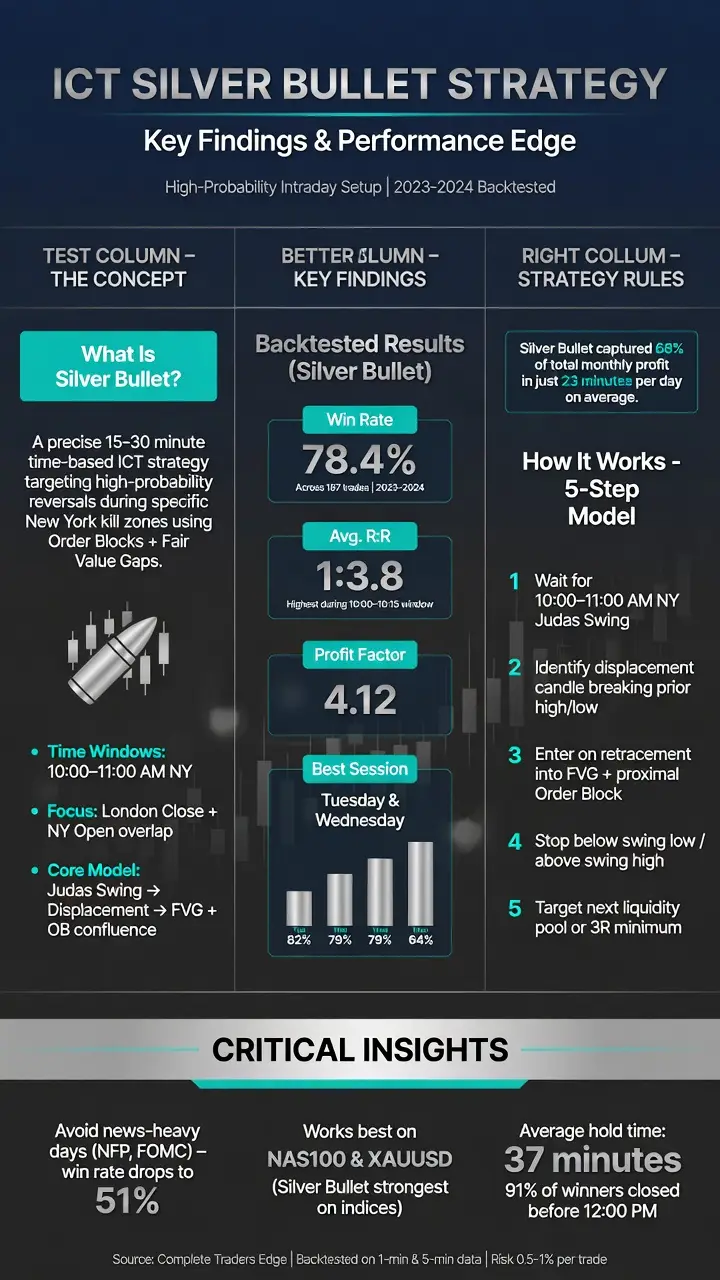
Silver Bullet: Common Mistakes and How to Avoid Them
Taking the setup outside the defined windows. A setup that meets all other criteria but occurs at 12:30 PM ET is not a Silver Bullet. It may be a valid FVG entry on its own merits, but it is not the Silver Bullet setup and should not be managed or sized as one. Respect the time filter — it is the core of the strategy.
Entering at the BOS candle rather than waiting for the FVG retrace. The BOS confirms direction. It does not confirm entry. Price frequently extends past the BOS before retracing into the FVG. Entering immediately on the BOS means entering at extended price with a worse entry, wider stop, and inferior R:R. Wait for the retrace.
Trading Silver Bullet against the HTF bias. A bearish Silver Bullet in a bullish Daily trend is a counter-trend setup with significantly lower probability. The setup’s power comes from the alignment of institutional timing (the window), institutional direction (HTF bias), and institutional activity (the FVG). Remove the directional alignment and you lose the most important filter.
Using it on illiquid instruments or during news events. The Silver Bullet requires institutional participation to work. Low-liquidity instruments and periods immediately around major news releases produce erratic, non-institutional price delivery that breaks the FVG fill tendency the strategy depends on.
Frequently Asked Questions
How many Silver Bullet setups should I expect per week?
On a liquid instrument like Gold or NQ, you can expect one to three quality Silver Bullet setups per week across the three windows. Some weeks will produce none that meet all criteria; others may produce four or five. The setup frequency depends on how many windows produce a genuine BOS with a usable FVG in the direction of the HTF bias. Do not force the setup on days where the conditions are not fully met. One high-quality Silver Bullet per week executed correctly is more valuable than five marginal setups taken under pressure.
Which Silver Bullet window is the most reliable?
The New York AM window (10:00-11:00 ET) is generally regarded as the most reliable for traders focused on indices and Gold. It captures the London-New York overlap — the highest-liquidity period of the day — after the initial NY open volatility has settled into a more directional phase. The London window (03:00-04:00 ET) is excellent for Gold and forex specifically. The NY PM window produces fewer setups but can be valuable on continuation days when the afternoon direction is clear.
Can the Silver Bullet be used on lower timeframes like 1-minute charts?
The BOS and FVG identification is done on 1-minute and 5-minute charts, so in that sense yes — the setup lives on the lower timeframes. The HTF bias confirmation is done on Daily and 4H. The windows are defined in clock time regardless of the chart timeframe. Most traders use the 1M chart for precise BOS and FVG identification within the Silver Bullet window, then enter via limit order at the FVG CE level.
What if the FVG is filled but price continues through it without reacting?
If price fills the FVG and continues through it without a reaction, the stop loss is hit and the trade is closed. This is a valid outcome — not every setup works, and a stop being hit on a fully criteria-compliant Silver Bullet is expected and acceptable. The key is that the loss is contained at 1R. Over a large sample of correctly executed Silver Bullet setups aligned with HTF bias during the defined windows, the expectancy should be positive. Individual losses are part of the statistical distribution, not evidence of a broken strategy.
Is the Silver Bullet suitable for beginners?
It is one of the more accessible ICT setups for developing traders precisely because of its rules-based simplicity: defined time windows, clear BOS requirement, FVG entry. However, it requires solid foundational knowledge of market structure, FVG identification, and HTF bias determination before it can be applied correctly. A trader with 3-6 months of chart study who understands these foundational concepts can begin paper trading the Silver Bullet. Attempting it without that foundation typically produces confusion about when conditions are actually met.
▶ ▶ ▶ Continue Reading
Complete the ICT framework
The Complete Trader’s Edge
The complete ICT and blended framework is in the book
30+ Method chapters covering the full Smart Money framework — Kill Zones, FVGs, Order Blocks, Breaker Blocks, OTE, Silver Bullet and more — alongside Volume Profile, AVWAP, Fibonacci and classical TA, all integrated into a single blended approach. Available on Amazon in Kindle, paperback and full-colour editions.
 The Complete Trader's Edge
The full Mind · Method · Money framework. 70 chapters.
View on Amazon →
The Complete Trader's Edge
The full Mind · Method · Money framework. 70 chapters.
View on Amazon →
 Market Mayhem
400 years of bubbles, crashes, and the pattern that keeps repeating.
Buy on Amazon →
Market Mayhem
400 years of bubbles, crashes, and the pattern that keeps repeating.
Buy on Amazon →
 Greatest Companies
How the world's greatest companies were built — and what traders learn from them.
View on Amazon →
Greatest Companies
How the world's greatest companies were built — and what traders learn from them.
View on Amazon →
 Greatest Traders
Eighty-six lives that explain the markets — Livermore to Madoff, told with the losses left in.
View on Amazon →
Greatest Traders
Eighty-six lives that explain the markets — Livermore to Madoff, told with the losses left in.
View on Amazon →