
Trading is the skill of buying something at one price and selling it at a higher price, or selling something at one price and buying it back at a lower price. That is the entire concept. Everything else, the charts, the strategies, the terminology, is just a structured way of getting better at that one thing.
If you have ever sold something on a marketplace for more than you paid for it, you have already traded. If you have ever watched the price of something go up and wished you had bought it earlier, you understand the basic emotion that drives every market in the world. Trading is not reserved for people in suits on Wall Street. It is a skill that anyone can learn, and the earlier you start learning it, the more time you have to develop it properly.
This guide is written for teenagers and young adults who want to understand what trading actually is, how financial markets work, and what you need to know before ever risking real money.
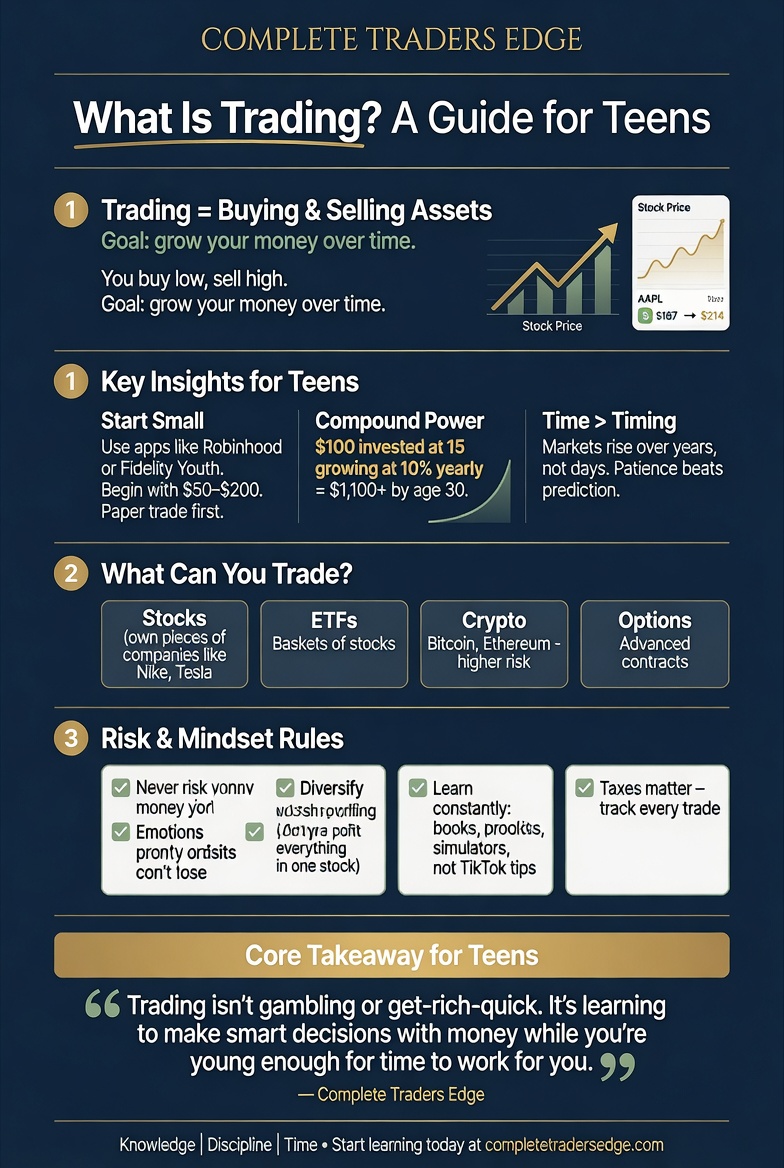
How Financial Markets Work
A financial market is a place where people buy and sell financial instruments: stocks, currencies, commodities, and more. Think of it as a global marketplace, except instead of buying clothes or electronics, participants are buying and selling financial assets.
When you buy a stock, you are buying a tiny piece of a company. If the company grows and becomes more valuable, your piece becomes worth more. If the company struggles, your piece loses value. Companies like Apple, Tesla, and Google all have their stock prices determined by millions of buyers and sellers around the world, every second of every trading day.
When you trade currencies (forex), you are exchanging one country’s money for another. The US dollar, the Euro, the British pound, and the Japanese yen all change in value relative to each other based on economic conditions, interest rates, and global events.
When you trade commodities, you are trading physical goods like gold, oil, or agricultural products. Gold, for example, has been considered valuable for thousands of years and still trades actively every day.
| Market | What You Trade | Example | Trading Hours |
|---|---|---|---|
| Stocks | Pieces of companies | Apple, Tesla, Nike | Mon-Fri, 9:30 AM – 4:00 PM ET |
| Forex | Currencies | EUR/USD, GBP/JPY | 24 hours, Mon-Fri |
| Commodities | Physical goods | Gold, Oil, Wheat | Nearly 24 hours, Mon-Fri |
| Crypto | Digital currencies | Bitcoin, Ethereum | 24/7, every day |
| Indices | Baskets of stocks | S&P 500, NASDAQ | Nearly 24 hours, Mon-Fri |
Why Do Prices Move?
Prices move because of one thing: supply and demand. If more people want to buy something than sell it, the price goes up. If more people want to sell than buy, the price goes down. Every single price movement in every market comes back to this principle.
But why would more people suddenly want to buy or sell? There are many reasons. A company announces record profits, and people rush to buy its stock. A country raises interest rates, and its currency becomes more attractive. A war starts, and people buy gold because they see it as safe. An electric car company announces a breakthrough battery, and its stock price jumps.
The people who consistently make money in markets are the ones who can read these shifts in supply and demand better than others, either by analysing charts (technical analysis), understanding the underlying factors driving prices (fundamental analysis), or a combination of both.
Trading vs Investing: What Is the Difference?
Trading and investing are related but different.
| Feature | Trading | Investing |
|---|---|---|
| Time horizon | Minutes to weeks | Months to decades |
| Goal | Profit from price movements | Grow wealth over time |
| Activity level | Active, regular decisions | Passive, buy and hold |
| Analysis | Charts, price action, timing | Company value, growth potential |
| Risk approach | Controlled per trade (1% rule) | Diversified across holdings |
| Skill required | High; requires training | Moderate; patience is key |
Neither is better than the other. Many successful people do both. Warren Buffett is the world’s most famous investor; he buys great companies and holds them for decades. George Soros is one of the world’s most famous traders; he made billions by identifying short-term price movements driven by macroeconomic events. Both approaches work. The question is which one fits your personality, your schedule, and your goals.
The Three Pillars: Mind, Method, and Money
Successful trading is built on three pillars. Miss any one of them and the whole thing falls apart.
Mind (Psychology). Your mindset is the most important factor in trading success. Fear, greed, impatience, and overconfidence are the enemies. The best traders are not the smartest people in the room. They are the most disciplined. They follow their rules even when it feels uncomfortable, and they accept losses as a normal part of the process.
Method (Strategy). Your method is the system you use to decide when to buy and when to sell. This includes learning to read charts, understanding price patterns, and developing a set of rules that tell you exactly what to look for, when to enter, and when to exit. Without a method, you are guessing. With a tested method, you are operating with a statistical edge.
Money (Risk Management). Even the best strategy in the world will destroy your account if you risk too much on each trade. Professional traders typically risk 1% of their account per trade. This means that even ten consecutive losses only costs them 10% of their capital, leaving them with 90% to recover. Risk management is what keeps you in the game long enough for your edge to pay off.
Key Concepts Every Young Trader Should Understand
The Power of Compounding
Compounding is the single most powerful force in finance. It means that your gains earn their own gains. If you start with $1,000 and earn 10% per year, you have $1,100 after year one. In year two, you earn 10% on $1,100, giving you $1,210. The growth accelerates over time because the base keeps getting larger.
The reason starting young matters so much is that compounding needs time. A 16-year-old who learns to invest wisely has 50+ years of compounding ahead of them. That is an enormous advantage over someone who starts at 40.
Risk and the 1% Rule
Every trade can lose money. This is not a failure; it is a mathematical certainty. Even the best traders in the world are wrong 40-50% of the time. The difference between professionals and beginners is not how often they are right. It is how much they lose when they are wrong.
The 1% rule means never risking more than 1% of your total capital on any single trade. On a $1,000 account, that means your maximum loss per trade is $10. This feels small, but it is the foundation of survival. Ten losses in a row costs you $100 (roughly 10% of your account). You can recover from that. Ten losses where you risked 10% each time costs you $650 (about 65% of your account). Recovering from that is nearly impossible.
Paper Trading: Practice Without Risk
Before ever using real money, you should practise on a demo account (also called paper trading). Every major trading platform offers free demo accounts with virtual money. You trade real market conditions, with real price movements, but with no financial risk.
Paper trading teaches you how orders work, how charts move, and how your emotions respond to winning and losing, all without the cost of learning through real losses. Treat your demo account seriously. Follow the same rules you would follow with real money. The habits you build in practice are the habits you will carry into live trading.
What You Can Start Doing Today
You do not need a brokerage account or any money to begin your trading education. Here is what you can do right now.
Learn to read a chart. Open TradingView (it is free) and look at the chart of any stock or cryptocurrency. Learn what candlesticks are, what the green and red colours mean, and how to identify when price is going up (uptrend) or down (downtrend). This is the foundation of all technical analysis.
Start a journal. Every time you think a stock or cryptocurrency will go up or down, write it down. Note the date, the price, and your reason. Check back a week or a month later. Were you right? Were you wrong? What did you miss? This process of predicting, recording, and reviewing is exactly what professional traders do. It trains your pattern recognition and teaches you humility when your predictions are wrong.
Read one good book. Instead of watching random YouTube videos (most of which are selling something), read a structured book on trading. Understanding the fundamentals from a coherent source is far more valuable than absorbing fragments of conflicting advice from social media.
Follow the markets. Pick three stocks, one cryptocurrency, and the price of gold. Check them once a day. Over time, you will start to notice patterns: what happens to stock prices when the company announces earnings, what happens to gold when there is a crisis, what happens to Bitcoin on weekends. This observational habit is the beginning of market awareness.
Myths About Trading That Social Media Gets Wrong
“You can get rich quickly.” You cannot. People who show screenshots of massive profits on social media are either showing their best day out of hundreds of losing days, or they are selling you something. Consistent trading profits come from discipline and process applied over months and years, not from one lucky trade.
“You need a lot of money to start.” You do not. You can start learning with zero money using demo accounts. When you are ready for real money, many brokers allow you to open accounts with $100 or less. The learning phase costs nothing except time and attention.
“Trading is gambling.” Gambling is placing bets where the odds are stacked against you. Trading, when done properly, involves a tested strategy with a statistical edge, strict risk management, and disciplined execution. Professional traders are closer to casino owners than casino gamblers; they have an edge and they execute it consistently over thousands of repetitions.
“You need to watch charts all day.” Most professional traders spend 2-4 hours per day actively trading. Many styles, like swing trading, require only 30-60 minutes of analysis per day. Trading is about quality of decisions, not quantity of screen time.
5 Frequently Asked Questions for Young Traders
How old do I need to be to start trading?
In most countries, you need to be 18 to open a brokerage account. However, you can start learning at any age using demo accounts, educational resources, and by following markets. Some brokers allow custodial accounts where a parent opens the account and a minor can use it under supervision. The learning phase is the most important phase, and there is no age restriction on learning.
How much money do I need?
To learn: $0. Demo accounts are free. To start trading with real money: as little as $50-100 at some brokers, though $500-1,000 gives you more room to practise proper risk management. Never trade with money you cannot afford to lose, and never trade with money you need for school, food, or other essentials.
Is trading safe?
Trading involves financial risk. You can lose money. However, with proper education, risk management (the 1% rule), and a disciplined approach, trading is a manageable risk, much like starting a business. The key is never risking more than you can afford to lose and treating the learning process as a long-term investment in yourself.
What should I study first?
Start with three things: how to read candlestick charts, what supply and demand means, and the basics of risk management. These three foundations will serve you regardless of which market you eventually trade or which strategy you develop. Everything else builds on top of these.
Can I trade while in school?
Many successful traders started learning while in school. Trading does not require full-time attention. Swing trading (holding trades for days or weeks) requires only 30-60 minutes of analysis per day, which fits around school schedules. The most important thing is that trading never comes at the expense of your education. School teaches you critical thinking, discipline, and problem-solving, all of which directly improve your trading.
▶ Continue Reading
▸ Market Structure: The Foundation of All Technical Analysis
▸ Risk-to-Reward: How to Make Money Even When You Are Wrong Half the Time
▸ Candlestick Patterns: What They Tell You and What They Don’t
▸ The Best Trading Books: 15 Books That Actually Changed How We Trade
The Complete Trader’s Edge
Want to learn trading from the ground up? The Complete Trader’s Edge by Louw van Riet covers everything from your first chart to professional-level risk management across 70 chapters. Built on the Mind · Method · Money framework.
 The Complete Trader's Edge
The full Mind · Method · Money framework. 70 chapters.
View on Amazon →
The Complete Trader's Edge
The full Mind · Method · Money framework. 70 chapters.
View on Amazon →
 Market Mayhem
400 years of bubbles, crashes, and the pattern that keeps repeating.
Buy on Amazon →
Market Mayhem
400 years of bubbles, crashes, and the pattern that keeps repeating.
Buy on Amazon →
 Greatest Companies
How the world's greatest companies were built — and what traders learn from them.
View on Amazon →
Greatest Companies
How the world's greatest companies were built — and what traders learn from them.
View on Amazon →