


Explore all 80 books in the Trader’s Library →
If you have ever heard a trader say they look for stocks breaking out of a sound base on heavy volume, you have heard a William O’Neil disciple. The vocabulary, the methodology, the philosophy — all of it traces back to one founder, one book, and one of the most-tested stock-trading frameworks ever published.
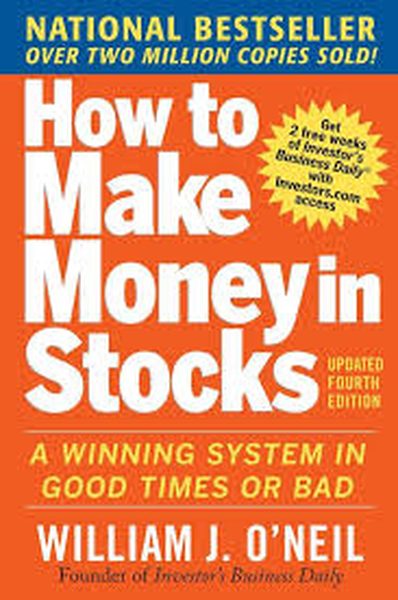
How to Make Money in Stocks by William O’Neil is the canonical text on growth-stock trading. First published in 1988, now in its fifth edition, the book introduced CAN SLIM, codified the cup-and-handle pattern, and produced a generation of stock traders who built careers on a single methodology. Investor’s Business Daily, the newspaper O’Neil founded, exists primarily to deliver the data the book’s method requires.
For traders steeped in futures, forex, or general technical analysis, this book is the most coherent argument anywhere for why stock trading deserves its own framework rather than borrowed tools from other markets. For stock traders, it is the foundational text the entire growth-investing community references.
This review breaks down what the book actually delivers, why CAN SLIM remains effective decades after publication, where the methodology gets pushed back on by professionals, and how to use the book without falling into the same trap that snares most readers.
At a Glance
| Author | William J. O’Neil |
| First Published | 1988 (5th edition 2023) |
| Pages | ~480 |
| Genre | Growth-stock trading methodology |
| Difficulty | Intermediate — accessible but data-heavy |
| Best For | Stock traders, swing traders, anyone trading individual equities |
| Skip If | You only trade forex, futures, crypto, or indices and have no interest in single-name equities |
OVERALL RATING: 9.0 / 10
Who Should Read This Book
| Reader | Verdict | Why |
|---|---|---|
| New stock trader (0–1 year) | Read it immediately | The most coherent introduction to stock-specific methodology in print |
| Intermediate (1–3 years) | Read it now | You have the context to apply CAN SLIM without taking it as gospel |
| Advanced / professional | Re-read selectively | The historical case studies on past market leaders remain valuable. The methodology, you have probably already absorbed. |
| SMC / ICT trader | Read for context | O’Neil’s framework is fundamentally different from SMC. Reading it teaches you a parallel way to think about price. |
| Forex / futures trader | Read selectively | The fundamentals-plus-technicals approach is interesting but the specific tools do not port. Read for ideas, not for direct application. |
| Long-term investor | Read it | The chapters on identifying market leaders before they break out are valuable regardless of holding period |
The Book in Context
William O’Neil started his career as a broker at Hayden Stone in the late 1950s and made his first fortune trading the same growth-stock methodology he would later codify in this book. He bought a seat on the New York Stock Exchange in 1964 at age 30, then founded William O’Neil + Co. in 1963 as one of the first computer-based stock research firms. He launched Investor’s Business Daily in 1984 specifically to provide the data CAN SLIM required.
The book itself emerged from decades of empirical study. O’Neil’s firm analysed every major stock-market winner from the 1880s onward, looking for common characteristics. CAN SLIM is the seven-letter summary of what those studies found. The methodology was not invented. It was reverse-engineered from historical winners.
That research-driven origin matters. Most trading books are written by traders who codify what they personally do. O’Neil’s book is written by a researcher who studied what worked across thousands of stocks over a century. The methodology is more defensible than most because it was tested against history before it was published.
The Core Argument: CAN SLIM Decoded
The book’s central contribution is CAN SLIM, the seven-letter acronym describing what O’Neil’s research found in every major stock market winner. The acronym is more useful than it looks, because each letter targets a specific characteristic that, when present together, produces a higher-probability candidate.
CAN SLIM Decoded
| Letter | Stands For | What to Look For |
|---|---|---|
| C | Current quarterly earnings | EPS growth of at least 25% year-over-year in the most recent quarter, ideally accelerating |
| A | Annual earnings growth | Three to five years of strong annual earnings growth (25%+) and rising return on equity |
| N | New product, service, or management | A catalyst that explains why earnings are accelerating. The “story” behind the numbers. |
| S | Supply and demand | Smaller float (limited shares outstanding) tends to outperform. Big volume on price breakouts. |
| L | Leader or laggard | Trade the strongest stocks in the strongest industries. Ignore laggards regardless of “value.” |
| I | Institutional sponsorship | Growing ownership by quality mutual funds and institutional buyers. Avoid stocks no professional wants to own. |
| M | Market direction | Most stocks follow the broader market. Only buy aggressively when the major indexes are in confirmed uptrends. |
Each letter is a filter. Stocks passing all seven are rare, which is the point. CAN SLIM identifies the few candidates worth heavy position-taking.
The methodology combines fundamental factors (C, A, N, I) with technical and structural factors (S, L, M). That combination is unusual in trading literature. Most books are either fundamental or technical. O’Neil’s argument is that neither alone is sufficient and that the combination is the actual edge.
“What seems too high in price and risky usually goes higher, and what seems low and cheap usually goes lower.”
— from How to Make Money in Stocks
The Cup and Handle: The Single Most Influential Chart Pattern of the Modern Era
If CAN SLIM is the methodology, the cup-and-handle pattern is the most famous technical artefact. O’Neil did not invent the pattern, but he was the writer who codified its rules and standardised the terminology. Most modern stock traders use his definition whether they realise it or not.
The pattern describes a stock that has run up, pulled back into a rounded base that looks like a teacup, formed a tight consolidation handle near the highs, and then broken out to new highs on heavy volume. The full pattern takes weeks or months to form. O’Neil’s rules specify the depth of the cup, the duration of the base, the volume signature, and the exact buy point.
The pattern works because it encodes a story. A stock pulls back as weak holders sell. The base forms as the selling exhausts. The handle is the final shakeout of remaining weak hands. The breakout on volume signals that demand has overwhelmed the remaining supply. Everything CAN SLIM looks for fundamentally is supposed to be confirmed visually by this kind of base.
For SMC traders, the cup-and-handle is essentially a longer-timeframe accumulation phase ending with a break of structure on displacement. The vocabulary is different. The price action is the same.
How O’Neil Built the Book
O’Neil wrote as a researcher and a practitioner. Three structural choices reflect that balance and account for the book’s enduring usefulness.
Case studies as backbone. The book is built around dozens of annotated charts of historical winners. Microsoft. Cisco. Home Depot. Apple. Google. Tesla. Each one is shown at its breakout point with annotations explaining what CAN SLIM detected and when. The cumulative effect is empirical: by the time you have seen fifty winners, the pattern is hard to miss.
Rules over interpretations. O’Neil tries to make the methodology rule-based rather than discretionary. He gives specific numbers, specific patterns, specific buy and sell criteria. This is unusual in trading literature, where most authors rely on judgment. Some readers find the rules constraining. Others find them liberating because they remove the need to constantly re-interpret what they are seeing.
The 7-8% stop loss rule. The most quoted operational rule in the book. Sell any new position automatically if it falls 7-8% below the buy point, no exceptions. This is treated as the single most important rule in the methodology. O’Neil argues it is what separates traders who survive their inevitable misjudgments from traders who do not.
Five Passages Worth Carrying With You
“The whole secret to winning in the stock market is to lose the least amount possible when you are not right.”
The 7-8% rule in plain English. Every trader thinks they understand this. Almost none actually execute it. O’Neil’s edge over the average retail trader is largely in this discipline alone.
“What seems too high in price and risky usually goes higher, and what seems low and cheap usually goes lower.”
The reframe that destroys most retail “buy the dip” instincts. Stocks at new highs are usually at new highs because something fundamental has changed. Stocks at new lows are usually at new lows for the same reason.
“You should never buy a stock simply because it is going down or sell short a stock just because it is going up.”
The line that breaks the contrarian impulse most retail traders inherit from value-investing literature. Trends persist longer than predicted and reverse less often than expected.
“Be careful of the opinions of friends, brokers, and analysts. They are usually wrong at the most important turning points.”
The independence principle, restated for the stock-trading context. The consensus is what you fade. The actual leadership comes from price and earnings, not opinion.
“The market always reveals what works.”
The empirical foundation of CAN SLIM in a single sentence. The methodology is not a theory imposed on the market. It is a description of what the market itself has shown actually works over a century of data.
Common Misreadings of the Book
Misreading #1: “CAN SLIM is just growth investing”
It is not. CAN SLIM is growth-stock trading with strict technical and structural filters. Pure growth investors hold through drawdowns. CAN SLIM forces you to cut at 7-8%. The methodology is fundamentally different from buy-and-hold growth investing despite some overlap in stock universe.
Misreading #2: “The 7-8% rule is optional”
O’Neil treats this as non-negotiable. Readers who treat it as a guideline rather than a rule eventually take a 30% loss that destroys their statistics for the year. The rule exists because human discretion at the moment of loss is unreliable.
Misreading #3: “CAN SLIM is too restrictive to work in modern markets”
This is the standard critique and it is mostly wrong. The methodology has been validated by multiple academic studies and by IBD’s tracked performance over decades. What is true is that CAN SLIM produces fewer signals in choppy markets, which is by design. The methodology is supposed to keep you out, not force you in.
Misreading #4: “I can apply CAN SLIM to crypto, forex, or futures”
You cannot, at least not in any straightforward way. CAN SLIM requires earnings data, institutional sponsorship, and a finite share float. These do not exist for currencies, commodity futures, or most cryptocurrencies. The principles of trading with the trend and cutting losses port. The methodology itself does not.
Misreading #5: “Memorising the chart patterns is sufficient”
The patterns without the CAN SLIM context are noise generators. A cup-and-handle in a stock with deteriorating earnings during a bear market is not a setup. It is a trap. The methodology requires all the inputs together, not any one of them alone.
Where the Book Falls Short
- Stock-market-only scope. The methodology applies to single-name equities. Forex, futures, crypto, and indexes are out of scope. Readers in other markets will find the broad principles transferable but the specific tools inapplicable.
- Limited treatment of psychology. O’Neil acknowledges the importance of trading psychology but does not develop it. Pair with Mark Douglas for the psychological dimension.
- Sparse on position sizing. The book mentions diversification limits and basic risk principles but does not develop position sizing in any rigorous way. Pair with Van Tharp for this.
- US-centric data examples. Almost every case study is a US-listed company. Traders in other markets will recognise the pattern but may need to adapt the institutional and earnings filters.
- Newer editions feel padded. The 5th edition adds material that feels added rather than essential. The core methodology fits in the first 300 pages of the 1988 original. Later editions added market commentary, longer case studies, and more product references.
- Self-promotion is noticeable. Investor’s Business Daily and IBD’s other products are referenced frequently. This is reasonable since they provide the data CAN SLIM requires, but it can feel heavy on a second reading.
How the Book Fits the Mind · Method · Money Framework
This is a Method-pillar book with specific application to stock markets. The other pillars are touched on but not developed.
| Pillar | Contribution | What the Book Delivers |
|---|---|---|
| MIND | LIGHT TOUCH | Independence from consensus, discipline to cut losses, the difference between price and value |
| METHOD | PRIMARY | The complete CAN SLIM methodology, chart pattern catalogue, base structure analysis, breakout rules, market timing |
| MONEY | SECONDARY | The 7-8% stop loss rule, profit-taking targets, basic position concentration guidance |
If you have read The Complete Trader’s Edge, O’Neil gives you a complete worked example of how Method becomes operational for a specific market. Reading the book alongside the Mind · Method · Money framework gives you depth in stock-specific Method while keeping the broader structure intact. Pair with Mark Douglas for Mind and Van Tharp for Money, and you have one of the most complete stock-trading educations available in print.
Read This Instead Of / Read This After
| Relationship | Book | Why |
|---|---|---|
| Read after | Technical Analysis of the Financial Markets by John Murphy | Murphy gives you the broader TA framework. O’Neil narrows it to a specific, rule-based stock methodology. |
| Read after | Trade Your Way to Financial Freedom by Van Tharp | Tharp gives you the Money framework. O’Neil’s 7-8% rule fits inside Tharp’s R-multiple system cleanly. |
| Read alongside | Trade Like a Stock Market Wizard by Mark Minervini | Minervini is essentially a CAN SLIM disciple with refinements. Read together for two complementary takes on the same methodology. |
| Read instead of | Most generic “how to pick stocks” books | CAN SLIM remains the most empirically validated stock-selection framework in popular literature. Other “how to pick stocks” books are mostly less rigorous versions of similar ideas. |
| Read after | Market Wizards by Jack Schwager | Several wizards in Schwager’s book either reference O’Neil or use methodologies that overlap heavily. Reading both together creates context. |
Final Verdict: Should You Read This Book in 2026?
If you trade individual stocks, yes. Without question.
The book is the canonical stock-trading text for a reason. CAN SLIM has been validated by decades of tracked performance, multiple academic studies, and a generation of professional stock traders who built careers on the methodology. No other single-volume treatment of stock trading comes close to the rigor or breadth of this book.
The caveat is that the methodology demands discipline. The 7-8% rule is the easiest test of whether you can actually follow O’Neil’s framework. If you cannot reliably exit at 7-8% on every losing trade, CAN SLIM will not work for you regardless of how well you can identify cup-and-handle patterns. The methodology is internally consistent. Half-applying it is worse than not applying it at all.
CTE Rating Breakdown
9.0/10
Essential Reading
| Readability | 8 | |
| Actionability | 10 | |
| Timelessness | 9 | |
| Beginner-Friendly | 8 | |
| Modern Relevance | 9 |
Frequently Asked Questions
What is CAN SLIM?
CAN SLIM is the seven-letter acronym summarising William O’Neil’s research-based stock-selection methodology. It stands for Current quarterly earnings, Annual earnings growth, New product or service, Supply and demand, Leader or laggard, Institutional sponsorship, and Market direction.
Is CAN SLIM still relevant in 2026?
Yes. The methodology has been validated through multiple market cycles since 1988, including the dot-com bubble, 2008 crisis, COVID-era volatility, and the AI-driven rallies. The principles remain effective for identifying growth-stock leaders.
Is the book good for complete beginners?
Yes, with one note. The book is accessible but data-heavy. Beginners should plan to read it slowly and look up unfamiliar concepts. A basic understanding of stock market terminology helps but is not strictly required.
How long does it take to read?
Around 20 to 25 hours for the full 480 pages. The book rewards slow reading, especially through the chart case studies. Plan for a longer engagement rather than a quick pass.
Which edition should I buy?
The 5th edition is the most recent and includes updated case studies. The 4th edition is also widely cited. Earlier editions cover the same methodology with older examples. Any edition works because the core methodology has not changed.
Does CAN SLIM work for crypto or forex?
Not directly. CAN SLIM requires earnings data, institutional sponsorship metrics, and limited share float. These do not exist for currencies, commodity futures, or most cryptocurrencies. The broader principles of trend trading and loss cutting port. The specific framework does not.
What is the cup-and-handle pattern?
A chart pattern where a stock pulls back into a rounded base resembling a teacup, forms a tight consolidation handle near the highs, and then breaks out to new highs on heavy volume. O’Neil’s specific rules define the cup depth, base duration, and exact buy point.
What is the 7-8% rule?
O’Neil’s loss-cutting rule. Every new stock position must be sold automatically if it falls 7-8% below the buy point, no exceptions, no rationalisations. The rule exists because human discretion at the moment of loss is unreliable, and small losses turn into large losses through hesitation.
Is there an audiobook?
Yes, but the book is chart-heavy and the case studies do not translate to audio. Read the print or Kindle version. Use audio for review after first reading visually.
What is the single most important takeaway from the book?
Combine fundamentals and technicals to identify growth-stock leaders, buy them at proper base breakouts, and cut every loser at 7-8%. The methodology is internally consistent and survives only when all the parts work together.
About the Author
William J. O’Neil (1933–2023)
William O’Neil started his career as a broker at Hayden Stone in the late 1950s and made his first fortune trading the growth-stock methodology he would later codify. He bought a seat on the New York Stock Exchange in 1964 at age 30 and founded William O’Neil + Co. in 1963 as one of the first computer-based stock research firms. In 1984 he launched Investor’s Business Daily specifically to provide the data CAN SLIM required, building it into a major financial publication that ran for decades.
Other notable works: 24 Essential Lessons for Investment Success (2000), The Successful Investor (2003), Business Leaders and Success (2003). The complete body of work centres on growth-stock methodology at varying levels of depth.
O’Neil died in 2023. His firm and his methodology continue to influence professional stock-trading practice worldwide.
Continue Learning
- The Three Pillars: Mind, Method, Money
- Market Structure: The Complete Guide
- Technical Analysis of the Financial Markets Book Review (2026)
- Trade Your Way to Financial Freedom Book Review (2026)
- Market Wizards Book Review (2026)
- The Complete Trader’s Edge — The Book
 The Complete Trader's Edge
The full Mind · Method · Money framework. 70 chapters.
View on Amazon →
The Complete Trader's Edge
The full Mind · Method · Money framework. 70 chapters.
View on Amazon →
 Market Mayhem
400 years of bubbles, crashes, and the pattern that keeps repeating.
Buy on Amazon →
Market Mayhem
400 years of bubbles, crashes, and the pattern that keeps repeating.
Buy on Amazon →
 Greatest Companies
How the world's greatest companies were built — and what traders learn from them.
View on Amazon →
Greatest Companies
How the world's greatest companies were built — and what traders learn from them.
View on Amazon →