

Explore all 80 books in the Trader’s Library →
This book weighs more than a laptop and nobody has read it.
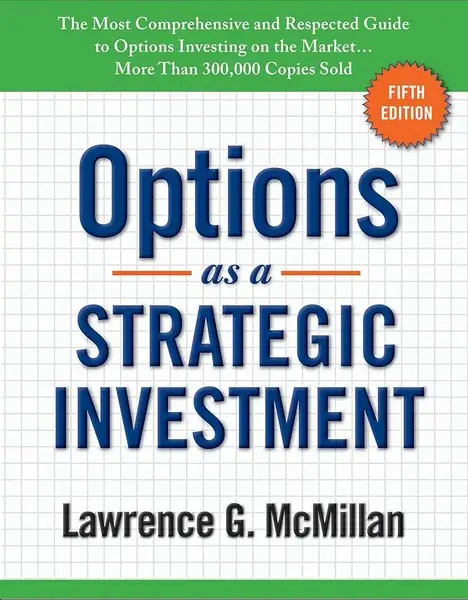
That is not an insult. It is the correct way to use it. Lawrence McMillan’s thousand-page volume is not a book in the sense that Trading in the Zone is a book. It is the options equivalent of a pharmacopoeia: an exhaustive catalogue of every structure the instrument permits, each one dissected into what it costs, what it can make, when it works, when it does not, and what to do when the position goes against you.
Nobody reads a pharmacopoeia cover to cover. They look things up in it, and they are extremely glad it exists, and they would not dream of practising without one on the shelf.
Which sets up the only question that matters here, and it is a question about you rather than about McMillan: do you already know why you would want a ratio backspread? Because if you do, this book is indispensable. And if you do not, it is one of the most dangerous objects on the shelf, for a reason worth spelling out.
At a Glance
| Author | Lawrence G. McMillan |
| Full Title | Options as a Strategic Investment |
| Editions | First published 1980; revised in 1986, 1993 and 2002; the fifth edition (2012) is the current one |
| Pages | ~1,000. This is not a figure of speech. |
| Difficulty | Moderate per page, overwhelming in aggregate |
| Best For | Reference. The trader who needs to know exactly how a structure behaves before he puts it on. |
| Skip If | You have not read Natenberg. Seriously. Come back. |
OVERALL RATING: 8.3 / 10
Who Should Read This Book
| Reader | Verdict | Why |
|---|---|---|
| Options beginner | Not yet, and not for the obvious reason | Not because it is too hard. Because a catalogue of 60 strategies handed to someone with no theory produces strategy-shopping, which is the characteristic way retail options accounts die. |
| Intermediate options trader | Buy it, shelve it, use it | The correct relationship. You will consult it fifty times and read it never. |
| Professional | It is already on your desk | The follow-up action sections alone justify the shelf space |
| Covered-call writer | Read the relevant chapters | McMillan is unusually good on the boring, high-usage strategies most books rush past to reach the exotic ones |
| Trader in a losing position | This is when it earns its price | Almost nobody writes about adjusting a trade that has gone wrong. He does, systematically, for every structure. |
| Reader wanting to understand options | Wrong book | This tells you what exists. Natenberg tells you why. Understanding comes from the second one. |
The Book in Context
McMillan is a professional options trader and analyst who has spent a career in the instrument and built a research and advisory business around it. He is known in the field by a nickname that tells you everything about his standing and nothing about his method: Mr. Options.
The book first appeared in 1980 and has been revised across five editions, which is itself the strongest available evidence of its status. Trading books do not get revised for four decades. They get remaindered. This one persists because it occupies a slot nothing else fills: the complete reference, maintained, in a field where most writing is either introductory or promotional.
Its relationship to Natenberg is the defining fact about it, and the two books are almost always discussed together because they are almost exactly complementary. Natenberg is a theory of the instrument: he teaches you what an option is, and having understood it you could derive most structures yourself. McMillan is an inventory of the instrument’s outputs: he has already derived them all, catalogued them, and told you how each one behaves. One book makes you think. The other saves you time.
Read in the wrong order they are actively harmful, which is a claim worth taking seriously and which the next section explains.
The Core Structure: Every Strategy, Dissected the Same Way
The book’s method is relentless consistency, and that consistency is the product.
Take any structure: the covered write, the vertical spread, the calendar, the diagonal, the butterfly, the condor, the ratio spread, the backspread, the straddle, the strangle, the synthetic, the conversion. McMillan takes each one and runs it through an identical dissection. What is the construction. What does the profit and loss profile look like at expiry and before it. Under what conditions does it make money. What is the maximum loss and where does it live. What are the margin implications. What happens as time passes. And, crucially, what do you do when it goes wrong.
Natenberg vs McMillan
| Dimension | Natenberg | McMillan |
|---|---|---|
| What it is | A theory of the instrument | An inventory of the instrument’s outputs |
| How you use it | Read it, in order, over months | Look things up in it, for years |
| Answers | Why does this position behave like that? | What exactly is a jelly roll and what is my max loss? |
| Blind spot | Will not find you a trade | Will not tell you which trade is right for the moment |
| Read alone, produces | A trader who understands options and hesitates | A trader with sixty tools and no theory of when |
The bottom-right cell is the danger. Hesitation is survivable. Sixty tools and no theory is not.
Here is why the order matters so much. McMillan’s organisation is by strategy, and a book organised by strategy implicitly answers the question “which strategy should I use?” by presenting sixty of them as a menu. A reader with no theory does what anyone does with a menu: he browses, finds one whose payoff diagram looks appealing, and orders it.
But an options structure is not a preference. It is an expression of a specific view about volatility, direction and time. The iron condor is not “a good strategy.” It is a bet that realised volatility will come in below implied within a range, and it is either the correct expression of a view you actually hold or it is a slow way to lose money elegantly. The payoff diagram cannot tell you which, because the diagram looks identical in both cases.
A strategy catalogue answers “what could I do?” It cannot answer “what do I believe?” and only the second question has money in it.
— Why order of reading matters
The Follow-Up Action Sections: The Book’s Real Gift
If the book has one genuinely underrated contribution, it is this, and it is worth buying for on its own.
Almost every options text ends its treatment of a strategy at the entry. Here is the structure, here is the payoff diagram, here is when to use it. Then silence, as though the trade resolves itself. The reader is left with the strong implicit suggestion that you put it on and wait.
Real options trading is not like that at all. The underlying moves. Your delta changes. The position you have is no longer the position you designed, and it now expresses a view you do not hold. What then? Roll it. Close a leg. Convert it into something else. Take the loss. Add. Each of these has consequences and most of them are wrong most of the time.
McMillan is one of very few authors who treats this as a first-class subject and works through it systematically, structure by structure. It reflects something true about the instrument that beginners consistently miss: options positions are managed, not held. The entry is perhaps a third of the decision. The rest happens afterwards, in conditions you did not anticipate, and having thought about it in advance is the difference between adjusting and improvising.
How McMillan Built the Book
He optimised for completeness over everything. The organising principle is that nothing should be missing. That decision produced a thousand pages, an unreadable book and an unmatched reference, and those are all the same decision. Judging it as a bad read is judging a dictionary for having no plot.
He is rigorously uniform. Every structure gets the identical treatment in the identical order. This makes the book navigable, comparable and dull. You can hold two strategies side by side and compare like with like, which is exactly what a reference should permit and exactly why nobody reads it for pleasure.
He does not sell. Given the size of the retail options-education industry and McMillan’s standing in it, the restraint is notable. There is no system here, no proprietary indicator, no promise. The book presents the strategies neutrally, including the ones that are usually bad ideas, and lets the reader work out the rest. That neutrality is precisely what makes it trustworthy as a reference and useless as a course.
Five Ideas Worth Carrying With You
Options positions are managed, not held.
The entry is a fraction of the decision. The underlying moves, your Greeks change, and the position you are holding on Thursday expresses a view you did not have on Monday. Traders who put on a structure and wait are not being patient. They are being absent from a trade that is still asking questions.
A structure is an expression of a view, not a preference.
Nobody should have a favourite strategy. The iron condor is not good or bad; it is the correct expression of one specific set of beliefs about volatility, range and time, and the wrong expression of every other set. Choosing a structure because its payoff diagram appeals to you is choosing a conclusion before you have an argument.
Know exactly where your maximum loss lives before you enter.
McMillan’s uniform dissection makes this unavoidable, which is its quiet virtue. Some structures have a defined worst case. Some have a theoretically unlimited one wearing a friendly payoff diagram. The trader who cannot state his max loss and the exact conditions that produce it does not know what he owns.
The boring strategies are where most real money is made.
McMillan gives serious, unglamorous attention to covered writes and simple spreads, which most books hurry past to reach the exotic constructions that sell courses. The complexity of a structure is uncorrelated with its profitability, and often inversely related to how well the trader understands what he has done.
Every structure can be built more than one way, and the differences are not cosmetic.
Synthetics, conversions and equivalent positions are not a curiosity for exam questions. They are why the same economic exposure can carry different margin, different assignment risk and different transaction costs. The construction you pick is a decision, even when the payoff diagram is identical.
What the Book Tells You to Do (and Why Most Readers Skip It)
Actionability is a 9, and this is the book’s genuine strength: it is almost entirely operational. Every structure comes with construction, risk profile, margin, conditions of use and, unusually, a plan for when it goes wrong. If you want to know exactly what happens to a diagonal spread when the underlying gaps through your short strike, the answer is in here, worked out.
What readers skip is the discipline of using it as a reference rather than a menu. The intended use is: form a view, identify the structure that expresses it, look it up, verify the risk profile and the adjustment plan, then trade. The actual use is: browse, find something appealing, deploy. The book is complicit in this to the extent that its organisation invites browsing, and McMillan never tells you not to.
Common Misreadings of the Book
Misreading #1: “I should read it cover to cover”
You will not, and you should not try. A thousand pages of uniform strategy dissection is not designed for linear reading and produces almost nothing when consumed that way. The trader who attempts it stalls around page 200, feels defeated, and concludes options are beyond him. He has drawn a conclusion about himself from a fact about the book’s format.
Misreading #2: “It’s outdated, it’s from 1980”
Revised across five editions, and the mechanics of a butterfly have not changed since the contract was invented. What has aged is the market context: the tax material, the commission assumptions, some of the market structure. The structural analysis, which is 90% of the book, is as valid as arithmetic.
Misreading #3: “This is the only options book I need”
The most costly misreading available. Its size creates a powerful impression of sufficiency, and it is not sufficient. It is a catalogue without a theory, and a trader who has only this book knows sixty structures and cannot tell you what implied volatility is doing today. That trader will pick structures by their diagrams, which is precisely how a well-informed person loses money.
Misreading #4: “More complex structures are more sophisticated”
The book catalogues the exotic alongside the plain with no editorial hierarchy, which readers interpret as a difficulty ladder to climb. It is not. Complexity adds legs, costs, assignment risk and ways to be wrong. A well-understood vertical beats a poorly understood butterfly every time, and the reader who graduates to condors because they seem advanced has confused sophistication with surface area.
Misreading #5: “The follow-up sections are the boring part”
They are the best part, and they are what almost no competing book contains. Skipping them to read about more strategies is skipping the material on managing a live position in order to collect more ways to open one. That is the exact ratio of attention that loses money in this instrument.
Where the Book Falls Short
- Catalogue without theory. The central limitation. It tells you what exists in exhaustive detail and never builds the unifying framework that lets you decide. Read alone, it produces a trader with sixty tools and no principle for choosing between them, which is worse than a trader with three tools he understands.
- The organisation encourages strategy-shopping. A book arranged by strategy presents strategies as a menu. That format quietly teaches the wrong mental model: that you pick a structure and then find a market for it, rather than form a view and then find its expression.
- Effectively unreadable at length. Readability is a 5 and that is a description, not a complaint. A thousand uniform pages is a reference format, and readers who do not know that going in have a bad time.
- The tax and regulatory material is US-specific and stale. Fine if you are American and consulting an accountant anyway. Useless to everyone else, and dated even for the Americans.
- Market context has moved. Commission assumptions, market structure, the retail product set. The fifth edition predates commission-free options flow, the 0DTE boom and the current state of the retail market entirely.
- Nothing on where an edge comes from. Like Natenberg, and for similar reasons, McMillan tells you how the instrument behaves and leaves the question of why you would have an advantage entirely unaddressed. Two thousand pages between them and neither will find you a trade.
How the Book Fits the Mind · Method · Money Framework
| Pillar | Contribution | What the Book Delivers |
|---|---|---|
| MIND | ABSENT | Nothing at all. It is a reference work and does not pretend otherwise. |
| METHOD | PRIMARY | The complete structural inventory: construction, payoff, conditions of use, and the adjustment plans nobody else writes |
| MONEY | STRONG | Every entry states max loss, max gain and margin explicitly. Defined-risk versus undefined-risk is treated as a first-class distinction. |
A Method reference that is quietly a Money book: its uniform insistence on stating maximum loss for every structure is risk management enforced by format. Read against the Mind · Method · Money framework and The Complete Trader’s Edge.
Read This Instead Of / Read This After
| Relationship | Book | Why |
|---|---|---|
| Read after | Option Volatility and Pricing | Non-negotiable order. Natenberg supplies the theory that makes this catalogue usable rather than dangerous. |
| Own alongside | Trading Options Greeks by Passarelli | The three-book options shelf: theory, Greeks made accessible, complete reference. Very little else is needed. |
| Read instead of | Any “top 10 options strategies” course | This has all of them, dissected far more rigorously, without anyone trying to sell you the eleventh |
| Pair with | Trading in the Zone | McMillan tells you the adjustment. Douglas addresses why you will not make it, because making it means admitting the original trade was wrong. |
| Do not read instead of | A theory book. Any theory book. | Its bulk creates a false sense of completeness. A thousand pages of what, with no why, is not an education. |
Final Verdict: Should You Read This Book in 2026?
You should own it. Whether you should read it is a different question, and the answer is mostly no.
The 8.3 is a rating of a reference work judged as a reference work. Actionability 9 and timelessness 9, because the mechanics of a spread are permanent and every entry tells you exactly what you own and what it can cost. Readability 5 and beginner-friendliness 5, because a thousand pages of uniform dissection is not a reading experience and was never trying to be. Modern relevance takes the only real hit, at 7, because the tax material, the commission assumptions and the market context have all moved on while the structural analysis stayed correct.
What holds it below Natenberg is not size or dryness. It is that a catalogue cannot teach judgement, and options punish absent judgement faster than any instrument on this shelf. Read alone, this book gives you sixty precise ways to express views you have not learned how to form.
So: buy Natenberg, work through it properly, then buy this and put it on the shelf. Read the chapters covering the two structures you actually trade, read their follow-up action sections twice, and let the other nine hundred pages sit there until a specific question sends you looking. Used that way it is close to indispensable and will still be on your desk in a decade. Used as a menu, it is an expensive way to discover that a payoff diagram is not a thesis.
CTE Rating Breakdown
8.3/10
Essential Reference
| Readability | 5 | |
| Actionability | 9 | |
| Timelessness | 9 | |
| Beginner-Friendly | 5 | |
| Modern Relevance | 7 |
Ready to read it?
Available in hardcover and Kindle. Buy the latest edition available.
Frequently Asked Questions
What is Options as a Strategic Investment?
A comprehensive reference cataloguing essentially every options strategy that exists. Each structure gets an identical dissection: construction, profit and loss profile, when to use it, maximum risk, margin implications, and what to do when the position moves against you.
Should I read it cover to cover?
No. It is roughly a thousand pages of uniform strategy analysis, designed for lookup rather than linear reading. Read the chapters for the structures you actually trade and let the rest wait until a specific question sends you there.
McMillan or Natenberg?
Natenberg first, then McMillan. Natenberg teaches you what an option is and how to think about it. McMillan tells you what every structure does. The catalogue without the theory produces a trader who picks strategies from payoff diagrams, which is an expensive habit.
Which edition should I buy?
The most recent available. The fifth edition was published in 2012; check whether a newer one has since appeared before purchasing, as the book has been revised repeatedly across its life.
Is a 1980 book still relevant?
The structural analysis is, and it is most of the book. A butterfly has the same mechanics it always had. What has dated is the surrounding context: tax treatment, commission assumptions, and market structure, none of which are why you own the book.
What are the follow-up action sections?
McMillan’s systematic treatment of what to do when a position goes against you: roll, close a leg, convert, take the loss. Almost no other options book covers adjustment properly, and this material is arguably the single best reason to own the volume.
Is it too advanced for a beginner?
Not conceptually, and that is not the concern. The problem is that a catalogue of sixty strategies given to someone with no theory encourages picking structures by their payoff diagrams. That is not a knowledge gap; it is a bad mental model, and it is expensive.
Does it teach volatility?
It covers volatility-based strategies, but it is not the book that teaches you to think in volatility terms. That is Natenberg’s contribution, and it is the reason the two books are almost always recommended as a pair rather than as alternatives.
Will it help me find trades?
No. It tells you how to express a view once you have one. Where the view comes from, and why you would have an advantage in forming it, is outside the book’s scope entirely.
What is the single most important takeaway from the book?
That an options position is managed rather than held, and that the adjustment plan should exist before the entry does. The follow-up action sections teach a discipline that most traders only acquire by paying for it.
About the Author
Lawrence G. McMillan
Lawrence McMillan is a professional options trader and analyst who has spent a career inside the instrument and built a research and advisory practice around it. In a field with no shortage of self-appointed experts, he is known simply as Mr. Options, a nickname that reflects standing rather than salesmanship.
On the book’s longevity: first published in 1980 and revised across five editions. Trading books are not maintained for four decades unless they are doing something nothing else does. This one holds the reference slot in a field where most writing is either introductory or promotional, and it holds it because McMillan chose completeness over readability and never wavered.
His notable restraint is that he does not sell anything in these pages. No system, no proprietary edge, no promise. The strategies are presented neutrally, including the ones that are usually bad ideas. That neutrality is exactly what makes the book trustworthy as a reference, and exactly why it will never be anybody’s favourite read.
Continue Learning
- Option Volatility and Pricing Book Review (2026)
- The Top Trading Books Explorer
- Recommended Reading for Traders
- The Mind · Method · Money Framework
- The Complete Trader’s Edge — The Book
 The Complete Trader's Edge
The full Mind · Method · Money framework. 70 chapters.
View on Amazon →
 Market Mayhem
400 years of bubbles, crashes, and the pattern that keeps repeating.
Buy on Amazon →
 Greatest Companies
How the world's greatest companies were built — and what traders learn from them.
View on Amazon →
 Greatest Traders
Eighty-six lives that explain the markets — Livermore to Madoff, told with the losses left in.
View on Amazon →