

Explore all 80 books in the Trader’s Library →
There is a specific kind of reader this book exists for, and if you are him, nothing else on the options shelf will do.
You have tried Natenberg. You got through the contract mechanics, made it into the pricing chapters, and somewhere around the point where volatility stopped being a word and became a surface, you closed it. Not because you could not follow the sentences. Because the pace assumed a reader being paid to keep up, and you are not being paid, and there is a limit to how many evenings a person will spend feeling stupid.
Dan Passarelli’s book is the ramp. It takes the same core material, the Greeks as the actual language of an options position, and teaches it at a speed a working adult can absorb. It is less rigorous than Natenberg, covers less ground, and reaches shallower. It is also the book that will get you to the point where Natenberg becomes readable, which makes it more useful than a better book you did not finish.
At a Glance
| Author | Dan Passarelli |
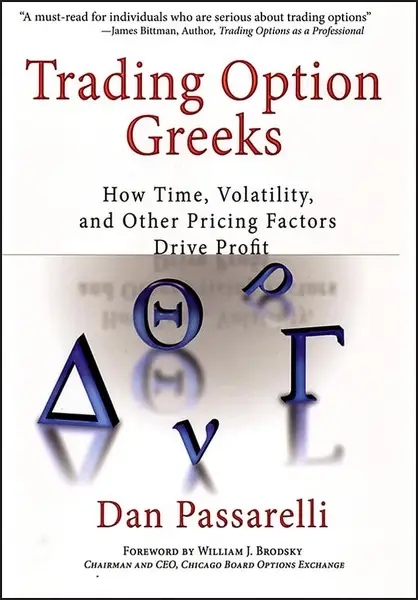
| Full Title | Trading Options Greeks: How Time, Volatility, and Other Pricing Factors Drive Profits |
| First Published | 2008; second edition 2012 (Bloomberg Press) |
| Pages | ~350 |
| Difficulty | Moderate. The gentlest serious options book on this shelf. |
| Best For | Retail traders who bounced off Natenberg and need the same material at survivable speed |
| Skip If | You finished Natenberg. This has almost nothing to add for you. |
OVERALL RATING: 8.0 / 10
Who Should Read This Book
| Reader | Verdict | Why |
|---|---|---|
| Options beginner | Start here | The best on-ramp available. Learn contract basics elsewhere, then this, then Natenberg. |
| Trader who quit Natenberg | This is your book | Same core material, survivable pace. It exists precisely for you and it works. |
| Trader who finished Natenberg | Skip it | You have this material at greater depth. There is no second thing here. |
| Premium seller | Read the gamma and theta chapters | You are running a short-gamma business. This explains, clearly, what you actually sold. |
| Multi-position trader | Worth it for position Greeks alone | Aggregating exposure across a book is under-taught everywhere and handled well here |
| Professional | No | Written for the serious retail trader. You are not the reader. |
The Book in Context
Passarelli traded options as a market maker on the floor in Chicago, then moved into education, including instructing at the exchange’s own options education arm, and later founded his own options mentoring business.
That last fact deserves stating up front rather than buried, because it is the honest context for the book. Passarelli runs a commercial options education operation, and this book functions in part as the calling card for it. That does not make the content wrong, and there is no system being sold in these pages. But it is a different incentive structure from Natenberg, who was writing a firm’s internal curriculum, and a reader is entitled to know which kind of book he is holding.
Its position on the shelf is precise and slightly awkward: it sits in the gap between the introductory book that teaches you what a call is and the professional text that assumes you already know. That gap is real and badly served, and Passarelli fills it competently. The awkwardness is that a book defined by the space between two other books is always vulnerable to the question of why you would not just read the better one, and this review is going to take that question seriously.
The Core Argument: Trade the Greeks, Not the Strategies
The organising claim is a genuine reframe and it is the reason to read the book.
Most retail options traders think in strategies. I put on an iron condor. I am running a covered call. I bought a vertical. The strategy is the unit of thought, the thing with a name, the thing you tell people about.
Passarelli’s argument is that the strategy name is a label on a box, and the box contains the actual position: a specific quantity of delta, gamma, theta and vega. Two structures with different names can carry near-identical exposures. One structure can transform into something with the opposite character in an afternoon while keeping its name. The name is stable. The position is not. And you are trading the position.
The strategy is what you called it on Monday. The Greeks are what you own on Thursday.
— The book’s organising claim
Follow this through and it changes what you look at. The trader thinking in strategies checks whether price is still inside his condor’s range. The trader thinking in Greeks checks what his gamma has done, because gamma is what decides whether the next one percent move is an inconvenience or an event. Same position. One of them can see the risk coming.
Position Greeks: The Chapter Worth the Price
The book’s most valuable and least-copied material is on aggregating Greeks across multiple positions, and it addresses a failure mode almost no options book acknowledges.
A trader has four positions on. Each was entered with a clear thesis and each is individually sensible. He evaluates them individually, because that is how they were entered and that is how the platform displays them. What he has never done is add them up.
When he does, he discovers that his book is short vega across the whole account, three times over, because four separate reasonable decisions all leaned the same way. He never chose to make a large bet on implied volatility staying flat. He made four small bets that happened to rhyme, and their sum is a position he would never have entered deliberately.
Two Ways to Look at the Same Book
| Question | Thinking in strategies | Thinking in Greeks |
|---|---|---|
| What do I have on? | Two condors, a calendar and a covered call | Short vega, short gamma, long theta, roughly flat delta |
| What am I betting? | Four separate things, each sensible | One thing, four times: that nothing much happens |
| What kills me? | Unclear. Depends which one you look at. | A vol spike. All four at once. Visible in advance. |
| Did I choose this? | You chose each position, so it feels chosen | No. It accumulated. That is the whole problem. |
Four reasonable decisions that all lean the same way are one large decision nobody made.
This is a real and under-discussed way that competent options traders die, and it is the strongest argument for owning this book even if Natenberg is also on your shelf. Correlated exposure that accumulates through individually defensible decisions is invisible to a trader who evaluates positions one at a time, and it does not announce itself until the single event that all four were quietly betting against actually arrives.
How Passarelli Built the Book
He organises by Greek rather than by strategy. The structural decision that separates it from McMillan and aligns it with Natenberg. A book arranged by Greek teaches you that exposures are the unit of analysis, before it teaches you anything specific. The architecture is the argument.
He paces for a reader with a job. This is the book’s actual product and it should not be undersold. Passarelli covers less ground than Natenberg and takes longer to cover it, which is exactly right for the audience. Concepts arrive one at a time, get explained twice, and are given room to land. Readability is an 8 against Natenberg’s 6, and that two-point gap is the entire reason this book has a reason to exist.
He does not oversell. Given that the author runs an education business, the restraint is worth crediting. There is no proprietary system, no promise of returns, no funnel inside the text. It is a straight teaching book that happens to have been written by someone who teaches commercially.
Five Ideas Worth Carrying With You
The strategy name is a label. The Greeks are the position.
You did not put on an iron condor. You put on short gamma, long theta, short vega and roughly flat delta, and someone gave that combination a name. The name will not change as the market moves. Everything the name describes will.
Add up your book before you add to it.
Four individually sensible positions that all lean the same way are one large concentrated bet that nobody consciously made. Position Greeks are how you find out what you actually own, as opposed to what you remember deciding. Most platforms will show you this. Almost nobody looks.
Your position changes its character while you are not watching.
Gamma means your delta is not a constant, which means the trade you designed on Monday is a different trade by Thursday without anyone touching it. This is why options positions require monitoring in a way stock positions do not, and why “set and forget” is not conservatism in this instrument. It is absence.
Vega is the Greek that ruins people who never learned it existed.
Delta is intuitive and theta is visible in the daily decay. Vega is neither, and it is the exposure that turns a well-reasoned position into a loss when the market simply changes its mind about the forecast. The underlying can do nothing at all and you lose, which is the moment most traders discover the word.
A book you finish beats a better book you abandoned.
Not the author’s point, but the honest lesson of this book’s existence. Natenberg is the superior text and a large fraction of the people who buy it never reach the volatility chapters. Understanding acquired at survivable speed is understanding. A shelf ornament is not.
What the Book Tells You to Do (and Why Most Readers Skip It)
Actionability sits at 8 because the instruction is concrete and mostly operational: before you enter, state your position in Greeks rather than in a strategy name. After you enter, monitor the Greeks rather than the price relative to your strikes. Before you add a position, aggregate your existing exposures and check whether the new trade diversifies your book or concentrates it. Know where your vega is, always, because it is the exposure you did not choose and cannot feel.
Readers skip it because thinking in Greeks is genuinely harder work than thinking in strategies, and offers no compensating pleasure. “I’m running a condor on SPY” is a sentence you can say to another human being. “I’m carrying about negative 400 vega and short gamma into a Fed week” is a sentence that describes your actual risk and interests nobody. The strategy name is social. The Greeks are just true.
Common Misreadings of the Book
Misreading #1: “This replaces Natenberg”
It does not, and reading it as a substitute is the main way it gets misused. Passarelli covers the Greeks well and stops considerably short of Natenberg on volatility as a tradeable object, on the pricing model’s assumptions, and on skew. It is a ramp, not a destination. A trader who reads this and considers his options education complete has stopped one book early.
Misreading #2: “The Greeks are analytics”
They are inventory. This is the distinction the whole book is built to install. An analytic is something you consult to form an opinion. An inventory is a list of what you own. Your delta is not information about your position; it is a quantity of stock you are effectively holding right now, and treating it as a dashboard reading rather than a possession is how traders end up surprised by exposures they were looking at all along.
Misreading #3: “I only have one position, so position Greeks don’t apply”
A multi-leg structure is already multiple positions. A condor is four options with four sets of Greeks that net into something, and the netting is the point. If you have any spread on at all, you are already in the territory the position Greeks chapter covers.
Misreading #4: “It’s an education-company book, so it’s marketing”
The incentive is real and worth naming, which is why this review named it. But the text does not behave like marketing. There is no system, no proprietary indicator, no promise, and no funnel inside the pages. Judge the content, hold the context lightly, and note that the absence of a sales pitch in a book by someone who sells things is itself informative.
Misreading #5: “Delta-neutral means risk-neutral”
Flat delta means you have no directional exposure at this instant, at this price. It says nothing about your gamma, which determines how fast that changes, or your vega, which is a completely separate bet. A delta-neutral position can be an enormous wager. It is just not a wager on direction, and the word “neutral” does a great deal of quiet damage here.
Where the Book Falls Short
- Substantially redundant if you have read Natenberg. The central limitation. There is essentially no idea here that Natenberg does not cover at greater depth. Its value is entirely in the delivery, which means it is worthless to a reader who did not need the gentler delivery.
- Shallower where depth matters most. The treatment of skew, of the pricing model’s assumptions, and of volatility as a tradeable object rather than an input is noticeably lighter than the professional text. That is exactly the material that separates a trader who understands options from one who understands the Greeks.
- Caught between two audiences. A book defined by the gap between two other books can end up serving neither. Too much for a true beginner who does not yet know what a call is; too little for a trader ready for Natenberg. It hits its reader precisely, and its reader is a narrower slice than the book’s positioning implies.
- 2012, and the market moved. Predates the 0DTE retail boom, commission-free flow and the current retail options ecosystem. The physics are permanent; the environment described is not the one you are trading in.
- Commercial context. The author runs an options education business and the book operates partly as its calling card. The text is clean, but the reader should know the structure rather than discover it later.
- Will not find you a trade. Same limitation as the rest of the options shelf, and worth repeating because three books in a row have now had it. Passarelli teaches you to read your position. Where an edge comes from is not addressed by anyone in this section.
How the Book Fits the Mind · Method · Money Framework
| Pillar | Contribution | What the Book Delivers |
|---|---|---|
| MIND | ABSENT | Nothing, and like Natenberg it assumes an operator who acts on what he knows |
| METHOD | PRIMARY | The Greeks as the language of a position, structures read through their exposures, volatility as a pricing input |
| MONEY | STRONG | Position Greeks are portfolio risk management. Aggregating exposure across a book is a Money-pillar discipline wearing a Method label. |
The position-Greeks material is the bridge between Method and Money on the options shelf: knowing what a structure is, and knowing what your whole book is exposed to, are different skills and only the second one keeps you solvent. Read against the Mind · Method · Money framework and The Complete Trader’s Edge.
Read This Instead Of / Read This After
| Relationship | Book | Why |
|---|---|---|
| Read before | Option Volatility and Pricing | The whole point. This is the ramp; Natenberg is the road. Read this first only if you need to. |
| Read before | Options as a Strategic Investment | McMillan’s catalogue is only safe once you think in exposures rather than strategy names. This installs that. |
| Skip if you have read | Option Volatility and Pricing | Genuine redundancy. There is no second reason to own this book. |
| Read instead of | Any “options for beginners” title | Most beginner options books teach strategies, which teaches the wrong mental model from day one. Learn exposures first. |
| Pair with | Trading in the Zone | Knowing your short gamma and reducing it are different acts. The options shelf handles the first and is silent on the second. |
Final Verdict: Should You Read This Book in 2026?
Only if you need it, and a meaningful number of people genuinely do.
The 8.0 is an unusual rating to explain because it is not really a judgement about quality. Nothing here is original. Everything here is in Natenberg, deeper. Judged as a contribution to the field, this book adds one thing: the position Greeks material, which is handled better than almost anywhere else and addresses a real way that competent traders die.
What it actually adds is access. Readability 8 against Natenberg’s 6, beginner-friendliness 7 against his 4. Those numbers look modest and they are the entire product. A large share of retail traders who buy the definitive options text never finish it, and a book that gets those people to competence has done something the better book failed to do for them. That is worth an 8.0 and it is worth being honest about what kind of 8.0 it is.
So the recommendation is conditional and slightly unusual: if you can read Natenberg, read Natenberg and skip this entirely. If you have tried and stalled, buy this without embarrassment, finish it, then go back. The three-book options shelf is Passarelli, Natenberg, McMillan, in that order, and most traders only need the middle one. This is for the ones who need the runway.
CTE Rating Breakdown
8.0/10
Recommended
| Readability | 8 | |
| Actionability | 8 | |
| Timelessness | 9 | |
| Beginner-Friendly | 7 | |
| Modern Relevance | 7 |
Frequently Asked Questions
What is Trading Options Greeks about?
It teaches options through their risk exposures rather than through strategy names. The argument is that delta, gamma, theta and vega are what you actually own, and that the strategy label on a position tells you almost nothing about how it will behave.
Passarelli or Natenberg?
Natenberg is the better and deeper book. Passarelli is the one you will finish if Natenberg’s pace has already defeated you. If you can read Natenberg, read Natenberg and skip this. If you have tried and stalled, this is the ramp back on.
Is it redundant if I’ve read Natenberg?
Almost entirely, yes. Its value is the delivery rather than the content. The one arguable exception is the position Greeks material on aggregating exposure across a book, which is handled unusually well here.
What are position Greeks?
Your total exposure summed across every position you hold, rather than each trade evaluated separately. It matters because several individually sensible positions can all lean the same way, producing a large concentrated bet you never consciously made.
Is it good for beginners?
Good for a beginner who already knows what a call and a put are. It is not an absolute first book; it is the second one, and it is the best available second one because it installs the right mental model before you learn any strategies.
Why does the author’s education business matter?
Only as context you are entitled to have. Passarelli runs a commercial options mentoring operation and the book functions partly as its calling card. Notably, the text itself contains no system, no proprietary edge and no sales pitch, which is more restraint than the arrangement required.
Does delta-neutral mean risk-free?
No, and the word “neutral” is responsible for a lot of damage. Flat delta means no directional exposure at this instant at this price. Your gamma decides how fast that changes and your vega is an entirely separate bet. A delta-neutral position can be an enormous wager.
Which Greek do traders underestimate most?
Vega. Delta is intuitive and theta is visible in daily decay, but vega is neither. It is the reason the underlying can do exactly nothing and you still lose, because the market changed its mind about how much movement to expect.
Which edition should I buy?
The second edition, published 2012. Note that it predates the 0DTE retail boom and commission-free options flow entirely, though the mechanics it teaches are unaffected by either.
What is the single most important takeaway from the book?
That you should be able to state your position in Greeks before you enter it, and that if you cannot, the strategy name you are using is hiding the trade from you rather than describing it.
About the Author
Dan Passarelli
Dan Passarelli traded options as a market maker on the floor in Chicago before moving into education, including a period instructing at the exchange’s own options education arm. He later founded his own options mentoring business, which is the context this book was written from and which readers should know about rather than discover afterwards.
On the incentive: a book by someone who sells options education is a book with a commercial function. What is notable here is how little the text behaves like one. There is no proprietary system, no promise of returns, and no funnel embedded in the pages. That restraint is worth crediting rather than assuming away.
His real skill is pedagogical rather than analytical. Passarelli is not adding to what is known about options; he is making what is known reachable by people who are not being paid to learn it. That is a smaller contribution than Natenberg’s and a genuinely useful one.
Continue Learning
- Option Volatility and Pricing Book Review (2026)
- Options as a Strategic Investment Book Review (2026)
- The Top Trading Books Explorer
- Recommended Reading for Traders
- The Mind · Method · Money Framework
- The Complete Trader’s Edge — The Book
 The Complete Trader's Edge
The full Mind · Method · Money framework. 70 chapters.
View on Amazon →
 Market Mayhem
400 years of bubbles, crashes, and the pattern that keeps repeating.
Buy on Amazon →
 Greatest Companies
How the world's greatest companies were built — and what traders learn from them.
View on Amazon →
 Greatest Traders
Eighty-six lives that explain the markets — Livermore to Madoff, told with the losses left in.
View on Amazon →