

Explore all 80 books in the Trader’s Library →
Somewhere in this book Kevin Davey tells you roughly how many strategy ideas he tests to find one worth trading, and the ratio is bleak enough that most readers assume he is being modest or unlucky.
He is not. He is telling you what the job is.
That single disclosure reframes everything a retail trader believes about systematic trading. The fantasy is that you have an idea, you test it, it works, you trade it. The reality is that you have an enormous number of ideas, almost all of them die, and the entire skill is killing them cheaply and quickly enough that the survivors pay for the funeral costs of the rest. This is a book about industrialised disappointment, written by an engineer who is completely at peace with that.
It is the most honest account of the systematic development process I have read, and it pairs with Chan so precisely that the two should probably be sold together. Chan tells you why your backtest is lying. Davey gives you the machine that catches it.
At a Glance
| Author | Kevin J. Davey |
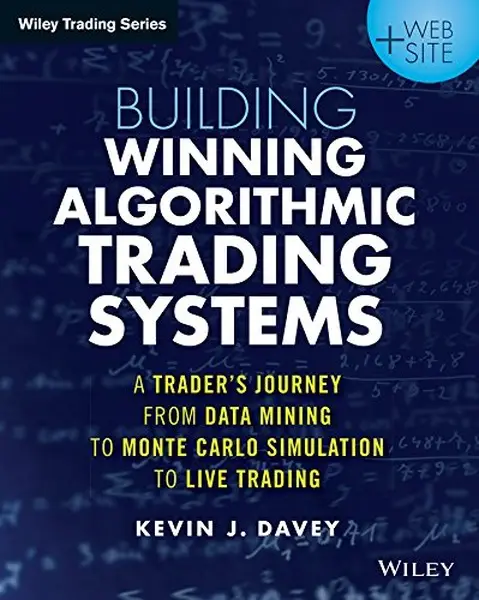
| Full Title | Building Winning Algorithmic Trading Systems: A Trader’s Journey From Data Mining to Monte Carlo Simulation to Live Trading |
| Published | 2014 (Wiley) |
| Difficulty | Moderate. An engineer’s book: clear, procedural, light on theory. |
| Best For | Anyone building systematic strategies who wants the actual process, failure rate included |
| Skip If | You want strategies, or you want quantitative depth. Neither is on offer. |
OVERALL RATING: 8.3 / 10
Who Should Read This Book
| Reader | Verdict | Why |
|---|---|---|
| System builder | Essential | The complete lifecycle, honestly described, including the failure rate nobody else prints |
| Trader with one good backtest | Read it before funding | Monte Carlo will show you the drawdowns your single backtest path politely omitted |
| Discretionary trader | Worth it anyway | The incubation and retirement discipline applies to you and you almost certainly do not have it |
| Professional quant | Too basic | This is a retail practitioner’s process book. You have institutional versions of all of it. |
| Prop-firm challenger | Strong yes | Monte Carlo drawdown distributions tell you your real odds of breaching the limit. Almost nobody computes this. |
| Beginner | Later | Assumes you know what a backtest is and roughly why you would run one |
The Book in Context
Davey is an engineer by training who became a futures trader, and both halves of that show on every page. His distinguishing credential is a documented record of strong finishes in the World Cup Championship of Futures Trading, a live-money competition, which is a meaningfully harder thing to point at than a book deal. This site does not usually get to say that about an author, and it is worth saying when it is true.
The engineering background is the more important fact for understanding the book. Engineers are trained to expect failure, to test destructively, to assume the design is wrong until it survives an attempt to break it. Applied to trading strategies, that disposition produces exactly the right instincts and it produces them without any of the mystique the genre normally trades on. There is no wisdom here. There is a procedure.
It sits directly downstream of Chan. Chan diagnoses; Davey operationalises. A reader who takes Chan’s pitfalls seriously and then asks “so what do I actually do about it, step by step, on Tuesday” is holding the question this book answers.
The Core Argument: Most of Your Ideas Are Rubbish and That Is Fine
The book’s spine is a claim about base rates that retail traders find genuinely difficult to accept.
The retail model of strategy development is: have an idea, test it, if it fails feel bad, if it works trade it. Every failure is a small personal defeat, which creates pressure to rescue ideas rather than kill them. Optimise the parameters a bit. Try a different period. Add a filter. The idea survives, not because it is good, but because you are emotionally invested in the ten hours you spent on it.
You are not looking for a strategy that works. You are running a factory whose product is dead strategies, and occasionally something walks out alive.
— The reframe the whole book rests on
Davey’s model is industrial. Ideas are cheap and disposable. The process is a series of gates, each designed to kill, and the design goal is to kill as early and as cheaply as possible. A strategy that dies in step two cost you an hour. A strategy that dies in month four of live trading cost you real money and, worse, four months.
The emotional consequence is the point. If you expect almost everything to fail, a failure is throughput rather than judgement on you. The engineer does not grieve a failed prototype. He logs it and builds the next one, and that disposition is worth more than any technique in the book.
Monte Carlo: The Chapter That Justifies the Rating
The book’s most valuable technical contribution is on Monte Carlo simulation, and the reason it matters is one most traders have genuinely never considered.
Your backtest produced one equity curve. You look at it, note the maximum drawdown was 18%, and size accordingly. But that curve is a single path. It is one ordering of your trades, the ordering that history happened to deal you, and the sequence was arbitrary. Reshuffle the same trades into a different order and the maximum drawdown changes, sometimes dramatically. Your losers happened to be spread out. They could have clustered. Nothing about your edge would differ.
One Curve vs the Distribution
| Question | What the backtest says | What Monte Carlo says |
|---|---|---|
| Max drawdown | 18%. A fact about one shuffle of history. | A distribution. 18% was a median-ish draw. The tail is much worse. |
| Can I survive it? | Yes, I sized for 18% | What is your probability of hitting 35%? It is not zero and you never asked. |
| Risk of ruin | Unaddressed. One path cannot express it. | A number. Which is the only form in which it is useful. |
| Prop-firm limit | “I’ve never drawn down that far” | Your odds of breaching before payout, computed rather than hoped |
The backtest gives you one sample from a distribution and lets you mistake it for the distribution.
This connects directly to the point Donnelly makes from the trader’s chair: most of what gets called a discipline problem is a variance problem nobody did the arithmetic on. Davey supplies the arithmetic. A trader who has seen the distribution of drawdowns his system can produce is not surprised when one arrives, and a trader who is not surprised does not need the discipline he was going to fail to summon.
For prop-firm traders this material is close to essential and almost nobody uses it. The question “what is my probability of breaching the drawdown limit before I get paid” is answerable, and it is answered by exactly this technique. Most challengers instead reason from a single backtest and a feeling.
How Davey Built the Book
He shows his own numbers. The rarest thing in the genre and the reason to trust the book. Davey publishes his own development statistics, including the ugly ratios, and discusses his own failed systems by name. Most authors present a curated highlight reel; he presents the factory floor.
He structures it as a lifecycle, not a topic list. Idea, test, walk-forward, Monte Carlo, incubate, deploy, monitor, retire. It reads as a procedure you could follow on Monday, which is why actionability is a 9 and the highest in this batch.
He includes the ending. The retirement chapter is the one nobody else writes. Every book tells you how to build a system; this one tells you how to know when it is dead and how to switch it off without waiting for the account to make the decision for you.
Five Ideas Worth Carrying With You
The skill is killing ideas cheaply, not finding good ones.
Almost everything you test will fail, and that is the normal operating condition rather than evidence you are bad at this. Design your process so failures die in hour one instead of month four. Throughput of rejections is the actual product.
Your backtest is one shuffle of the deck, not the deck.
The sequence of your trades was arbitrary. Reorder the same wins and losses and the maximum drawdown moves, sometimes a lot. You sized for the drawdown history happened to hand you, and history had no obligation to hand you a representative one.
Optimisation is the sound of a strategy being rescued rather than tested.
When you tune the parameters until the curve improves, you are not learning about the market. You are learning about your dataset, and you are doing it because you are attached to the hours already spent. The sunk cost is doing the analysis.
Incubate before you fund. The strategy has not earned your money yet.
A period of forward observation on unseen data, with no capital at risk, is the cheapest test available and the one everybody skips because it is boring and the curve already looks so good. That impatience is the tuition.
Know in advance how you will decide it is dead.
Write the retirement criteria before you deploy, while you are still capable of thinking clearly about it. A trader deciding mid-drawdown whether his system has stopped working is not making a decision; he is having a feeling, and he will call it either way for reasons that have nothing to do with the system.
Common Misreadings of the Book
Misreading #1: “The failure rate means he’s not very good”
The failure rate means he is counting. Every other author has the same ratio and does not publish it, which is why readers arrive believing that strategies mostly work and that their own experience of constant failure is personal deficiency. Davey’s numbers are not a confession. They are the base rate, finally printed.
Misreading #2: “Monte Carlo is a technicality for quants”
It is the difference between knowing your maximum drawdown and knowing your distribution of possible drawdowns, and only one of those is a fact about your future. If you size from a single backtest path you have sized from a coincidence. This is the most practically load-bearing chapter in the book.
Misreading #3: “I’m discretionary, so this is irrelevant”
You also have a method, you also should retire it when it stops working, and you also have a drawdown distribution you have never computed. The systematic trader’s advantage is that his process is explicit enough to be audited. Yours is not, which makes the discipline harder to impose rather than unnecessary.
Misreading #4: “It’ll give me a system”
Deliberately not. Davey gives you the process by which a system is found, tested, deployed and eventually buried. Handing you a strategy would be self-defeating for exactly the reason Chan explains: a published edge is a former edge.
Misreading #5: “It’s a quant book”
It is a process book with a small amount of statistics in it. A genuine quant will find the mathematics thin, and that is not a defect, because the audience is the retail practitioner who needs a procedure rather than a derivation. Judge it as engineering, not as finance research.
Where the Book Falls Short
- Thin on mathematics. A process book, not a quantitative text. Monte Carlo and walk-forward are explained operationally rather than rigorously, which suits the audience and will frustrate anyone wanting depth.
- Futures-centric. Davey’s world is futures and the examples live there. The process generalises cleanly; the instrument context does not always.
- Tooling of its era. 2014, and the platform assumptions show. The procedure is unaffected; the specifics of how you would implement it today are not what is on the page.
- Data-snooping survives the process. The gates catch a great deal and cannot fix the fact that you personally generated and discarded hundreds of ideas before this one. Davey knows this; the process still cannot see the searcher.
- Competition record is not a strategy record. Strong finishes in a live-money contest are a real and unusual credential, and a contest is not a decade of managing capital. It is meaningfully better evidence than most authors offer, and it is not proof of a durable edge.
- It will not find you an idea. Same limitation as Chan, stated plainly by the author. This is a book about evaluating ideas. Where they come from is somebody else’s subject.
How the Book Fits the Mind · Method · Money Framework
| Pillar | Contribution | What the Book Delivers |
|---|---|---|
| MIND | SECONDARY | Stronger than it looks. Treating failure as throughput rather than verdict is a psychological intervention wearing an engineer’s overalls. |
| METHOD | PRIMARY | The full lifecycle: test, walk-forward, incubate, deploy, monitor, retire. The most complete process account on the shelf. |
| MONEY | STRONG | Monte Carlo drawdown distributions and risk of ruin. Sizing from a distribution rather than from one lucky ordering of history. |
The Money score is where this book earns its rating over Chan’s. Knowing your backtest might be fake is diagnosis; knowing the distribution of drawdowns it implies is treatment, and it is the number that decides your sizing and, for prop traders, your odds of getting paid. Read against the Mind · Method · Money framework and The Complete Trader’s Edge.
Read This Instead Of / Read This After
| Relationship | Book | Why |
|---|---|---|
| Read after | Quantitative Trading | The essential pairing. Chan names the ways a backtest lies; Davey builds the process that catches it. Sequential, not competing. |
| Pair with | Alpha Trader | Donnelly says most discipline problems are variance problems nobody computed. Davey is how you compute them. |
| Read instead of | Any book selling a system | This teaches you to evaluate systems, which is the skill that makes every future system decision cheaper |
| Read after | Forex Price Action Scalping | If Volman taught you to see, this is how you find out whether what you see is worth anything |
| Read before | Advances in Financial Machine Learning | Davey’s process instincts are the right preparation for López de Prado’s far more demanding treatment of the same anxieties |
Final Verdict: Should You Read This Book in 2026?
Yes, and read it immediately after Chan.
The 8.3 puts it above Chan and the reason is that it does something rather than only warning you. Actionability is a 9, the highest in the quant section, because the book is a procedure you could start following this week. The Monte Carlo material alone changes how a serious trader sizes, and the retirement chapter is the one that literally nobody else writes.
The deductions are honest. It is thin mathematically, the tooling is of 2014, it is futures-flavoured, and it cannot fix data-snooping because no process can see the searcher. And I will hold the line on the credential: a strong live-money competition record is a genuinely better thing to point at than most authors have, and it is not the same as a decade of managing capital. Better evidence, not proof.
What makes it worth 8.3 is the honesty about the base rate. Retail traders arrive believing strategies mostly work and that their own relentless failures are a personal defect. Davey prints the ratio, shows his own dead systems, and reframes the whole activity as a factory whose output is mostly rejects. That single correction saves more accounts than any technique, because the trader who expects to fail constantly stops rescuing ideas he should be burying, and rescued ideas are what get funded and then kill people.
CTE Rating Breakdown
8.3/10
Highly Recommended
| Readability | 8 | |
| Actionability | 9 | |
| Timelessness | 8 | |
| Beginner-Friendly | 6 | |
| Modern Relevance | 7 |
Frequently Asked Questions
What is Building Winning Algorithmic Trading Systems about?
It walks the full lifecycle of a systematic strategy: generating ideas, testing them, walk-forward analysis, Monte Carlo simulation, incubation, live deployment, monitoring and eventually retirement. It is a process book rather than a strategy book.
Who is Kevin Davey?
An engineer by training who became a futures trader. His distinguishing credential is a documented record of strong finishes in the World Cup Championship of Futures Trading, a live-money competition, which is harder evidence than most trading authors can point at. He finished second in 2005, first in 2006 and second in 2007. The full story is in our Kevin Davey profile.
Why does Monte Carlo simulation matter?
Because your backtest is one ordering of your trades and that ordering was arbitrary. Reshuffle the same wins and losses and the maximum drawdown changes. Monte Carlo gives you the distribution of drawdowns rather than the single one history happened to deal you.
Chan or Davey?
Both, in that order. Chan names the ways a backtest deceives you. Davey supplies the process that catches the deception and the sizing arithmetic that follows. They are sequential rather than alternatives.
Does the book give you trading strategies?
No, deliberately. It teaches you how to find, test, deploy and eventually retire them. Handing you a strategy would be self-defeating, because a published edge is a former edge.
Is it useful for prop-firm traders?
Unusually so, and almost nobody uses it this way. “What is my probability of breaching the drawdown limit before payout” is an answerable question, and Monte Carlo is how it is answered. Most challengers reason from one backtest and a feeling.
Why does he publish his failure rate?
Because it is the base rate and nobody else prints it. Readers arrive believing strategies mostly work, so their own constant failures feel like personal deficiency. Seeing the real ratio stops you rescuing ideas you should be burying.
Is it a quant book?
Not really. It is an engineer’s process book with modest statistics. A professional quant will find the maths thin, which is fine, because the audience is the retail practitioner who needs a procedure rather than a derivation.
What is strategy retirement and why does it matter?
Deciding in advance how you will know a system has stopped working, and writing it down before deployment. A trader deciding mid-drawdown whether his edge is gone is not making a decision, he is having a feeling, and he will resolve it in whichever direction hurts less.
What is the single most important takeaway from the book?
That you are not looking for a strategy that works, you are running a factory whose main product is dead strategies. The skill is killing them cheaply and early rather than rescuing the ones you have grown attached to.
About the Author
Kevin J. Davey
Kevin Davey trained as an engineer before becoming a futures trader, and has a documented record of strong finishes in the World Cup Championship of Futures Trading, a live-money competition. He writes and teaches on systematic strategy development.
Why the engineering matters more than the trading: engineers are trained to test destructively, to expect the design to fail, and to treat a failure as data rather than as a verdict on themselves. Imported into trading, that culture produces exactly the right instincts, and it produces them without any of the mystique the genre normally runs on.
The honest boundary: a contest record is real, unusual and better than most authors offer. It is also not a decade of managing capital, and this site will not inflate it into one.
Continue Learning
- Quantitative Trading Book Review (2026)
- Alpha Trader Book Review (2026)
- Forex Price Action Scalping Book Review (2026)
- The Top Trading Books Explorer
- Recommended Reading for Traders
- The Mind · Method · Money Framework
- The Complete Trader’s Edge — The Book
 The Complete Trader's Edge
The full Mind · Method · Money framework. 70 chapters.
View on Amazon →
 Market Mayhem
400 years of bubbles, crashes, and the pattern that keeps repeating.
Buy on Amazon →
 Greatest Companies
How the world's greatest companies were built — and what traders learn from them.
View on Amazon →
 Greatest Traders
Eighty-six lives that explain the markets — Livermore to Madoff, told with the losses left in.
View on Amazon →