


If you trade ICT or Smart Money Concepts from India, two questions decide most of your results before you ever draw a fair value gap. What time do the killzones actually happen on an Indian clock, and how do you trade them without tripping a prop firm rule? Almost every killzone guide is written in New York time and quietly assumes you live there. This page converts the whole thing to Indian Standard Time, shows you why those times move twice a year, and walks the specific places where ICT and prop firm rules collide.
The good news first, because it is genuinely good news for an Indian trader. The two windows ICT cares about most, the London open and the New York open, land in your afternoon and evening. The highest-liquidity window of the entire trading day falls after most people finish work. Geography is on your side here. The discipline required to use it is another matter.
The daylight-saving trap, stated once so you never forget it.
India does not observe daylight saving. London and New York do. That means every IST session time on this page shifts by an hour twice a year. Any guide that gives you a single fixed “London opens at 1:30 PM IST” is wrong for roughly half the year. Learn both the summer and winter figures below, and check which one is currently in force before you trade.
The killzones in Indian Standard Time
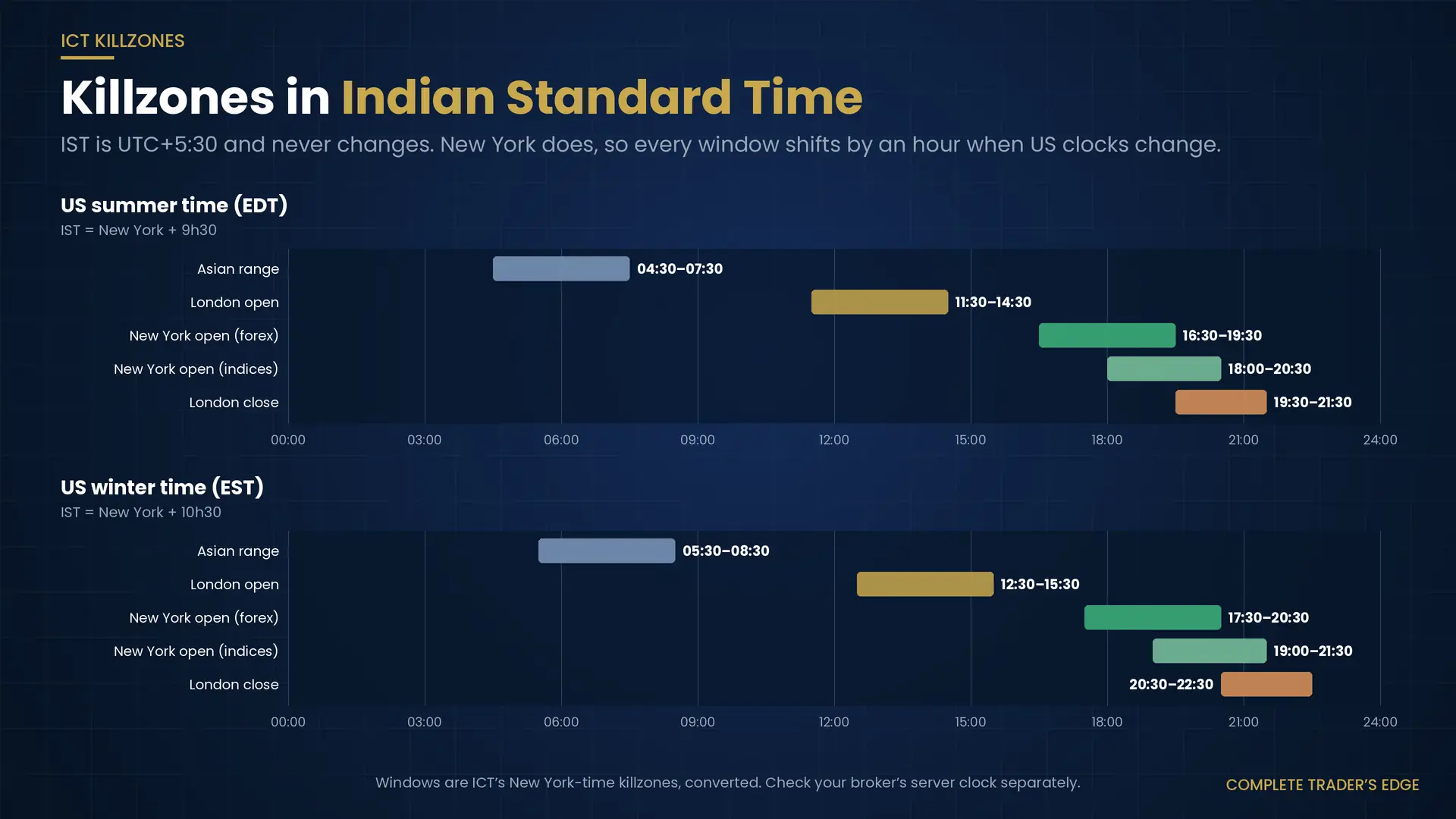
ICT anchors its killzones to New York local time. India sits at UTC+5:30 all year, while New York runs on EST in winter (UTC−5) and EDT in summer (UTC−4), and London on GMT in winter and BST in summer. Convert carefully and the windows land like this. Note that different ICT sources define the exact minutes slightly differently, so treat these as the widely used windows rather than a single official standard.
| Killzone | New York time | IST (summer) | IST (winter) |
|---|---|---|---|
| London open | 02:00–05:00 | 11:30–14:30 | 12:30–15:30 |
| New York open (forex) | 07:00–10:00 | 16:30–19:30 | 17:30–20:30 |
| New York open (indices) | 08:30–11:00 | 18:00–20:30 | 19:00–21:30 |
| London close | 10:00–12:00 | 19:30–21:30 | 20:30–22:30 |
| Asian range | 19:00–22:00 | 04:30–07:30 | 05:30–08:30 |
Read that table as a working Indian trader and the shape of the day is clear. The London open killzone is your early-to-mid afternoon, roughly 11:30 to 15:30 IST across the year. The New York open and the London–New York overlap, the busiest and most liquid window of the day, is your evening, roughly 16:30 to 21:30 IST depending on the season. The Asian range forms in your early morning while you sleep, which is exactly how ICT uses it: as the overnight liquidity pool that London and New York later run.
For anyone with a day job, this is close to ideal. You are not being asked to trade at 3 AM. The window ICT prizes most sits in the evening, after work. That is a real structural advantage of trading these concepts from India, and it is worth naming plainly because the killzone guides written for a New York audience never mention it.
One caution before you set your alarms
Two housekeeping points that catch Indian traders out. First, for a couple of weeks each March and late October the US and UK do not switch daylight saving on the same date, so for those short windows the usual offsets are briefly out of step. If a session feels an hour off around those changeovers, that is why. Second, your trading platform’s clock is almost never set to IST. Most broker and prop servers run on New York or a European server time, so the candles are stamped in a zone that is not yours. Know your platform’s offset from IST so that when you decide to trade the 17:30 IST New York open, you are actually looking at the right candle.
Where ICT and prop firm rules actually collide
This is the part the methodology videos skip. ICT was built for your own capital on a 24-hour market. A prop firm challenge adds a layer of rules on top, and several of them rub directly against how ICT is taught. Knowing the friction points in advance is the difference between a clean pass and a breach you did not see coming.
The consistency rule versus the home-run day
Many firms apply a consistency rule that caps how much of your total profit can come from a single day. ICT teaching, on the other hand, romanticises the one clean killzone move that makes the week. Those two ideas are in direct tension. If you bank most of your target in one explosive New York session, you can clear the profit target and still fail the challenge on consistency. The practical answer is to spread your gains across several sessions rather than swinging for a single home run, even when a setup tempts you to press. Read your firm’s exact consistency wording before you start, because the definitions differ.
News restrictions versus the New York open
A large share of prop firms restrict opening or closing trades within a set window around high-impact news. Here is the collision: major US data is released at 08:30 New York time, which sits squarely inside the New York forex killzone, around 18:00 to 19:00 IST depending on the season. The single window ICT most wants you trading is the same window your firm may forbid you from trading around. You do not have to abandon the session, but you do have to know your firm’s news rule precisely and check the calendar for the day, or a technically perfect entry can become a rule violation.
Daily loss limits versus killzone volatility
The selective, few-high-quality-setups spirit of ICT suits a daily loss limit well, in theory. In practice, killzone volatility cuts both ways. The same fast move that delivers a clean entry can also stop you out hard and fast, and the temptation to re-enter immediately inside a live killzone is how a single bad session eats a daily loss limit. One-and-done discipline, taking your setup and stepping away whether it wins or loses, protects the limit far better than staying glued to a volatile window looking for redemption.
Minimum trading days versus patience
ICT preaches patience: no A-plus setup, no trade. Many firms require a minimum number of active trading days before a payout. If your selectivity means you genuinely do not trade some days, make sure you are still meeting the minimum-days requirement, or you can hit your profit target and still be locked out of a payout on a technicality. Track the count deliberately rather than assuming it will take care of itself.
An honest word on killzone edge.
You will see win-rate figures attached to killzone trading, sixty-something per cent inside the window against forty-something outside it. Treat those numbers with real caution. They come from sources selling something, and killzone reliability is exactly the kind of claim that is easy to support with hand-picked examples after the fact and hard to prove as a rule. Session timing is a filter that tells you when institutional participation is highest. It is not a system, and it does not replace structure. The setup still has to be there.
A practical routine for the Indian ICT trader
- Mark the Asian range before you sleep or first thing in the morning. It formed overnight in your early hours and becomes the liquidity map for the London session that follows.
- Treat the London open (early afternoon IST) as your first live window, where the daily direction often shows itself.
- Treat the New York open and overlap (evening IST) as your prime window, but respect that it collides with US news embargoes and, for you, with the fatigue of a full day already behind you.
- Confirm which daylight-saving season is in force and adjust every time by an hour accordingly.
- Cross-check your firm’s consistency, news, daily-loss and minimum-day rules against your ICT plan before the challenge, not during it.
Where this sits in Mind, Method, Money
Session timing looks like a Method detail, the “when” of your setups. In practice it touches all three parts of the framework at once. It is Method in that it tells you which hours carry the institutional footprint ICT is built to read. It is Money in that trading the wrong window inside a prop account can breach a rule and cost you the account. And it is Mind above all, because the evening New York killzone asks a working Indian trader to show up sharp and disciplined after a full day, and to take one clean setup rather than chasing the volatility. The trader who masters the clock, respects the rules, and walks away after their setup has an edge the one hammering every candle in the window never will.
Timing is half the battle. Rules and legality are the other half.
Before you fund a challenge from India, make sure the ground underneath is solid.
Read the complete prop firm trading guide for how the firms actually treat rules and payouts, and LRS, FEMA and prop firm payouts in India for the legal side of getting funded and paid.
Frequently asked questions
What time is the ICT London killzone in IST?
Roughly 12:30 to 15:30 IST in winter and 11:30 to 14:30 IST in summer, corresponding to 02:00 to 05:00 New York time. It shifts by an hour when New York and London change daylight saving, because India does not, so always confirm which season is in force.
What time is the New York killzone in IST?
For forex, roughly 17:30 to 20:30 IST in winter and 16:30 to 19:30 IST in summer, corresponding to 07:00 to 10:00 New York time. The index-focused window (08:30 to 11:00 New York) lands slightly later. This evening slot, overlapping with London’s close, is the highest-liquidity window of the day and is convenient for Indian traders with a day job.
Can I trade ICT killzones and still pass a prop firm challenge?
Yes, but you have to plan around the rule collisions. Consistency rules discourage the single home-run day ICT romanticises, news restrictions can forbid trading around the 08:30 New York data release that sits inside the NY killzone, and daily loss limits punish overtrading a volatile window. Know each rule precisely before you start and adjust your plan to fit.
Does daylight saving really change my killzone times?
Yes, and it is the most common timing mistake Indian traders make. India stays on IST year-round while New York and London shift twice a year, so every session time moves by an hour in summer versus winter. For a couple of weeks each March and October the US and UK also change on different dates, briefly putting the offsets out of their usual step.
Are killzone win-rate statistics reliable?
Be sceptical. The high win-rate figures circulating for killzone trading come from sources with something to sell, and session-timing reliability is easy to support with cherry-picked examples and hard to prove as a rule. Timing is a filter for when institutional activity is highest, not a standalone edge. Your market structure and risk management still do the real work.
Killzone windows on this page follow the widely used ICT session definitions in New York time; individual ICT sources vary slightly on the exact minutes. IST conversions are calculated from India’s fixed UTC+5:30 offset against New York (EST/EDT) and London (GMT/BST) times, current for 2026. Prop firm rules differ by firm; verify the exact wording with your firm. This page is educational and is not financial advice.
 The Complete Trader's Edge
The full Mind · Method · Money framework. 70 chapters.
View on Amazon →
The Complete Trader's Edge
The full Mind · Method · Money framework. 70 chapters.
View on Amazon →
 Market Mayhem
400 years of bubbles, crashes, and the pattern that keeps repeating.
Buy on Amazon →
Market Mayhem
400 years of bubbles, crashes, and the pattern that keeps repeating.
Buy on Amazon →
 Greatest Companies
How the world's greatest companies were built — and what traders learn from them.
View on Amazon →
Greatest Companies
How the world's greatest companies were built — and what traders learn from them.
View on Amazon →
 Greatest Traders
Eighty-six lives that explain the markets — Livermore to Madoff, told with the losses left in.
View on Amazon →
Greatest Traders
Eighty-six lives that explain the markets — Livermore to Madoff, told with the losses left in.
View on Amazon →