

Trading courses all seem to be sold the same way. There’s a teacher who says they make money, a method that looks tidy on the slides, and a rough idea of how fast you’ll be profitable. None of that tells you if the course will actually make you a better trader. Good courses get marketed badly and bad ones get marketed brilliantly, so the sales page won’t help you much.
What will help is looking at how the course is built. What does it make you do? In what order? And what does it count as “finished”? The ten questions below get at exactly that. Use them on any course before you pay, whether it’s $50 or $5,000. If a course answers most of them well, take a closer look. If it can’t answer them, you’ve learned what you needed to know.
A quick disclosure first. We run our own course, The Independent Trader, so keep that in mind as you read. These are the standards we set for it, and you’re welcome to check us against them.
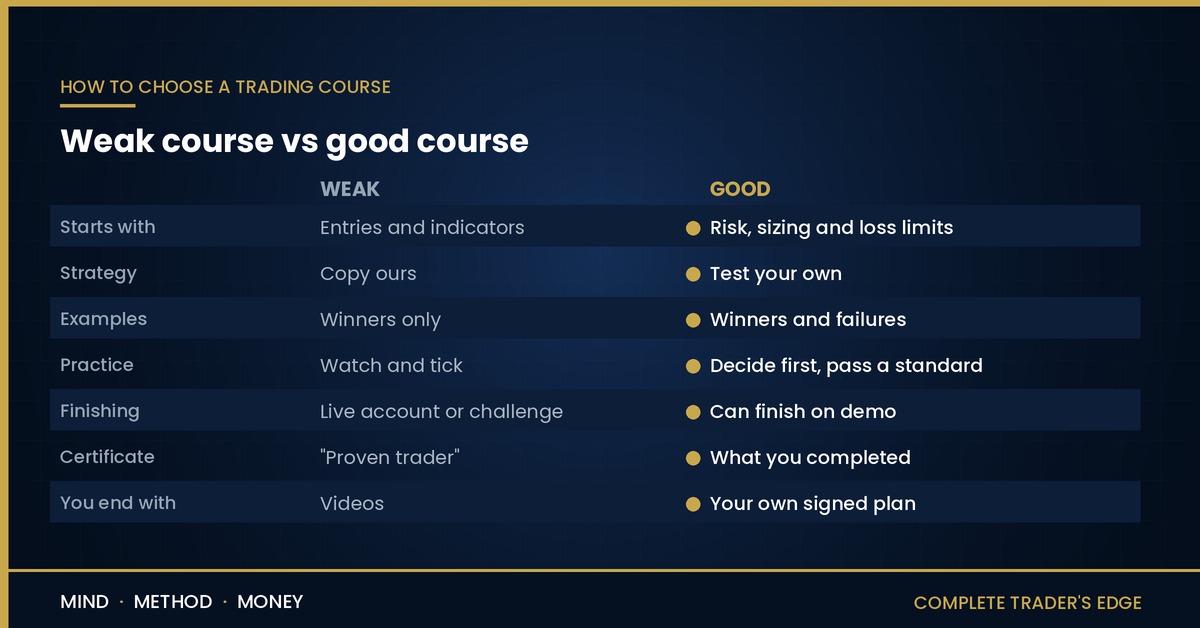
1. Does it teach risk before it teaches setups?
Have a look at the module list. If the first several are about entries, patterns and indicators, and position sizing shows up somewhere around module eight, the order is wrong. You’ll be placing practice trades for weeks before anyone tells you how big they should be.
Accounts rarely die because of a bad entry. They die because a decent entry was taken far too big, or because a losing trade was held with no stop written down anywhere. Those are position sizing and stop-loss problems, and they should be dealt with first. In a good course you’ll work out what a trade costs, how big it should be and where your loss limits sit before you see a single setup.
2. Does it teach you to test, or only to copy?
When a course hands you a strategy and tells you to trade it, you’ve been given someone else’s plan. Borrowed plans tend to fall apart at the first losing streak, because you’ve got no evidence of your own that the rules still work. We wrote about this in why borrowed rules break first.
So find out if the course shows you how to test an idea yourself. That means writing a setup down clearly enough that two people would mark the same trades on the same chart. Then you backtest it by hand, and then you try it on fresh data. Once you can do that, you can judge any strategy you come across, including the ones the course never mentioned.
A QUICK TEST
Ask the seller: “What would show me that your method doesn’t work for me?” Someone who has thought about testing will have an answer ready. Someone who hasn’t will probably tell you to keep practising.
3. Does it show the setups that failed?
Any chart pattern looks reliable if you only pick the examples after the fact. Order blocks, fair value gaps, supply and demand zones, head and shoulders: grab the ten best examples from five years of charts and every one of them looks like a sure thing.
A serious course puts the failures next to the winners. It also checks each idea against something plain. Say a zone “holds” 60% of the time. How often does a random level of the same size hold? Without that comparison you can’t tell a real edge from a shape your eye has learned to spot. Our fair value gap guide tries to work this way, and your setup’s base rate is the number that settles it.
4. Is there practice with a pass standard?
Watching someone mark up a chart feels like learning. Mostly it’s just recognising things. The skill only starts to build when you mark the chart yourself, make a call, and find out if you were right.
Ask what the practice looks like. Are there exercises where the right side of the chart is hidden and you have to decide before you see what happened? Does each one have a standard you need to hit, like “nine out of twelve correct” or “every trade logged with entry, stop and invalidation”? Or do you tick a box once you’ve watched the video? If there’s no standard, it’s really just a box to tick.
5. Can you finish it without risking money?
Some courses quietly need a live account before you can complete them, or they nudge you into a funded challenge at the end. Either way you end up paying twice: once for the course, and again in losses while you’re still learning.
Demo trading isn’t perfect. The fills are kinder and nothing’s at stake. Even so, it’s the right place for a first forward test, as long as you’re honest about labelling your trades as live, forward demo or replay. Replay is good practice, but it doesn’t count as a forward test because you can skip ahead whenever you like. A good course keeps those three separate and lets you finish on demo. Our guide to paper trading and when to go live covers this in more detail.
6. Does it sell one method as the only method?
Plenty of courses are built around one school, whether that’s ICT, Wyckoff, supply and demand, price action or order flow. There’s nothing wrong with that. The trouble starts when the course treats its method as the only way markets work and everything else as noise.
Markets behave differently depending on conditions. A setup built for a trending session will struggle in a range. That doesn’t mean the setup is broken. It’s just outside its regime. Check whether the course teaches you to recognise trending, ranging, quiet and volatile conditions, and to say which ones your setup needs. A course that teaches one method well and is upfront about where it stops working beats one that says it works everywhere.
7. What does it say about losing streaks?
Every edge has rough patches. If a strategy wins 45% of the time, it’ll eventually hit a run of six or seven losses in a row. That’s just how the numbers work, and it doesn’t mean the strategy has failed. There’s more on this in every edge has a painful period.
Look for a course that gets you to work out the drawdown you should expect, using your own win rate and risk per trade. Then it should get you to write down what you’ll do when it happens. At what point do you cut your size? At what point do you stop? If all you ever see are equity curves going up, the course isn’t preparing you for the part of trading that decides whether you last.
8. What does the certificate actually claim?
Certificates cost almost nothing to print, so read the wording. “Certified Trader” or “Proven Trader” after a few weeks of videos and a quiz is claiming far more than any course can check. Nobody looks at your trade log, and a handful of trades doesn’t prove much either way.
An honest completion record just says what you did: the lessons, the exercises, a written plan, maybe a set number of logged trades. It doesn’t say you’re profitable, and it isn’t a licence or a qualification. If the certificate oversells, the rest of the course probably does too.
9. Who earns when you trade?
Follow the money after you’ve paid. Is the course steering you towards one broker, a particular prop firm, a paid signals group, or a monthly community upgrade? None of these is automatically bad, but each one gives the seller a reason to want something you might not.
Signals groups are the obvious example. If the real product is trade alerts, you’re learning to follow someone, and you won’t have much left when the alerts stop. Affiliate links are a smaller issue as long as they’re disclosed. We have them on this site too, and we say so. The thing to ask is whether they’d still recommend that broker if the link paid them nothing.
10. What do you have when it ends?
This one pulls the other nine together. Once you’ve finished, what do you have that you didn’t have before?
A weak answer is “knowledge”, which usually means a folder of videos you’ll never rewatch. A better answer is a written trading plan that’s yours. It should cover your market, your session, your risk per trade, your stop rule, your loss limits and a setup you’ve actually tested, plus a journal where every trade gets checked against it. You’ll stick with a plan you built and tested yourself far longer than one you copied off someone.
Red flags that end the conversation
Some things on a sales page are reason enough to close the tab:
- A win rate with no sample size, no time period and no losing trades shown
- Income screenshots, cars, or “replace your salary in 90 days”
- A countdown timer on a course that’s always for sale
- No mention of risk, drawdown or losing streaks anywhere on the page
- A method described as secret, institutional, or something “they” don’t want you to know
- A refund policy you can’t find
None of these means the teacher can’t trade. They mean the course is being sold on results, and results are the one thing no course can hand you.
Do you even need a course?
Honestly, no. Lots of traders learned from books, a journal and a great deal of screen time. When Richard Dennis trained the Turtles in the 1980s, everyone got the same rules, and their results still ended up all over the place. The rules turned out to be the easy part. Following them when it felt wrong was the hard part.
What a good course gives you is order and feedback: the right things in the right sequence, and practice that tells you when you’ve got it wrong. If you’re disciplined enough to set that up yourself, our step-by-step guide to learning trading and our list of the best trading books will take you a long way for very little money. If you know you need structure, use these ten questions to pick the right one.
THE TEN QUESTIONS
1. Risk before setups? 2. Does it teach testing? 3. Are failures shown? 4. Practice with a pass standard? 5. Can you finish without risking money? 6. Honest about where its method stops working? 7. Ready for losing streaks? 8. Honest certificate? 9. Who earns when you trade? 10. Your own plan at the end?
Not sure where your weak spot is? Try the free Mind · Method · Money assessment. And if you want to check our course against these ten questions, The Independent Trader is open now.
 The Complete Trader's Edge
The full Mind · Method · Money framework. 70 chapters.
View on Amazon →
 Market Mayhem
400 years of bubbles, crashes, and the pattern that keeps repeating.
Buy on Amazon →
 Greatest Companies
How the world's greatest companies were built — and what traders learn from them.
View on Amazon →
 Greatest Traders
Eighty-six lives that explain the markets — Livermore to Madoff, told with the losses left in.
View on Amazon →