
Short answer: sometimes. A trading course is worth paying for when it gives you things that are hard to put together on your own. That means the right topics in the right order, practice that shows you when you’re wrong, and a way to test your own ideas. If it’s mostly selling information you could find for free, or a promise about what you’ll earn, it isn’t worth it. And the price on its own won’t tell you which kind you’re looking at.
Below we go through what you actually get at each price level, the costs nobody mentions on the sales page, and the situations where you shouldn’t buy a course at all.
What you’re really paying for
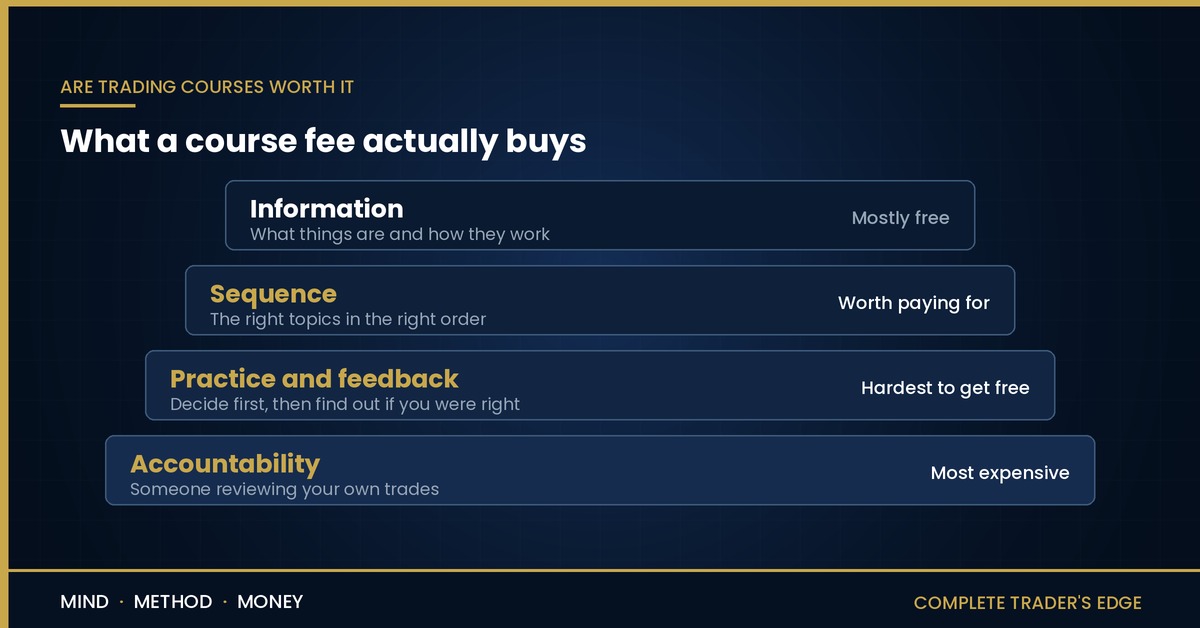
Pretty much every trading course sells some mix of four things. It’s worth pulling them apart, because they’re worth very different amounts.
- Information. What a fair value gap is, how a stop order works, what leverage does. This is close to free. Books, broker academies and YouTube cover most of it well.
- Sequence. What to learn first, and why. Beginners waste a lot of time learning entries before sizing, or indicators before they can read a plain chart. A sensible order is worth paying for.
- Practice and feedback. Exercises where you have to make a call before you see what happens, with a standard you need to hit. This is the hardest thing to find for free, and it’s what turns knowing something into being able to do it.
- Accountability. A person, or a system, that checks if you actually followed your plan. Live mentoring falls here, and it’s the most expensive thing on the list.
When you look at a course, ask yourself how much of the price is really for information. If the answer is “most of it”, you could probably have had it for nothing.
Free: YouTube, broker academies and books
Free material is great for the mechanics and the concepts. You can learn how pips, lots and leverage work, how to read a chart, and what each school of analysis believes without spending a cent. A lot of experienced traders learned exactly this way.
The problems come from how free content is made. It turns up in whatever order an algorithm decides, which is rarely the order you need. It hardly ever asks you to practise. And the examples tend to be the clean ones, because a tidy winning trade makes a better video than a messy loss. You end up with plenty of answers and very little testing.
If you’re disciplined enough to set your own order and your own practice, free is enough. Our step-by-step guide to learning trading is one way to go about it.
Low cost: structured, recorded courses
At the cheaper end of paid courses, usually under a few hundred dollars, you’re mainly paying for the order of things and, in the better ones, for practice. It’s all recorded, so nobody reviews your work personally. A well-built course can still check you, though, with exercises that have clear right answers. Mark the swing points. Size this trade. Make a call on this chart before the next bar appears.
This kind of course is worth it if the practice is real. If it’s two hundred videos and a quiz at the end, you’ve bought a library. If it gets you to size trades, write rules, run a backtest and log a forward test, you’ve bought a process you’d otherwise have to design yourself.
High ticket: live rooms and mentoring
Courses that cost thousands usually add live sessions, a community, and sometimes one-to-one reviews. Out of all that, the only thing clearly worth a big premium is someone reviewing your own trades. You can’t really get that anywhere else.
So before you pay at this level, ask exactly how much personal feedback you’ll get. One group call a month shared between hundreds of people isn’t mentoring. Watching someone else trade live can be fun and now and then useful, but they’re the one making the decisions.
A high price does buy commitment, and that’s real. People tend to finish things they paid a lot for. Still, be honest with yourself about whether you actually need that push before you pay for it.
A SIMPLE VALUE TEST
Write down what you’ll be able to do by the end that you can’t do today. “Know about order blocks” doesn’t count. “Size any trade to a fixed risk, test a written setup over 30 trades and decide whether to keep it” does. If you can’t write that sentence from what’s on the sales page, the course hasn’t told you what you’re buying.
The costs that aren’t on the sales page
The course fee is usually the cheapest part of learning to trade. The bigger costs come later:
- Losses while you learn. Going live too early, at the wrong size, costs far more than any course. A course that keeps you on demo until you’ve got a tested plan can pay for itself just through the losses you avoid.
- Upsells. Monthly community fees, indicator subscriptions, an “advanced” tier. Add up a full year of them before you decide.
- Funded challenges. Some courses finish by pushing you into prop firm evaluations. Every attempt costs money, and a failed one is just another loss.
- Time. If the method doesn’t suit your hours or your market, you can lose months to it.
That’s why the cheapest option doesn’t always work out cheapest. What matters is the total cost of getting to a tested plan, including everything you spend after the first purchase.
When a course isn’t worth it at all
In some situations, buying any course is a bad idea:
- You want trade calls. If you’re after someone telling you when to buy and sell, that’s a signals service, which is a different thing from education. It won’t make you a trader, and you’ll never really know if the results would hold up without that person sending the alerts.
- You haven’t got money you can afford to lose. Learn on demo for free first. The course can wait.
- You’re hoping trading will fix a money problem. Trading is a poor way to get money fast. The pressure warps your decisions, and losing streaks are completely normal. Have a read of can you make a living trading before you go any further.
- You won’t do the work. If you skip the exercises, all you’ve bought is a set of videos.
So, are trading courses worth it?
A good one is, if you’re going to do the practice. It saves you time working out what to learn when. It gives you feedback you’d otherwise get from the market at a much higher price. And you come out the other end with a plan you’ve tested. A bad course isn’t worth it at any price, and you can’t tell the two apart by looking at what they cost.
To tell them apart, use our ten questions for choosing a trading course. They look at what a course actually makes you do and what it counts as finishing, and that’s where the value is.
To be upfront, we’re building a course ourselves, The Independent Trader, so we’ve got a stake in this. We built it around the test above. You start with risk and sizing, then test a setup of your own, run a forward test you can finish on demo, and sign your own trading plan at the end.
Find out where you’re weakest with the free Mind · Method · Money assessment. When you want the full path, The Independent Trader is open: 39 lessons that end with your own trading plan, tested on 30 logged trades.
 The Complete Trader's Edge
The full Mind · Method · Money framework. 70 chapters.
View on Amazon →
 Market Mayhem
400 years of bubbles, crashes, and the pattern that keeps repeating.
Buy on Amazon →
 Greatest Companies
How the world's greatest companies were built — and what traders learn from them.
View on Amazon →
 Greatest Traders
Eighty-six lives that explain the markets — Livermore to Madoff, told with the losses left in.
View on Amazon →