

Everyone who has ever opened a trading account has asked this question. Some ask it with hope. Some ask it after a string of winning trades. Some ask it after watching someone on social media claim $50,000 months from a laptop on a beach. The honest answer is more nuanced than “yes” or “no” — and the numbers behind it will either settle your ambitions on a realistic foundation or clarify exactly what it will take.
Yes, you can make a living trading. Thousands of people do. But the path to that outcome looks nothing like what most trading content suggests, and the timelines involved are longer than most people want to hear. This article gives you the real numbers: realistic income expectations at different capital levels, the actual statistics on who makes it and why, and a clear-eyed comparison with every other career path most people would never question.
The Question Behind the Question
When most people ask “can you make a living trading?”, what they are actually asking is one of three different things:
- “Can I replace my current income with trading income within 12 months?”
- “Is it mathematically possible for trading to generate a full-time income?”
- “Am I wasting my time, or is this a realistic long-term goal?”
The answers are: probably not, yes absolutely, and it depends entirely on how you approach it.
The 90% Failure Rate — In Context
The most quoted statistic in retail trading is that 70% to 90% of retail traders lose money. This is broadly true and well-documented in regulated broker disclosures. But the number is almost always presented without the context that makes it meaningful.
Before drawing any conclusions, consider how it compares with other fields people pursue with equal ambition but rarely question in the same way.
| Career / Field | Start with the dream | Still active at year 5 | Earn a full-time living | Reach elite level |
|---|---|---|---|---|
| Trading (retail) | 100% | ~20-30% | ~5-10% | ~1-2% |
| Law (graduates) | 100% | ~55% still practising | ~45% in legal roles | ~5-8% partner/senior counsel |
| Medicine | 100% | ~75% still clinical | ~65% in practice | ~10-15% specialist/consultant |
| Entrepreneurship | 100% | ~50% survive year 5 | ~30% self-sustaining | ~4-5% scale significantly |
| Architecture | 100% | ~60% qualify | ~40% in architecture roles | ~5% own a practice |
| Acting | 100% | ~20% still auditioning | ~4-5% earning from acting | <1% headline roles |
| Music (artists) | 100% | ~15% still performing | ~2-3% sustainable income | <0.5% mainstream success |
| Professional sport | 100% | ~5% semi-pro level | ~1% full-time income | <0.1% elite level |
| Writing / authorship | 100% | ~30% still writing | ~3% earning full-time | <1% bestseller level |
| Film direction | 100% | ~25% still making films | ~5% sustained income | <1% Hollywood level |
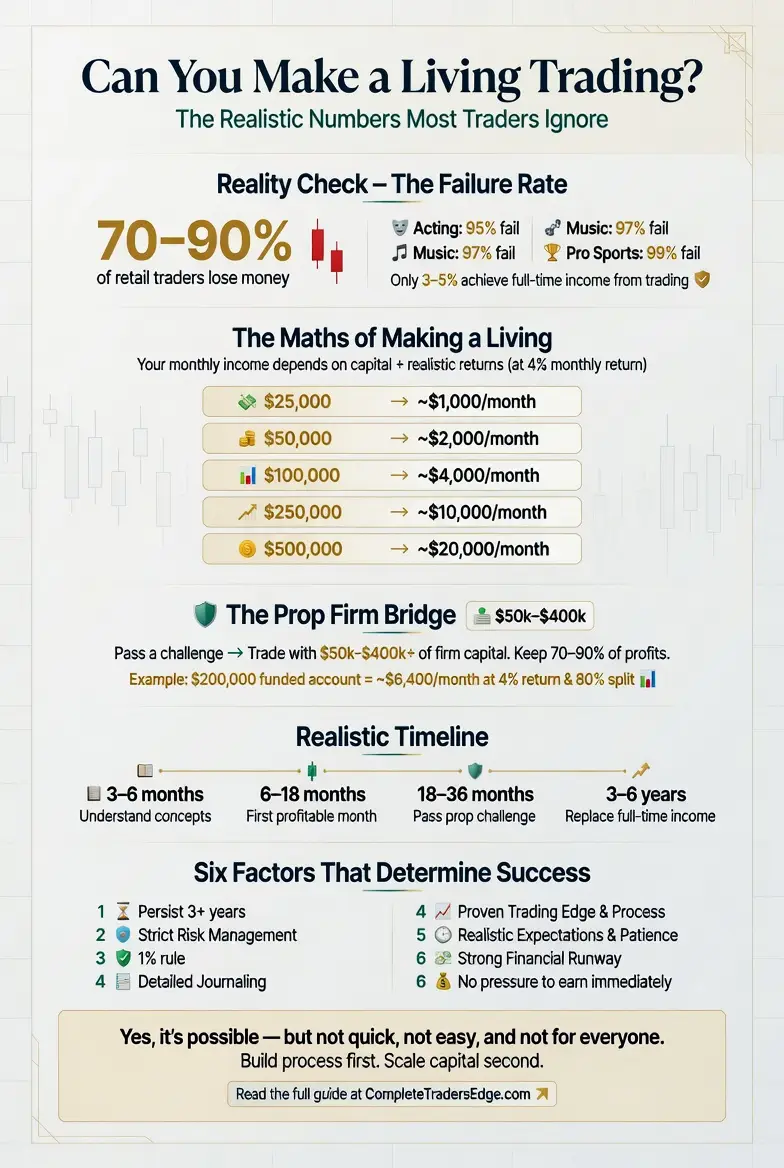
Look at that table carefully. Trading’s “90% lose money” figure is frequently held up as unique evidence that the endeavour is somehow impossible or rigged. But acting has a 95% failure rate by income. Music has a 97% failure rate. Professional sport is effectively 99%. Nobody tells aspiring actors that acting is a scam because 95% don’t earn a living from it.
There is, however, one crucial difference between trading and every other field on that list: the barrier to entry. A medical degree takes 6 years of structured, supervised study before you are allowed to practise independently. Law requires passing bar examinations after years of study. Even getting a role as an actor or musician requires auditions, rejection, and a minimum standard of demonstrated skill before anyone will employ you.
Trading requires an internet connection and a deposit. That is it. The result is that the trading population includes an enormous number of people who are genuinely at the equivalent of “day one of medical school” — no framework, no risk management, no structured learning plan — yet they are already risking real money in live markets. If you applied the same filter to trading as every other profession (structured education before you are counted), the failure rate would look comparable to any other skilled field.
The Maths of Making a Living: What You Actually Need
Professional traders consistently target between 2% and 8% monthly return on capital, depending on their style, risk tolerance and market conditions. For this calculation, let’s use a realistic and sustainable 4% average monthly return — achievable by a skilled, disciplined trader but not trivially easy to sustain.
| Capital base | 4% monthly | Annual income | Lifestyle context |
|---|---|---|---|
| $5,000 | $200/month | $2,400/year | Side income only — not liveable |
| $25,000 | $1,000/month | $12,000/year | Supplement; not full-time income in most countries |
| $50,000 | $2,000/month | $24,000/year | Modest living in lower cost-of-living areas |
| $100,000 | $4,000/month | $48,000/year | Comfortable living in many regions |
| $250,000 | $10,000/month | $120,000/year | Strong full-time income in most countries |
| $500,000 | $20,000/month | $240,000/year | Upper-income lifestyle by any standard |
The maths is blunt: the income you can extract from trading is entirely determined by your capital base. The same strategy, executed with identical skill, produces $200 per month on a $5,000 account and $20,000 per month on a $500,000 account. This is the core reason most retail traders with small accounts cannot make a living from trading, even when their strategy is sound. Most people starting out do not have $100,000 to $250,000 in trading capital. This is the reality that social media traders selling $500 courses carefully avoid discussing.
The Prop Firm Bridge: Solving the Capital Problem
The practical answer to the capital problem is the prop firm model. Proprietary trading firms provide professional capital to traders who can demonstrate a disciplined, profitable process through an evaluation challenge. Instead of needing $100,000 of your own money, you need to pass a challenge on a $10,000 to $25,000 evaluation account and prove you can trade within defined risk parameters.
Pass the challenge, and the firm gives you a funded account of $50,000 to $200,000 or more. You trade their capital. You keep 70% to 90% of the profits. You risk only the evaluation fee (typically $100-$500) rather than your personal capital.
| Prop firm account | 4% return | 80% profit split | Your monthly income |
|---|---|---|---|
| $50,000 | $2,000 | 80% | $1,600/month |
| $100,000 | $4,000 | 80% | $3,200/month |
| $200,000 | $8,000 | 80% | $6,400/month |
| $400,000 | $16,000 | 80% | $12,800/month |
Multiple funded accounts are allowed by most firms, and many professional traders run two to four simultaneously. A trader managing $400,000 across two funded accounts at 4% monthly, keeping 80%, generates $12,800 per month — $153,600 annually — without ever risking significant personal capital. That is a real, achievable number for a skilled trader with a documented process. It is not fast. It is not easy. But it is attainable. Firms like FundedNext and FundingPips are among the more established options in the market.
What Realistic Timelines Actually Look Like
| Milestone | Realistic timeline | What it requires |
|---|---|---|
| Understanding the concepts | 3-6 months | Consistent study, chart reading, paper trading |
| First profitable month on live account | 6-18 months | Small account, strict risk rules, journaling |
| 3 consecutive profitable months | 12-30 months | Consistent process, emotional control, documented edge |
| Pass first prop firm challenge | 18-36 months | 100+ trade sample, proven risk management |
| Replace part-time income | 24-48 months | Multiple funded accounts or significant personal capital |
| Replace full-time income | 3-6 years | Sustained profitability, capital growth, prop firm scaling |
Three to six years to replace a full-time income. That is a long time if you were expecting 12 months. It is a short time if you consider that a medical degree takes 6 years before you earn a cent as a qualified doctor, or that most successful small businesses take 3-5 years to reach sustainable profitability.
The Three Types of “Full-Time Traders”
The income trader
They generate enough trading profit each month to cover living expenses without any other income. This requires either a substantial capital base ($100,000+), a successful prop firm allocation, or both. These traders exist in meaningful numbers, but they represent a minority of those who try.
The income-supplementer
Far more common and far more achievable in the near term. A trader with a $20,000 to $50,000 account generating 3-5% monthly is earning $600 to $2,500 per month. Combined with a part-time income or a scaled-down lifestyle, this represents genuine financial freedom for many people. Many traders here are also building toward income trader status through compounding and prop firm scaling.
The institution-backed trader
This trader works for a proprietary firm, hedge fund or investment bank. They trade firm capital and receive a salary plus performance bonus. Entry to this path typically requires an undergraduate degree in finance, mathematics or computer science, plus demonstrable quantitative skills. It is a formal career path with formal requirements.
The Six Factors That Determine Whether You Make It
| Factor | What it means in practice |
|---|---|
| Longevity | Still trading and learning after 3 years. Most who fail quit within 18 months. |
| Risk management | Never blew an account due to oversizing. 1% rule maintained without exception. |
| Journaling | Every trade recorded from day one. Patterns identified and acted on. |
| Structured learning | Framework built deliberately, not accumulated randomly from different sources. |
| Realistic expectations | Never tried to multiply a small account quickly. Patient with the compounding process. |
| Financial runway | Did not depend on trading income to pay bills while still learning. Income pressure kills objective decision-making. |
The last factor deserves particular emphasis. The single most damaging thing you can do as a developing trader is put yourself in a position where you need to make money from trading this month to pay your rent. Financial pressure transforms every trade from a process-based decision into a survival decision. Survival decisions override risk management, chase returns, and destroy the patience that good setups require.
The Honest Summary
Yes. It is mathematically straightforward at appropriate capital levels, and the prop firm model has made meaningful capital accessible to skilled traders who could not otherwise afford it.
But not quickly. The realistic timeline to full income replacement is 3 to 6 years of structured, disciplined development — roughly comparable to qualifying as a professional in any other skilled field.
And not for the majority who try. The failure rate is real. It is driven primarily by undercapitalisation, no risk management, financial pressure during the learning phase, and abandoning the process before the edge has time to prove itself.
And the income you can earn is directly proportional to your capital base. There is no shortcut around this. A $5,000 account earning 4% per month produces $200. A $200,000 funded account earning 4% per month produces $6,400. The strategy can be identical. The capital determines the income.
Frequently Asked Questions
How much money do you need to make a living from trading?
At a realistic 4% average monthly return, you need approximately $100,000 in trading capital to generate $4,000 per month ($48,000 per year). For a more comfortable living in most Western countries, $200,000 to $250,000 in capital is a more practical target. The prop firm route changes this significantly — a trader managing $200,000 in funded capital and keeping 80% of profits can generate $6,400 per month without having that capital personally. The exact figure depends on your cost of living, your average monthly return, and whether you use personal capital, prop firm capital or both.
Can you make a living from trading with a small account?
Not sustainably, and attempting to do so is one of the most common causes of blown accounts. To generate a living income from a small account, you would need to take excessive risk per trade — which dramatically increases the probability of account destruction before the income goal is reached. Use a small account to build and prove your process, then access meaningful capital through a prop firm evaluation once that process is documented.
What percentage of traders actually make a full-time living?
Estimates vary, but figures consistently suggest somewhere between 3% and 10% of retail traders who persist for several years eventually reach profitability that supplements or replaces other income. The percentage who achieve full-time income replacement from trading alone is at the lower end — probably 3-5% of those who start. This is not dramatically different from success rates in other performance-based fields like professional sport, music or creative arts.
Is day trading or swing trading better for making a full-time income?
Both are viable paths to full-time income, and the choice should be based on temperament and lifestyle rather than which produces higher theoretical returns. Day trading requires dedicated session time (London and New York opens), faster decision-making, and the psychological capacity to handle multiple trades per day. Swing trading requires more patience, fewer active hours, and the ability to hold positions through short-term noise. Many full-time traders combine both: swing trading stocks for a core portfolio while day trading Gold or indices during key sessions.
Do I need to quit my job to learn to trade?
No — and in fact, quitting your job before you have documented profitable trading income is one of the highest-risk decisions you can make as a developing trader. Income pressure during the learning phase is a major driver of poor decision-making. Keep your income source until your trading generates consistent, documented returns that you trust enough to rely on. Most successful full-time traders built their process while employed, often for 2 to 4 years, before making the transition.
▶ ▶ ▶ Continue Reading
Build the foundation that makes full-time trading possible
The Complete Trader’s Edge
The full roadmap to building a sustainable trading income
70 chapters on Mind, Method and Money — from understanding why the failure rate is what it is, to building the process that puts you in the 10%. Available on Amazon in Kindle, paperback and full-colour editions.
 The Complete Trader's Edge
The full Mind · Method · Money framework. 70 chapters.
View on Amazon →
The Complete Trader's Edge
The full Mind · Method · Money framework. 70 chapters.
View on Amazon →
 Market Mayhem
400 years of bubbles, crashes, and the pattern that keeps repeating.
Buy on Amazon →
Market Mayhem
400 years of bubbles, crashes, and the pattern that keeps repeating.
Buy on Amazon →
 Greatest Companies
How the world's greatest companies were built — and what traders learn from them.
View on Amazon →
Greatest Companies
How the world's greatest companies were built — and what traders learn from them.
View on Amazon →
 Greatest Traders
Eighty-six lives that explain the markets — Livermore to Madoff, told with the losses left in.
View on Amazon →
Greatest Traders
Eighty-six lives that explain the markets — Livermore to Madoff, told with the losses left in.
View on Amazon →