

Legendary Traders · U.S. Investing Championship
Goverdhan Gajjala
Seventeen Losses in a Row, Then 805%
2023 winner · $20,000+ Stock Division · Day trader, Dallas
Last reviewed: 25 November 2026. Contest figures come from the organiser’s 2023 final release and its monthly standings archive. The trading history, the losing streak and the rule changes come from Business Insider’s January 2024 profile, in which the reporter viewed his monthly brokerage statements. Complete Trader’s Edge has not seen any account statement.
Part of our championship research
Every modern winner, every division and the month-by-month record behind this profile live on our U.S. Investing Championship hub. The 2026 race is in our October standings report.
Goverdhan Gajjala won the 2023 U.S. Investing Championship stock division for accounts under $1 million with +805.1%. The organiser called it the second-highest performance in the competition’s history at the time. He is a Dallas software consultant, born in India, who day trades small-cap momentum stocks.
The number is not the reason to read his story. In June 2023, halfway through the year he won, he took seventeen losing trades in a row and finished the month down 44.4%, according to Business Insider. And when he entered the competition in January, by the same account, he was not yet a profitable trader.
This profile sets out the published record, the bad month, and the rules he changed afterwards.
Goverdhan Gajjala at a glance
| Field | Detail |
|---|---|
| Background | Born in India, lives in Dallas, Texas. Private software consultant (organiser’s 2023 final release) |
| Started trading | Introduced to stocks and CAN SLIM by a friend who swing traded. He first thought the friend was gambling (Business Insider) |
| Training | About a year in Mark Minervini’s paid private access programme |
| Style | Day trading momentum in low-float small caps on 5-minute charts, from mid-2021 |
| 2023 result | +805.1%, winner, stock division under $1 million. 352 competitors |
| Worst month of the winning year | June 2023, down 44.4% after seventeen consecutive losing trades |
| Verification | Organiser checks statements; Business Insider also viewed monthly brokerage statements. Not an audited composite |
Goverdhan Gajjala’s 2023 U.S. Investing Championship record
| Standings | Return | Context |
|---|---|---|
| 30 Apr 2023 (four months) | +90.7% | On the board |
| 31 May 2023 (five months) | +180.4% | On the board; about +47% in May, by our arithmetic |
| June, July and August boards | – | Not listed. June was the month of the seventeen-trade losing streak |
| 30 Sep 2023 (nine months) | +266.5% | Back on the board |
| 31 Dec 2023 (final) | +805.1% | Winner. Afzal Lokhandwala second at +500.2%, Miguel Zambrano Sánchez third at +347.7% |
Read as a path, the year has three acts. A strong spring took him to +180.4% by the end of May. A collapse in June took him off the published boards for three months. Then a final quarter in which the account grew by roughly 147%, by our arithmetic, from +266.5% to +805.1%.
Our hub uses this sequence as its clearest example of a pattern worth knowing about the monthly standings: the eventual winner is sometimes invisible in the middle of the year. A reader following the June to August boards would not have known he was in the contest.
The June that nearly ended it
Business Insider’s account of June 2023 is the most useful part of the record. After a loss on a single stock, Advanced Health Intelligence, Gajjala revenge traded, the profile says, and the result was seventeen losing trades in a row. He finished the month down 44.4%.
That is a loss of almost half the account in four weeks, inside a year that ended with a title. For most traders a month like that ends the season. He described his earlier trading, before he fixed the habit, as “bleeding by a thousand cuts”.
The changes he made afterwards, as reported by Business Insider, are specific:
- Faster exits. He cut losing trades within five minutes rather than waiting up to fifteen.
- Fewer trades. From five to ten a day down to two or three.
- A routine against revenge trading. Daily meditation, a trade journal, and rehearsing a losing trade in his head and choosing to exit it rather than fight it.
None of these are setups. All three are behaviour, and the final quarter came after them.
From swing trading to day trading
Gajjala began as a swing trader. A friend introduced him to CAN SLIM, and during the pandemic, with remote work freeing up time, he found Mark Minervini and spent about a year in Minervini’s paid private access programme, according to Business Insider. Our hub notes he is one of several modern winners from that programme.
He found swing trading hard to control. Holding for days or weeks in search of 20 to 30% moves, he often caught 5 to 10% and then watched news take the rest. By summer 2021 he was studying scanners, top movers and 5-minute charts of low-float small caps with sudden momentum, such as stocks moving on regulatory news. That is where he moved to day trading, and where his early results were, in his own description, boom and bust: too many trades and no risk management.
The setup, as he describes it
Business Insider set out the three conditions he looks for before entering:
- Demand. Volume rising with price, a sign that many traders are on the long side.
- An orderly pullback. Volume falling as price pulls back, suggesting fewer sellers than buyers. He waits for the selling volume to dry up before entering.
- Support at the moving average. Price touching and holding the 9-period exponential moving average on the 5-minute chart, ideally bouncing off it at least twice.
Readers of the Minervini profile will recognise the logic: demand, a quiet pullback, then support. Gajjala applied it on a 5-minute chart to stocks that can move tens of per cent in a session.
The organiser’s founder, Norman Zadeh, told Business Insider that the record was statistically significant because Gajjala makes many trades, that the style requires constant scrutiny of the market, and that most investors who try for returns like these will lose.
Mind, Method, Money
Goverdhan Gajjala through the three pillars
| Pillar | What the record and the reporting support | What it cannot tell you |
|---|---|---|
| Mind | A documented revenge-trading spiral, then specific rules against it: journalling, meditation, rehearsed exits | Whether the rules have held in the years since 2023 |
| Method | Demand, an orderly pullback and 9 EMA support on 5-minute charts of momentum small caps | Win rate, average hold time or trade count from an independent source |
| Money | Started at about $20 risk per trade while learning; cut losers within five minutes after June 2023 | Account size, position size or the risk per trade in the winning year |
The framework behind the table is set out in The Three Pillars: Mind, Method, Money.

Eighty-six lives read through Mind · Method · Money, from Livermore reading a chalkboard in 1892 to the traders still working from those ideas today. Told as they happened, with the losses left in, and every quotation traced to a source.
The counterweight
A 44% month is the headline, not a footnote. Most accounts that lose 44% in a month do not recover to a title. Survivorship decides which of those stories gets written up.
Small caps are a narrow, crowded game. Low-float momentum stocks can move tens of per cent intraday in either direction, and fills at size are not guaranteed. What works on a $20,000-band account may not work on a larger one.
One year on the record. The 2023 result is verified. We found no later year-end result for him in the organiser’s releases or podiums, and Business Insider’s profile does not cover his results from late 2021 to late 2022.
He now teaches. Gajjala has published a free day trading masterclass. That is not a criticism, but readers should know it when they meet his material.
What actually transfers
Name your revenge trade before it happens. His fix was to rehearse the losing trade and the exit in advance. The habit is cheaper than the month it prevents.
Put a time limit on being wrong. Five minutes instead of fifteen is a rule anyone can write down. Choose the number that fits your timeframe, then keep it.
Cut the trade count when it goes badly. Two or three trades a day instead of ten reduces both cost and the number of chances to tilt.
Read the year as a path. A final number of +805% hides a −44% month. Our psychology of losing and risk of ruin pieces explain why the month matters more than the year.
Free research sheet
The U.S. Investing Championship: The Complete Research Sheet
Five pages covering every modern winner by board, the peak-versus-final and vanished-leader tables, the record book, the original era with source grades, the SEC chapter, and seven rules for reading any number from this contest.
Frequently asked questions
Who is Goverdhan Gajjala?
Goverdhan Gajjala is a Dallas-based software consultant, born in India, who won the 2023 U.S. Investing Championship stock division for accounts under $1 million with +805.1%. He day trades momentum in low-float small-cap stocks.
How did Goverdhan Gajjala make 805%?
By day trading small caps on 5-minute charts, entering when volume rose with price, then pulled back quietly to the 9-period EMA and held it. The year included a June in which he lost 44.4% after seventeen straight losing trades, followed by a final quarter in which the account grew by roughly 147%, by our arithmetic.
What did Goverdhan Gajjala change after his losing streak?
According to Business Insider, he began cutting losers within five minutes instead of fifteen, reduced his trades from five to ten a day to two or three, and added daily meditation, journalling and a rehearsal of exiting a losing trade instead of revenge trading.
Is Goverdhan Gajjala a Minervini student?
Yes. He spent about a year in Mark Minervini’s paid private access programme before moving from swing trading to day trading, according to Business Insider.
Was 805% a record?
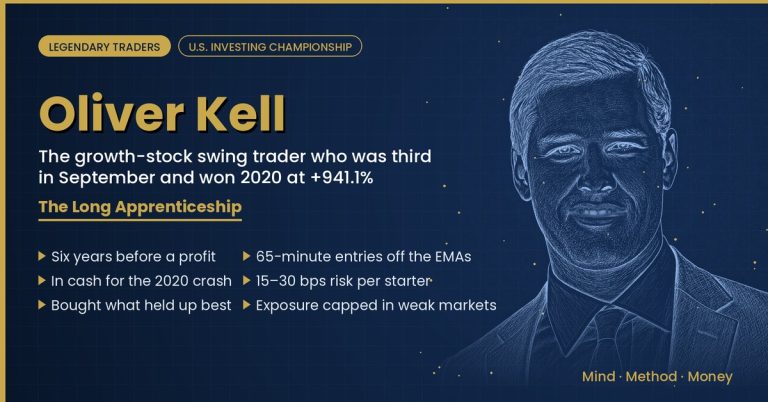
Not the record. The organiser called it the second-highest performance in the contest’s history at the time, behind Oliver Kell’s +941.1% in 2020. Martin Luk raised the Stock Division record to +969.8% in 2025.
Sources and how we built this profile
Results come from the organiser’s 2023 final release (26 January 2024) and its monthly standings archive, as transcribed on our championship hub. Trading history, the June 2023 losing streak, the rule changes and the setup come from Business Insider’s profile published in January 2024, in which the reporter viewed his monthly brokerage statements and quoted Norman Zadeh. Monthly and quarterly changes are our own arithmetic from the organiser’s cumulative returns. Complete Trader’s Edge has no relationship with Goverdhan Gajjala.
Continue Learning
- The U.S. Investing Championship: Winners, Records and Results by Year
- Oliver Kell: Third in October, 941% by December
- Martin Luk: The 969.8% Record, the 26% December, and a 2026 Lead
- Mark Minervini: The Retail Trader Who Became Champion
- Up 960% in November, Third by December: What the Championship Leaderboard Hides
- The Psychology of Losing
- The Three Pillars: Mind, Method, Money
 The Complete Trader's Edge
The full Mind · Method · Money framework. 70 chapters.
View on Amazon →
 Market Mayhem
400 years of bubbles, crashes, and the pattern that keeps repeating.
Buy on Amazon →
 Greatest Companies
How the world's greatest companies were built — and what traders learn from them.
View on Amazon →
 Greatest Traders
Eighty-six lives that explain the markets — Livermore to Madoff, told with the losses left in.
View on Amazon →