

A trading plan is a written document that defines every aspect of how you trade — your markets, your strategy rules, your risk limits, your daily routine, your review process. It is not a strategy document. It is more fundamental than that. It is the operating system your strategy runs on. Without a written plan, every decision you make under pressure is being made without a framework — which means it is being made emotionally.
| Trading Plan Section | What It Contains | Why It Is Non-Negotiable |
|---|---|---|
| Markets and instruments | Which instruments you trade, which sessions, which timeframes | Prevents scope creep and impulsive instrument-hopping. |
| Strategy rules | Entry criteria, exit criteria, setup types, confirmation signals | The core of your edge. Must be specific enough for two traders to take the same trade. |
| Risk parameters | Risk per trade (%), daily loss limit, weekly/monthly drawdown limits | Capital preservation is the foundation. Without this section, one bad day can destroy months of work. |
| Daily routine | Pre-session, in-session, and post-session activities | Routine carries you when motivation fails. Structure produces consistency. |
| Review schedule | Weekly review, monthly KPIs, quarterly strategic review | Without review, mistakes repeat invisibly. With review, improvement compounds. |
| Scaling rules | When to increase size, when to reduce, drawdown protocol tiers | Prevents overconfidence after wins and panic after losses. |
Why Writing the Plan Is the Work
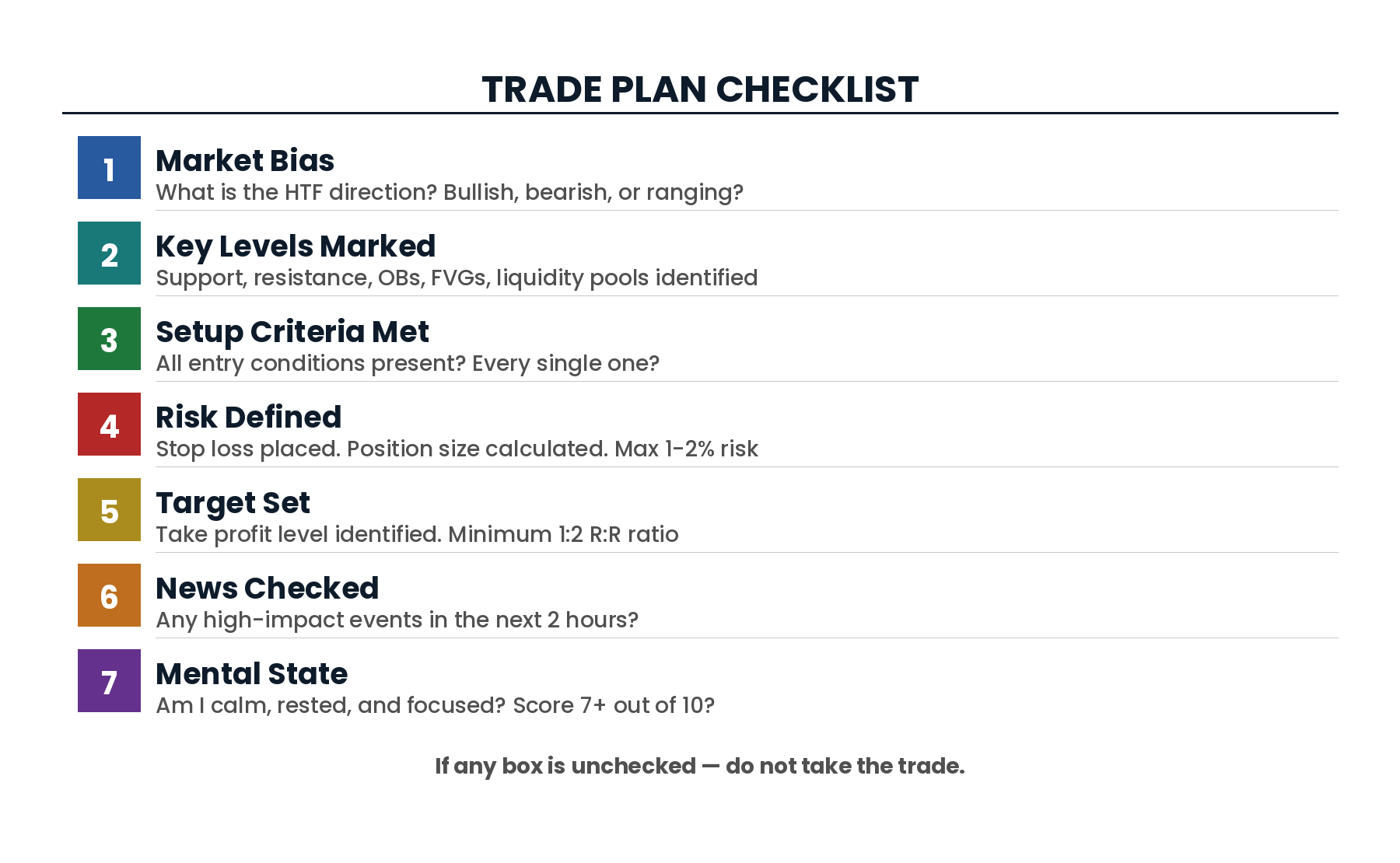
The act of writing forces clarity you cannot fake. You cannot write vaguely about your entry criteria — you are forced to define exactly what qualifies. The gaps in your thinking become visible on paper before the market exposes them at cost. Many traders discover when writing their first real plan that they do not actually have rules — they have habits and instincts they have mistaken for rules. The plan fixes this.
The Complete Trading Plan Template
Section 1: Mission Statement
One paragraph. What are you building? What kind of trader do you want to become? What does success look like in 12 months and 5 years? Write this in the present tense as if it is already true. This is your north star — return to it when you lose direction.
Section 2: Markets and Sessions
- Which markets do you trade? (Forex pairs, indices, commodities, equities?)
- Which sessions? (London, New York, Asian?)
- What timeframes do you use for analysis and for entries?
Section 3: Your Edge — Entry Criteria
Define your setup in unambiguous, testable terms. What must be present before you consider a trade? This section must be detailed enough that you could give it to another trader and they could identify your setups from a chart. If you cannot write it clearly, you do not have a rule — you have a feeling.
Section 4: Exit Rules
- Where does your stop loss go? (Defined by structure, not arbitrary distance)
- Where is your initial target? (First level of liquidity or structure)
- Do you trail the stop? Under what conditions?
- Do you take partial profits? At what level?
Section 5: Risk Management Rules
- Maximum risk per trade: ___% of account
- Maximum daily loss limit: ___% — trading stops for the day when hit
- Maximum weekly drawdown: ___% — mandatory break if hit
- Position sizing method: (Fixed % of account / Fixed dollar risk)
Section 6: Daily Routine
- Pre-session: What do you review? Higher timeframe structure, key levels, economic calendar?
- During session: How do you monitor open trades? What is your check-in process?
- Post-session: What do you record in your journal?
Section 7: Non-Negotiable Rules
List the rules that, if broken, represent a serious discipline failure. These might include: never move a stop loss against you, never trade without a pre-defined exit, never add to a losing position, always record every trade in your journal. These are the rules you protect at all costs.
Section 8: Review Process
How and when do you review your performance? Weekly journal review? Monthly statistics analysis? Quarterly plan update? Define the process — it will not happen consistently without a structure.
Key Lessons
- A written trading plan is the operating system of professional trading — every decision should be pre-decided, not made under market pressure.
- Writing the plan reveals the gaps in your thinking before the market does.
- Non-negotiable rules defined in advance are the primary protection against emotional decision-making.
- Review and update your plan regularly — it is a living document that evolves as your trading develops.
→ Becoming a Trader: Complete Roadmap | The Trading Journal Guide
 The Complete Trader's Edge
The full Mind · Method · Money framework. 70 chapters.
View on Amazon →
The Complete Trader's Edge
The full Mind · Method · Money framework. 70 chapters.
View on Amazon →
 Market Mayhem
400 years of bubbles, crashes, and the pattern that keeps repeating.
Buy on Amazon →
Market Mayhem
400 years of bubbles, crashes, and the pattern that keeps repeating.
Buy on Amazon →
 Greatest Companies
How the world's greatest companies were built — and what traders learn from them.
View on Amazon →
Greatest Companies
How the world's greatest companies were built — and what traders learn from them.
View on Amazon →
 Greatest Traders
Eighty-six lives that explain the markets — Livermore to Madoff, told with the losses left in.
View on Amazon →
Greatest Traders
Eighty-six lives that explain the markets — Livermore to Madoff, told with the losses left in.
View on Amazon →