

SNAPSHOT · 18 NOVEMBER 2026
Anthropic is marketing 825 million Class A shares at $70–78, with pricing expected tonight New York time and the first trade on Nasdaq tomorrow, 19 November, under the ticker ANT. At the $74 midpoint the IPO shares raise about $61bn, or $70bn with the over-allotment. Seven strategic partners led by Google and Nvidia are buying a further $26bn of non-voting Class N shares at the IPO price.
The amended filing also puts the missing quarter on the record: Q3 revenue of $17.0bn, up 1,127% year on year. On basic shares the range values Anthropic at $916bn to $1.02tn, well below the $1.5–2tn the press was talking about a month ago.
Three weeks ago we went through Anthropic’s original S-1 line by line. Since then the company has filed three amendments, set a price range, found its cornerstone buyers and opened 20% of the deal to retail brokers. The AI stocks it will trade alongside have had a rough three weeks. Nvidia is down 28% since the filing and the Nasdaq-100 is down 7.8%.
This piece covers what changed in the terms, what the numbers say about value, what the last trillion-dollar listing did after its own debut, and what to watch from the opening print tomorrow. We will add the day-one result at the bottom once ANT has closed.
The Anthropic IPO Price and Terms
All figures below come from Amendment No. 3 to the S-1, filed with the SEC on 17 November 2026, unless marked as a press report.
Anthropic IPO: the offer at a glance
| Term | Detail |
|---|---|
| Ticker and exchange | ANT, Nasdaq Global Select Market (listing approved; Form 8-A filed 17 Nov) |
| Price range | $70–78 per Class A share |
| Shares offered | 825,000,000: 801,351,354 from Anthropic, 23,648,646 from the seven co-founders |
| Over-allotment option | 123,750,000 shares |
| Class N private placement | $26.0bn of non-voting shares at the IPO price, from Google, Nvidia, AMD, Broadcom, Micron, Microsoft and TSMC |
| Net proceeds to Anthropic | About $84.6bn at $74, or $93.7bn if the option is exercised |
| Shares outstanding after the offering | 13,086,672,593 (Class A 7,427,991,791; Class N 5,658,680,800) |
| Retail allocation | Up to 20%, through Schwab, Fidelity, Robinhood, Trade-PMR, SoFi and E*TRADE |
| Lead banks | Goldman Sachs and Morgan Stanley, with 20 further underwriters |
| Timing | Pricing expected the evening of 18 Nov (New York); trading 19 Nov (CNBC, Anthropic’s IPO website) |
Source: Anthropic PBC Form S-1/A, Amendment No. 3, 17 November 2026. Timing as reported by CNBC and on Anthropic’s IPO website.
Two things in this table matter more than the headline range.
The Class N placement is a quarter of the cash. At the $74 midpoint, Google and Nvidia each buy 135,135,135 shares, about $10bn apiece. The other five take the rest of the $26bn. These are Anthropic’s suppliers and, in Google’s and Microsoft’s case, its cloud landlords and rivals. Their money comes in at whatever price tonight’s book sets, with no discount.
The co-founders are selling, but barely. 23.6 million secondary shares is under 3% of the offering. Almost all of the IPO money goes to the company, not to existing holders cashing out. That is the opposite of the pattern that hurt buyers of several listings in our series, where early holders used the IPO as an exit.
Is It the Largest IPO in History?
It depends what you count, and the answer is more interesting than the headlines suggest.
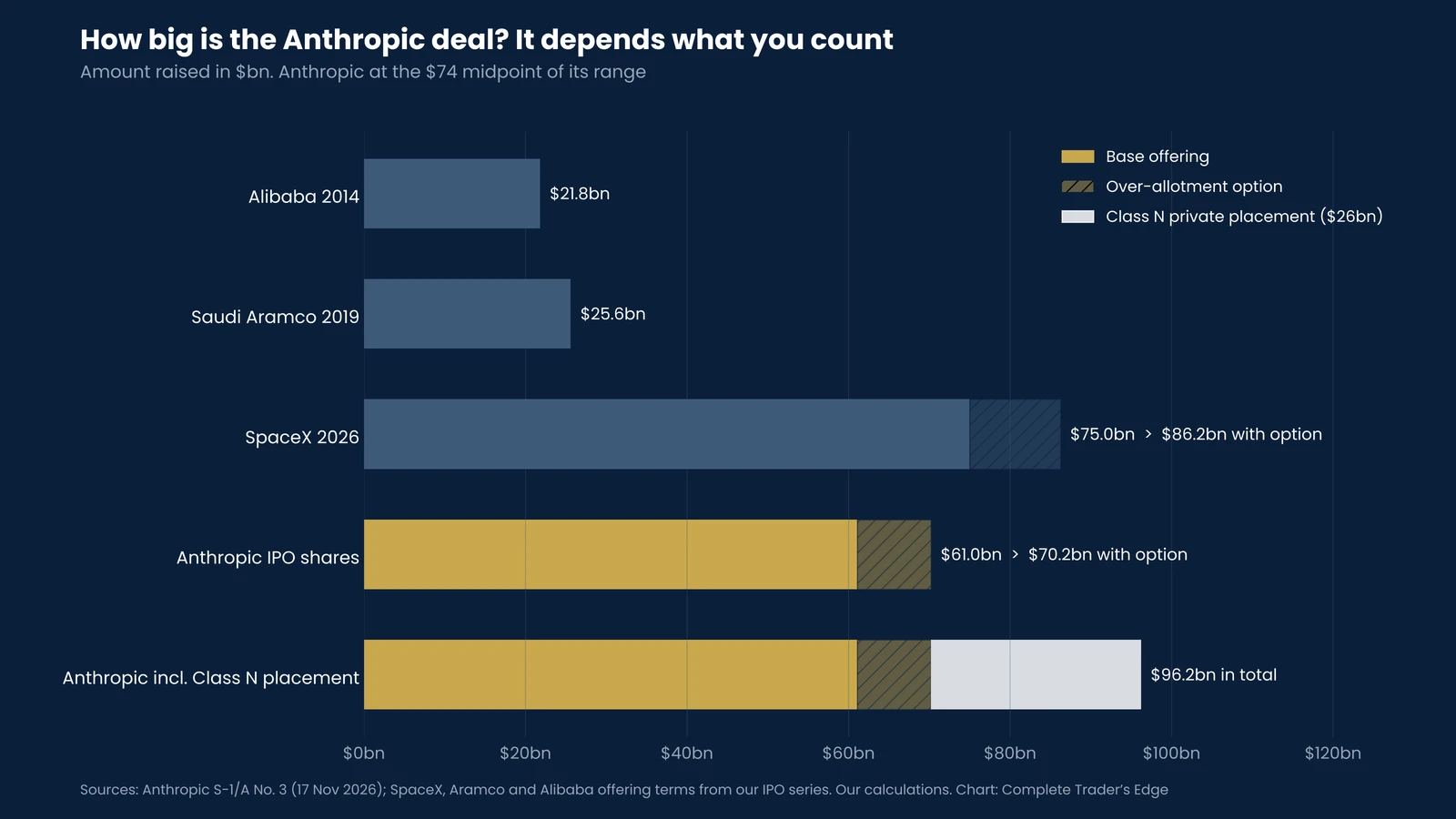
- IPO shares only: 825 million shares at $74 is $61.0bn. That is below SpaceX’s $75bn base deal in June. To beat it on base shares alone, ANT would need to price above about $91, well over the top of the range.
- With the over-allotment: $70.2bn at the midpoint, against $86.2bn for SpaceX.
- Including the Class N placement: about $96bn at the midpoint. TradingKey cites up to $90.4bn at the top of the range on base shares plus the placement.
So the record claim rests on the private placement. That is not a technicality for a trader. The $26bn of Class N stock is non-voting and goes to seven strategic holders. It does not trade on day one. The supply that actually hits the order book tomorrow is the 825 million Class A shares, plus whatever early-release insider stock is eligible. Measured by tradable supply, this is a smaller deal than SpaceX, with a 20% retail tranche against SpaceX’s 30%.
Demand looks strong. Bloomberg reported orders of about six times the shares on offer, according to mlq.ai and TradingKey. Board members have indicated interest in buying up to $303m of shares. Oversubscription that heavy usually means one of two things by tonight: pricing at or above the top of the range, or an upsized deal. Either changes the arithmetic above, so check the final terms before relying on any of it.
What Changed Since the S-1
Our first breakdown flagged an unfiled third quarter, a valuation that existed only in press reports, and a lock-up spread across more than 20 windows. The amendments have answered each of those.
The quarter is now filed. Q3 2026 revenue was $17.0bn, up 1,127% from a year earlier. The press had reported $16.8bn, so the filed number came in slightly higher. Compute expenses rose 382% over the same period, about a third of the revenue growth rate. That widening gap is the unit-economics story from the S-1 continuing for another quarter.
The balance sheet is enormous before a single IPO dollar arrives. At 30 September Anthropic held $95.6bn in cash and $36.3bn in short-term investments. Add roughly $85bn of net proceeds and the company will hold more than $200bn of liquidity. That is more than most of its suppliers.
The valuation is lower than the talk. In October the Financial Times reported that existing investors expected $1.5–1.75tn, and the Wall Street Journal reported $1.5–2tn. The range values the company at $916bn to $1.02tn on the 13.09 billion shares outstanding after the offering, or about $1.26–1.41tn fully diluted according to press calculations. The midpoint on basic shares is close to the $965bn Series H valuation from May, though the two are not measured on the same share basis.
The principle: a price range set below the market chatter is a deliberate choice. Banks want a book that is many times covered and a first-day gain, because a broken deal hurts the next one. A modest range with six-times demand is built to pop. Whether that pop is yours to chase is a separate question.
Anthropic Valuation Against Revenue
Our first piece compared Anthropic and SpaceX on value against annualised latest-quarter revenue. With a filed quarter and a filed range, the comparison is now on firmer ground.

Value against annualised Q3 2026 revenue
| Company | Value | Annualised revenue | Multiple |
|---|---|---|---|
| Anthropic at $70 | $916bn | $68.0bn | 13.5x |
| Anthropic at $74 | $968bn | $68.0bn | 14.2x |
| Anthropic at $78 | $1,021bn | $68.0bn | 15.0x |
| Anthropic fully diluted (press) | $1,260–1,410bn | $68.0bn | 18.5–20.7x |
| SpaceX (SPCX) at 17 Nov close | about $1,900bn | $58.3bn | 32.6x |
Anthropic value on 13,086,672,593 shares outstanding after the offering; Q3 revenue of $17.0bn from the S-1/A, multiplied by four. SPCX value scaled from TradingView at the 17 November close of $141.70; SpaceX revenue from its Q3 2026 results. Our calculations.
The bull case writes itself. Anthropic grows faster than SpaceX, its compute ratio keeps improving, and it is being offered at less than half SpaceX’s multiple. If the first day closes 50% above the midpoint, the basic-share multiple would still be only about 21x.
The bear case is just as plain. Annualising a quarter that grew more than elevenfold in a year assumes the curve holds. The company itself warns in its risk factors that it may not. Half a trillion dollars of compute commitments do not shrink if revenue does. And the multiple flatters any company growing this fast, which is exactly what made Rivian look cheap on its forward numbers in 2021.
The Tape Anthropic Is Pricing Into
Anthropic does not list into a calm market. Since the S-1 was filed on 26 October, the stocks most tied to its business have been mixed to weak.
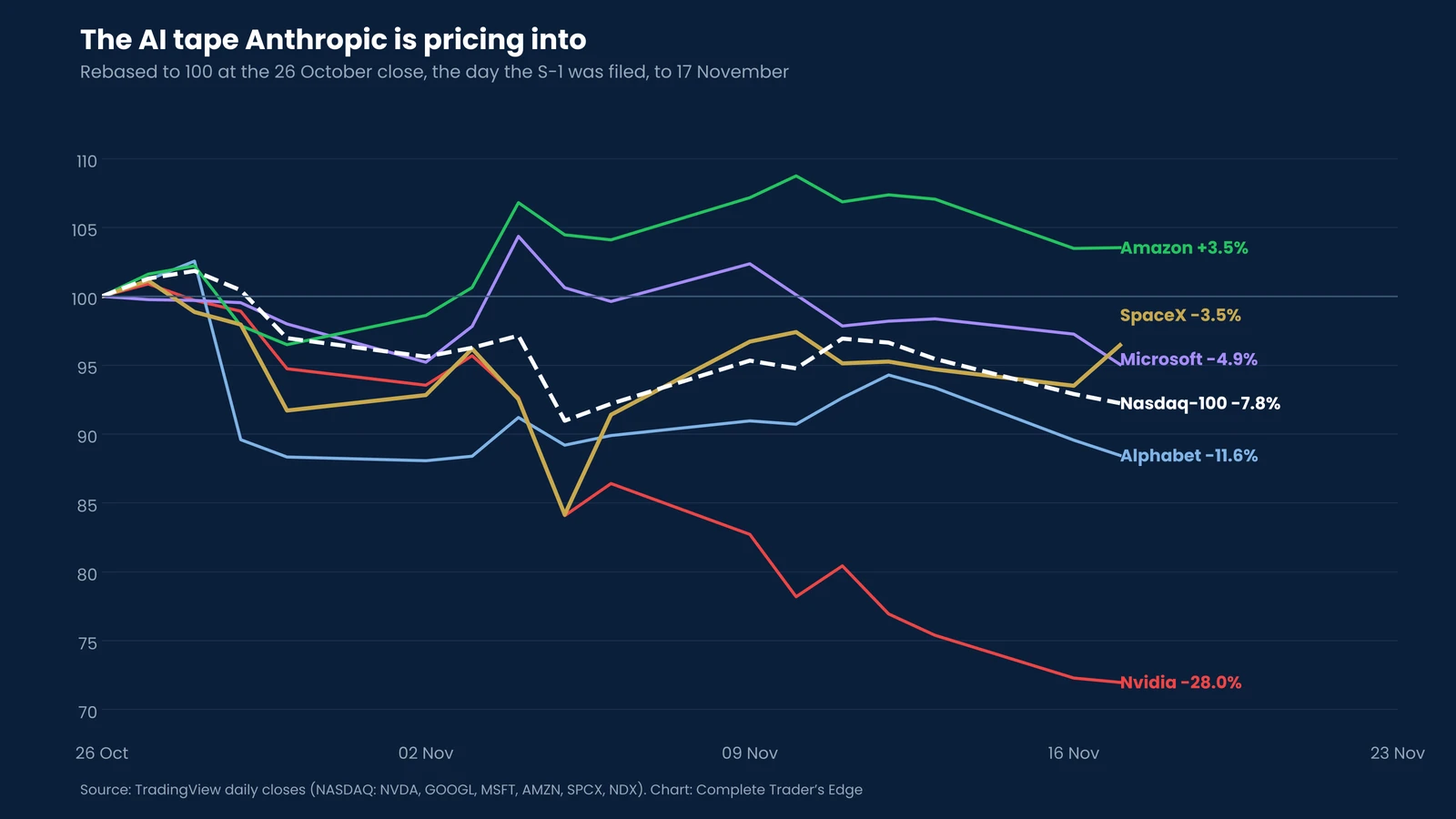
- Nvidia, down 28.0% from $216.00 to $155.46. That covers Jensen Huang’s departure, which we covered in Nvidia without Jensen Huang, and the run into last night’s Q3 results. Today’s session is the first to trade on those numbers. Nvidia is buying about $10bn of ANT in the placement.
- Alphabet, down 11.6%, most of it in a single 12.6% fall on 29 October. Google is Anthropic’s largest compute supplier, a major shareholder and the other $10bn Class N buyer.
- Microsoft, down 4.9%; Amazon, up 3.5%. Amazon is the only name on the chart above its 26 October level.
- SpaceX, down 3.5%, closing below its $135 IPO price on three days, with a low close of $123.62 on 5 November. Anthropic is the largest customer of SpaceX’s AI division.
- The Nasdaq-100, down 7.8%.
Six-times demand into a falling AI tape says the book is pricing Anthropic on its own numbers rather than on sector mood. It also means the stock opens into a group that has been sold hard. If the sector keeps falling, a hot debut has less underneath it.
What SPCX Did After Its Own Debut
SpaceX is still the closest template: a founder-controlled, trillion-dollar listing with a large retail tranche, sold partly on an AI story, five months ago. Here is the full path to last night’s close.
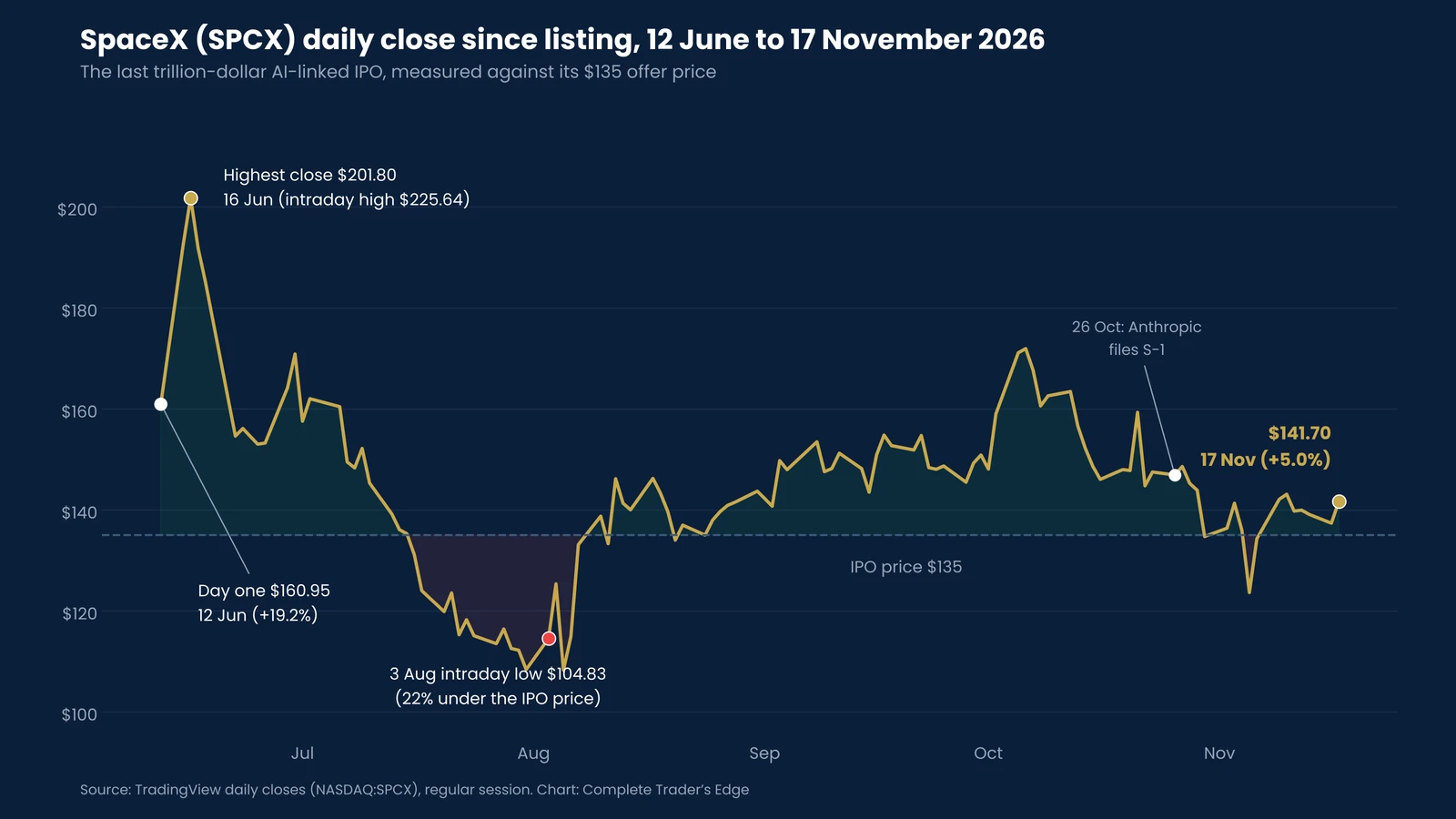
- Priced at $135. First close $160.95, up 19.2%.
- Highest close $201.80 on 16 June, the third session, with an intraday high of $225.64.
- Below the offer price from mid-July. Intraday low of $104.83 on 3 August, 22% under $135.
- Closed at $141.70 on 17 November: 5.0% above the IPO price, and 3.5% lower than on the day Anthropic filed.
Anyone who received SPCX at $135 is ahead. Anyone who bought on the first three days, when the stock was everywhere, is still behind five months later. That is the most useful single fact for anyone planning to buy ANT at the open tomorrow. The SPCX lock-up breakdown shows how much of the summer slide was supply rather than news.
The Lock-Up Calendar
The amended filing sets out a more conventional structure than the original draft suggested.
- 180 days for most holders, covering about 15.5 billion Class A shares. Counted from 19 November, that ends around mid-May 2027.
- Up to 365 days for the co-founders and holders of more than 0.5%.
- Early-release provisions cover about 3.7 billion shares, including up to 10% of shares held by non-founder insiders from day one. Up to 315 million insider shares are eligible to trade from the first session.
- According to the amended filing, the Class N placement shares are not covered by the lock-up. In practice the buyers are strategic partners with no obvious reason to sell, but there is no contractual wall either.
Put that against the 825 million shares in the offering. Up to 315 million eligible insider shares on day one is a large overhang relative to the float, even if most of it never comes to market. That supply has to be absorbed before the first earnings report as a listed company. SpaceX’s first big unlock coincided with its slide below the offer price.
Anthropic Against the IPO Record Book
The pattern from our IPO case-study series still holds. Day one tells you about demand. It tells you very little about the next three years.
Landmark IPOs: size, day one and the ending
| IPO | Raised | Day one | The ending |
|---|---|---|---|
| Amazon 1997 | $54m | +30.6% | Down more than 90%, then a 2,000x survivor |
| Google 2004 | $1.67bn | +18.0% | Compounded 60x with no near-death |
| Visa 2008 | $17.9bn | +28.4% | Launched into a crisis, compounded for two decades |
| Facebook 2012 | $16.0bn | +0.6% | Fell 54%, then a tenfold dynasty |
| Alibaba 2014 | $21.8bn | +38.1% | Biggest pop, then through the floor |
| Saudi Aramco 2019 | $25.6bn | +10.0% | Biggest ever, still fell about 29% |
| Uber 2019 | $8.1bn | −7.6% | Fell 67%, then doubled over years |
| Rivian 2021 | $11.9bn | +29.1% | Up 120% in a week, then about −85% |
| SpaceX 2026 | $75.0bn | +19.2% | +5.0% at 17 Nov, after a 22% dip below the offer |
| Anthropic 2026 | $61bn IPO + $26bn placement (at $74) | 19 Nov | Not yet written |
Base offering sizes before over-allotment. Endings approximate, measured against each offer price, from our IPO series. SPCX from TradingView (NASDAQ:SPCX) to the 17 November 2026 close.
Two of these match ANT’s set-up most closely. Google priced with discipline, under founder control, and rewarded patient holders from day one. Alibaba drew enormous demand, opened far above its price, and punished the people who chased the open. The difference was not the company. It was the price paid on the first day.
What to Watch on Day One
If you plan to trade ANT, or SPCX and Nvidia around it, these are the things that will tell you the most in the first 48 hours.
- Where it prices against the range. Above $78 confirms the demand reports and raises the bar for a first-day gain. At or below the midpoint, despite six-times cover, would say the banks chose to leave room.
- Whether the deal is upsized. More shares means more supply on day one. Check the final share count, not just the price.
- The opening indication and the first trade. Large IPOs do not open at 09:30. SpaceX’s first trade came at 11:46 New York time, which is 18:46 in South Africa. Expect ANT’s opening cross some time after midday in New York. The gap between the IPO price and the first trade is the number everyone will quote.
- The first-day close against the open. A stock that closes below its opening print has already handed losses to everyone who bought the open. That matters more than whether it closed above the IPO price.
- Sympathy moves. Watch SPCX, Nvidia and Alphabet in the same session. Money rotating into ANT has to come from somewhere, and it may come out of the AI names people already own.
- Volume in the following sessions. With up to 315 million insider shares eligible from day one, the first week’s volume shows whether that stock is coming to market.
The Anthropic IPO Through Mind, Method and Money
Mind. Tomorrow will feel like the event of the year, because it will be covered that way. The SPCX chart shows the cost of acting on that feeling. The first three days were the most exciting, and the buyers in those three days are still underwater five months later. If you want a position because everyone is talking about one, notice it and wait.
Method. A first-day stock has no history, no levels and no volume profile. Almost every edge that depends on structure is missing. The IPO price itself is the only reference everyone shares, which is why SPCX kept returning to $135. A sound plan is to let ANT print its first range, wait for the first earnings report and the first meaningful unlock, and trade the levels the market creates. Write your conditions down tonight, before the first trade, so you are not inventing them in the moment.
Money. SPCX moved from +19% on day one to +49% at its highest close and −22% at its August low in under two months. Size any ANT position for that range, not for a normal large cap. A 1% account risk on a stock that can move 20% in a session means a small position and a wide stop. Our trading calculators will show you what your rules allow before you place the order.
The Short Version
Anthropic prices tonight at $70–78 and trades tomorrow as ANT. The amended filing confirms Q3 revenue of $17.0bn, a compute bill growing far more slowly than sales, and over $130bn of cash and short-term investments before the IPO money arrives. The range values it at about 14x annualised revenue on basic shares, less than half SpaceX’s current multiple.
It is the largest raise ever only once you count the $26bn sold privately to Google, Nvidia and five other partners. The IPO shares alone are a smaller deal than SpaceX. Demand is reported at six times the shares on offer, into an AI sector that has fallen since the S-1.
The record book says the size of the deal and the first-day move will tell you little about the next three years. SPCX says the same thing in five months of data. The pattern we trace across four centuries in Market Mayhem is the one to keep in mind: a real business, a bigger story around it, and a price that moves on the story and the supply before the business settles the argument.
Day One: Update
This section will be updated after ANT’s first close on 19 November with the final IPO price, the opening trade, the first-day close and how SPCX, Nvidia and Alphabet traded in the same session.
Related Reading
- Anthropic IPO: Inside the S-1, the IPO Record Book, and SpaceX on Both Sides – the original filing, line by line.
- SpaceX IPO 2026: What Traders Must Know Before the Biggest Listing in History – the template for ANT.
- SPCX Stock: The IPO That Fell Below Its Price – how a lock-up calendar moved a trillion-dollar stock.
- SpaceX Q3 Earnings: The First Real Profit, and the Bill Underneath It – the AI segment Anthropic pays into.
- Nvidia Q3 Earnings – last night’s results from Anthropic’s $10bn placement partner.
- AI Bubble vs Dotcom Bubble: What the Data Actually Says – the wider valuation backdrop.
- The M·M·M Assessment – find your weakest link before a headline IPO finds it for you.
Frequently Asked Questions
When does Anthropic start trading?
Pricing is expected on the evening of 18 November 2026, New York time, with trading on Nasdaq from 19 November, according to CNBC and Anthropic’s IPO website. Large IPOs usually open some time after the 09:30 bell; SpaceX’s first trade in June came at 11:46 New York time.
What is the Anthropic IPO price range?
$70 to $78 per Class A share, according to Amendment No. 3 to the S-1 filed on 17 November. The final price is set after the book closes and can fall outside the range.
How much is Anthropic raising?
At the $74 midpoint, the 825 million IPO shares raise about $61bn, or $70bn with the 123.75 million-share over-allotment. A separate $26bn private placement of non-voting Class N shares to Google, Nvidia, AMD, Broadcom, Micron, Microsoft and TSMC brings the total to roughly $96bn. Anthropic’s net proceeds are about $84.6bn at the midpoint.
What is Anthropic’s valuation at the IPO?
On the 13.09 billion shares outstanding after the offering, the range values Anthropic at $916bn to $1.02tn. Press reports put the fully diluted value at about $1.26–1.41tn. That is below the $1.5–2tn reported in October.
Can retail investors buy Anthropic IPO shares?
Up to 20% of the offering is allocated to retail investors through Schwab, Fidelity, Robinhood, Trade-PMR, SoFi and E*TRADE. Allocation depends on each broker’s rules and demand. Everyone else can buy once ANT starts trading on Nasdaq.
When does the Anthropic lock-up end?
For most holders, 180 days after the IPO, which points to around mid-May 2027. Co-founders and holders of more than 0.5% are locked up for up to 365 days. Early-release provisions cover about 3.7 billion shares, and up to 315 million insider shares can trade from the first day.
The takeaway. The terms are built for a strong debut: a modest range, heavy demand, a filed record quarter and $26bn of strategic money alongside. None of that tells you what ANT is worth at the price you can actually buy it tomorrow. SPCX shows how far a celebrated listing can travel either side of its offer price in five months.
Decide your rules before the first trade. The CTE trading calculators will tell you what your risk limits allow.
This article is educational and is not financial advice. It does not recommend buying or selling Anthropic, ANT, SpaceX, SPCX, Nvidia, Alphabet or any security. Offering terms, share counts, Q3 revenue, cash balances and lock-up terms are taken from Anthropic PBC’s Form S-1/A, Amendment No. 3, filed with the SEC on 17 November 2026. Timing is as reported by CNBC and on Anthropic’s IPO website. Order-book demand is as reported by Bloomberg via mlq.ai and TradingKey; fully diluted valuation and earlier valuation talk are press reports from the Financial Times, the Wall Street Journal and others. Stock prices are TradingView daily closes to 17 November 2026. Valuation multiples are our calculations. Final terms may differ from the range. Prices change constantly; verify current figures against primary sources before making any decision. Trading and investing carry risk, including the loss of capital.
 The Complete Trader's Edge
The full Mind · Method · Money framework. 70 chapters.
View on Amazon →
 Market Mayhem
400 years of bubbles, crashes, and the pattern that keeps repeating.
Buy on Amazon →
 Greatest Companies
How the world's greatest companies were built — and what traders learn from them.
View on Amazon →
 Greatest Traders
Eighty-six lives that explain the markets — Livermore to Madoff, told with the losses left in.
View on Amazon →