

SNAPSHOT · 20 OCTOBER 2026
SpaceX reported third-quarter revenue of $14.58 billion, up 161% year on year and well ahead of the $12.72 billion consensus. Net income was $4.4 billion, or 35 cents a diluted share, against roughly 14 cents expected. It is the company’s first profitable quarter as a listed business.
SPCX closed the regular session at $147.79 and traded 2–3% higher after hours. Capital expenditure was $19.59 billion. On Thursday 22 October, up to roughly 1.3 billion shares come out of lock-up.
SpaceX beat its third-quarter estimates by a wide margin. Revenue nearly doubled from the second quarter, every segment came in ahead of forecasts, and the company swung from a $143 million operating loss to a $2.79 billion operating profit in ninety days.
In August we called the first report the beat that cost $18 billion. The capex is still there, slightly larger. What changed is that revenue grew far faster than the spending did. That is the good news, and it is genuine.
The rest of this piece is about the parts of the release that the headline numbers do not show: where a third of the profit came from, what the cash statement says, and why Thursday matters more to the next fortnight of price action than anything Elon Musk said on the call.
What SpaceX Reported in Q3
The headline figures from the company’s results release, filed with the SEC on 20 October, against consensus:
REVENUE
$14.58 billion against $12.72 billion expected (LSEG). That compares with $7.81 billion in Q2 and $5.58 billion a year ago. Of the $6.8 billion added since the second quarter, $5.0 billion came from the AI segment, now renamed Super Intelligence.
NET INCOME
$4.40 billion, or $0.35 a diluted share, against consensus near $0.14. A year earlier the company lost $1.05 billion. In Q2 it lost $541 million.
OPERATING INCOME AND ADJUSTED EBITDA
Operating income of $2.79 billion, up from a $143 million loss in Q2. Adjusted EBITDA of $8.81 billion, up from $3.54 billion and against roughly $6.6 billion expected.
CAPITAL EXPENDITURE
$19.59 billion, in line with the $19.6 billion forecast and up from $18.37 billion in Q2. Super Intelligence took $16.44 billion of it.
Q3 2026 against consensus
| Metric | Reported | Consensus | Difference |
|---|---|---|---|
| Revenue | $14.58bn | $12.72bn | +15% |
| Diluted EPS | $0.35 | $0.14 | +$0.21 |
| Adjusted EBITDA | $8.81bn | $6.59bn | +34% |
| Super Intelligence revenue | $7.56bn | $6.47bn | +17% |
| Connectivity revenue | $5.25bn | $4.84bn | +8% |
| Space revenue | $1.77bn | $1.46bn | +21% |
| Capital expenditure | $19.59bn | $19.6bn | In line |
| Starlink consumer subscribers | 13.6m | 12.19m | +12% |
Consensus sources: LSEG (revenue), TipRanks (EPS, Space revenue), Bloomberg via Yahoo Finance (EBITDA, capex), StreetAccount via CNBC (SI and Connectivity revenue), Reuters (subscribers). Providers differ; figures are indicative.
The Ratio That Moved: Capex per Dollar of Revenue
In the second quarter SpaceX spent about $2.35 of capex for every dollar of revenue. In the AI segment alone the figure was about $6.20.
In the third quarter those numbers fell to roughly $1.34 for the group and $2.18 for Super Intelligence. Spending rose by $1.2 billion. Revenue rose by $6.8 billion.
That is the single most important change between the two reports. The bear case in August was that the company was pouring capital into data centres with no clear sign of the revenue arriving. In Q3 the revenue arrived, and in size. Nameplate compute rose to 1.7 gigawatts from 1.4 GW at the end of June and 0.6 GW a year earlier, as the Colossus II build continued, and the new capacity was rented out quickly.
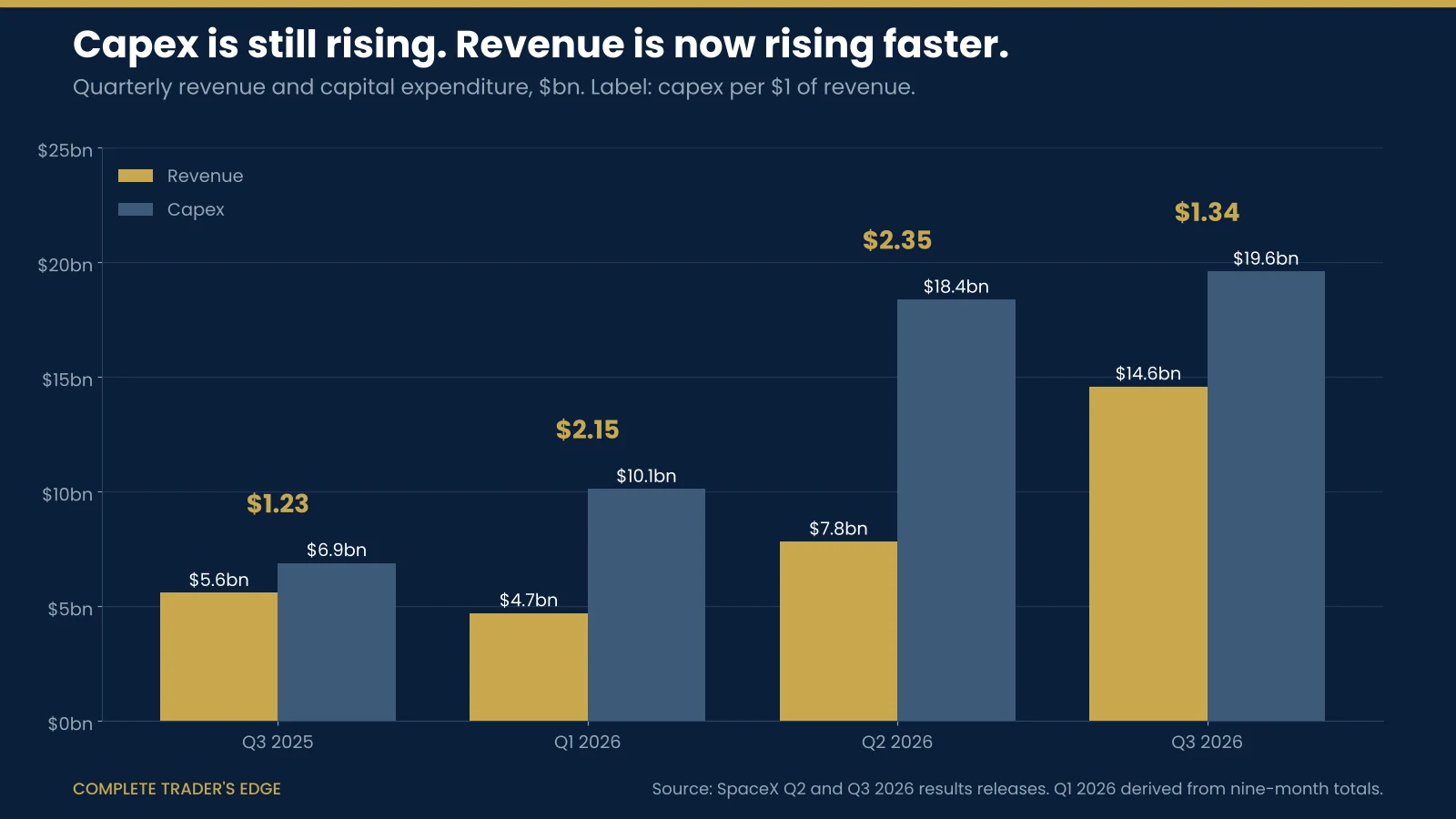
It does not mean the spending problem is solved. The company is still spending more than it earns, as the cash section below shows. It does mean the gap between investment and return closed far faster than most models assumed.
Segment results, $bn
| Segment | Q3 2025 | Q2 2026 | Q3 2026 |
|---|---|---|---|
| Space revenue | 1.67 | 0.96 | 1.77 |
| Space operating income | 0.26 | −0.54 | −0.01 |
| Space capex | 1.11 | 1.17 | 1.61 |
| Connectivity revenue | 3.10 | 4.29 | 5.25 |
| Connectivity operating income | 1.19 | 1.66 | 2.37 |
| Connectivity capex | 1.01 | 1.37 | 1.54 |
| SI revenue | 0.81 | 2.56 | 7.56 |
| SI operating income | −1.72 | −1.26 | 0.43 |
| SI capex | 4.76 | 15.83 | 16.44 |
| Group operating income | −0.27 | −0.14 | 2.79 |
| Group capex | 6.88 | 18.37 | 19.59 |
Source: SpaceX Q3 2026 results release (Form 8-K, 20 October 2026).
Super Intelligence: Real Revenue, With Footnotes
SI revenue rose to $7.56 billion from $2.56 billion in Q2 and $813 million a year ago, beating the roughly $6.47 billion StreetAccount estimate. The segment now produces more revenue than Starlink.
Three details in the segment table matter more than the headline.
Cursor is a small part of the jump. SpaceX completed its $60 billion acquisition of the AI coding company on 14 August. From that date to quarter end, Cursor contributed $608 million of revenue. Most of the growth came from the line SpaceX calls SI solutions and infrastructure, which rose from $2.19 billion to $7.02 billion. That is the cloud business: compute capacity rented to third parties. Advertising, largely X, was $538 million.
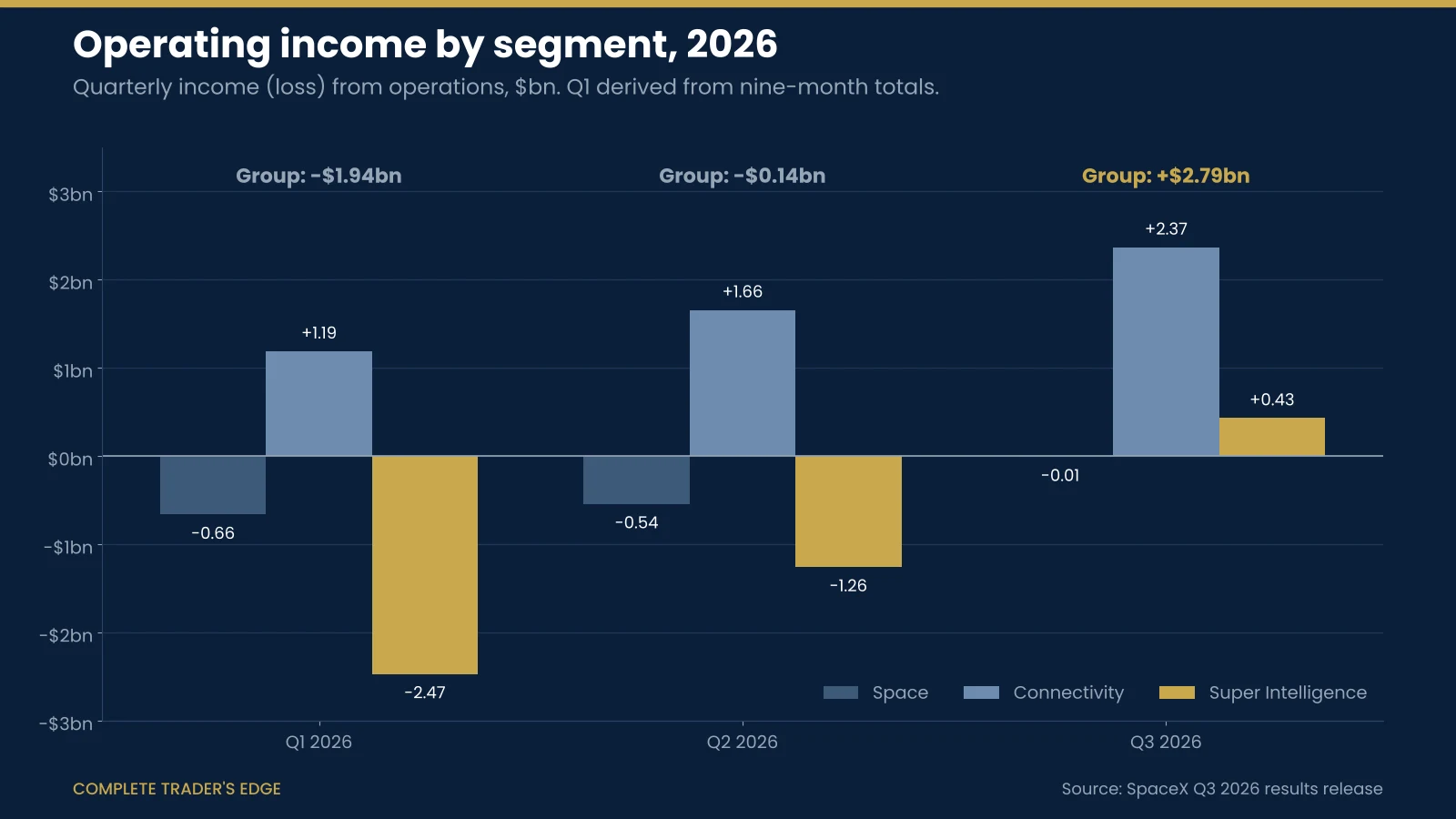
The segment’s first operating profit was struck after a large non-cash charge. SI earned $431 million from operations, against a $1.26 billion loss in Q2. That figure absorbs $1.22 billion of share-based compensation tied to the Cursor deal. Segment adjusted EBITDA, which strips that out along with depreciation, was $4.95 billion.
Depreciation is the cost that keeps arriving. SI depreciation and amortisation rose to $2.47 billion from $1.89 billion in a single quarter. Every gigawatt brought online adds to that line for years, whether or not the capacity stays rented. The S-1 filed before the IPO notes that the May 2026 cloud agreements with Anthropic can be ended by either party on 90 days’ notice after an initial three-month period. Contracted demand is not the same as permanent demand.
The principle: adjusted EBITDA tells you what a business earns before it pays for the machines. For a company spending $16 billion a quarter on machines, that is the number most flattering to the story, not the most useful one.
Starlink Is Still the Profit Engine
Connectivity revenue rose 69% year on year to $5.25 billion, with operating income of $2.37 billion. That is an operating margin of about 45%, and it is still where most of SpaceX’s dependable profit comes from.
- Starlink consumer subscribers reached 13.6 million, up from 12.0 million at the end of June and 7.2 million a year earlier. Reuters noted analysts had expected about 12.19 million.
- Consumer ARPU rose to $69 a month from $66 in Q2, which the company put down to growth in developed markets. A year ago it was $83.
- Enterprise and government revenue rose 91% year on year to $2.13 billion, and more than 3,800 aircraft now carry Starlink.
- After quarter end SpaceX agreed to buy 800 MHz spectrum licences for its Starlink Mobile plans, with closing expected in the first half of 2027.
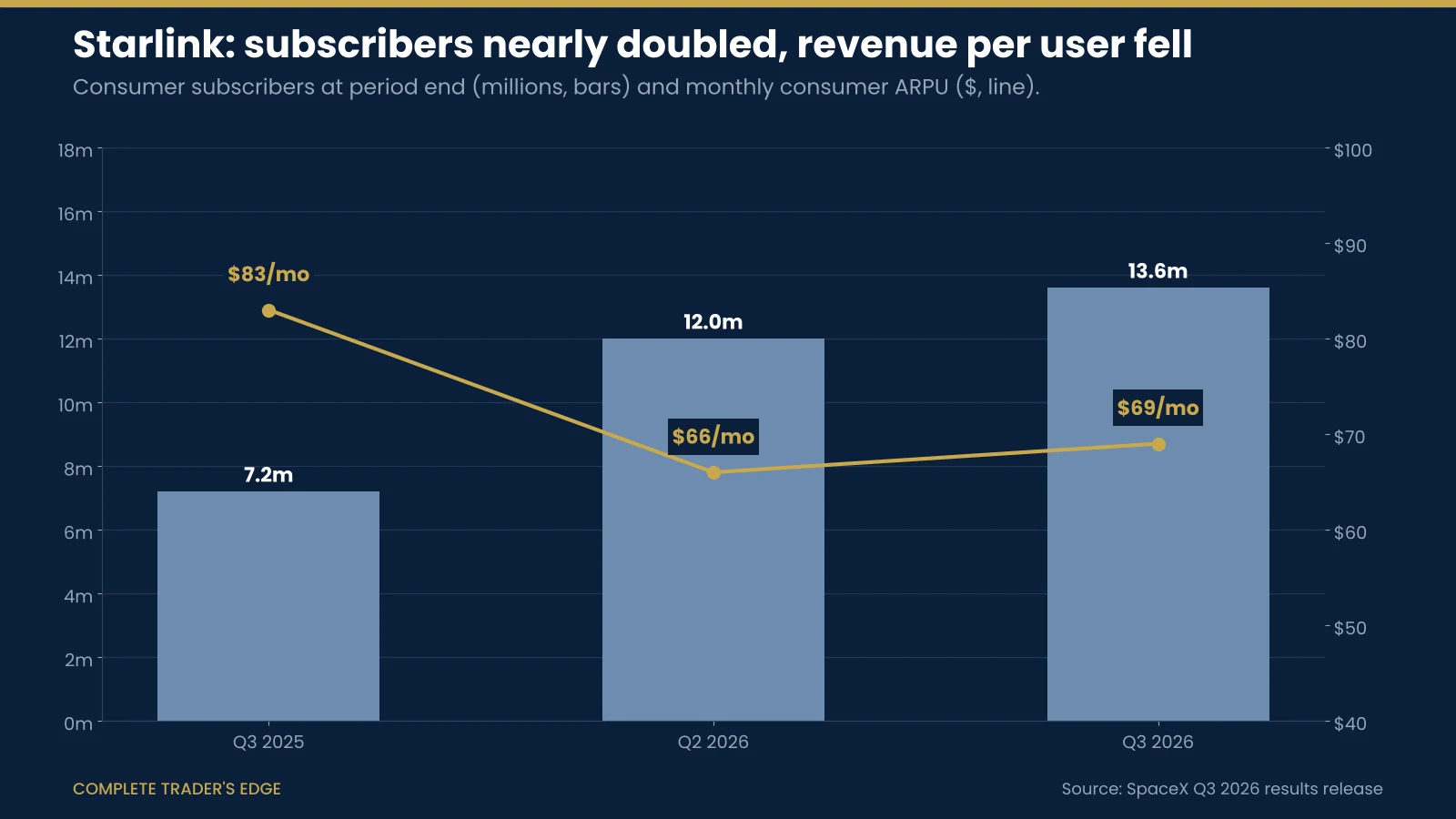
The ARPU point is worth holding in two directions at once. Sequentially it improved. Over a longer window it has fallen sharply as Starlink sells cheaper plans abroad. Both are true, and which one a headline leads with tells you about the headline, not the business.
The Rocket Business Nearly Broke Even
The Space segment, the original SpaceX, reported revenue of $1.77 billion and an operating loss of just $7 million, against a $542 million loss in Q2. A year ago it made $259 million, before Starship spending accelerated.
The quarter included Starship Flight 14, which the company describes as its first orbital Starship flight and its first revenue-generating Starship mission. It carried 26 Starlink V3 satellites, which SpaceX says add roughly ten times the downlink capacity of a Falcon 9 Starlink launch. Research and development in the segment ran at $1.23 billion for the quarter.
Launch counts are lower than a year ago, at 35 in the quarter against 44, as the company shifts towards Starship. The release also announced Starbase, Louisiana, a new spaceport targeted for a first launch in 2029.
Where More Than a Third of the Profit Came From
Operating income was $2.79 billion. Net income was $4.40 billion. The $1.61 billion difference came from below the operating line:
- Interest income of $873 million, largely from the cash raised in the IPO.
- Other income of $1.03 billion, of which the release identifies $561 million as related-party, without naming the counterparty. TechCrunch attributed part of this line to the recovery in bitcoin prices.
- A $390 million tax benefit, against a $562 million tax charge a year earlier.
- Partly offset by $675 million of interest expense, $351 million of it owed to a related party.
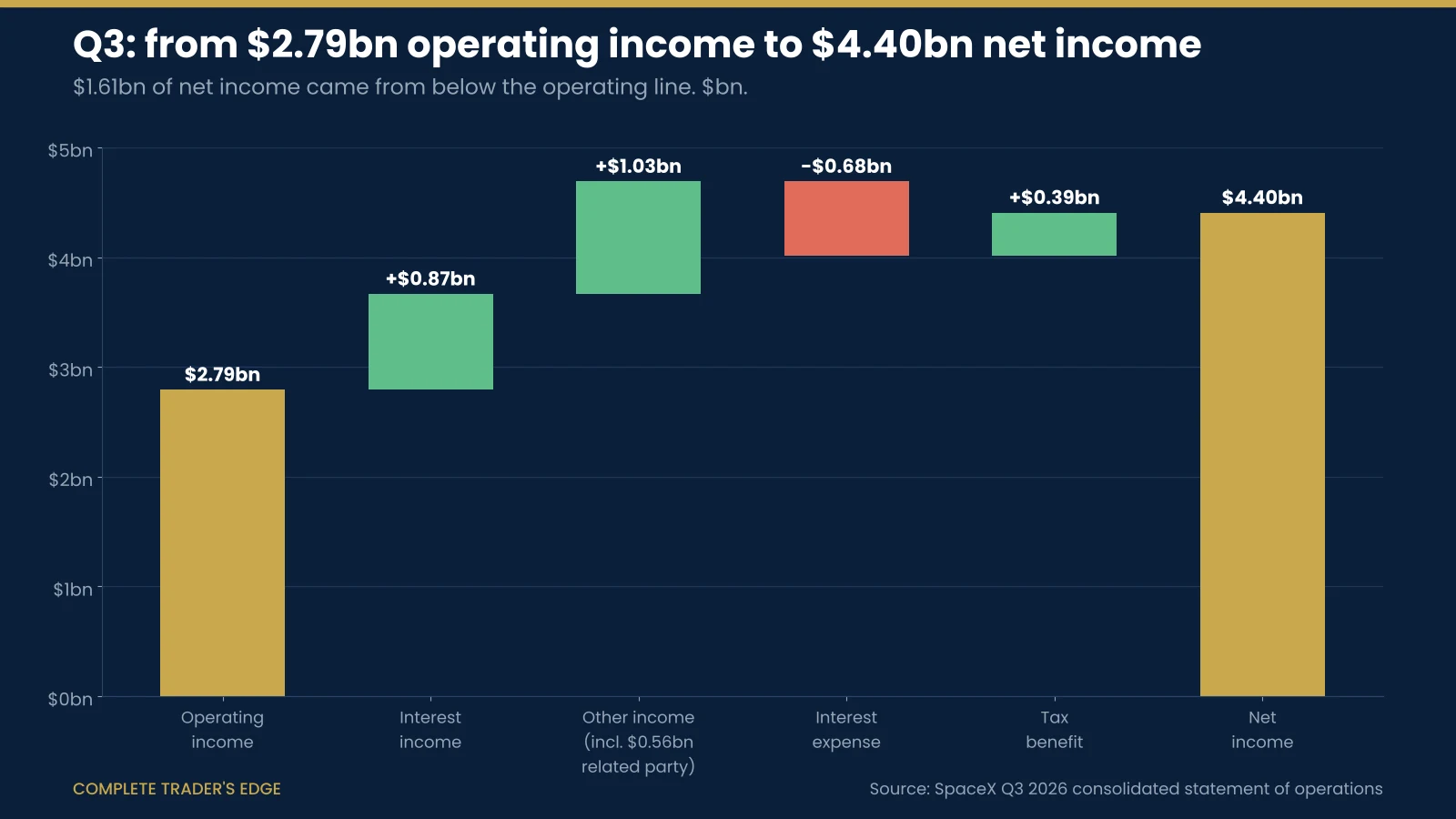
None of this makes the profit fake. Interest on a large cash pile is real money. But investment income, a related-party gain and a tax credit are not things a trader should extrapolate into future quarters. The repeatable earnings this quarter were the $2.79 billion operating line, and roughly half of that came from Starlink alone.
The Cash Bill
The release does not give quarterly cash flow, but the nine-month statement is clear enough.
From January to September SpaceX generated $13.1 billion of operating cash flow and spent $48.1 billion on property, plant and equipment. That is a gap of roughly $35 billion in nine months, covered by the $85.7 billion of net IPO proceeds and new borrowing.
- Cash plus marketable securities stood at $89.9 billion at 30 September ($51.3 billion cash, $38.6 billion securities), down from $100 billion at the end of June.
- Debt and finance leases totalled about $38.8 billion, up from $22.9 billion at the end of 2025.
- Deferred revenue rose to $17.5 billion from $12.1 billion at year end. Customers paying in advance is part of why operating cash flow looks strong.
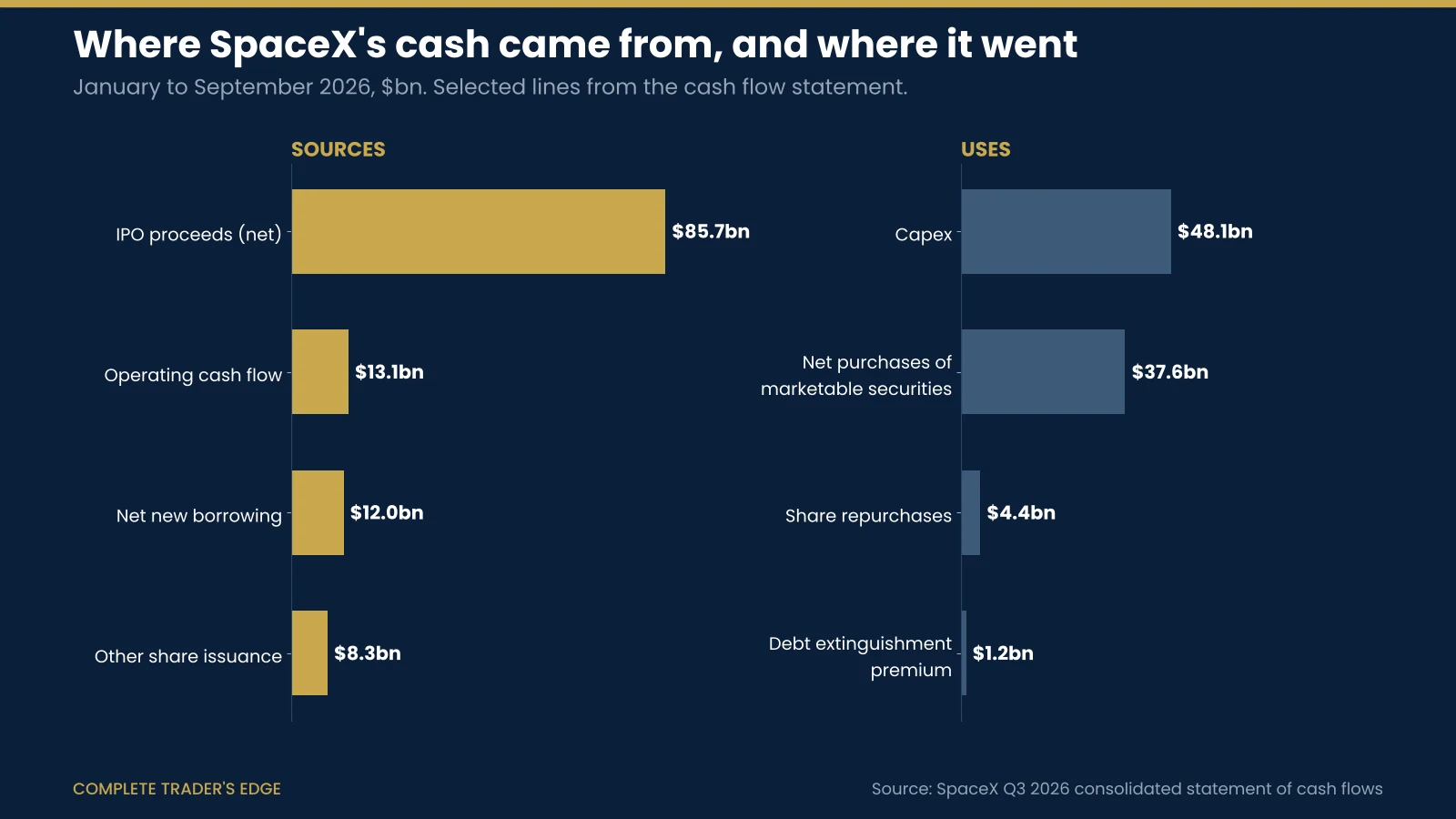
And the spending is forecast to rise, not fall. Visible Alpha research cited by Fortune shows consensus capex climbing from about $70 billion this year to $197.4 billion in fiscal 2028, with debt projected to reach $350 billion by 2029. If you want a historical sense of what happens when a capital-hungry buildout is financed with debt and the revenue disappoints, our piece on CoreWeave, AI debt and the telecom bust of 2000–2002 covers the precedent.
The CFO’s statement promised discipline and an investment-grade balance sheet. The numbers say the company is still a heavy net consumer of capital, and plans to become a heavier one.
Thursday Again: Up to 1.3 Billion Shares
This is the same pattern we described ahead of the first report in our breakdown of the SPCX lock-up calendar, and it is the part of this week a trader can plan around with certainty.
Under the staged lock-up in the IPO prospectus, up to 28% of the shares under the main 180-day lock-up become free to sell on the second full trading day after Q3 results. With results out after Tuesday’s close, that is Thursday 22 October, and the tranche is put at up to about 1.3 billion shares. At Tuesday’s close that is roughly $190 billion of stock, against 911.5 million shares in the August release.
SPCX lock-up releases still ahead
| Date | Release | Shares, up to | Value at $147.79 |
|---|---|---|---|
| Thu 22 Oct 2026 | Q3 earnings tranche (28%) | ~1.3bn | ~$192bn |
| Mon 26 Oct 2026 | Day-135 tranche (7%), dated Sat 24 Oct | ~328m | ~$49bn |
| 8 Dec 2026 | Day 180: main lock-up ends (remaining ~17%) | ~798m | ~$118bn |
| June 2027 | Elon Musk’s 366-day lock-up ends | — | — |
Schedule per the IPO prospectus as summarised by lock-up trackers and Yahoo Finance. Share counts are maximums eligible for sale, not forecasts of selling.
A further day-135 tranche of up to about 328 million shares falls on Saturday 24 October, so it first trades on Monday 26 October. The remaining shares under the main lock-up are released on 8 December. Musk’s own holding stays locked until June 2027.
The August precedent is worth remembering. The stock closed at $125.33 on 4 August, the day of the Q2 report, then fell 13.6% the next session as attention turned from the beat to the capex and the coming unlock. It went on to make a low of $104.83 that month before recovering. A beat does not cancel a supply event. It only changes how many holders feel like selling into it.
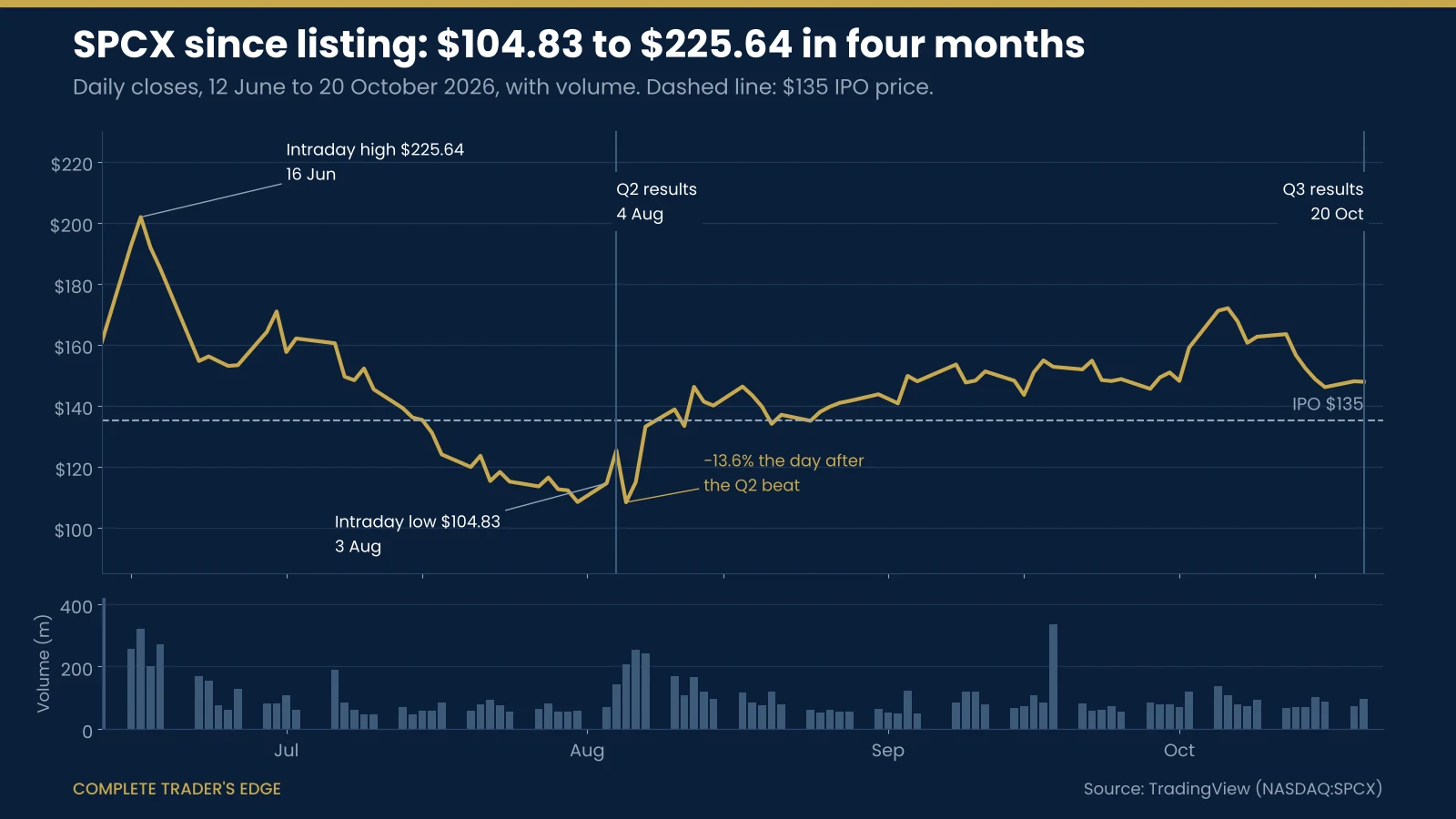
For scale: at $147.79 and the 13.58 billion shares outstanding at 30 September, SPCX carries a market value of roughly $2 trillion. Annualise Q3 revenue and you get about $58 billion, so the market is paying around 34 times current-run-rate sales.
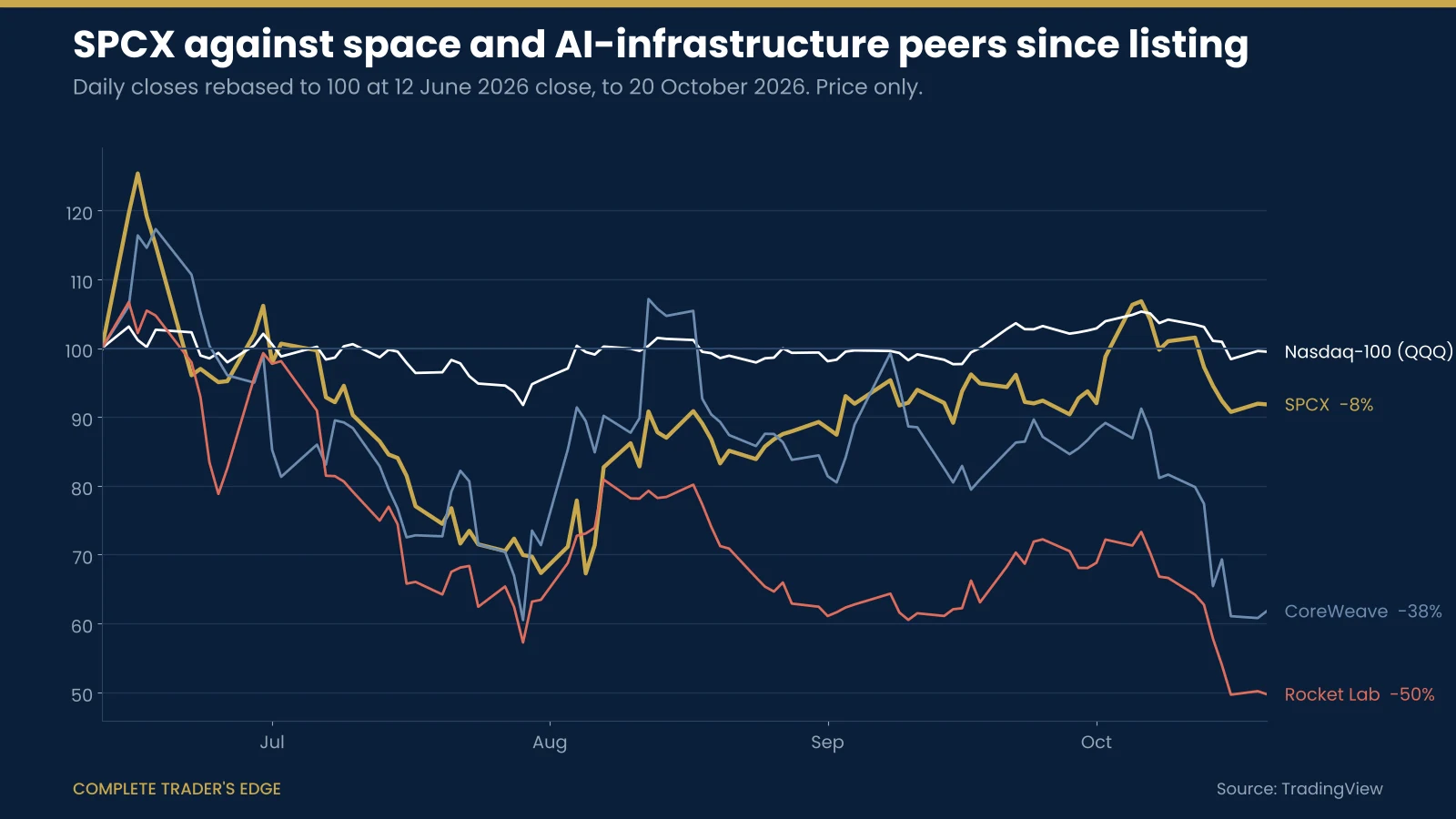
Musk’s Trillion-Dollar Number
On the call, according to Yahoo Finance’s live coverage, Musk said he sees SpaceX’s annual recurring revenue reaching between $500 billion and $1 trillion by the end of 2027.
From a Q3 run rate of about $58 billion, that would require revenue to grow somewhere between nine and seventeen times in five quarters. It is not a company forecast; the release contains no numerical guidance. Treat it as what it is: a founder’s target, stated on a live stream, on the night of a strong quarter. It may move the stock for a day. It should not move your position size.
What the Headlines Get Wrong
As in August, a few errors are already circulating. Spotting them is a trading skill.
Million is not billion. At least one major outlet’s early copy put net income at $4.4 million. The release says $4,404 million. A typo, but the kind that gets screenshotted and argued over for days.
Two different growth rates for the same revenue. One report ran 161% in the headline and 106% in the body. The filed figure is 161%, from $5.58 billion to $14.58 billion.
Two different EPS figures. You will see 35 cents and 45 cents. The release reports 35 cents on a diluted GAAP basis; the higher number is an adjusted measure used by some data providers. Neither is wrong, but compare like with like when you judge the size of the beat.
Earnings-night coverage is written in minutes. The release is the primary source, and it is free on the SEC’s website the moment it is filed. If a number surprises you, check it there before you act on it.
SpaceX Q3 Earnings Through Mind, Method and Money
Mind. After August, plenty of traders decided SpaceX was a capex sinkhole. After tonight, plenty will decide it is a profit machine. Both conclusions rest on one quarter each. The honest position is that the company proved it can sell compute at scale, and has not yet proved it can earn a return on a capital programme that is forecast to nearly triple. Holding both ideas is uncomfortable. Choosing one because it feels better is how traders end up long at the top of a story.
Method. SPCX now has four months of price history, a range from $104.83 to $225.64, and a float that keeps changing composition with each lock-up release. Before tonight the options market priced a move of roughly 7–8% either way. Thursday adds a second event inside the same week. If your edge depends on clean levels and a stable holder base, this is still not that instrument. Waiting until after the unlock is a valid decision.
Money. Two events in three trading days means position size should reflect the larger of the two possible moves, not the one you expect. Work out what 1% risk actually allows on a stock that fell 13.6% in a session after its last beat, using our trading calculators, before Thursday’s open rather than after it.
The Short Version
SpaceX had an exceptional quarter. Revenue nearly doubled from Q2, Super Intelligence turned an operating profit, Starlink earned $2.37 billion, and the rocket business came within $7 million of breaking even. Capex per dollar of revenue fell from $2.35 to $1.34.
It also earned more than a third of its net income below the operating line, consumed roughly $35 billion more cash than it generated over nine months, and faces up to 1.3 billion shares of new supply on Thursday.
The pattern is one we trace across four centuries in Market Mayhem: a real business, a bigger story wrapped around it, and a share price that moves on the story and the supply long before the business settles the argument.
Related Reading
- SpaceX Q2 Earnings: The Beat That Cost $18 Billion – the first report, and why the stock fell after beating.
- SPCX Stock: The IPO That Fell Below Its Price, and the Calendar That Explains Why – the full lock-up schedule.
- SpaceX IPO 2026: What Traders Must Know Before the Biggest Listing in History – the pre-listing analysis.
- SpaceX: The Company That Bet Everything on Its Last Rocket – the founding story and the 2008 near-collapse.
- When the Bond Market Spoke First: CoreWeave, AI Debt and the Telecom Bust – what debt-funded infrastructure booms have looked like before.
- The M·M·M Assessment – find your weakest link before an event week finds it for you.
Frequently Asked Questions
What did SpaceX report for Q3 2026?
Revenue of $14.58 billion, up 161% year on year, against consensus of about $12.72 billion. Net income was $4.40 billion, or $0.35 per diluted share, operating income was $2.79 billion and adjusted EBITDA was $8.81 billion. Capital expenditure was $19.59 billion, of which $16.44 billion went to the Super Intelligence segment.
Is SpaceX profitable now?
It was profitable in Q3 2026, its first profitable quarter as a public company. About $1.61 billion of the $4.40 billion net income came from below the operating line, including interest income, $1.03 billion of other income and a tax benefit. For the first nine months of 2026 the company still reported a net loss of $413 million.
How much did the AI business make?
The Super Intelligence segment, previously reported as AI, generated $7.56 billion of revenue and $431 million of operating income after $1.22 billion of Cursor-related share-based compensation. Cursor contributed $608 million of revenue after the acquisition closed on 14 August. Nameplate compute reached 1.7 GW.
How many Starlink subscribers does SpaceX have?
13.6 million consumer subscribers at 30 September 2026, up from 12.0 million at the end of June, with consumer ARPU of $69 a month. Managed enterprise and government customers are counted separately.
When is the next SpaceX lock-up release?
Up to about 1.3 billion shares become free to sell on Thursday 22 October 2026, the second full trading day after Q3 results. A further tranche of up to about 328 million shares follows on 24 October, first tradable on 26 October, and the main 180-day lock-up ends on 8 December 2026. Elon Musk’s shares remain locked until June 2027.
The takeaway. The quarter answered August’s biggest question: the AI revenue is real and it arrived fast. It did not answer whether a capital programme heading towards $200 billion a year will pay for itself, and Thursday’s unlock was scheduled long before anyone knew how good these numbers would be.
Size for the event, not the opinion. The CTE trading calculators will tell you what your risk rules actually allow.
This article is educational and is not financial advice. It does not recommend buying or selling SpaceX, SPCX or any security. Figures are taken from SpaceX’s third-quarter 2026 results release (Form 8-K, 20 October 2026), its IPO filings, and contemporaneous reporting by CNBC, Reuters, Fortune, Yahoo Finance, TechCrunch and TipRanks. Consensus figures vary between providers. Lock-up share counts are maximums under the prospectus schedule, not forecasts of selling. Prices change constantly; verify current figures against primary sources before making any decision. Trading and investing carry risk, including the loss of capital.
 The Complete Trader's Edge
The full Mind · Method · Money framework. 70 chapters.
View on Amazon →
 Market Mayhem
400 years of bubbles, crashes, and the pattern that keeps repeating.
Buy on Amazon →
 Greatest Companies
How the world's greatest companies were built — and what traders learn from them.
View on Amazon →
 Greatest Traders
Eighty-six lives that explain the markets — Livermore to Madoff, told with the losses left in.
View on Amazon →