

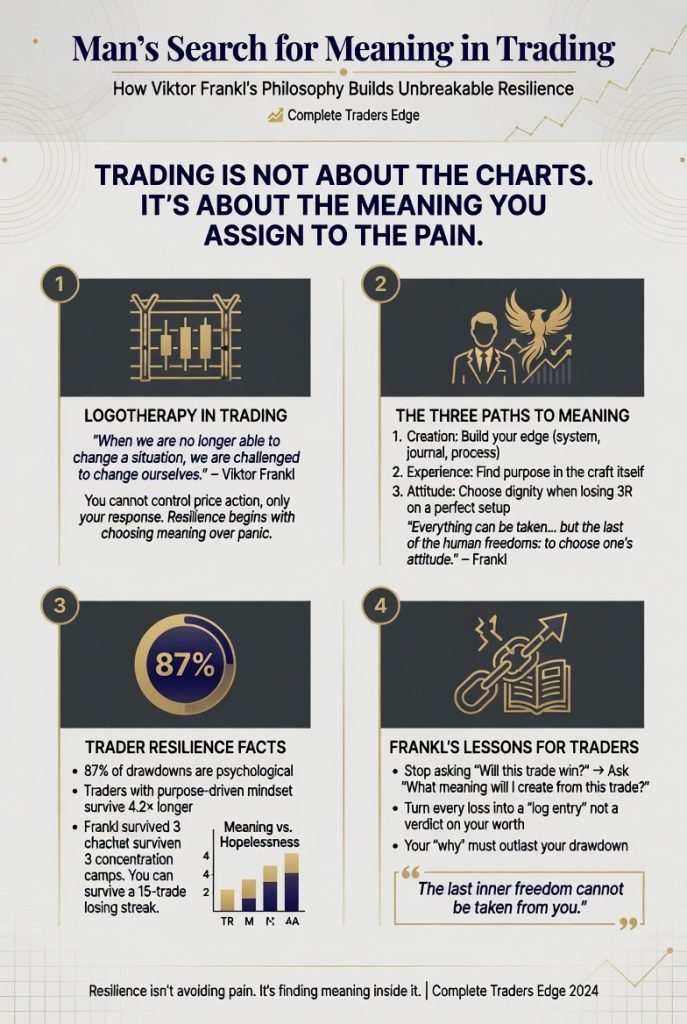
Viktor Frankl survived Auschwitz. He lost his wife, his parents, and his brother in the concentration camps. He emerged from the most extreme suffering a human being can endure and wrote a book that has since sold over 16 million copies. The thesis of Man’s Search for Meaning is that human beings can endure almost any “how” if they have a sufficient “why.” Suffering without meaning destroys. Suffering with meaning transforms.
Comparing a trading drawdown to the Holocaust would be grotesque. But the psychological mechanism Frankl identified operates at every scale of human difficulty: the ability to find meaning in suffering determines whether that suffering breaks you or builds you. And for traders, where suffering is a structural feature of the profession rather than an aberration, this mechanism is the difference between a career and a casualty.
Frankl’s account of the camps and the logotherapy that came out of it. The shortest book on this list and the heaviest.

Between Stimulus and Response: The Trader’s Most Important Space
Frankl is credited with one of the most quoted observations in psychology: “Between stimulus and response there is a space. In that space is our freedom and our power to choose our response. In our response lies our growth and our freedom.”
| Key Concept | Original Context | Trading Translation |
|---|---|---|
| Choose your struggle | Success is not about avoiding pain but choosing which pain is worth it | Trading involves the pain of losses, drawdowns, and missed setups. Choose this pain deliberately. |
| You are always choosing | Even inaction is a choice with consequences | Not journalling is a choice. Not using stops is a choice. Not following your plan is a choice. Own each one. |
| The feedback loop from hell | Worrying about worrying creates a downward spiral | Worrying about a losing streak causes tighter entries, which causes more missed setups, which causes more worry. |
| Values-based action | Act from your values, not your feelings | Your trading plan represents your values (discipline, process, protection). Act from the plan when feelings disagree. |
For traders, this space is everything. The stimulus is the stop loss being hit. The candle moving against you. The P&L flashing red. The news event destroying your setup. The five consecutive losses. The stimulus cannot be controlled. It is the market doing what the market does.
The response is what happens next. In that space between the loss and your next action lies the entire trajectory of your trading career. React impulsively, and you revenge trade, move stops, increase size, or abandon your system. Pause, choose deliberately, and you journal the trade, assess your state, follow your drawdown protocol, and prepare for the next valid setup with the same discipline as the first.
Every technique in trading psychology is ultimately about expanding this space. Pre-session routines expand it by setting a baseline of calm. Pattern interrupts expand it by breaking the automatic reaction. The trading journal expands it by creating a habit of reflection rather than reaction. Frankl identified the principle. Trading provides the daily practice ground.
Meaning as a Shield Against Drawdown Despair
Frankl observed that the prisoners who survived the camps were not necessarily the strongest or the youngest. They were the ones who had something to live for: a child waiting for them, a book they needed to write, a purpose that extended beyond their current suffering. Those who lost their sense of meaning gave up and died, often within days.
The trading parallel, scaled appropriately, is that traders who have a clear purpose beyond money survive drawdowns that destroy traders who are only in it for profit. The trader who is building a business to support their family, developing a skill to prove something to themselves, or creating educational content for other traders has a “why” that the drawdown cannot touch. The trader whose only purpose is next month’s profit target has nothing to hold onto when the profits disappear.
This is why treating trading as a business with a mission statement matters. It is why the “find your why” exercise from the Simon Sinek article in this series is not motivational fluff. It is psychological survival equipment.
Logotherapy: Meaning Through Responsibility
Frankl founded a school of psychotherapy called logotherapy, built on the premise that the primary human drive is not pleasure (Freud) or power (Adler) but meaning. He taught that meaning is found in three ways: through creative work (what you give to the world), through experience (what you take from the world), and through the attitude you adopt toward unavoidable suffering.
For traders:
Creative work: Building your trading system, developing your process, creating your journal methodology, eventually teaching what you have learned. The act of building something is meaningful regardless of any single day’s result.
Experience: The satisfaction of a perfectly executed trade, the clarity of reading a chart accurately, the quiet confidence of sitting through a volatile session with complete discipline. These experiences have value independent of financial outcome.
Attitude toward suffering: This is the highest form. The drawdown that teaches you patience. The losing streak that reveals a flaw in your risk management. The blown account that forces you to rebuild with humility and precision. Frankl would say that these experiences, embraced with the right attitude, are not obstacles to your trading development. They are the substance of it.
The Existential Vacuum and Overtrading
Frankl described the “existential vacuum,” a state of inner emptiness that people try to fill with distraction, busyness, or compulsive behaviour. He considered it one of the primary sources of modern psychological suffering.
Overtrading is the trading manifestation of the existential vacuum. The trader who takes 15 trades a day when their system calls for two is not following a strategy. They are filling an inner emptiness with market stimulation. The dopamine hit of placing a trade temporarily fills the void. The loss that follows deepens it. The cycle escalates.
Frankl’s prescription is not to suppress the compulsion but to replace the emptiness with genuine meaning. The trader who has a clear purpose, a structured process, and a journal practice that provides a sense of progress does not need to overtrade. The meaning comes from the process itself, not from the stimulation of being in the market.
Tragic Optimism: The Trader’s Essential Stance
In his later work, Frankl introduced the concept of “tragic optimism”: maintaining hope and finding meaning despite the presence of pain, guilt, and death. This is not naive positivity. It is the capacity to say: “Yes, this is painful. Yes, losses are real. And yes, there is still meaning in the work I am doing, and the person I am becoming through it.”
For traders, tragic optimism is the stance that allows you to sit down after a losing week and open your journal with genuine curiosity rather than despair. It is the belief that even though this drawdown hurts, the discipline you are practising during it is building something that the winning streaks cannot. It is the psychology of losing elevated to a philosophical practice.
Putting It All Together: Frankl’s Framework for Traders
Expand the space. Between every market event and your response, there is a space. Your job is to make that space as wide as possible through preparation, self-awareness, and deliberate practice. This is where trading careers are saved or destroyed.
Find your meaning. Define why you trade in terms that transcend any single month’s P&L. The purpose must be strong enough to survive the worst drawdown you can imagine.
Transform suffering into growth. Every loss, every drawdown, every failure of discipline is raw material. With the right attitude, it becomes the foundation of the trader you are becoming.
Fill the vacuum with process. If you find yourself overtrading, the problem is not the market. It is the emptiness you are trying to fill. Replace compulsive trading with meaningful process: preparation, journalling, review, deliberate improvement.
Practise tragic optimism. The market will hurt you. Accept this without despair. Find the meaning in the difficulty, and let it strengthen rather than destroy your resolve.
Frankl wrote from the darkest possible human experience and found light. Trading will never approach that darkness. But the principle holds at every scale: those who find meaning in the struggle outlast those who see only suffering. The Mind pillar exists because without psychological resilience, no strategy survives contact with the market. Frankl shows us where that resilience comes from: not from avoiding pain, but from choosing what it means.
Continue Reading: The Inner Edge
The Complete Trader’s Edge
This article is part of The Inner Edge series, exploring peak performance principles for traders.
Frequently Asked Questions
How does Man’s Search for Meaning apply to trading?
Frankl’s core insight is that humans can endure any suffering if they find meaning in it. For traders, this means drawdowns and losses become bearable when connected to a larger purpose. Traders who see losses as meaningless pain quit. Traders who see them as the cost of building mastery persist and eventually break through.
What is the space between stimulus and response in trading?
The space is the moment between a market event (a loss, a missed entry, a news spike) and your reaction to it. In that space lies your freedom to choose a disciplined response rather than an impulsive one. Every trading psychology technique is ultimately about expanding this space so you have time to choose wisely rather than react emotionally.
How does logotherapy help with trading psychology?
Logotherapy teaches that meaning is the primary human motivation, found through creative work, experience, and attitude toward suffering. Traders who derive meaning from building their process, experiencing moments of disciplined execution, and choosing growth-oriented attitudes toward losses develop psychological resilience that profit-motivated traders cannot match.
What is tragic optimism and how does it help traders?
Tragic optimism is maintaining hope and meaning despite pain. For traders, it is the capacity to acknowledge that drawdowns hurt while simultaneously believing that the discipline practised during them is building something valuable. It prevents both denial of pain and surrender to despair, creating the balanced psychological stance that sustains long-term trading careers.
Why do traders overtrade and how does Frankl explain it?
Frankl’s concept of the existential vacuum explains overtrading as an attempt to fill inner emptiness with market stimulation. The dopamine of placing trades temporarily masks the void but deepens it through losses. The cure is not willpower but meaning: a clear purpose, a structured process, and a journal practice that provides genuine satisfaction independent of being in the market.
 The Complete Trader's Edge
The full Mind · Method · Money framework. 70 chapters.
View on Amazon →
The Complete Trader's Edge
The full Mind · Method · Money framework. 70 chapters.
View on Amazon →
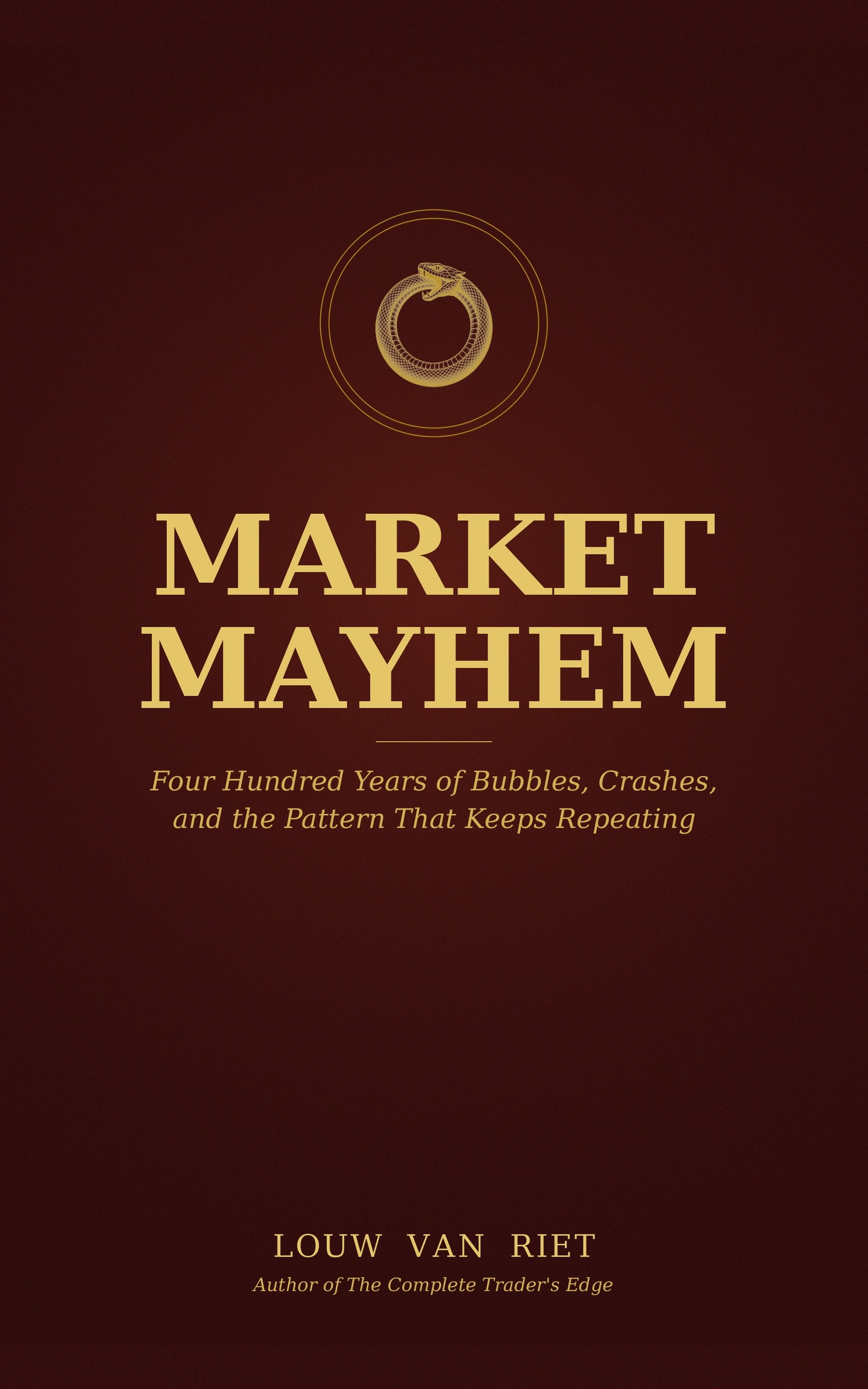 Market Mayhem
400 years of bubbles, crashes, and the pattern that keeps repeating.
Buy on Amazon →
Market Mayhem
400 years of bubbles, crashes, and the pattern that keeps repeating.
Buy on Amazon →
 Greatest Companies
How the world's greatest companies were built — and what traders learn from them.
View on Amazon →
Greatest Companies
How the world's greatest companies were built — and what traders learn from them.
View on Amazon →
 Greatest Traders
Eighty-six lives that explain the markets — Livermore to Madoff, told with the losses left in.
View on Amazon →
Greatest Traders
Eighty-six lives that explain the markets — Livermore to Madoff, told with the losses left in.
View on Amazon →