

Reading this from India?
The Reserve Bank of India publishes an Alert List of entities not authorised to deal in forex or operate a forex trading platform in India. Two of the three firms compared here are on it: FTMO at number 13 and FundedNext at number 83. FundingPips is not listed as of the 19 November 2025 update. That is not a ban, and FundedNext disputes its listing, but it does mean an Indian resident dealing with a listed entity sits outside Indian regulatory protection. Absence from the list is not approval either. See the full RBI Alert List and the Trading in India hub before choosing.
Three names dominate every prop-firm conversation in 2026: FTMO, FundedNext, and FundingPips. Most comparison articles you find online are written by people who have never traded a funded account. Affiliate sites pump whichever firm pays them the highest commission. Forum threads cherry-pick the worst payout horror stories. Almost no one tells you the truth: these three firms are not equivalents, and choosing the wrong one for your strategy can cost you the challenge fee, weeks of evaluation work, and your confidence.
This guide is the cleanest read you will get on the FTMO vs FundedNext vs FundingPips comparison. Full transparency: I’m an affiliate partner of all three firms, so I earn a commission whichever one you choose. That is precisely why I can call this straight: there is no firm I need to push over another. Where FTMO wins, I’ll say so plainly.
By the end of this article, you’ll know exactly which of the three fits your trading style, your risk profile, and your account size, with full rule-by-rule comparison, scoring across nine dimensions, real-money cost analysis, and the tactical breakdown of how an ICT or smart-money trader survives each evaluation. This is the comparison article I wish someone had written before I burned through my first three challenges.
All pricing, rules, and policies in this article are accurate as of April 2026 and verified against each firm’s current public checkout pages. Prop firms run frequent promotions (often 10–25% off via discount codes) and revise pricing without notice. Always confirm the live numbers on each firm’s checkout page before paying — figures here are the standard published rates, not promotional discounts.
Quick Verdict (For Traders Who Don’t Want to Read 6,000 Words)
Pick FTMO if: You’re a swing trader who needs the longest-running, most-respected brand, you want the most analytical platform (FTMO MetriX, Mentor App), and you don’t need futures or instant funding. The gold standard since 2015.
Pick FundedNext if: You want the broadest product range (CFDs and futures, 7 account types), the highest profit splits (up to 95% on CFDs with the lifetime add-on, 100% on futures), the fastest payouts in the industry (24-hour guarantee or $1,000 compensation), and the option of a 15% reward paid on your evaluation profit.
Pick FundingPips if: You want the cheapest entry point ($29 for a $5K 2-Step Pro challenge, ~$36 for a $5K 2-Step Standard), four distinct challenge types, the strongest scaling plan (up to $2M via Hot Seat with 100% profit split), and the most flexible payout system (60–100% tiered).
My personal pick for ICT and smart-money traders: FundingPips 2-Step Standard. The combination of static drawdown, 5%/10% rule structure, news trading allowed during evaluation, and the fee refund after the fourth payout makes it the most forgiving environment for the way I trade. Full rationale below.
The 30-Second Comparison Table
Before we get into the detailed rule analysis, here’s the head-to-head on the metrics that actually move the needle. All figures verified as of April 2026 against each firm’s live checkout. I’ve used the most popular product from each firm: FTMO 2-Step Standard, FundedNext Stellar 2-Step, and FundingPips 2-Step Standard, all on the $100K account size for a like-for-like comparison.
| Metric | FTMO | FundedNext | FundingPips |
|---|---|---|---|
| $100K Challenge Fee | €540 (~$580) | $549.99 | ~$399 (Standard) |
| Cheapest Entry Point | €89 (10K, often promo) | $59.99 (6K Stellar 2-Step) | $29 (5K 2-Step Pro) |
| Phase 1 Profit Target | 10% | 8% | 8% |
| Phase 2 Profit Target | 5% | 5% | 5% |
| Daily Loss Limit | 5% | 5% | 5% |
| Max Drawdown | 10% static | 10% static | 10% static |
| Time Limit | Unlimited | Unlimited | Unlimited |
| Min Trading Days | 4 per phase | 5 per phase | 3 per phase |
| Profit Split (Standard) | 80% → 90% | 80% → 95% | 60–100% tiered |
| Payout Speed | ~8 hrs avg, every 14 days | 24-hour guarantee | Same-day to 24 hrs |
| News Trading (Funded) | 2-min restriction | 5-min window: profits cut to 40% | 5-min restriction |
| Weekend Holding (Funded) | Swing acct only | Not allowed | Suspended Jan 2026 — verify status |
| Max Capital Scale | $2M | $4M | $2M |
| Year Founded | 2015 | 2022 | ~2021 |
| Trustpilot | 4.8 / 40,000+ | 4.5 / 62,000+ | 4.5 / 52,000+ |
| Total Paid to Traders | $500M+ | $260M+ | $200M+ |
| US Traders Accepted | FTMO US (MT5 only) | CFD: No, Futures: Yes | No |
The headline reads: FundingPips wins on price, FundedNext wins on product breadth, FTMO wins on track record. But none of those single-word verdicts capture the nuance that matters when you’re sitting in front of a $100K simulated account at 14:00 SAST trying to decide whether to push for the target or call it a week. That’s what the next 5,000 words are for.
Why These Three Firms Dominate the Conversation
Before we get into rules, you need to understand why these three firms have separated from the pack. The prop trading industry has been brutal over the past three years. MyForexFunds was shut down by the CFTC in 2023. TrueForexFunds folded in May 2024. MyFundedFX closed in February 2026. Dozens of smaller firms have come and gone. The fact that FTMO, FundedNext, and FundingPips are still standing in 2026 is itself a meaningful data point. They have survived because they have real operational discipline, real liquidity relationships, and real payout systems. Most of their competitors did not.
That doesn’t mean they’re identical. Each firm has carved out a distinct identity in the market. Understanding those identities is the first filter for choosing the right one.
FTMO: The Original (Since 2015)
FTMO is the oldest and most-recognized prop firm in the forex/CFD category. Founded in 2015 in Prague (under the original Czech name “Získej účet”), FTMO has paid out over $500 million to traders across 240,000+ funded accounts. They are the firm every other firm copies. The two-step evaluation model that’s now standard across the industry was largely defined by FTMO’s original product. When traders argue about whether prop trading is “real,” FTMO is usually the firm that ends the argument because their payout history is the most extensively documented.
FTMO’s strengths are structural: long operational history, the highest brand recognition in trader communities, and the most analytical platform in the industry (FTMO MetriX dashboard, Mentor App, Equity Simulator). Their weaknesses are also structural: higher fees than competitors, a narrower product range (CFDs only, no futures), no instant funding option, and the FTMO Global product no longer accepts US traders (FTMO US is a separate offering with MT5 only).
FTMO is the conservative choice. The “I want the most-respected name on my account screenshot” choice. The “I never want to wonder if my payout will arrive” choice. For a certain trader, that conservatism is worth paying a premium for. For others, it’s not.
FundedNext: The Aggressive Challenger (Since 2022)
FundedNext launched in 2022 out of the UAE and grew faster than any prop firm in the industry’s history. By 2024 it was the most-discussed challenger to FTMO. By 2026 it has paid out $260M+ across 93,000+ funded accounts and operates in 170+ countries. The firm built its reputation on three things: aggressive product innovation, ridiculous payout speed, and trader-friendly economics.
FundedNext is the only major prop firm that operates both CFD and futures programs under a single brand. Their lineup includes 7 distinct account types: Stellar 2-Step, Stellar 1-Step, Stellar Lite, Stellar Instant on the CFD side; Bolt Challenge, Rapid Challenge, and Legacy Challenge on the futures side. Each is built for a different trader profile. The 15% reward on evaluation profit (paid with first funded withdrawal on the Stellar 2-Step product) is genuinely innovative. The 24-hour payout guarantee with $1,000 compensation if delayed is not a marketing line — it’s enforced.
FundedNext is the choice for traders who want maximum optionality, the highest profit splits in the industry (95% on CFDs with the paid lifetime add-on, 100% on futures), and the fastest cash flow. Their weaknesses: shorter operational history than FTMO, more complex add-on pricing structure (you can stack 95% profit split, no-min-days, swing trading), and more rules to track if you trade across multiple of their account types. They do accept US traders on the futures side.
FundingPips: The Disruptor (Since ~2021)
FundingPips operates out of Dubai and has built one of the largest user bases in prop trading. Their 52,000+ Trustpilot reviews give them more review volume than almost any competitor. They’ve paid out $200M+ across 127,000+ verified payouts, including a single payout exceeding $140K. The firm’s strategy has been built on aggressive pricing, deep product variety, and the most flexible payout system in the industry.
FundingPips offers four challenge types: 1-Step, 2-Step Standard, 2-Step Pro, and Zero (instant funding). Pricing starts at $29 for a $5K 2-Step Pro account — the cheapest entry point of any major prop firm — with the $5K 2-Step Standard at around $36. Their tiered profit split system is unique: 60% for weekly payouts, 80% for bi-weekly (default), 90% for on-demand, and 100% for monthly cycles. The Hot Seat scaling tier (16 successful payouts + 40% cumulative profit) unlocks $2M total capital, doubled initial balance, on-demand payouts, and 100% profit split — the most generous funded-trader tier in the industry.
FundingPips is the choice for traders who want maximum value-per-dollar, the cheapest path to a funded account, and the deepest scaling rewards if they prove consistency. Their weaknesses: shorter brand history than FTMO, the trade-off matrix between payout cycle and profit split adds complexity, the consistency rule on the Zero (instant) program is strict (15%, applies at every payout), and as of January 29, 2026 weekend holding was suspended on funded accounts (verify current status before relying on it).
The Real Decision Framework: Three Trader Profiles
The reason most “FTMO vs FundedNext vs FundingPips” articles fail is they treat the question as if there’s a universal best. There isn’t. The right firm depends on what kind of trader you are. Here are the three profiles I see most often, and the firm that fits each.
Profile 1: The Risk-Conscious Swing Trader
You trade: Daily and 4H bias, 1H entries. Hold trades for 2–10 days. Maximum 1–2% account risk per trade. You think in weeks, not minutes.
Your friction points: You need weekend holding. You don’t want a daily loss limit so tight it kills you on a normal Asia-session opening gap. You hate trailing drawdowns because they punish profitability.
Best fit: FTMO Swing Account. The 5%/10% static drawdown gives you maximum room. Weekend holding is permitted on the Swing variant. No news trading restrictions in evaluation. The 14-day payout cycle matches your trading rhythm. As of April 2026 it’s the cleanest swing-trading environment among the three because both FundedNext (funded CFD) and FundingPips (since Jan 29, 2026) restrict weekend holding on funded accounts.
Backup: FTMO Standard. If you can close all positions Friday, the FTMO Standard product still gives you the maximum brand reliability and the cleanest news rule on the funded stage.
Profile 2: The Intraday ICT / Smart-Money Trader
You trade: 15M-1H entries off Daily/4H bias. London Open and New York Open kill zones. Liquidity sweeps, order blocks, fair value gaps. In and out the same session.
Your friction points: You need news-event flexibility because half your best setups are CPI/FOMC reactions. You need consistent intraday volatility tools (cTrader is preferred). Weekend holding is rarely needed.
Best fit: FundingPips 2-Step Standard. Three platforms supported (MT5, MatchTrader, cTrader). News trading allowed during evaluation. The 35% consistency rule applies only to On-Demand payouts, not to bi-weekly or monthly cycles, so a normal ICT trader running 4-6 trades per week never trips it. Hot Seat scaling means if you prove consistency, you go to $2M with 100% split.
Backup: FundedNext Stellar 2-Step. Identical drawdown math but with the 15% evaluation reward bonus paid on first funded withdrawal. The 24-hour payout guarantee removes any cash flow worry. cTrader supported. The trade-off: news trading reduces profit by 60% on funded accounts, which can sting for a CPI scalper.
Profile 3: The Multi-Account Scaling Trader
You trade: Multiple funded accounts simultaneously. You’re past the “can I pass a challenge?” stage. You’re optimising for total payout volume across 3-5 accounts.
Your friction points: You need maximum capital ceiling. You need the highest profit split possible. You need a firm that won’t auto-flag you for trading correlated positions across their accounts.
Best fit: FundedNext. The $4M scaling cap is the highest of the three. Multiple account types let you diversify across CFD/Futures and 1-step/2-step structures. The 95% profit split lifetime add-on is worth its weight on a high-volume strategy. The Live Trading Program (Futures Legacy product) graduates you to actual real-money trading once you accumulate $100K in active profits.
Backup: FundingPips Hot Seat path. If you can hit 16 successful payable periods and 40% cumulative profit, the Hot Seat tier ($2M, 100% split, on-demand payouts) is the single best funded-account tier in the industry. The challenge is the time required: typically 6–12 months of disciplined trading.
Pricing Breakdown: What You Actually Pay (All Account Sizes)
Most comparison articles only quote the $100K fee because that’s the most popular size. That’s misleading. The real economics depend on which account size matches your risk tolerance and your bankroll for retries. Here’s the verified pricing matrix as of April 2026, taken from each firm’s published checkout pages. Promotions, discount codes (often 10–25% off), and currency conversions move the exact numbers around — confirm the live price before paying.
| Account Size | FTMO 2-Step | FundedNext Stellar 2-Step | FundingPips 2-Step Standard | Cheapest |
|---|---|---|---|---|
| $5–6K | N/A | $59.99 | ~$36 (Std) · $29 (Pro) | FundingPips |
| $10K | €89–155 (~$95–165) | $119.99 ($15K) | ~$69 | FundingPips |
| $25K | €199–250 (~$215–270) | $199.99 | ~$169 | FundingPips |
| $50K | €345 (~$370) | $299.99 | ~$289 | FundingPips |
| $100K | €540 (~$580) | $549.99 | ~$399 | FundingPips |
| $200K | €1,080 (~$1,160) | $1,099.99 | ~$799 | FundingPips |
Sources: ftmo.com pricelist, fundednext.com Stellar 2-Step plan page, fundingpips.com 2-Step Standard checkout — all verified April 2026. FTMO regularly runs promo pricing on the $10K product (€89 vs €155 standard). FundingPips standalone account pricing without 2-Step Pro is shown; Pro variants and Zero/Instant pricing run separately.
FundingPips is the cheapest at every tier. The $100K product is roughly 31% cheaper than FTMO and 27% cheaper than FundedNext. That’s not a marketing flourish — at the $200K tier, the FundingPips fee saves you roughly $360 vs FTMO; enough to fund another $50K challenge attempt if your first run fails.
Important: all three firms refund the challenge fee. FTMO refunds with your first payout. FundedNext refunds with your first payout. FundingPips refunds after your fourth successful payout on 1-Step and 2-Step Standard (but not on 2-Step Pro or Zero). So in practice, if you pass and stay funded, the fee is recovered — but the path to that recovery is meaningfully different.
The Real Economics of Refunds: When Does the Fee Actually Come Back?
This is the part most articles skip. The “fee refund” is a marketing line that hides a meaningful operational reality. Let’s run through what each firm actually does:
FTMO: The €540 challenge fee is refunded as part of your first payout, paid out approximately 14 days after your first trade on the funded account. So if you pass the Verification phase on March 1st, you can request your first payout on March 15th, and the refund arrives roughly 8 hours later (per FTMO’s average processing time). Total time from purchase to refund: typically 6–10 weeks if you pass on first attempt. Speed grade: A.
FundedNext: The $549.99 challenge fee is refunded with your first funded withdrawal, available 21 days after your funded account opens. With the 24-hour payout guarantee, the refund itself processes the day you request it. Total time from purchase to refund: typically 7–11 weeks. Speed grade: A. The added benefit on the Stellar 2-Step product is the 15% reward, which is calculated on your evaluation profit and added to that same first payout. On a $100K account where you hit the full $8,000 Phase 1 target, that’s an extra $1,200.
FundingPips: The ~$399 challenge fee is refunded after your fourth successful payout on 1-Step and 2-Step Standard products. On the bi-weekly default cycle, that’s roughly 8 weeks of funded trading after passing the evaluation. So total time from purchase to refund: typically 14–18 weeks. Speed grade: B. But here’s the trade-off: FundingPips’ lower up-front cost (~$399 vs ~$580 for FTMO) means you’re risking $180 less to get to the funded stage. If you fail two challenges and pass on the third, you’ve spent ~$1,197 with FundingPips vs ~$1,740 with FTMO — a $543 difference. That’s almost double the cost of another FundingPips $50K challenge.
For most traders trying to break into the funded space, the question isn’t “which firm refunds fastest” but “which firm gives me the most challenge attempts for my bankroll.” On that metric, FundingPips wins, FundedNext is a strong second, and FTMO is the most expensive way to learn — though the FTMO €89 promo pricing on the $10K product narrows the gap considerably for traders willing to start small.
Profit Splits: The Number That Compounds
Profit split is the single biggest factor in your long-term funded-account economics. Over a year of consistent trading on a $100K funded account, the difference between an 80% split and a 95% split on $50,000 of generated profit is $7,500. That’s more than the cost of an FTMO challenge, every single year.
Here’s where each firm really sits, beyond the marketing:
FTMO: Default 80%, scaling to 90% via the FTMO Scaling Plan. Scaling kicks in when you’ve made 10% profit across separate payouts within a 4-month period. So roughly 4–8 months of consistent funded trading before you reach 90%. The math: profitable for the long-term, but you’ll spend the first 4–8 months at 80%.
FundedNext: Default 80% on Stellar 2-Step, scaling to 90% via the FundedNext Pro program. Or, you can pay an upfront add-on (typically +30% of challenge fee) for a permanent 95% profit share starting from your first payout. On a $100K account where you generate $30K in profit during Year 1, the upgrade adds $4,500 to your annual take-home — roughly 27x the add-on fee. Stellar 1-Step starts at 80% and scales to 90% via FundedNext Pro. Futures Legacy and Rapid run 80% baseline scaling to 90%.
FundingPips: The most flexible system in the industry, but also the most complex. Your split is determined by the payout cycle you choose:
| Payout Cycle | Profit Split | Best For |
|---|---|---|
| Weekly (every 7 days) | 60% | Active scalpers needing constant cash flow |
| Bi-weekly (every 14 days, default) | 80% | Most traders — balanced |
| On-Demand (any time, ≥2% balance) | 90% | Traders who concentrate profit on big days (35% consistency rule applies) |
| Monthly (every 30 days) | 100% | Patient traders maximising long-run upside |
Read carefully: FundingPips at 100% profit split on a monthly cycle is unmatched in the prop industry. Nobody else offers 100% on a standard funded account. The catch is the 30-day waiting period and the consistency rule trade-off on On-Demand. For a swing trader who is genuinely patient and disciplined, the monthly 100% cycle is the best deal in prop trading by some distance.
The 9-Dimension Scoring Matrix
I’ve evaluated all three firms across nine dimensions that actually matter for funded trading. Each dimension is scored 1–10. Higher is better. This is the most analytical comparison you’ll find on the topic.
| Dimension | FTMO | FundedNext | FundingPips |
|---|---|---|---|
| Brand Reliability | 10 | 8 | 8 |
| Pricing | 6 | 8 | 10 |
| Profit Split (Funded Stage) | 7 | 9 | 10 |
| Payout Speed | 9 | 10 | 9 |
| Rule Flexibility | 8 | 7 | 7 |
| Product Range | 5 | 10 | 9 |
| Platform Quality (MetriX, dashboards) | 10 | 8 | 8 |
| Scaling Cap (Maximum Capital) | 8 | 10 | 9 |
| ICT / Smart-Money Compatibility | 8 | 9 | 10 |
| TOTAL (out of 90) | 71 | 79 | 80 |
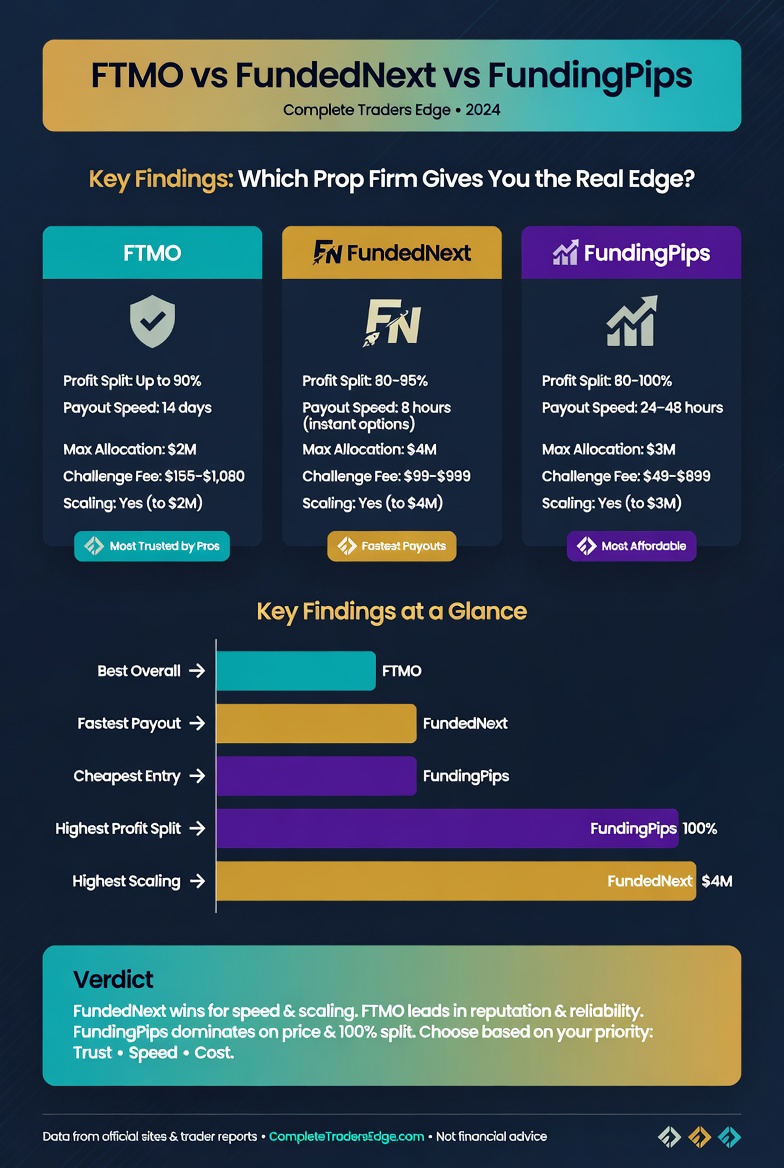
The math says FundingPips edges FundedNext by 1 point, with FTMO trailing by 9. But raw scores hide context. FundingPips wins on price and split. FundedNext wins on product range and payout speed. FTMO wins on brand reliability and platform analytics. The right answer depends on which dimensions matter most to your trading.
Head-to-Head Battles
FTMO vs FundedNext: The Established vs The Aggressive
This is the comparison most traders run first because they’ve seen FTMO marketed for years and FundedNext is the brand name that keeps coming up in 2026 trader Discords. The honest summary:
Where FTMO wins: Operational track record (10+ years vs FundedNext’s 4), the analytical depth of FTMO MetriX and the Mentor App, and a slightly higher Trustpilot rating (4.8 vs 4.5). The brand premium is real.
Where FundedNext wins: Lower fees, higher profit split ceiling (95% with lifetime add-on vs 90% on FTMO), futures programs (FTMO has none), 24-hour payout guarantee with $1,000 compensation if late, the 15% reward on evaluation profit (Stellar 2-Step), and the Stellar Instant option for traders who don’t want an evaluation at all.
Verdict: If you’re a CFD-only swing trader who wants the most-respected brand and you’re willing to pay 5–8% more, FTMO. If you want optionality, faster payouts, and access to futures, FundedNext. For most traders building a serious funded-account strategy in 2026, FundedNext is the better economic choice and FTMO is the better legacy choice.
FTMO vs FundingPips: The Premium vs The Value
This is the cleanest cost comparison in the prop industry. FTMO is the BMW. FundingPips is the Toyota. Both will get you to the funded stage. One costs roughly 30% more to drive at the $100K tier — though FTMO’s frequent €89 promo on the $10K starter narrows the gap meaningfully for small-account traders.
Where FTMO wins: Brand history (since 2015 vs ~2021), the most refined analytical platform, weekend holding on the FTMO Swing variant (FundingPips suspended weekend holding on funded accounts in January 2026), and a slightly cleaner rule structure with fewer add-ons to track.
Where FundingPips wins: Cheaper at every account tier (often by 30%+), four challenge product types vs FTMO’s two, the tiered profit split system reaching 100% on monthly cycles, and the Hot Seat scaling tier that takes you to $2M with 100% split. Three platforms supported (MT5, MatchTrader, cTrader; MT4 is not available) vs FTMO’s MT4/MT5/cTrader/DXtrade.
Verdict: If you’ve passed prop firm challenges before and you know your edge, FundingPips is the better economic choice — full stop. If you’re attempting your first challenge and you want the most established firm in case anything goes sideways, FTMO is worth the premium. For experienced traders, the FundingPips Hot Seat path is genuinely the best long-term outcome in the industry.
FundedNext vs FundingPips: The Direct Battle
This is the most evenly matched of the three. Both firms operate out of the UAE, both launched within roughly 12 months of each other, and both have built their reputations on being the “non-FTMO” choice for serious traders. The differences come down to product strategy and economics.
Where FundedNext wins: Futures markets (FundingPips has no futures product), faster default payout speed (24-hour guarantee), the 15% reward on evaluation profit, the $4M maximum scale (vs FundingPips’ $2M), and the Live Trading Program graduation path. Multiple platforms supported (MT4, MT5, MatchTrader, cTrader).
Where FundingPips wins: Cheaper at every account tier, the tiered profit split reaching 100% on monthly cycles, no consistency rule on standard 2-Step evaluation, the Hot Seat scaling tier with on-demand payouts and 100% split, and three modern platforms (no MT4 — some traders see this as a positive since MT5 and cTrader are the modern standard).
Verdict: If you trade futures, FundedNext — there’s no competition because FundingPips doesn’t offer the product. If you trade only forex/CFDs and you’re optimising for long-term profit split, FundingPips. If you trade forex/CFDs and you’re optimising for fast cash flow and product variety, FundedNext. Both firms are excellent choices and the worst case is you split your bankroll across both, which several professional funded traders I know do deliberately for risk diversification.
The ICT Trader’s Lens: Which Firm Survives Smart-Money Strategy
This section is for the segment of my readership that actually trades ICT, smart money concepts, or some variant of institutional order flow analysis. The standard rule comparisons miss the operational reality of trading these styles. Here’s what actually matters.
Kill Zone Trading (London Open & New York Open)
If your bread and butter is the 02:00–05:00 EST London kill zone or the 07:00–10:00 EST New York kill zone, you need a firm that doesn’t punish concentrated session trading. All three firms allow this — none have explicit time-of-day restrictions. But the consistency rule structure matters. FTMO has no consistency rule on the 2-Step product beyond the Best Day rule (max 50% of positive day profits on the 1-Step). FundedNext applies a 40% consistency rule on Futures Legacy/Rapid evaluations and Stellar Instant, but not on Stellar 2-Step CFD. FundingPips applies a 35% consistency rule only on On-Demand payouts.
For an ICT kill-zone trader running a normal weekly distribution of trades, none of these consistency rules trip in normal operation. They only become a problem when a single setup goes parabolic and dominates your weekly P&L. Practical outcome: all three firms support kill-zone trading. FTMO 2-Step is the cleanest. FundingPips standard 2-Step is functionally identical.
News Event Trading (CPI, FOMC, NFP)
This is where the firms diverge significantly. ICT teaches that the highest-quality liquidity sweeps occur around scheduled news events. If your strategy involves trading the algorithmic move that follows a high-impact release, you need to know exactly what each firm allows:
| Firm | Evaluation Phase | Funded Phase |
|---|---|---|
| FTMO 2-Step | News trading allowed | 2-min restriction (no open/close ±2 min around major macro) |
| FundedNext Stellar 2-Step | News trading allowed | 5-min window: only 40% of profit counts if trade opened/closed within 5 min of high-impact news (losses count 100%) |
| FundingPips 2-Step | News trading allowed | 5-min window before/after high-impact news; profits don’t count toward payouts |
FTMO has the cleanest news rule on the funded stage. FundedNext’s 60% profit reduction with full loss attribution is the harshest financial penalty. FundingPips’ “doesn’t count” is binary. For ICT news traders, FTMO is the best choice on the funded stage. But practically, most traders shouldn’t be opening trades within 5 minutes of CPI anyway — the spread blowouts and slippage make the math worse than the rule penalty.
Drawdown Reality on a Smart-Money Strategy
ICT traders typically run wider stops than mean-reversion traders. A 1H FVG entry might require a 60-pip stop on Gold, which on a $100K account at 1% risk is a $1,000 risk per trade. The 5% daily loss limit means you can lose 5 trades in a day before you breach. The 10% max drawdown means you can lose 10 trades total before you blow the account.
Run the math: an ICT trader with a 50% win rate and a 1:2 risk-to-reward ratio has roughly a 1-in-32 probability of losing 5 trades in a row. That’s enough to breach the daily limit on a single bad day. Static drawdown — which all three firms use on the standard 2-Step product — is more forgiving than trailing because your floor doesn’t move up as you make profit. For ICT/smart-money trading, all three firms’ static drawdown structure on 2-Step products is acceptable. The 5% daily limit is the real constraint, not the 10% total.
For our complete framework on managing drawdown on funded accounts, see how to build a drawdown protocol and how correlation risk doubles your exposure when trading multiple instruments.
Real-Money Scenario: $1,000 Bankroll, Three Different Firms
Let me make this tangible. Imagine you have $1,000 to spend on prop firm challenges over the next 6 months. You’re an intermediate ICT trader with a 50% win rate and a 1:2 risk-to-reward ratio. Here’s what you can actually do at each firm.
Path A: All-In on FTMO
$1,000 buys you one $100K Standard at ~$580 plus one $25K at ~$270, with $150 left over. If you fail both, you’re out $850 with no funded account. If you pass the $100K but fail the $25K, you’re funded on $100K. After 6 weeks of funded trading at 80% split with normal performance, you might generate $4,000–6,000 in trader payouts plus the $580 fee refund. Total Year 1 outcome on a single pass: ~$11,000–16,000. Alternative: stack three $10K starter challenges at €89 promo pricing (~$285 total) to learn the rules cheaply before committing to a $100K attempt.
Path B: Spread on FundedNext
$1,000 buys you one $100K Stellar 2-Step (~$549.99) plus one $50K Stellar 2-Step (~$299.99), with $150 in reserve. If you pass both, you have $150K total funded capital. The lifetime 95% profit split add-on (typically +30% of fee = ~$165 each) is worth considering on each. With 95% split + 15% evaluation reward + 24-hour payouts, the cash-flow advantage starts compounding immediately. A normal Year 1 on $150K combined funded capital might generate $9,000–14,000 in profits plus fee refunds.
Path C: Stack on FundingPips
$1,000 buys you two $100K 2-Step Standard challenges (~$798 total) with ~$200 in reserve for a smaller third attempt or a discount-code save. If you pass both, you have $200K total funded capital. On the bi-weekly 80% cycle, you receive your fee refund after the fourth payout (roughly 8 weeks of funded trading). On the monthly 100% cycle, you keep every dollar of profit but wait 30 days between payouts. A normal Year 1 on $200K combined funded capital at 80% bi-weekly might generate $10,000–18,000 in profits, while the monthly 100% cycle could yield $12,500–22,500.
The math reveals why I keep recommending FundingPips for value-conscious traders: on the same $1,000 bankroll, you end up with more total funded capital and more long-run profit potential. The trade-offs: the slower fee refund cycle (4 payouts vs FTMO’s 1), the brand-recognition deficit, and the recent weekend-holding suspension on funded accounts. For a trader who has already proven they can pass challenges and trades intraday, that trade-off is easy. For a first-timer worried about whether they’ll even get funded, FTMO’s brand premium is worth paying — especially with €89 starter pricing.
If you want to map this against your specific strategy and account size, our prop firm risk calculator walks you through position sizing for each of the three firms’ rule structures. And the broader framework for choosing between prop firms and self-funded trading is in our prop firms casino-edge breakdown.
The Hidden Traps Nobody Tells You About
Every prop firm review focuses on the headline rules. The traps are in the operational details. Here are the issues I’ve personally encountered or seen experienced traders trip on.
Trap 1: The “Equity-Based” Daily Loss Calculation
FTMO calculates the 5% daily loss against equity, not balance. This means floating losses on open positions count against the daily limit in real time. If you’re up $2,000 unrealised on a position that suddenly retraces $4,000, the $4,000 floating loss counts immediately. You don’t get to wait for the trade to close. FundedNext and FundingPips also calculate equity-based. All three firms will breach you on a fast reversal even if your closed-position P&L is fine.
Practical implication: If you size positions based on closed-trade math, you’ll under-estimate your real-time risk by 30–50%. Always size assuming the worst-case floating drawdown of your open positions. This is covered in detail in risk of ruin: the mathematics every trader must understand.
Trap 2: The Min-Trading-Days Rule
Each firm requires a minimum number of trading days before you can advance from Phase 1 to Phase 2 or before you can request a payout:
- FTMO: 4 trading days per phase (down from 10 in earlier versions)
- FundedNext Stellar 2-Step: 5 trading days per phase + 21-day initial period before first payout
- FundingPips 2-Step Standard: 3 trading days per phase
If you’re a trader who hits your target in 2 sessions because of a single big win, you’ll have to artificially add trading days, which often leads to losing trades and breaching. This is more common than you’d think — I’ve watched friends pass their target by Day 3 and then breach by Day 5 trying to manufacture filler trading days. The discipline lesson: stop trading the moment you hit your target on the right number of days.
Trap 3: Weekend Holding Restrictions
The funded-stage rules are stricter than the evaluation-stage rules at all three firms, and weekend holding is the most commonly overlooked. FundedNext’s funded CFD accounts ban weekend holding, even though weekend holding is allowed during the evaluation. FundingPips suspended weekend holding on funded accounts on January 29, 2026 — a temporary measure that may or may not still be in force when you read this. Verify before relying on overnight setups. FTMO’s standard funded account also bans weekend holding — only the FTMO Swing variant explicitly permits it. If you pass on Friday with an open position and forget to close it before market close, you breach on Monday’s gap.
Trap 4: The 30-Day Inactivity Rule
FundingPips and FundedNext both terminate inactive accounts after 30 days of no trading activity. FTMO uses a similar threshold. If life gets in the way and you take a month off, your account closes. This is a real issue for traders who pass their challenge while holding a day job and then can’t trade their funded account regularly. Solution: place at least one small trade every 25 days to reset the inactivity clock.
Trap 5: The KYC Block on First Payout
All three firms require KYC verification before your first payout will process. The verification typically takes 24–72 hours. If you wait until Day 14 to start your KYC, you’re not getting paid on Day 14 — you’re getting paid on Day 15-17. Start the KYC process the moment your funded account opens.
Decision Flowchart: Which Firm Should You Choose?
Step 1: Are you US-based?
If yes → FundedNext Futures (Bolt, Rapid, or Legacy) or FTMO US (MT5 only) are your options of these three. FundingPips doesn’t accept US traders.
If no → continue to Step 2.
Step 2: Do you trade futures (NQ, ES, CL, GC) on CME?
If yes → FundedNext Futures is your option of these three. FTMO and FundingPips are CFD-only.
If no → continue to Step 3.
Step 3: What’s your bankroll for challenge attempts?
If under $200 → FundingPips $5K Pro at $29 or 2-Step Standard at ~$36, or FTMO €89 promo on the $10K. Cheapest entry into the funded space.
If $200–$1,500 → FundingPips for value, FundedNext for speed-to-funded.
If above $1,500 → All three are viable. Choose on brand preference and rule preference.
Step 4: What’s your trading style?
If you’re a swing trader needing weekend holding → FTMO Swing (the cleanest weekend-holding option in 2026).
If you’re an intraday ICT trader → FundingPips 2-Step Standard or FundedNext Stellar 2-Step.
If you’re a news event trader → FTMO has the cleanest funded-stage news rule.
If you’re a multi-account scaling trader → FundedNext for max ceiling, or FundingPips Hot Seat path for max long-term split.
Step 5: How important is brand recognition to you?
If “very important” (e.g., you want to talk about your funded account in professional contexts) → FTMO.
If “not particularly” → FundingPips for value, FundedNext for product breadth.
The Mind · Method · Money Lens
I write everything on this site through the framework of Mind · Method · Money, the three pillars from The Complete Trader’s Edge. Choosing a prop firm hits all three pillars, so let me close with that lens.
Mind: The firm you choose shapes your psychological experience of trading. FTMO’s brand reliability removes one source of anxiety — you’re not worrying about whether the firm will be operational in 12 months. FundingPips’ Hot Seat tier gives you a tangible long-term goal that aligns the funded-trader incentive with consistent execution. FundedNext’s 24-hour payout guarantee removes cash-flow uncertainty. None of these firms will make you a profitable trader, but the right one removes friction and the wrong one adds it. See funded trader psychology for the mental game of trading on someone else’s capital.
Method: The firm you choose constrains your method. FTMO’s standard CFD-only product means you can’t trade NQ futures through them. FundedNext’s news-trading penalty means an ICT news scalper trades worse there than at FTMO. FundingPips’ weekend holding suspension closes off swing-trading setups for now. Match your method to the firm’s rule structure, not the other way around. The standard ICT, smart-money, and price-action methods documented across this site work at all three firms — but they work best at one specifically. Read multi-timeframe analysis and order blocks for the foundations.
Money: The firm you choose determines the math of your funded-trader career. Profit splits compound. Fee refund cycles compound. Scaling tiers compound. The 5–15 percentage point difference between an 80% and a 95% split looks small until you run it on $200K of capital across 36 months and see it represents $20K+ in lost profit. Choose with the long-run math in mind, not the short-term comfort. Detailed framework in professional trading plan template.
The Indian Trader’s View: Do These Firms Accept India, and Which Fits?
India is now one of the largest markets in prop trading, and as of 2026 all three firms accept Indian residents. The differences that matter from India are not the ones the global comparison above focuses on. Here is what actually changes when you trade these firms from India.
FTMO opened to Indian traders relatively recently and now serves the market openly. It runs the same simulated two-step Challenge and Verification, requires KYC, and has a long track record of paying Indian residents by bank transfer and by crypto. FundedNext counts India among its very largest trader bases and offers country-specific local payment options alongside crypto, bank transfer and RiseWorks, with low minimum thresholds. FundingPips goes further still: Indian traders make up the majority of its user base, its published restricted list does not include India, and its rules are among the most flexible of the three, with no consistency rule on most models and news and weekend holding permitted.
So acceptance is not the deciding factor; all three want your business. The real India-specific decisions sit underneath the firm choice, and they apply to all three equally.
The payout rail is a tax decision, whichever firm you pick.
Take your payout in crypto and it can land inside India’s Virtual Digital Asset regime, a flat 30% with no loss offset and a 1% TDS. Take it by bank transfer and it is generally taxed as business income at your slab rate. That difference dwarfs most of the fee and profit-split gaps between the three firms. Choose the rail before you choose the firm.
Two more India realities cut across all three. Funding a challenge usually means an international card, and many Indian banks decline those on merchant-category grounds, so you may need a card enabled for it and a backup. And the money you send out runs through the Liberalised Remittance Scheme with tax collected at source, on the legal footing that you are paying a fee for a simulated evaluation rather than trading margined product abroad. One honest caution specific to the firms above: FundedNext has appeared on the Reserve Bank of India’s Alert List of unauthorised forex entities. That does not settle the legal question on its own, but it is a fact an Indian trader should weigh and discuss with a chartered accountant rather than ignore.
For the full legal, tax and payment picture behind these decisions, read our guide to LRS, FEMA and prop firm payouts in India, and for how the model works before you commit to any firm, the complete prop firm trading guide.
Frequently Asked Questions
Which prop firm has the highest pass rate?
None of the three firms publish official pass rates. Independent estimates from prop-trading communities suggest that 8–15% of traders pass any given two-step evaluation on first attempt, with the figure roughly consistent across FTMO, FundedNext Stellar 2-Step, and FundingPips 2-Step. The bigger driver of pass rate is trader skill, not firm choice. Where firm choice matters is rule flexibility on edge cases (news events, weekend holding, consistency).
Are FTMO, FundedNext, and FundingPips legitimate, or are they scams?
All three are legitimate. FTMO has paid out $500M+ since 2015. FundedNext has paid out $260M+ since 2022. FundingPips has paid out $200M+ across 127,000+ verified payouts. The prop-firm scam concerns from 2023–2024 were primarily directed at firms like MyForexFunds (now defunct) and TrueForexFunds (now closed). The three firms in this comparison are the largest survivors of that industry shake-out, which is itself meaningful evidence of operational legitimacy.
What’s the cheapest way to start with one of these prop firms?
FundingPips’ $5K 2-Step Pro at $29 is the absolute cheapest entry point in the industry. The $5K 2-Step Standard at ~$36 is the next cheapest with more forgiving drawdown rules (10%/5% vs Pro’s 6%/3%). For FTMO, the $10K starter at €89 promo pricing (~$95) is meaningful value — that’s the cheapest legitimate way into the FTMO ecosystem. FundedNext’s $6K Stellar 2-Step at $59.99 sits between them, with the 15% evaluation reward bonus added at first payout.
Can I have funded accounts at multiple firms simultaneously?
Yes. There’s no prohibition on holding accounts at FTMO, FundedNext, and FundingPips at the same time. Many professional funded traders deliberately diversify across multiple firms to reduce concentration risk if any single firm changes its rules or runs into operational issues. The only restriction is that you must trade each account independently — copy trading or signal-mirroring across firms is typically prohibited and grounds for account termination.
What happens if a prop firm goes out of business while I have a funded account?
You typically lose any unwithdrawn profit. Several firms collapsed in 2023–2024 (MyForexFunds, TrueForexFunds, MyFundedFX) and traders with funded accounts at those firms received nothing in many cases. This is the strongest argument for FTMO’s brand premium: the operational track record makes a sudden collapse less likely. It’s also the strongest argument for diversifying across multiple firms.
Which firm is best for ICT and smart-money traders specifically?
FundingPips 2-Step Standard is my pick for the ICT trader. The combination of static drawdown (5%/10%), no consistency rule on standard payouts, three platforms (cTrader is preferred by many ICT traders), and the cheapest entry price gives you the most flexibility to deploy classic ICT setups during the London and New York kill zones. FundedNext Stellar 2-Step is a strong second with the 15% reward and faster payouts. FTMO is the conservative choice for ICT traders who want the maximum brand reliability or who specifically need clean news-event rules on the funded stage.
How long does it take to get a funded account?
The fastest path is FundingPips 2-Step Standard with the 3-day minimum trading days, technically allowing you to pass Phase 1 + Phase 2 in 6 actual trading days. In practice, most traders need 15–30 days to safely hit both phase targets. FTMO’s 4-day minimum and FundedNext’s 5-day minimum (Stellar 2-Step) push the floor a couple of days higher. None of the firms have time limits, so there’s no downside to taking 30–60 days if that’s what disciplined trading requires.
Can I trade EAs and automated strategies?
All three firms permit Expert Advisors (EAs) on MT4 and MT5. FundingPips permits EAs only as trade managers or risk managers (not full automation). FundedNext does not allow EAs on cTrader. None of the firms allow high-frequency trading bots, latency arbitrage systems, or copy-trading from external sources. If you’re running a custom-built EA, the rules are typically permissive provided your bot respects the drawdown limits and isn’t classed as HFT.
What’s the consistency rule and which firms enforce it?
The consistency rule limits how much of your total profit can come from a single big day. FTMO’s 1-Step product enforces a “Best Day” rule (max 50% of positive day profits). FTMO 2-Step has no consistency rule. FundedNext applies 40% consistency on Futures Legacy/Rapid evaluations and on Stellar Instant; the standard Stellar 2-Step has none. FundingPips applies 35% consistency only when you select On-Demand payouts on standard 1-Step/2-Step Masters; the bi-weekly default cycle has none. Zero accounts have a stricter 15% consistency rule that applies at every payout. For most traders, consistency rules don’t trip in normal trading.
Do these firms accept South African traders?
Yes. All three firms accept traders from South Africa. Payments are typically processed via international bank transfer (USD), with some firms offering crypto payouts (USDT, USDC) which can be more efficient for SA-based traders due to faster settlement and reduced FX conversion costs. KYC documentation typically includes a SA ID and proof of address; passport may be requested for higher-tier accounts.
Which firm has the best customer support?
FundedNext has the most responsive support, particularly via Discord which provides real-time response from their team. FTMO has the most professional support but operates primarily via email with 24–48 hour response times. FundingPips uses an AI chatbot first, with human escalation for unresolved issues. For traders who need fast support during a live trade, FundedNext wins. For traders who want detailed, well-documented responses, FTMO wins.
The Final Verdict
Here’s the cleanest summary I can give you:
Pick FTMO if you trade CFDs, swing-style, want the most-respected brand, value the analytical platform (MetriX, Mentor App), and you’re willing to pay roughly 30% more than the cheapest competitor at the $100K tier for that legacy. The 14-day payout cycle and 80% baseline split are slightly less competitive than alternatives, but for traders who prioritise operational reliability over economics, FTMO is still the gold standard. The €89 starter pricing on the $10K product also makes it surprisingly accessible for first-time prop traders. The Swing variant is the cleanest weekend-holding option among the three in 2026. Visit FTMO.
Pick FundedNext if you want the broadest product range (CFDs and futures), the highest profit splits (95% with the lifetime add-on), the fastest payouts (24-hour guarantee with $1,000 compensation), and the 15% reward on evaluation profits. Best choice for multi-account scaling traders, futures traders, and anyone optimising for cash-flow speed. Visit FundedNext.
Pick FundingPips if you want the cheapest entry point ($29 for a $5K Pro), the most flexible payout system (60–100% tiered), the deepest scaling rewards (Hot Seat tier with $2M and 100% split), and the simplest path to a funded account on a tight bankroll. Best choice for value-conscious traders, intraday ICT and smart-money traders, and anyone planning to grind their way through the Hot Seat scaling tier for the long-term economics. Visit FundingPips.
For most readers of this site — intermediate ICT and smart-money traders who are serious about funded trading as a long-term income source — FundingPips 2-Step Standard is my recommendation for intraday work. The math, the rule structure, the platform options, and the long-run scaling tier all line up. FundedNext is a close second if you also want futures exposure or you specifically value the 24-hour payout guarantee. FTMO is the right choice if your priority is the safest, most-respected name on your screenshots — or if you specifically need the FTMO Swing weekend-holding setup.
Whatever you choose, the firm is only the first decision. The trader you become while operating in their rule structure is the decision that compounds. Build the discipline, journal every trade, and treat the funded account like the professional capital it represents. The 70-chapter framework in The Complete Trader’s Edge walks through the full Mind · Method · Money discipline that separates traders who keep their funded accounts from those who blow them in 90 days.
Continue Your Prop Firm Research
For deeper individual reviews and adjacent strategy work, here’s the related reading on this site:
- How to Trade Prop Firms Like a Casino: The Mathematical Edge Most Funded Traders Miss
- 2026 Prop Firm Rule Changes: How to Adjust Your ICT Strategy
- Prop Firm Risk Calculator: How to Size Every Trade on a Funded Account
- Funded Trader Psychology: The Mental Game of Prop Firm Trading
- The5ers Review 2026: The Most Trusted Prop Firm for Funded Trading?
- Prop Firm Trading: The Complete Guide
Disclosure: I’m an affiliate partner of FTMO, FundedNext and FundingPips, and I earn a commission if you purchase a challenge through the links on this page. The recommendations in this article reflect honest analysis and my own funded-trading experience, not affiliate commission optimisation. Affiliate links are marked with the standard sponsored attribution. All prop firm trading involves significant risk; past payouts do not guarantee future operational reliability. Verify all firm rules and pricing directly on each firm’s official website before purchasing a challenge — prop firms change pricing and rules frequently.
 The Complete Trader's Edge
The full Mind · Method · Money framework. 70 chapters.
View on Amazon →
The Complete Trader's Edge
The full Mind · Method · Money framework. 70 chapters.
View on Amazon →
 Market Mayhem
400 years of bubbles, crashes, and the pattern that keeps repeating.
Buy on Amazon →
Market Mayhem
400 years of bubbles, crashes, and the pattern that keeps repeating.
Buy on Amazon →
 Greatest Companies
How the world's greatest companies were built — and what traders learn from them.
View on Amazon →
Greatest Companies
How the world's greatest companies were built — and what traders learn from them.
View on Amazon →