

Passing a prop firm challenge is not the hardest part of funded trading. The hardest part is what happens after you pass: managing a $100,000 account with real drawdown limits, real profit targets, and the specific psychological pressure of knowing that one bad week can end your allocation. Most traders who fail funded accounts do not fail because their strategy stopped working. They fail because the stakes changed and their psychology was not prepared for it.
This guide covers the complete mental game of prop firm trading — what makes the psychology different from personal account trading, the specific failure patterns unique to funded accounts, and the exact framework for protecting your allocation while building toward the income that made you pursue this path in the first place.
Why Funded Account Psychology Is Different
Trading a funded prop account introduces psychological pressures that simply do not exist when trading your own small account. Understanding these differences before they affect you is the entire game.
| Psychological factor | Personal small account | Funded prop account |
|---|---|---|
| Loss consequence | Reduces your personal capital; painful but recoverable | May breach drawdown limit and end the allocation entirely |
| Profit pressure | Optional — you can hold cash and wait for perfect setups | Profit targets required by some firms create implicit pressure to trade |
| Account size perception | Numbers feel real and proportional to personal finances | Large numbers ($100K+) can trigger risk-averse paralysis or detached recklessness |
| Rule complexity | Self-defined rules, adjustable anytime | External firm rules (daily drawdown, max loss, trading hours) add a compliance layer |
| Identity stake | Loss of money | Loss of money plus identity as a “funded trader” — ego is more exposed |
The identity factor is underestimated. Getting funded is an achievement that most people who attempt it do not reach. When you hold a funded account, you have passed a challenge that most applicants failed. Your identity becomes partially invested in maintaining that status. Losing the account means losing the achievement, which activates a threat response far more intense than the financial loss alone would produce. This identity exposure is why many funded traders take their worst trades in the final days before a payout — the pressure of maintaining the account distorts risk perception at exactly the wrong time.
The Six Most Common Funded Trader Failure Patterns
Pattern 1: Challenge mindset bleeding into live trading
Prop firm challenges are designed with specific profit targets and time constraints. Some traders develop a “challenge mindset” — slightly more aggressive than normal, willing to push for targets before the deadline — that carries over into the funded account phase where it should not apply. A funded account does not have an end date. It is not a challenge to be completed. It is a business to be operated indefinitely. The optimal approach shifts from “reach the target” to “protect the account while growing it systematically.”
The fix: after passing the challenge, write a new operational document specifically for the funded account phase. State explicitly that there is no deadline, no rush, and that the goal is sustainable monthly growth, not maximum extraction.
Pattern 2: Over-tightening around the daily drawdown limit
Most funded accounts have a daily drawdown limit of around 4-5% of the account. On a $100,000 account, this is typically $4,000-$5,000. Traders who have never managed at this scale often become hyper-aware of the drawdown limit, which paradoxically makes their trading worse — they cut winners early to “bank” profits, avoid valid setups near the limit, and make decisions based on account balance rather than market structure.
The correct approach is to trade exactly as your strategy dictates, using the same 1% risk per trade rule, and let the daily limit serve as an emergency brake rather than a constant presence in your decision-making. If you are risking 1% per trade ($1,000 on a $100,000 account), you need four consecutive losing trades to approach a 4% daily drawdown. Four consecutive losing trades in a single session, while trading valid setups, is rare enough that it should not affect your behaviour on any given trade.
Pattern 3: Profit target urgency
Some prop firms require a minimum profit target before the first payout. This creates a specific psychological trap: the closer you are to the target, the more reluctant you become to take losses that would push you back below it. Setups that previously would have been correctly declined get taken. Winners get cut early to “lock in” progress toward the target. The target stops being a milestone and starts being a pressure that distorts every trading decision.
The fix is a version of the same principle applied across all trading: focus entirely on process compliance. If your strategy has positive expectancy and you execute it correctly, the profit target will be reached in time. Changing your behaviour to reach it faster will, statistically, slow or prevent you from reaching it.
Pattern 4: The large account paralysis
Counterintuitively, some traders perform worse on large funded accounts than they did on small personal accounts. The mechanism: the larger numbers feel different. A 1% risk on a $100,000 account is $1,000. On a $500 personal account, it was $5. Cognitively, the trader knows the percentage is identical. Emotionally, placing a trade that could lose $1,000 triggers a risk-aversion response they never experienced at $5 risk per trade.
This manifests as analysis paralysis — every setup gets over-scrutinised to the point where the entry is missed — or as systematically under-sizing positions to the point where the account cannot reach profit targets on the normal strategy expectancy.
The fix is identical to the prescription for any psychological normalisation in trading: gradual exposure. If you are paralysed by the large account numbers, mentally translate every percentage figure back to your personal account equivalent. 1% of $100,000 is not $1,000. It is 1% — the same number that was correct on every account you have ever traded. The percentage is the reality. The dollar figure is just the current denomination of that percentage.
Pattern 5: The blow-up after the first payout
One of the most predictable funded trader patterns is strong performance in month one, successful payout, and then a significant drawdown or account breach in month two or three. The mechanism is overconfidence combined with a subtle shift in risk perception after the first payout: “I’ve already made real money from this account, so the current balance feels less real.” This psychological distancing from the capital leads to slightly looser risk management, slightly larger positions, slightly more tolerance for marginal setups — and gradually, the drawdown that ends the allocation.
Write this rule and keep it in your trading plan: a payout does not change anything about how I manage this account. Same rules. Same position size. Same entry criteria. The day after a payout is treated identically to the day before it.
Pattern 6: Firm rule confusion during live sessions
Most prop firms have specific rules around weekend holds, news events, trading hours, and news-adjacent positions. These rules vary by firm and can be complex. A trader who is uncertain whether a specific trade type is permitted will hesitate at the entry, miss the setup, or take the trade and then spend the session anxious about compliance. Either way, the uncertainty degrades performance.
The solution is straightforward: read every rule in your firm’s terms before trading the first session. Write out the rules that are most likely to affect your trading style — typically the news event policy and the daily loss reset timing — in your own words and keep them visible at your desk. Uncertainty about firm rules should never arise during a live session.
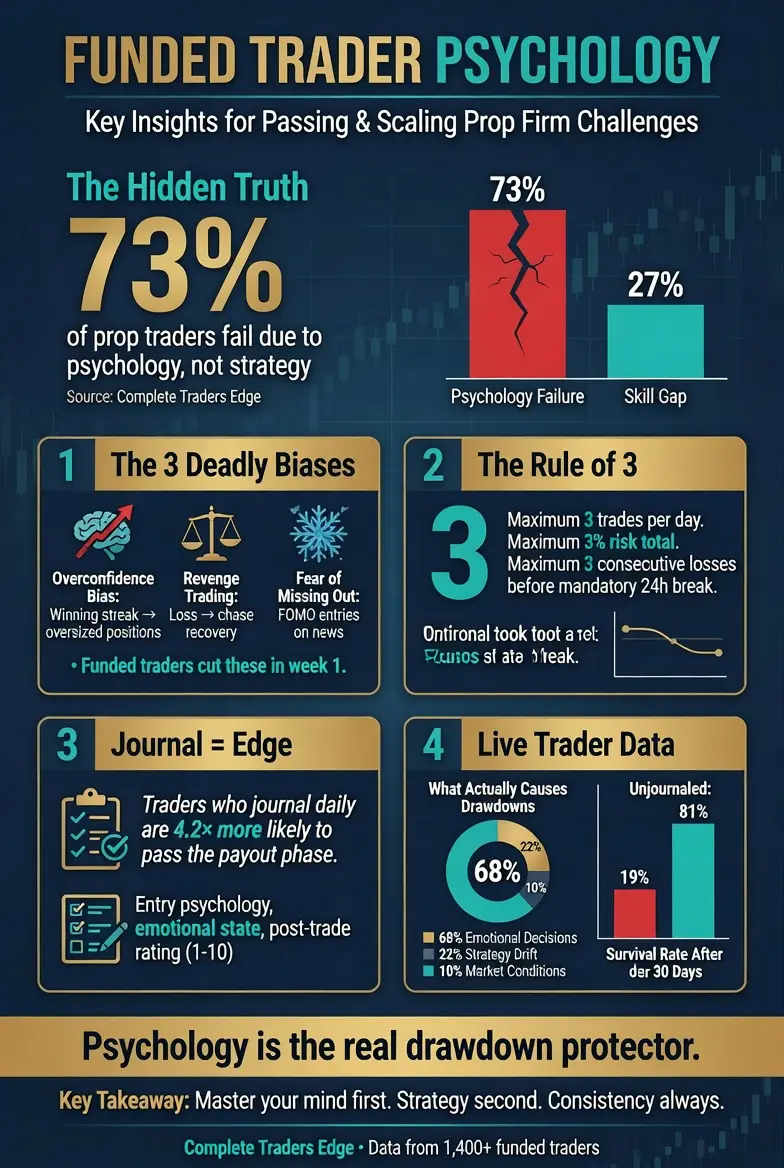
The Funded Trader Psychology Framework
The following framework applies specifically to managing the psychological demands of funded account trading.
| Principle | Application |
|---|---|
| The account is a tool, not an achievement | You passed the challenge. That achievement is permanent. The funded account is now simply a capital allocation. Losing it does not undo the achievement, and a new challenge can be attempted. |
| Percentages, not dollars | All risk decisions are made in percentages. The dollar figures are informational only. 1% risk means 1% risk regardless of what the denominator is. |
| The drawdown limit is not a target | Your daily drawdown limit exists to prevent catastrophic loss. Your actual daily trading target is zero to +2%. Staying far below the limit at all times is the goal, not approaching it. |
| Same process, bigger denomination | Everything about how you trade this account — preparation, checklist, entry criteria, stop placement, review — is identical to how you traded your personal account during development. The only variable is the account size. |
| A breached account is a data point, not a failure | Every funded trader who eventually sustains long-term success has almost certainly breached at least one account during development. The breach tells you something about your process under specific conditions. Extract the lesson, re-challenge, and apply it. |
The Daily Routine of a Funded Trader
Structure and routine are the primary psychological tools of the funded trader. When the same process is followed every day regardless of results, the account balance becomes less emotionally salient and decisions are made from a stable, prepared state rather than a reactive one.
Before the session: Review Daily and 4H charts on your primary instruments. Mark key levels — Order Blocks, FVGs, liquidity sweeps, pivots. Check the economic calendar. Confirm your risk parameters for the day (1% per trade, 2% daily maximum, maximum 2-3 trades). Note current account balance and drawdown status relative to firm limits. Assess your emotional and physical state — if you are not in a good state to trade, wait or sit out.
During the session: Execute the plan only. No new analysis while in a trade. No chart changes, timeframe switching, or second-guessing a set position. If the stop is hit, the trade is over. Journal the trade immediately. If the daily loss limit is reached, close the platform. No exceptions.
After the session: Journal every trade: setup type, entry, stop, target, outcome in R, rule compliance grade (1-5). Note anything notable about the session. Close all charts. A hard stop time enforced daily prevents the screen-addiction pattern that leads to overtrading and low-quality sessions.
Frequently Asked Questions
How is trading a funded account psychologically different from a personal account?
Three key differences. First, the consequence of losses is more acute — a sufficiently bad period ends the allocation entirely rather than just reducing your personal balance. Second, the identity stake is higher — funded trader status carries an earned meaning that creates additional ego exposure around maintaining it. Third, the absolute dollar figures are larger for most traders than they have experienced before, which can trigger risk-aversion or risk-detachment responses that were not present at smaller sizes. Understanding these differences before they activate is the primary psychological preparation for funded trading.
What is the best strategy for not breaching the daily drawdown limit?
Trade at 1% risk per trade, set a hard maximum of two to three trades per session, and stop trading when you hit two consecutive losses in the same session regardless of whether you have reached the daily limit. This approach means a genuinely terrible session — where every trade loses — produces a maximum loss of around 3%, safely below most firms’ 4-5% daily limits. The daily limit should never be approached because your own process limits should stop you well before it.
Should I trade differently on a funded account than on my personal account?
No. This is the most important principle of funded trading. The moment you trade differently on the funded account — more cautiously, more aggressively, with modified criteria — you have introduced a variable that your track record does not support. Your track record was built on a specific process. That process is what earned the allocation. Trade it identically.
How do I handle the pressure of profit targets on funded accounts?
Reframe the target as an outcome rather than a goal. Your goal is process compliance. If you execute your strategy correctly, the profit target will be reached in its own time. Changing your behaviour to reach it faster — taking more trades, accepting worse setups, holding winners longer than structure supports — is statistically more likely to prevent you from reaching the target than to accelerate it. Every time you feel target pressure affecting a trade decision, that is a signal to stop and review your process compliance, not a signal to push harder.
Is it worth attempting a funded account challenge before I am consistently profitable?
No. A prop firm challenge should be attempted only after you have a documented trading journal with at least 100 trades showing positive expectancy across different market conditions. The challenge is not a shortcut to capital — it is a test of whether your process deserves capital. Traders who attempt challenges before establishing a profitable track record have low pass rates and typically learn little from the failure because they do not yet have the reference point of knowing what correct execution looks like. Build the track record first. The challenge becomes straightforward once you have it.
▶ ▶ ▶ Continue Reading
Build the complete foundation for funded trading
The Complete Trader’s Edge
The full psychology and risk management system is in the book
70 chapters covering the complete Mind, Method and Money framework — including the specific mental and risk management systems that protect funded accounts and build toward consistent long-term income. Available on Amazon in Kindle, paperback and full-colour editions.
 The Complete Trader's Edge
The full Mind · Method · Money framework. 70 chapters.
View on Amazon →
The Complete Trader's Edge
The full Mind · Method · Money framework. 70 chapters.
View on Amazon →
 Market Mayhem
400 years of bubbles, crashes, and the pattern that keeps repeating.
Buy on Amazon →
Market Mayhem
400 years of bubbles, crashes, and the pattern that keeps repeating.
Buy on Amazon →
 Greatest Companies
How the world's greatest companies were built — and what traders learn from them.
View on Amazon →
Greatest Companies
How the world's greatest companies were built — and what traders learn from them.
View on Amazon →
 Greatest Traders
Eighty-six lives that explain the markets — Livermore to Madoff, told with the losses left in.
View on Amazon →
Greatest Traders
Eighty-six lives that explain the markets — Livermore to Madoff, told with the losses left in.
View on Amazon →