

Explore all 80 books in the Trader’s Library →
If you have ever picked up a chart and tried to figure out where price might go next, you have either read this book or read someone who has.
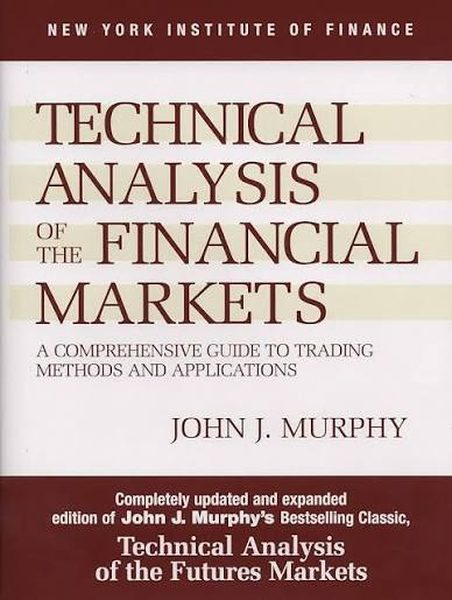
Technical Analysis of the Financial Markets by John J. Murphy is the textbook that taught a generation of traders what technical analysis actually is. Published in 1986, revised in 1999, the book remains the single most cited reference work in the field. Every prop firm, every CMT exam, every serious technical analysis course in the world either uses this book or borrows from it.
The question for any trader in 2026 is whether a textbook written before high-frequency trading, before Smart Money Concepts, before order-flow tools and electronic markets dominated the world, still earns its place on the shelf. The answer is yes, with one important qualification.
This review breaks down what the book does extraordinarily well, what it does not cover, where the modern reader should supplement it, and whether you should read all 542 pages or use it the way most professionals actually use it.
At a Glance
| Author | John J. Murphy |
| First Published | 1986 (revised 1999) |
| Pages | ~542 |
| Genre | Technical analysis textbook / reference |
| Difficulty | Beginner-friendly — methodical, comprehensive, sometimes dry |
| Best For | Anyone learning technical analysis from scratch or formalising self-taught knowledge |
| Skip If | You already know classical TA cold and want only SMC/ICT or order-flow content |
OVERALL RATING: 8.5 / 10
Who Should Read This Book
| Reader | Verdict | Why |
|---|---|---|
| New trader (0–1 year) | Read it now | The most comprehensive single-volume introduction to TA in existence. Start here. |
| Intermediate (1–3 years) | Use as reference | Keep it on your desk and dip in when you need to refresh on a specific pattern or indicator |
| Advanced / professional | Own a copy | Even if you do not use most of the content, the inter-market and seasonality chapters remain valuable |
| SMC / ICT trader | Read selectively | The classical patterns chapter is worth reading even if you reject the framework, because it explains what retail believes and therefore what institutions trade against |
| Algo / quant trader | Reference | Many of the indicators in the book have been quantified and tested in the academic literature. The book is the lay version of that work. |
| Long-term investor | Read selected chapters | The trend, cycle, and inter-market analysis chapters are highly relevant. Skip the short-term indicator chapters. |
The Book in Context
John Murphy was the Director of Technical Research at Merrill Lynch and later the lead technical analyst at CNBC. He spent decades inside professional desks, not as a retail educator, and the book reflects that. The first edition was published in 1986, the major revised edition came out in 1999, and the book has remained in continuous use ever since.
What set the book apart at the time was its scope. Before Murphy, technical analysis literature was scattered across dozens of single-method books. Murphy did the synthesis work, organising the entire field into a coherent textbook structure. He covered chart construction, trends, classical patterns, moving averages, oscillators, volume, cycles, and inter-market relationships in one volume, with consistent terminology and explicit cross-references.
That synthesis is the book’s enduring contribution. Even traders who now operate from completely different frameworks — Smart Money Concepts, order flow, statistical arbitrage — usually learned the vocabulary of charts from Murphy. The book taught the language. The arguments about what is true in that language are still happening twenty-six years later.
The Core Argument: Three Premises That Define Classical TA
Murphy opens the book with three premises that the rest of the text builds on. They are worth knowing whether you accept them or not, because every chart you ever look at is interpreted through them either explicitly or by inheritance.
Murphy’s Three Premises of Technical Analysis
| # | The Premise | What It Means in Practice |
|---|---|---|
| 1 | Market action discounts everything | Price already reflects every known and knowable input. You do not need to know the fundamentals separately because they are already in the chart. |
| 2 | Prices move in trends | Price is more likely to continue an existing trend than to reverse. Trade with the trend until evidence forces a re-evaluation. |
| 3 | History repeats itself | Patterns recur because human behaviour is consistent. What worked yesterday probably still works because the participants are still human. |
Accept all three and the rest of the book follows. Reject any one of them and you are doing something other than classical TA.
The book is at its best when Murphy is showing you how to apply these premises. It is at its weakest when he treats them as self-evidently true rather than as working assumptions. Modern readers should hold them as the latter, not the former.
“The most important rule in chart analysis is that a trend in motion tends to remain in motion.”
— from Technical Analysis of the Financial Markets
What the Book Covers
Murphy organises the entire field into a logical sequence. The book moves from foundation to specifics to synthesis, and the structure is one of the reasons it has aged well as a teaching text.
- Dow Theory and chart construction. Foundational vocabulary. Bar charts, candlesticks, line charts, the relationship between price and time. Necessary reading even if it feels basic.
- Trends, support, resistance, and trendlines. The core grammar of every chart. Murphy’s treatment of trendline drawing is still the cleanest in print.
- Classical reversal and continuation patterns. Head and shoulders, double tops, triangles, flags, pennants. The patterns most retail traders learn first and most institutions trade against.
- Moving averages, oscillators, and momentum indicators. RSI, stochastics, MACD, ADX. Every indicator on your modern platform has a section here explaining what it is and what it does.
- Volume, open interest, and price-volume confirmation. One of the strongest chapters in the book. Volume analysis has lost popularity in the SMC era but remains useful.
- Cycle analysis. Seasonal patterns, presidential cycles, sector rotation. The most underrated chapter, especially for swing and position traders.
- Inter-market analysis. Murphy’s specialty. The relationships between equities, bonds, currencies, and commodities. Worth reading even if you only trade one of them.
- Putting it together. The closing chapters integrate everything into a complete analytical workflow. The synthesis is what separates a textbook from a reference.
Reading the book front to back takes around 30 to 40 hours. Most professionals do not do this. They read the foundational chapters once, then use the rest as reference.
How Murphy Built the Book
Murphy was writing for the Merrill Lynch institutional audience first and the retail audience second. Three structural choices reflect that.
Concept first, illustration second. Each chapter introduces a concept in plain prose, then illustrates with multiple chart examples. The chart examples are deliberately drawn from different markets and timeframes to make the point that the principles port across instruments.
Cross-references everywhere. Murphy treats the book as a network, not a sequence. Every chapter references the relevant material in other chapters, so a reader who jumps in at chapter twelve gets pointed back to the trend material in chapter four. This is what makes the book function as a reference.
Standardised vocabulary. Murphy uses the same terminology consistently across all chapters and explicitly notes when other writers use different terms for the same concept. This is the single most valuable thing the book does for a beginner: it gives you the standard vocabulary that lets you read everything else in the field.
The Modern Translation: Murphy Through an SMC Lens
One of the most useful exercises for any 2026 trader is to read Murphy with SMC vocabulary in mind. Most concepts have direct equivalents, and recognising them sharpens both frameworks.
Murphy’s Vocabulary → SMC / ICT 2026
| Classical TA (Murphy) | Modern Equivalent (SMC / ICT) |
|---|---|
| Higher high / higher low (uptrend) | Bullish market structure |
| Trend break | Break of structure (BOS) / Change of character (CHoCH) |
| Support / resistance level | Liquidity pool / unmitigated zone |
| False breakout | Liquidity sweep / stop hunt |
| Strong volume on a breakout | Displacement |
| Pullback to a moving average | Retracement into a Fair Value Gap or order block |
| Accumulation / distribution phase | Institutional positioning / Wyckoff accumulation |
| Higher-timeframe trend bias | Higher-timeframe directional bias / draw on liquidity |
The same observations, repackaged. The SMC framework is more granular but rests on the same foundation Murphy mapped out in 1986.
For deeper coverage of the modern frameworks, see our complete guide to market structure and our breakdown of ICT for forex traders.
Five Passages Worth Carrying With You
“The trend is your friend except at the end where it bends.”
The single most quoted line from the book. Most traders forget the second half, which is where the actual lesson lives.
“Volume should expand in the direction of the trend.”
The cleanest statement of volume confirmation in the book. Modern SMC traders rebrand this as displacement. The observation predates the vocabulary by decades.
“Markets do not exist in isolation. All four sectors — currencies, commodities, bonds, and stocks — are inter-related.”
The thesis of Murphy’s later career and one of the book’s strongest chapters. Anyone trading a single instrument without watching the related markets is operating with one eye closed.
“Chart patterns are visual records of human emotion.”
The line that connects classical TA to trading psychology. Every pattern in the book is, at root, a snapshot of greed, fear, hope, and capitulation interacting at scale.
“Technical analysis is the study of market action, primarily through the use of charts, for the purpose of forecasting future price trends.”
The book’s working definition. Note the word “forecasting.” Murphy is not predicting. He is estimating probabilities. The distinction matters and is often lost.
Common Misreadings of the Book
Misreading #1: “Murphy gives you a system”
He does not. The book is a methodology and a vocabulary, not a system. Readers who finish it expecting a step-by-step setup checklist have missed the genre. Murphy is teaching you how to read charts. What you do with that reading is your problem.
Misreading #2: “Classical TA does not work in modern markets”
This is the standard SMC criticism and it is half right. Specific edges Murphy describes have been arbitraged away. Other concepts have been renamed but still work. The trend-following premise, the inter-market relationships, the volume work, and most of the cycle analysis are as relevant in 2026 as they were in 1999.
Misreading #3: “Indicators alone are enough”
This is the misreading that produces indicator-stacked charts and analysis paralysis. Murphy explicitly argues that indicators are confirmation tools, not signal generators. The chart structure is primary. The indicators are secondary. Traders who flip this hierarchy fail at the same rate Murphy was already warning about in 1986.
Misreading #4: “If I memorise every pattern, I will become profitable”
Pattern recognition without context is a noise generator. Murphy is clear that patterns only matter in the context of trend, volume, and the broader market structure. Most retail traders memorise the patterns and ignore the context, which is exactly backwards.
Misreading #5: “The book is too long to be useful”
The book is long because it is comprehensive. Most readers do not read it linearly. They read the foundational chapters once, then use the rest as reference. Used this way, the book is one of the highest-value-per-page references in trading literature.
Where the Book Falls Short
An honest review names the weaknesses.
- No Smart Money Concepts or order flow. The book predates these frameworks. Anyone trading SMC or ICT will need to supplement with modern texts. Murphy gives you the foundation, not the current frontier.
- Limited treatment of psychology. Murphy mentions trader psychology in passing but does not develop it. Pair the book with Trading in the Zone for the missing dimension.
- Risk management gets a single chapter. Position sizing, drawdown management, and risk-of-ruin are touched on but not developed in depth. This is a method book, not a money book.
- The 1999 revision feels dated in places. Some examples reference the dot-com bubble or pit-trading era. The principles still hold, but the visual feel is from a different decade.
- Some indicators have not aged well. Several oscillators Murphy describes are now used mostly for confirmation by automated systems. Discretionary traders should know the indicators exist but should not assume they remain edges.
- No discussion of crypto, ETFs, or modern retail instruments. Everything in the book applies to these instruments, but readers have to do the translation work themselves.
How the Book Fits the Mind · Method · Money Framework
This is the cleanest Method-pillar book in the canon. Mind and Money get acknowledged but not developed.
| Pillar | Contribution | What the Book Delivers |
|---|---|---|
| MIND | LIGHT TOUCH | Briefly references psychology as the engine behind chart patterns but does not develop it |
| METHOD | PRIMARY | Chart construction, trend analysis, pattern recognition, indicators, volume, cycles, inter-market analysis — the complete classical TA toolkit |
| MONEY | LIGHT TOUCH | Mentions stops and position sizing but does not develop risk-of-ruin or expectancy frameworks |
If you have read The Complete Trader’s Edge, Murphy gives you the depth on Method that no single chapter of the framework book can match. Pair them: read The Complete Trader’s Edge for the M·M·M structure, read Murphy for the deepest possible treatment of the Method pillar. Reading both alongside the Mind · Method · Money framework gives you the most complete technical foundation available.
Read This Instead Of / Read This After
| Relationship | Book | Why |
|---|---|---|
| Read instead of | Encyclopedia of Chart Patterns by Thomas Bulkowski | Bulkowski is more granular but harder to read as a first text. Use Murphy to learn the framework, then Bulkowski as a deep reference. |
| Read alongside | Steve Nison — Japanese Candlestick Charting Techniques | Murphy covers candles briefly. Nison is the canonical treatment. The two together cover the full vocabulary. |
| Read after | Trading in the Zone by Mark Douglas | Douglas gives you the psychology layer. Without it, the patterns in Murphy will not save you when the chart moves against your trade. |
| Read after | Trading for a Living by Alexander Elder | Elder is a lighter, more accessible introduction. Murphy is the heavier reference. Beginners often benefit from reading Elder first. |
| Read alongside | Modern SMC / ICT material | Murphy gives you the foundation. Modern frameworks give you the granularity. Both together produce a complete operator. |
Final Verdict: Should You Read This Book in 2026?
Yes, but read it the way professionals do. Read the foundation chapters carefully. Read the inter-market and cycle chapters because they are the strongest. Use the rest as a reference, returning to it whenever you encounter a pattern or indicator you want to understand more deeply.
The book remains the most comprehensive single-volume treatment of technical analysis ever written. That is unlikely to change. Anyone who is serious about charts should own a copy and refer to it for the rest of their career. Anyone who is not serious about charts should still read the foundation chapters, because the vocabulary Murphy teaches is the vocabulary every other technical writer uses, including the SMC and ICT writers who claim to have replaced him.
The caveat is that the book is method, not edge. Reading Murphy will not make you profitable. Reading Murphy and then doing the work to combine the method with psychology, risk management, and a real edge might.
CTE Rating Breakdown
8.5/10
Highly Recommended
| Readability | 8 | |
| Actionability | 9 | |
| Timelessness | 9 | |
| Beginner-Friendly | 9 | |
| Modern Relevance | 7 |
Frequently Asked Questions
What is Technical Analysis of the Financial Markets actually about?
The book is a comprehensive textbook on classical technical analysis, covering chart construction, trend analysis, pattern recognition, indicators, volume, cycles, and inter-market relationships in one volume.
Is it still relevant in 2026?
Yes, with one qualification. The foundational concepts, vocabulary, and inter-market analysis remain current. Some specific indicator strategies have been arbitraged away. Modern SMC and ICT frameworks are not covered.
Should I read this or focus only on SMC / ICT?
Read this. The SMC / ICT frameworks build on the classical foundation Murphy teaches. Skipping the foundation makes the modern frameworks harder to learn properly, not easier.
Is it good for complete beginners?
Yes. Murphy writes for beginners and assumes no prior knowledge. The book is methodical, sometimes dry, but accessible. Most CMT candidates use it as their primary reference.
How long does it take to read?
30 to 40 hours of reading time for the full 542 pages. Most professionals do not read it linearly. They read the foundation chapters once and use the rest as reference.
Should I read the 1986 or 1999 edition?
The 1999 revised edition. It is the standard reference and what every professional means when they cite “Murphy.” The 1986 original is mostly of historical interest now.
Which chapters are most important?
The chapters on trend, support and resistance, classical patterns, and inter-market analysis. The cycle and seasonality chapters are also high value. Treat the indicator chapters as reference rather than required reading.
Is there an audiobook?
No, and there should not be. The book is chart-heavy and only works visually. Read it in print or on a tablet where you can study the chart examples.
What is the difference between Murphy and Bulkowski?
Murphy covers the entire field at moderate depth. Bulkowski’s Encyclopedia of Chart Patterns covers chart patterns at exhaustive depth with statistical analysis. Use Murphy first, then Bulkowski when you want to go deep on a specific pattern.
What is the single most important takeaway from the book?
That every chart pattern, indicator, and signal exists in the context of a trend, a volume regime, and the broader market. Patterns out of context are noise. Patterns in context are probabilities. The book teaches you to recognise the difference.
About the Author
John J. Murphy
John Murphy was the Director of Technical Analysis at Merrill Lynch for seven years, then the lead technical analyst at CNBC for many more. He founded StockCharts.com’s technical commentary section and remains one of the most cited names in technical analysis education. His professional credentials are unusual in the field: most TA writers come from a retail background, while Murphy spent his career inside institutional desks.
Other notable works: Intermarket Analysis (2004), The Visual Investor (1996), and Trading with Intermarket Analysis (2013). The inter-market work is his most original contribution to the field.
Murphy’s body of work remains the standard educational foundation for technical analysis worldwide and the basis of much of the CMT curriculum.
Continue Learning
- The Three Pillars: Mind, Method, Money
- Market Structure: The Complete Guide
- Best Forex Brokers for ICT Traders 2026
- Reminiscences of a Stock Operator Book Review (2026)
- Trading in the Zone Book Review (2026)
- The Complete Trader’s Edge — The Book
 The Complete Trader's Edge
The full Mind · Method · Money framework. 70 chapters.
View on Amazon →
The Complete Trader's Edge
The full Mind · Method · Money framework. 70 chapters.
View on Amazon →
 Market Mayhem
400 years of bubbles, crashes, and the pattern that keeps repeating.
Buy on Amazon →
Market Mayhem
400 years of bubbles, crashes, and the pattern that keeps repeating.
Buy on Amazon →
 Greatest Companies
How the world's greatest companies were built — and what traders learn from them.
View on Amazon →
Greatest Companies
How the world's greatest companies were built — and what traders learn from them.
View on Amazon →