
Greatest Companies · Episode 12 · Disney
▶ Watch on YouTube🎵 Listen on Spotify
Also available on Apple Podcasts · Amazon Music · iHeart Radio
In the spring of 1984, the company that owned Mickey Mouse was for sale to whoever could seize it, and the people circling it intended to take it apart.
A financier named Saul Steinberg, a corporate raider in the era that invented the term, had been buying up Walt Disney Productions stock until he held better than a tenth of the company. The plan, as Disney’s own people understood it, was not to run a film studio. It was to break the company into pieces, the film library, the theme parks, the real estate, and sell them off for more than the whole had been trading for. Inside the studio, employees wore buttons that read “Save Disney.” The market value of the entire enterprise, the studio Walt built, the parks, Mickey himself, was around 2 billion dollars, a number that would later look like a rounding error.
📄 Free Download · Company Research Sheet
Disney Research Sheet (PDF)
The moat, the meltdown, the Legendary Scorecard, the timeline, and the Move, Money and Mind lessons from this story. Free, no email required.
The world before Disney
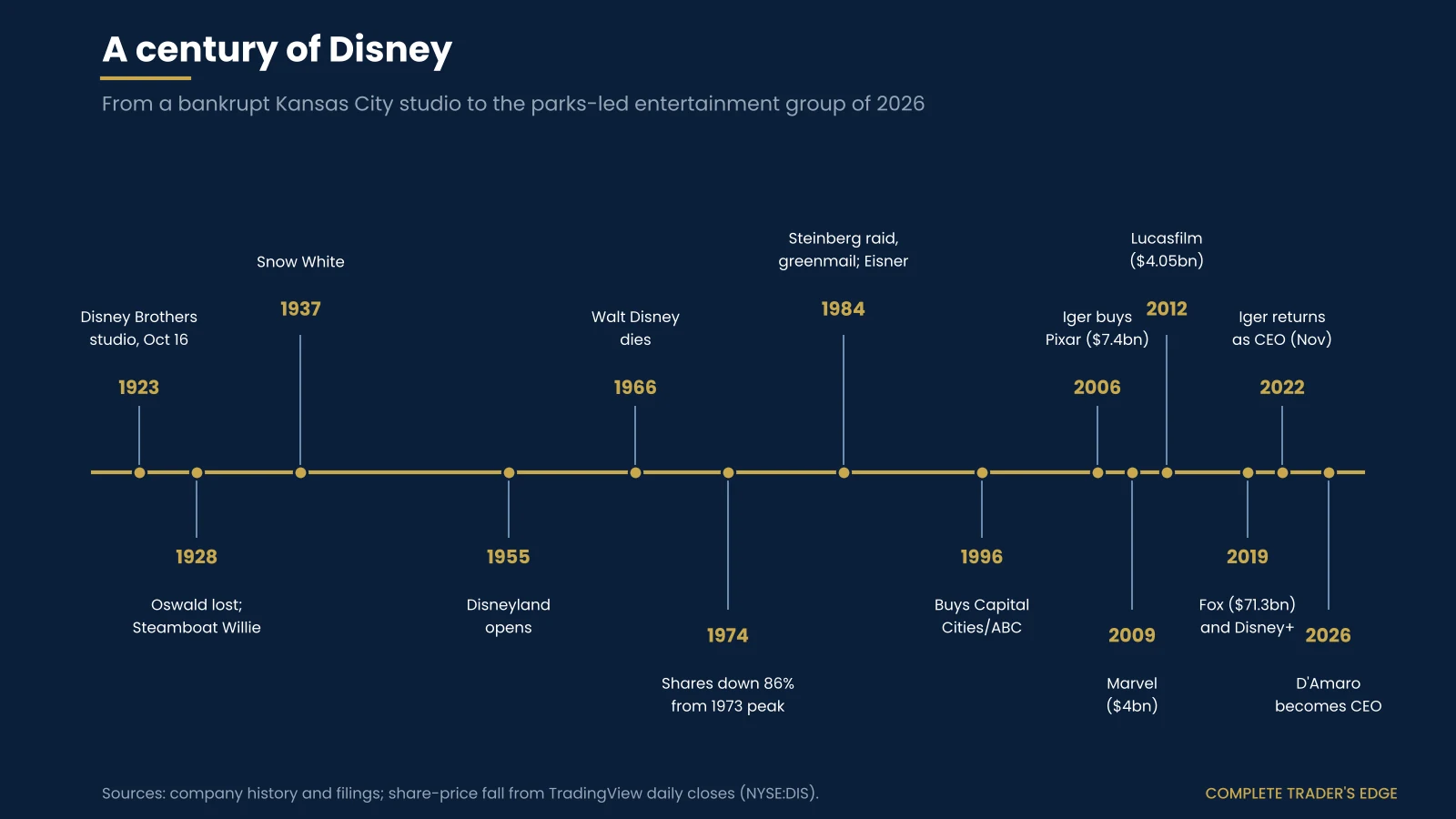
In the early 1920s, animation was a novelty, a few minutes of movement before the real film. The men who made it were craftsmen working for distributors who held all the power, and the economics were brutal. Walt Disney learned this the hard way before he ever reached California. His first studio, Laugh-O-Gram, founded in Kansas City when he was barely twenty, went bankrupt in 1923. He arrived in Hollywood that year with a reel of unfinished cartoon, a great deal of stubbornness, and, by the standard telling, about 40 dollars.
The founders: the dreamer and the banker
What saved the venture, and would save it again and again over the decades, is that Walt did not arrive alone. His older brother Roy, a former banker, cautious and numerate where Walt was visionary and reckless, put up money and took charge of the finances. The division of labor that founded the company is the one that sustained it: Walt chased the impossible, and Roy made the numbers survive the chase. On October 16, 1923, the brothers signed a distribution contract and started the studio that would carry the family name.
Then came the lesson that shaped everything. By 1927 Walt had a hit character, Oswald the Lucky Rabbit, distributed through a man named Charles Mintz. When the contract came up for renewal in 1928, Mintz revealed that he had quietly signed away most of Walt’s animators to his own operation and owned the rights to Oswald outright. He offered Walt a humiliating choice: take less money, or lose everything. Walt walked away with almost nothing, having learned the most important lesson of his life. Never again build value into something another party controls. He would own his characters.
Decision Point – 1928. You are Walt Disney.
Your distributor has just revealed he owns your hit character and has poached your animators. He offers you a steep pay cut to keep working on a rabbit you no longer control. Do you:
A. Accept the cut and keep the steady income from a proven character?
B. Sue, and fight for Oswald in court?
C. Walk away with nothing and build a brand-new character you will own completely?
Walt chose C. On the train home, the legend goes, he sketched a mouse. This is a thought experiment about ownership and leverage, not investment advice.
The founder, in full
Mickey Mouse was the direct product of the Oswald betrayal. Walt and his chief animator Ub Iwerks built a character Disney would own completely, and Walt made a bet the bigger studios thought foolish. The first two Mickey cartoons, silent, could not find a distributor, because sound was suddenly revolutionizing film. So Walt scrapped the plan and made the third, Steamboat Willie, with fully synchronized sound. When it opened in New York in November 1928 it was a sensation, and the mouse became one of the most recognized images ever created by a human hand.
What followed was a career of betting the company on things everyone else called reckless. The most famous was Snow White and the Seven Dwarfs. In the mid-1930s the idea of a feature-length animated film was openly mocked in Hollywood as “Disney’s Folly,” a sure way to bankrupt the studio, because surely no one would sit through ninety minutes of cartoon. Walt mortgaged his house. On release in 1937 the film became a phenomenon, briefly the highest-grossing film ever made. He did it again with Disneyland in 1955, an idea bankers found absurd, and again it worked.
This is the founder’s deepest contribution, and why he is the irreplaceable cause even though the company outlived him by sixty years. Walt understood, earlier and more completely than anyone, that a character a child loves is not a product that gets used up. It is an asset you can sell again as a film, then a toy, then a ticket to a park, then a costume, then to that child’s own children, and decades later as a streaming subscription. He built the first true intellectual-property flywheel, where each beloved character feeds every other line of business. The characters were the company. Everything else was a way to monetize how much people loved them.
Walt died in 1966, and the company spent much of the next two decades proving how much of it had lived in his head.
The near-death moment: the 1984 raid
Without Walt, Disney drifted. The studio kept trading on his legacy, reissuing the classics on a cycle and running the parks, but the creative engine that justified the brand had stalled. The films grew timid. The stock languished. And a languishing company sitting on priceless, underexploited assets is the most tempting target in all of finance. By the early 1980s the market had noticed that Disney’s pieces were worth more than its share price, which is the financial equivalent of leaving the vault door open.
That is what brought Steinberg. The siege ended in a way that satisfied no one cleanly. Disney bought him out, repurchasing his roughly 4 million shares at a premium for about 297 million dollars, a maneuver called greenmail: paying a raider to go away. Steinberg walked off with tens of millions for a few months’ work, and Disney’s other shareholders, who got nothing, were furious. But the raid forced the question of who should run Disney, and the answer that emerged, backed by a wealthy Texas family named Bass who stepped in as a friendly anchor shareholder, was a new chairman from Paramount named Michael Eisner and a new president from Warner named Frank Wells.
The inflection: rescue, then reinvention
Disney had nearly died, not in a fire or a bankruptcy, but in the cold arithmetic of a market that valued its parts more than its whole. Eisner and Wells then spent a decade proving the assets had been starved, not exhausted. They revived the animation studio, leaned into the parks, and grew profits and the stock enormously.
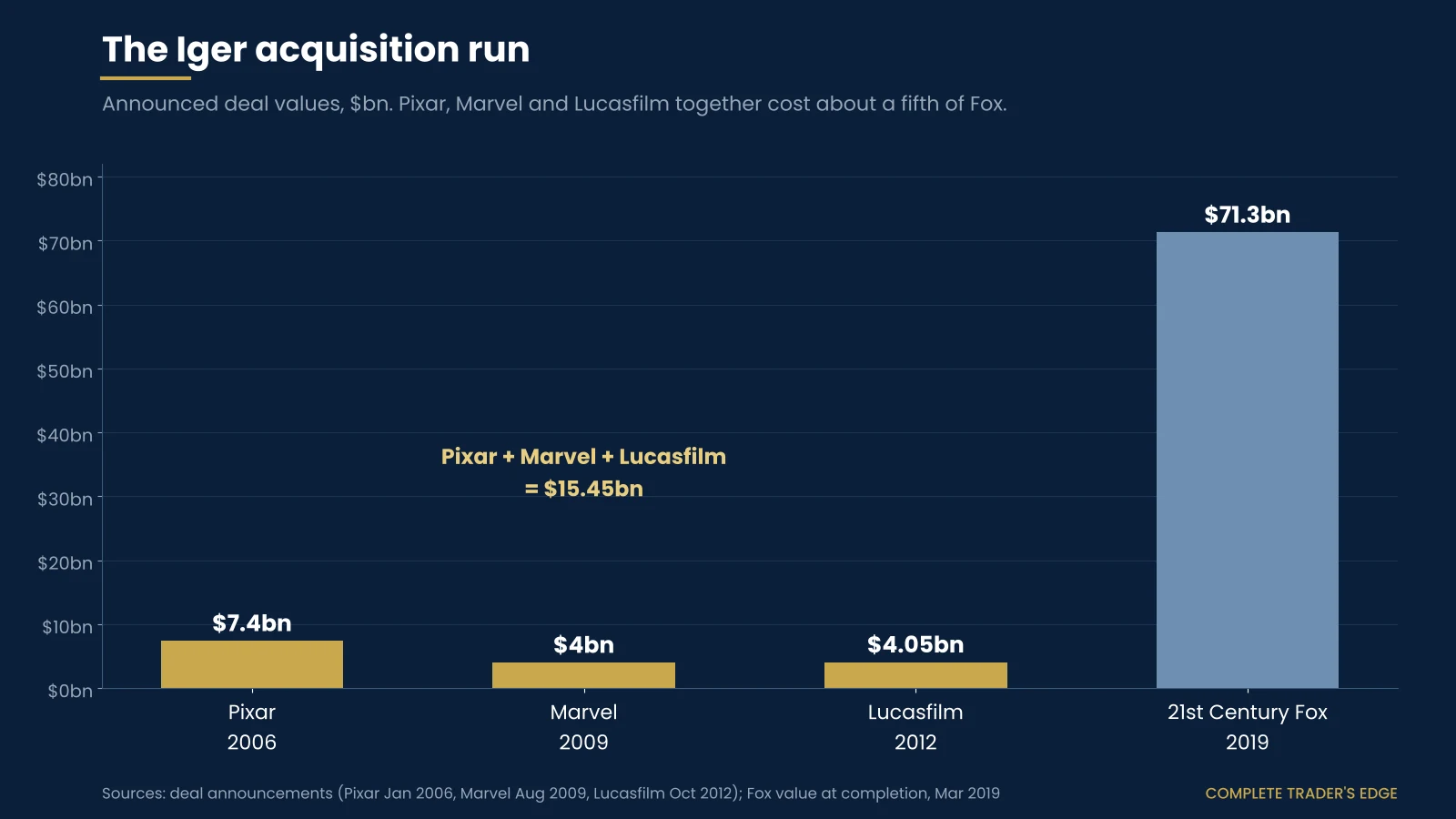
The deeper reinvention came later, under Bob Iger, who became CEO in 2005 and made a series of acquisitions that look, in hindsight, like the cheapest research and development in entertainment history: Pixar in 2006 for 7.4 billion dollars, Marvel in 2009 for about 4 billion, Lucasfilm in 2012 for about 4 billion, and the entertainment assets of 21st Century Fox in 2019 for 71.3 billion. Iger was not really buying companies. He was buying proven engines that manufacture beloved characters, and feeding them into the flywheel Walt had invented.
What everyone got wrong
Mistake #1: The distributor holds the power; the creator is replaceable. Reality: Charles Mintz took Oswald and the animators in 1928 and assumed Walt was finished. He had mistaken the pipe for the water. The value was the man who could conjure a character people loved, and he simply made a new one and kept it.
Mistake #2: Disney’s parts were worth more than its whole, so break it up. Reality: The raiders were right about the gap, but only because the company was mismanaged. The fix was to run it properly, which created far more value than any breakup could have. The assets were never the problem. The stewardship was.
Mistake #3: The stock is a proxy for how much the world loves Disney. Reality: The affection has been remarkably constant. The stock has soared, stalled, and soared again based on the business model wrapped around the affection. Loving the brand and owning the stock at the right price are two different decisions.
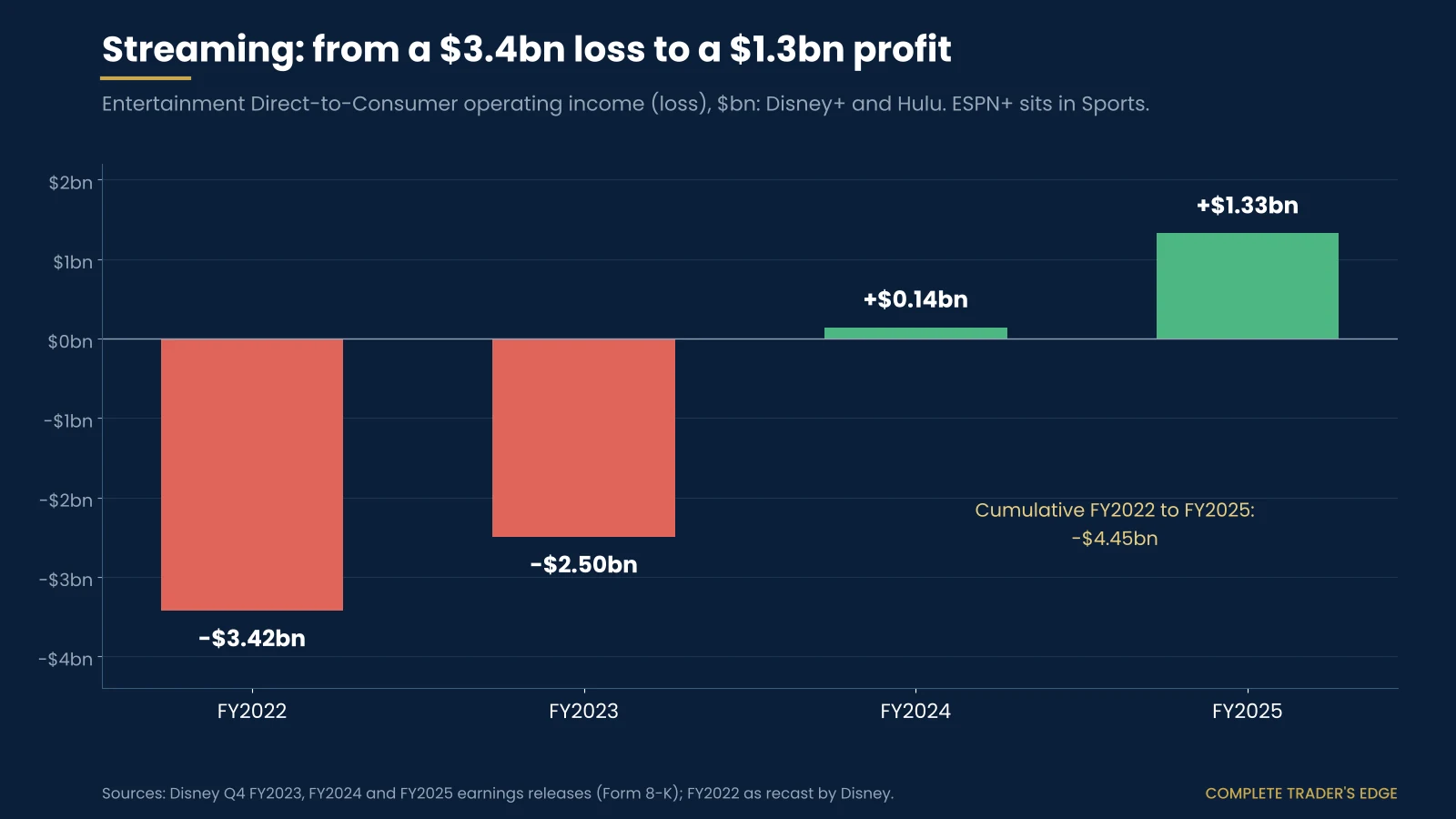
Mistake #4: Streaming would be easy because the content was unmatched. Reality: Having the best characters did not make rebuilding the entire delivery model cheap or fast. The years since the 2021 peak are a hard reminder that a wonderful library does not exempt a company from a brutal transition.
The moat
Disney is the richest single example of the Brand and Heritage moat layered on top of an Ecosystem, and the two reinforce each other in a way almost no other company achieves.
The brand is the emotional bond, the same kind of moat as Coca-Cola’s, built over a century and inherited across generations, so that a parent introduces a child to the same characters their own parent introduced them to. The ecosystem is the flywheel Walt invented and Iger industrialized: a character proven in one medium is pushed through every other. A Marvel hero becomes films, then sequels, then a streaming series, then a theme-park land, then merchandise, then the reason for a Disney+ subscription, each channel feeding the next. The moat is a vault of intellectual property so deep, and so emotionally held, that no competitor can build an equivalent in less than several human generations, because the essential ingredient is time and the love it accumulates.
The vulnerability, which is the whole reason Disney sits in the brand section with an asterisk, is that the vault still has to be delivered, and the delivery system can change. When it does, even the best vault in the world can be a poor investment for years.
The wealth created, and the road of pain
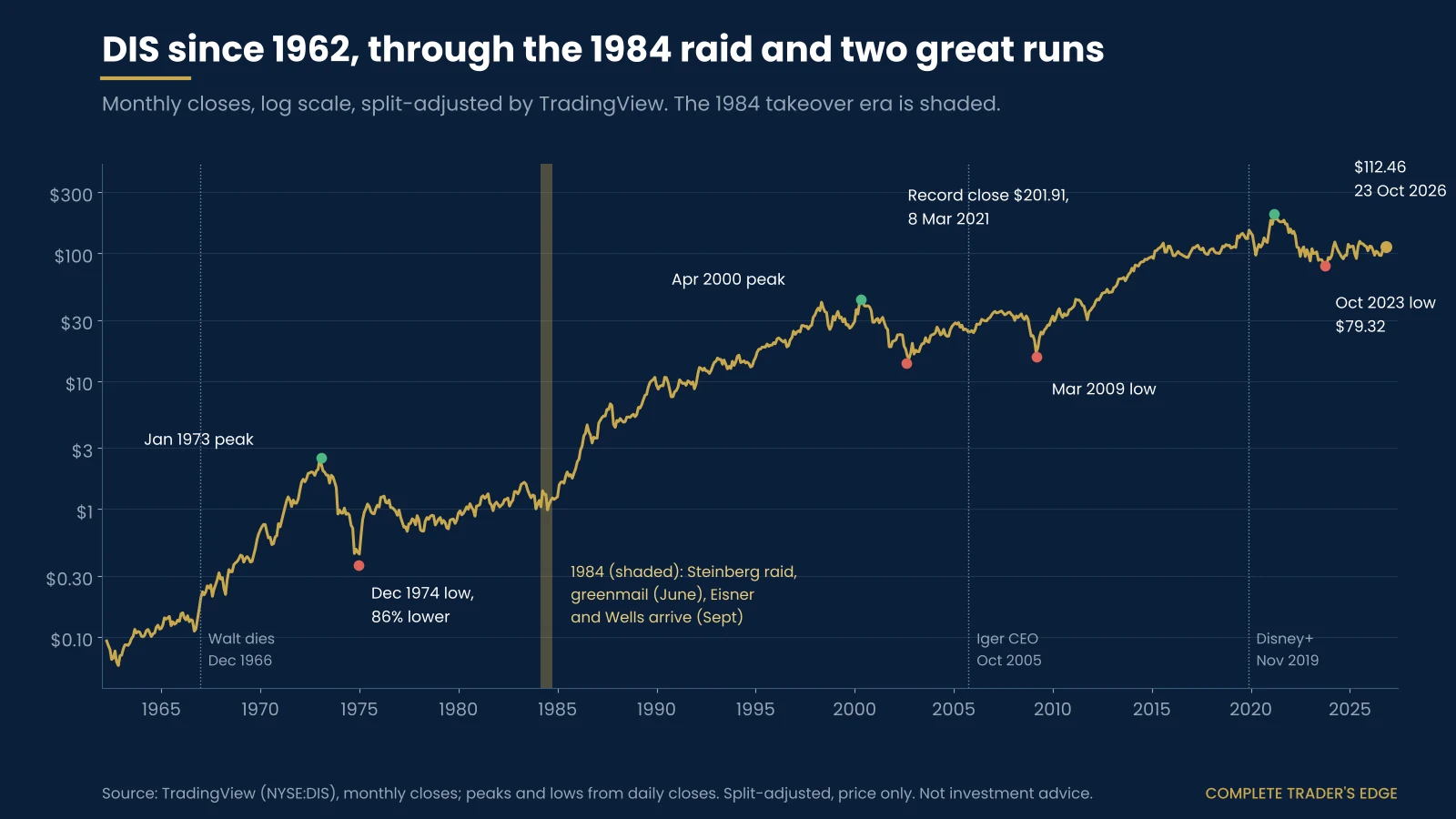
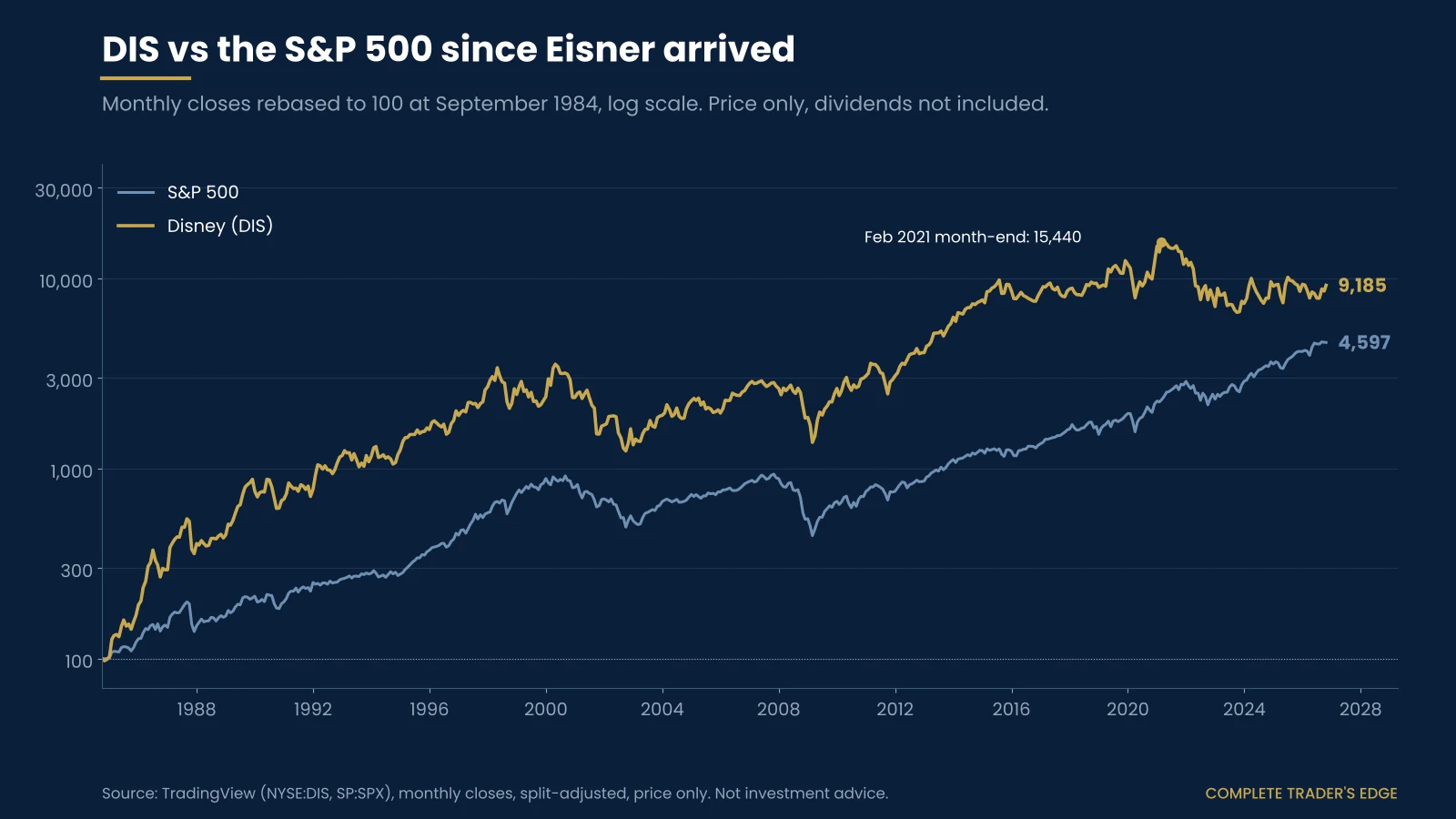
Under Eisner in the late 1980s and 1990s, and again under Iger from 2005, the stock compounded spectacularly. Iger’s first fifteen years took the company’s market value from roughly 50 billion dollars to well over 200 billion, and at the streaming-driven peak the company was briefly worth more than 350 billion, with the shares closing at a record 201.91 dollars on 8 March 2021.
And then the road turned to pain. The streaming business the market had cheered proved enormously expensive to build, the parks took a pandemic shock, a boardroom drama saw Iger leave and then return within three years to clean up a botched succession, and the stock fell hard. The shares fell 61% from the March 2021 record close to a low of 79.32 dollars in October 2023. On 23 October 2026 the company was worth about 194 billion dollars, a little over half its peak, and the shares were still about 44% below the old high. An investor who bought the most beloved brand in entertainment at its 2021 top, on the entirely reasonable thesis that Disney’s content was unbeatable, has spent years underwater while the company works through the hardest transition in its history.
Alternative Timeline (hypothetical).
What if the 1984 raiders had succeeded and broken Disney into pieces? The film library, the parks, and the real estate would have been sold to separate owners, each optimizing its own fragment. The flywheel, in which a single character feeds films and parks and merchandise at once, depends on those pieces being owned together. Split apart, the parts might each have survived, but the compounding machine that turned one mouse into a century-long empire would almost certainly not have existed in the form we know. We invent no numbers. What the real history shows is the opposite: kept whole and run well, the company became worth more than a hundred times its 1984 value.
The drawdowns you would have had to survive
Disney has handed its owners two distinct kinds of long, demoralizing drawdown. Would you have held?
| Episode | What happened | The test |
|---|---|---|
| Post-1966 drift | After Walt’s death the creative engine stalled, and the company coasted on legacy for nearly two decades, the slump that drew the 1984 raiders. The shares fell 86% from January 1973 to December 1974 (daily closes) and did not regain the 1973 high until January 1986. | Could you hold a brand coasting on inherited love, going nowhere? |
| 2021–2026 transition | From a record close of 201.91 dollars on 8 March 2021, the shares fell 61% to 79.32 dollars by 4 October 2023 as the streaming model proved costly, and in October 2026 they were still about 44% below the record. | Could you hold something wonderful through a multi-year transition on faith the vault still has value? |
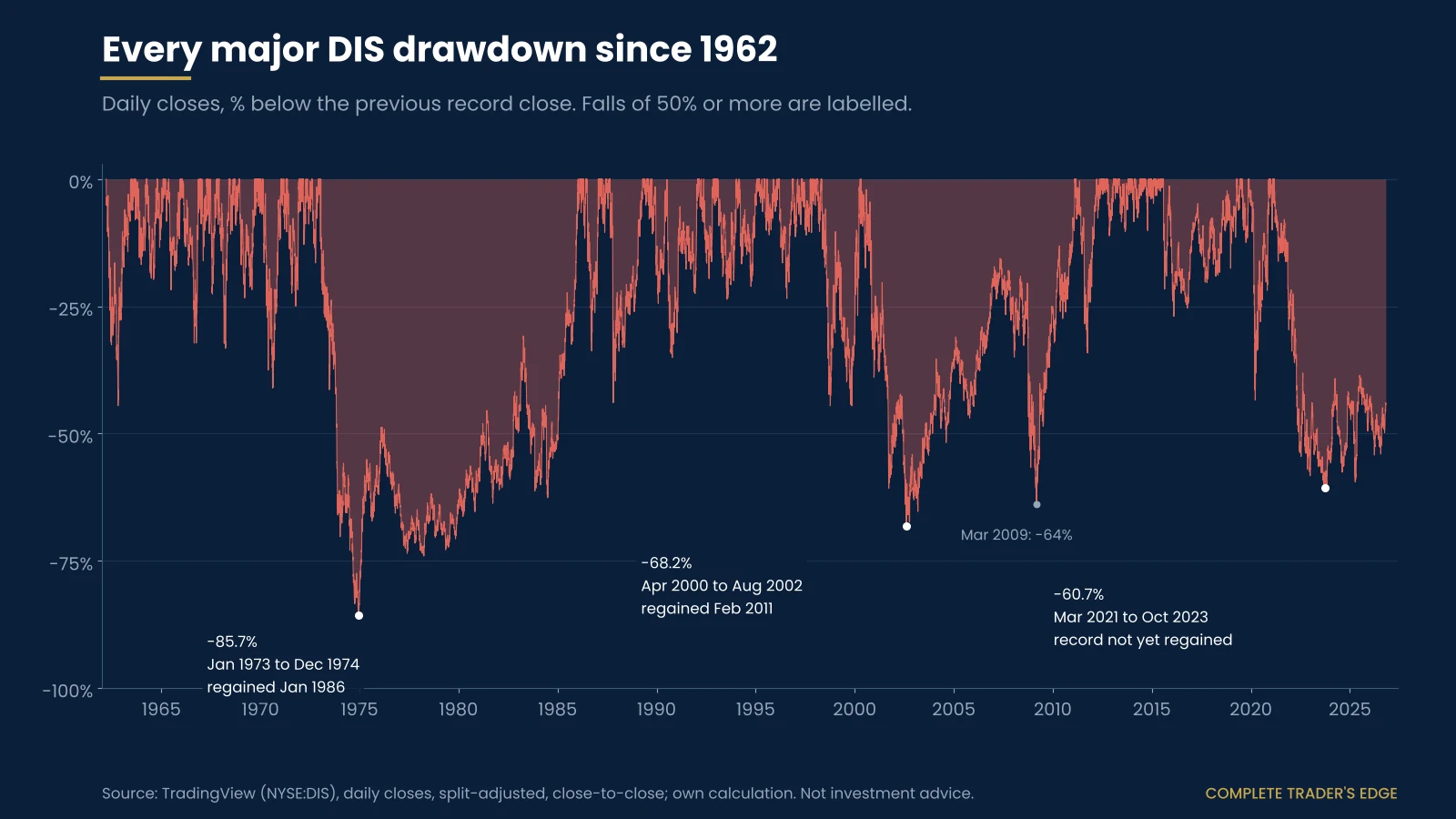
Neither drawdown is the story of a broken company. Both are stories of a great company in a hard stretch, and the question each poses to an owner is the cruelest one a great company can ask: can you hold something wonderful while it goes nowhere, or worse, for years? Most people cannot. That is exactly why the question is worth asking before you buy, not after.
Why this matters to investors
The Greatest Companies Thesis
Every legendary company begins with an idea that looks improbable.
Every one survives a stretch where failure looks inevitable.
Every one eventually reaches a point where success looks obvious.
The opportunity exists only in the space between the second and third.
Disney fits the thesis several times over, because it has run the full loop more than once. The improbable idea was that cartoons could carry feature films, that a park could be built around them, that children’s affection could be a permanent business. The stretches where failure looked inevitable were real and repeated: the Oswald betrayal, the “folly” of Snow White, the post-Walt drift, the 1984 raid that nearly dismembered the company, and the streaming-era slump it is still climbing out of. The points where success looked obvious arrived, each time, only in hindsight.
Study Disney alongside Coca-Cola and the brand-moat lesson completes itself. Coca-Cola shows the upside: a feeling, compounded for a century, that pays you to wait. Disney shows the complication: the same kind of feeling, just as durable, attached to a business whose delivery model keeps changing, so the brand can be permanent while the stock is, for long stretches, anything but. The asymmetry that makes legendary companies legendary is still here, but Disney teaches its hardest corollary, that the greatest brands almost always pass through stretches where holding them looks foolish, and that the entry price and the patience to survive the transition are as much a part of the result as the love that makes the brand great.
Lessons in order of depth
On the surface, the Method. Own your characters, and build a flywheel so each one feeds every line of business. Walt’s career turned on the Oswald lesson; Iger’s acquisitions were the same lesson at scale. Own the irreplaceable asset and rent everything else.
Below the surface, the Money. Great acquisitions can be the cheapest growth a company ever buys. Pixar, Marvel, and Lucasfilm looked expensive and turned out to be bargains, because each delivered decades of monetizable stories into a machine built to exploit them. What looks costly at purchase can be cheap against the cash flows it produces for a generation.
Below that, the Mind. Separate your love of a thing from your judgment of its price. The most expensive mistake in Disney’s investor history is buying the stock because the brand is wonderful, at the moment the wonder is fully priced and a hard transition lies ahead.
At the deepest level, the question it leaves us. Disney’s moat is a vault of other people’s childhoods, an asset made entirely of accumulated love. But that love is attached to a delivery system the world keeps reinventing. So the deepest question Disney poses is this: when your moat is permanent but the road to your customer is not, how much is the moat worth during the years you are rebuilding the road? A great brand guarantees you will matter. It does not guarantee when, or at what price, that mattering turns back into profit.
The Legendary Scorecard
| Category | Score | Note |
|---|---|---|
| Founder Vision | 10 / 10 | Walt invented the IP flywheel: a beloved character monetized across every medium, forever. |
| Innovation | 9 / 10 | Synchronized-sound animation, the feature cartoon, the theme park, all category-defining firsts. |
| Execution | 8 / 10 | Brilliant under Walt, Eisner, and Iger; the post-Walt drift and the streaming stumble cost points. |
| Moat | 9 / 10 | One of the deepest IP vaults on Earth; the delivery model, not the moat, is the vulnerability. |
| Capital Allocation | 8 / 10 | The Iger acquisitions were masterful; the greenmail and the costly streaming build were not. |
| Wealth Creation | 8 / 10 | Enormous over the long run, but a 61% fall from the 2021 peak to the 2023 low is still unhealed. |
| Durability | 9 / 10 | A century old; survived its founder’s death, a hostile raid, and repeated model shifts. |
| Historical Importance | 10 / 10 | Defined modern animation, the theme park, and the global entertainment conglomerate. |
| Overall | 9.0 | Editorial verdict, not a weighted average. |
At a Glance
| Origin | Walt and Roy Disney, Hollywood, October 16, 1923, after Walt’s first studio went bankrupt |
| Builders | Walt (characters and vision); Roy (finances); later Michael Eisner and Bob Iger |
| HQ | Burbank, California |
| The founding lesson | Lost Oswald to his distributor in 1928; created Mickey, and vowed to own his characters |
| Bet-the-company moments | Snow White (1937), mocked as “Disney’s Folly”; Disneyland (1955) |
| The near-death | The 1984 raid; raiders meant to break the company apart and sell the pieces |
| The Iger acquisitions | Pixar (7.4B, 2006), Marvel (~4B, 2009), Lucasfilm (~4.05B, 2012), Fox (71.3B, 2019) |
| The moat | Brand and heritage over an IP ecosystem (the character flywheel) |
| The drawdown | Down 61% from its record close of 201.91 dollars (8 March 2021) to the October 2023 low; still about 44% below the record in October 2026 |
| Pillar | Part V, Brand and Heritage (with a cautionary asterisk) |
| Status | Public (NYSE: DIS); market cap about 194 billion dollars (23 October 2026, TradingView); CEO Josh D’Amaro since 18 March 2026 |
Company timeline
- 1921 – Walt’s first studio, Laugh-O-Gram, is founded in Kansas City.
- 1923 – Laugh-O-Gram goes bankrupt; Walt moves to Hollywood and founds the Disney Brothers studio with Roy on October 16.
- 1928 – Loses Oswald when his distributor poaches his animators; creates Mickey Mouse; Steamboat Willie debuts with sound on November 18.
- 1937 – Snow White, the first feature-length animation, succeeds against all predictions.
- 1955 – Disneyland opens.
- 1966 – Walt Disney dies, beginning a long creative and financial drift.
- 1984 – Saul Steinberg’s takeover raid; ~297 million dollar greenmail buyback; the Bass family becomes white-knight shareholder; Eisner and Wells take over.
- 2005 – Bob Iger becomes CEO.
- 2006–2019 – Buys Pixar, Marvel, Lucasfilm, and 21st Century Fox; launches Disney+ in November 2019.
- 2021 – Stock hits a record close of 201.91 dollars on March 8.
- 2022 – Iger returns as CEO on November 20 after the board removes his successor, Bob Chapek.
- 2026 – Josh D’Amaro, chairman of Disney Experiences, succeeds Iger as CEO on March 18; market cap about 194 billion dollars in October, still well below the 2021 peak.
Key numbers
Founded: October 16, 1923 • Starting capital: roughly 40 dollars in Walt’s pocket • 1984 greenmail buyback: ~297 million dollars • Iger-era acquisitions: Pixar 7.4B, Marvel ~4B, Lucasfilm ~4.05B, Fox 71.3B • Peak market cap: over 350 billion dollars; stock record close 201.91 dollars (8 March 2021) • Market cap: about 194 billion dollars (23 October 2026), a little over half the peak
Disney and its peers at 23 October 2026
| Company | Share price | Market cap | Revenue (TTM) | Net income (TTM) | P/E (TTM) | Dividend yield | 2026 YTD |
|---|---|---|---|---|---|---|---|
| Disney (DIS) | $112.45 | $194bn | $99.1bn | $8.6bn | 23.2 | 1.3% | -0.9% |
| Netflix (NFLX) | $66.28 | $272bn | $50.0bn | $14.8bn | 19.2 | 0% | -29.6% |
| Comcast (CMCSA) | $22.65 | $80bn | $123.0bn | $11.3bn | 7.2 | 5.8% | -19.1% |
Source: TradingView, 23 October 2026. Figures change daily. Not investment advice.
Related reading
- Coca-Cola – the other great Brand and Heritage company, and the upside case for a feeling as a moat.
- Apple – another company saved from near-death by owning its ecosystem rather than renting it.
- Berkshire Hathaway – on judging a wonderful business by its price, not just its quality.
From the book. Disney sits in Part V, Brand and Heritage, in the Greatest Companies series, the cautionary companion to Coca-Cola. Explore how the world’s most durable companies were built, and what their drawdowns teach every investor, in The Complete Trader’s Edge.
★ Now in Kindle, Paperback & Hardcover
Greatest Companies
This story is one of fifty-one. The full book reads every legendary company through a single lens — Moat, Meltdown, Machine — from Standard Oil to SpaceX. Fifty-one companies, eight kinds of moat, one framework.
Kindle · $9.99 →
Paperback · $24.99 →
Hardcover · $34.99 →
Explore the Book →
This article is part of the Greatest Companies series, adapted from the book Greatest Companies, now available on Kindle.
Frequently asked questions
When was the Walt Disney Company founded, and by whom?
The Walt Disney Company was founded in Hollywood on October 16, 1923, by brothers Walt and Roy Disney, shortly after Walt’s first studio, Laugh-O-Gram, went bankrupt in Kansas City. Walt drove the creative vision while Roy, a former banker, managed the finances.
Why did Walt Disney lose Oswald the Lucky Rabbit?
In 1928, Walt’s distributor Charles Mintz revealed he owned the rights to Oswald and had quietly hired away most of Walt’s animators, then offered Walt a steep pay cut. Walt walked away rather than work on a character he did not own, and created Mickey Mouse, vowing to own his creations from then on.
What happened in Disney’s 1984 takeover battle?
Corporate raider Saul Steinberg accumulated a large stake in Disney intending to break the company up and sell its parts. Disney bought him out for about 297 million dollars in a controversial greenmail deal, and the wealthy Bass family stepped in as a friendly anchor shareholder, backing new leaders Michael Eisner and Frank Wells, who revived the company.
What companies did Bob Iger buy for Disney?
As CEO from 2005, Bob Iger acquired Pixar in 2006 for 7.4 billion dollars, Marvel in 2009 for about 4 billion, Lucasfilm in 2012 for about 4.05 billion, and the entertainment assets of 21st Century Fox in 2019 for 71.3 billion. Each purchase added proven characters to Disney’s intellectual-property flywheel.
What is Disney’s competitive moat?
Disney’s moat is brand and heritage layered on an intellectual-property ecosystem: a vault of beloved characters monetized across film, parks, merchandise, and streaming, with each channel feeding the others. The moat is extraordinarily durable, but the delivery model, most recently streaming, can change and pressure the stock for years even while the brand stays strong.
 The Complete Trader's Edge
The full Mind · Method · Money framework. 70 chapters.
View on Amazon →
 Market Mayhem
400 years of bubbles, crashes, and the pattern that keeps repeating.
Buy on Amazon →
 Greatest Companies
How the world's greatest companies were built — and what traders learn from them.
View on Amazon →
 Greatest Traders
Eighty-six lives that explain the markets — Livermore to Madoff, told with the losses left in.
View on Amazon →