

In 1964, a young investor named Warren Buffett shook hands on a deal to sell his shares in a struggling New England textile company called Berkshire Hathaway. The company’s chief executive, Seabury Stanton, had agreed to buy them back at eleven dollars and fifty cents a share. It was a fine outcome. Buffett had been buying the cheap, unloved stock of a shrinking mill, planning to sell into exactly this kind of offer for a quick profit. The handshake was the plan working.
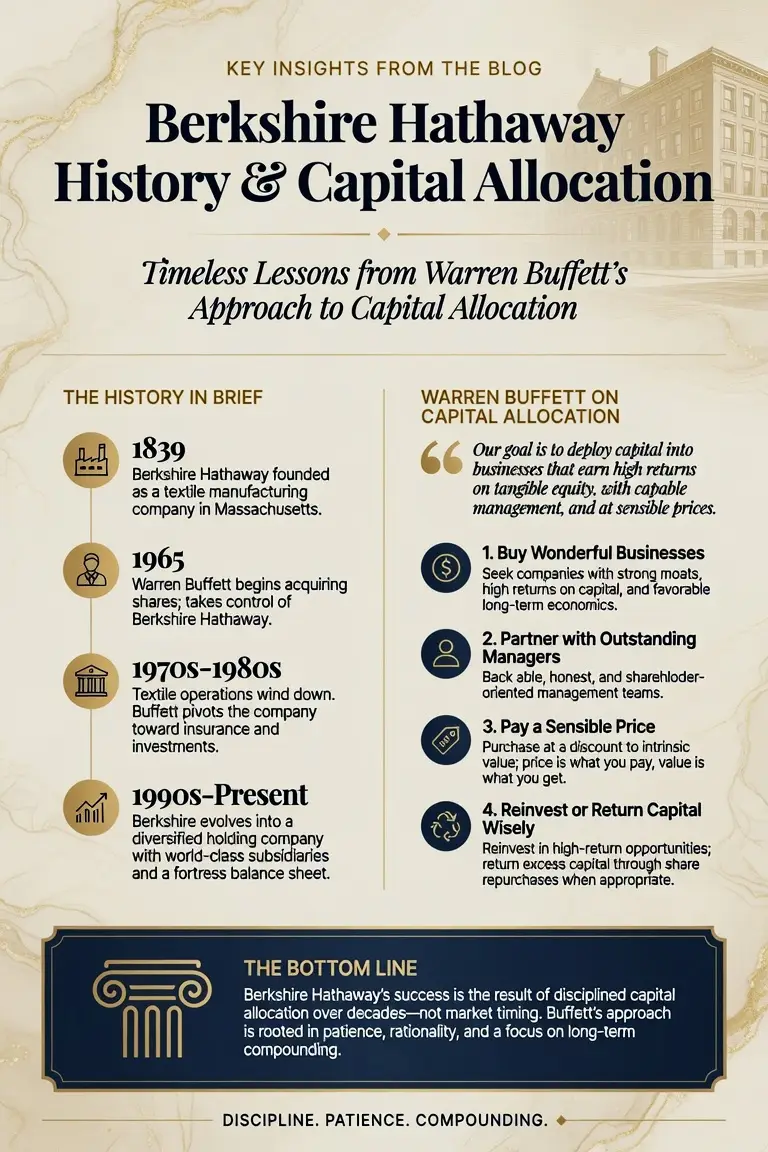
Then the written offer arrived in the mail, and it read eleven dollars and three-eighths. An eighth of a dollar less than they had shaken on. Twelve and a half cents a share.
It was a trivial sum and an enormous insult. And Buffett, furious at being chiseled, did something that was, by his own later assessment, one of the dumbest investment decisions of his life. Instead of selling, he bought more. He kept buying, aggressively, until by the spring of 1965 he had taken control of the entire company, and the first thing he did with that control was fire Seabury Stanton.
He had, in a fit of pique over twelve and a half cents, bought himself a dying textile business in a dying industry. The textile operations would limp along and finally be shut down for good in 1985. By Buffett’s own reckoning, taking control of Berkshire Hathaway, the act that gave his life’s work its name, was a colossal mistake.
And yet. That dying mill, bought out of spite, became the vehicle for the single greatest sustained act of wealth creation in the history of capitalism. This is the central paradox of Berkshire. Every other legendary company is great because of what it built. Berkshire is great because of how its owner used the cash thrown off by something he never should have bought.
📄 Free Download · Company Research Sheet
Berkshire Hathaway Research Sheet (PDF)
The moat, the meltdown, the Legendary Scorecard, the timeline, and the Move, Money and Mind lessons from this story. Free, no email required.
Greatest Companies Podcast · Episode 5
The Dying Mill That Compounded for Sixty Years: The Berkshire Story
The World Before Berkshire
To understand why Berkshire is extraordinary, you have to understand why almost every company like it has failed.
The conglomerate, a holding company that owns many unrelated businesses, was for most of the twentieth century a recipe for value destruction. The standard pattern was empire-building: an ambitious chief executive would use the company’s stock to acquire business after business, growing the empire and the executive’s prestige, while the actual returns on all that deployed capital quietly eroded. Conglomerates traded at a discount for good reason. They were junk drawers, places where capital went to be allocated by people optimizing for size rather than return.
The scarce skill, the one almost no one possessed, was capital allocation: the disciplined, unsentimental art of taking the cash a business generates and deploying it wherever it will earn the highest long-term return, even if that means doing nothing for years, or buying something utterly unrelated, or sitting on a mountain of cash while everyone else is euphoric. The premise of Berkshire was a company run, from the center, by a pure capital allocator, who treated every dollar of profit as a thing to be sent wherever in the world it would compound best. That had essentially never been done at scale, for decades, by someone genuinely great at it. Berkshire is what happens when it is.
The Founder
Warren Buffett was, by 1965, already an extraordinary investor, a student of Benjamin Graham who had learned to buy “cigar butt” companies: lousy businesses trading for less than their liquidation value, good for one last puff of profit. Berkshire was, originally, a cigar butt. The problem with cigar butts is that when you own the whole company, as Buffett now did, you are left holding a bad business with no more puffs.
The transformation of Buffett from a buyer of cheap bad businesses into the owner of wonderful ones is the hinge of the entire story, and it has a name: Charlie Munger. Munger, a laconic Californian lawyer with a ferocious intellect, became Buffett’s partner and, in 1978, Berkshire’s vice-chairman. Munger’s central argument, pressed on Buffett for years, was simple and revolutionary: it is far better to buy a wonderful business at a fair price than a fair business at a wonderful price. A great business with a durable competitive advantage, a moat, will compound for decades; a cheap bad business is a one-time trade that leaves you, eventually, holding something dying.
This is the intellectual core of Berkshire. The reason Buffett spent sixty years studying moats, brand strength, switching costs, and scale advantages is that the durability of a competitive advantage is what lets a business compound, and compounding is the entire game. And the trait that matters most in Buffett himself is not raw intelligence but temperament: the almost superhuman patience to let compounding work, to do nothing for years, to be greedy when others are fearful and fearful when others are greedy, and above all to stay in the game for sixty years without blowing up. The magic was never a single brilliant year. It was twenty percent a year, for sixty years, without interruption.
Decision Point — 1967
You now control a textile business that is structurally doomed. It still throws off some cash, but the industry is dying and reinvesting in it earns almost nothing. You have a pile of capital and a decision.
What do you do with the cash the mills generate?
A) Reinvest in the textile business to try to save it.
B) Pay it out and slowly wind the company down.
C) Divert it into an entirely different business with better economics.
Most owners, attached to the business they bought, choose A and feed the dying thing for years. Buffett chose C, buying an insurance company and redirecting the cash into compounding assets. That single reallocation decision is the seed of the greatest fortune in market history. (This is a thought experiment, not investment advice.)
The Near-Death That Wasn’t a Crash
Berkshire’s near-death is unlike any other legendary company, because it was not a sudden crisis but a slow trap. The textile business Buffett had bought was structurally doomed: a commodity manufacturer in a high-cost region competing against cheaper producers, the kind of business that consumes capital and returns little. Two years after Buffett took control, even after a period of growth, Berkshire’s net worth was still down sixty-four percent from its 1955 level. He was, in effect, the proud new owner of a melting ice cube.
The escape, and the true beginning of the Berkshire we know, came not from fixing the textile mills but from refusing to feed them. Rather than pour the cash the mills still generated back into the doomed business, Buffett began diverting it elsewhere. In 1967 he made the move that changed everything: he used Berkshire’s cash to buy an insurance company, National Indemnity. This was the masterstroke, and it requires understanding one beautiful, slightly magical idea: insurance float.
The Inflection: The Magic of Float
An insurance company collects premiums today and pays out claims later, sometimes years later. In between, it holds a vast pool of other people’s money, called the float. As long as the insurer prices its policies well enough not to lose money on the underwriting itself, that float is, in effect, a giant interest-free, or even better-than-interest-free, loan that the insurer gets to invest for its own account.
Buffett looked at insurance float and saw what almost no one else did: a permanent, growing, low-cost source of capital to allocate. The mills generated a little cash; insurance would generate a torrent of it, other people’s money, held for years, available to be poured into wonderful businesses. Berkshire’s engine, from that point on, was simple to describe and almost impossible to replicate: write insurance to generate float, then deploy that float, plus the earnings of every business Berkshire owned, into more wonderful businesses and stocks, then let those compound, then repeat, for decades.
The acquisitions and investments became legendary. See’s Candies in 1972, which taught Buffett the power of a beloved brand that could raise prices forever. A massive, era-defining stake in Coca-Cola beginning in 1988. Ownership of railroads, utilities, manufacturers, and insurers. And, decades later, the largest single bet of all: roughly thirty-eight billion dollars invested in Apple between 2016 and 2023, a position that grew to be worth well over a hundred and seventy billion and at one point made up more than half of Berkshire’s entire stock portfolio, the value-investing sage’s enormous wager on the ecosystem moat.
The Moat: When the Moat Is a Person and a Method
Here we reach the strangest part of the Berkshire story. Berkshire’s moat is not a product. It is partly structural: the float gives it cheap, permanent capital, and its fortress balance sheet and reputation let it act as a buyer of last resort in crises, when everyone else is paralyzed, supplying capital on its own terms, as it did, famously and profitably, in the 2008 panic. Its decentralized structure, dozens of wholly owned businesses run with near-total autonomy while capital decisions stay centralized in Omaha, avoids the bloat that kills other conglomerates. And the Berkshire brand itself became a moat: founders selling beloved family businesses chose Berkshire, often for less than a rival might pay, because they trusted Buffett not to gut what they had built.
But the deepest truth is that, for sixty years, the moat was substantially Buffett and his partner Charlie Munger themselves: a way of thinking, a temperament, an institution built as an extension of two minds. Which raises the question that has hung over Berkshire for decades and arrived in full force in 2026, when Buffett stepped down as chief executive on the first of January, handing the company to his chosen successor, Greg Abel, after sixty years at the helm. Can a moat made of a method outlive the mind that authored it? Berkshire’s entire structure was built precisely so that the answer might be yes. That is the great open experiment the company now runs.
The Wealth Created
The numbers are so large they almost stop meaning anything, so hold them slowly.
From 1964, the year before Buffett took control, to 2024, Berkshire Hathaway compounded at roughly nineteen-point-nine percent per year, against about ten-point-four percent for the S&P 500. That near-doubling of the annual rate, sustained for sixty years, produced a total gain on the order of five and a half million percent. A single Class A share, which changed hands for around eighteen or nineteen dollars when Buffett took over, was worth more than seven hundred and fifty thousand dollars by the end of 2025.
| Metric | Figure |
|---|---|
| Compounded annual return (1964–2024) | ~19.9% |
| S&P 500 over the same period | ~10.4% |
| Total return | ~5.5 million percent |
| Class A share, 1965 | ~$18 |
| Class A share, end 2025 | over $750,000 |
Put it in human terms: a thousand dollars invested with Buffett in 1965 became tens of millions. And here is the lesson that matters most, the one Buffett and Munger preached endlessly: the gains were grotesquely back-loaded. The overwhelming majority of Buffett’s wealth was earned after his fiftieth birthday, not because he got better, but because compounding is exponential, and the largest absolute gains always come at the end, after decades of patient accumulation. The first thirty years built the base. The next thirty produced the fortune.
This is the entire argument for patience, rendered as the most successful track record in financial history. The edge was not a secret stock. It was the willingness, and the temperament, to let twenty percent a year run uninterrupted for sixty years.
What Everyone Got Wrong
Mistake #1: Judging Berkshire by its starting business.
Reality: it was a dying textile mill, and the skeptics who wrote it off for that reason were judging the vessel, not the allocator pouring capital out of it. The business was almost irrelevant; the method was everything.
Mistake #2: Calling Buffett washed-up at every market top.
Reality: in nearly every euphoric bubble, from the dot-com mania onward, commentators declared Buffett had lost his touch because he refused to chase the hot thing. He was simply being fearful while others were greedy, holding cash, waiting. The subsequent crashes proved him right.
Mistake #3: Believing the gains would come smoothly.
Reality: Berkshire’s own stock fell roughly fifty percent on several occasions across its history. The greatest compounding machine ever built still forced its owners to endure repeated, terrifying drawdowns. Even here, the asymmetry demanded the stomach to hold.
The Alternative Timeline
A counterfactual, clearly hypothetical.
Picture the world where, in 1964, Seabury Stanton’s written offer matches the handshake. Eleven-fifty, exactly as agreed. No insult. No eighth-of-a-dollar chiseling.
Buffett sells his Berkshire shares into the tender, takes his tidy profit, and moves on. There is no spite purchase, no controlling stake in a textile mill, and the name “Berkshire Hathaway” remains attached to a forgotten New England manufacturer that closes its doors sometime in the 1980s. Buffett, of course, still becomes a great investor through his partnership and whatever vehicle he eventually builds. But the specific institution, Berkshire, the decentralized conglomerate powered by insurance float that became the most studied capital-allocation machine on Earth, never exists in the form we know. A million investors are never taught, through fifty years of plainspoken letters, how compounding actually works.
It did not happen that way, because a CEO tried to save twelve and a half cents a share and provoked the most consequential grudge in financial history. The lesson is almost comic, and entirely serious: the largest outcomes often pivot on the smallest, most human moments, and a great allocator can turn even a mistake made in anger into the foundation of a sixty-year masterpiece, provided he has the temperament to keep compounding long after the anger is forgotten.
Why Berkshire Hathaway History Matters to Investors
The Greatest Companies Thesis
Every legendary company begins with an idea that looks improbable.
Every one survives a stretch where failure looks inevitable.
Every one eventually reaches a point where success looks obvious.
The opportunity exists only in the space between the second and third.
Berkshire fits the thesis in its own idiosyncratic way. The improbable idea: that a dying textile mill could be reforged, through insurance float and disciplined allocation, into a compounding machine. The stretch where failure looked inevitable: a doomed commodity business with net worth down sixty-four percent, and later the repeated fifty-percent drawdowns that tested every holder. The point where success looks obvious: the most successful investment record in history. And the opportunity existed only for those with the temperament to hold across sixty years and multiple gut-wrenching declines.
The reason to study Berkshire is that it isolates the single most underrated variable in all of investing: time, applied with discipline, by someone who does not blow up. The asymmetry that makes legendary companies legendary, a small chance of an enormous payoff, is here revealed to be not so much about finding the one great idea as about surviving and compounding long enough for the math to become absurd. The greatest opportunities almost always looked terrible before they looked inevitable, and Berkshire looked, in 1965, like a man who had bought a melting ice cube out of spite.
Lessons in Order of Depth
On the surface — the move
Allocate capital ruthlessly to its highest-returning use, regardless of sentiment or history. Buffett refused to feed the textile mills he owned and sent the cash to insurance instead. The trader’s analogue is moving capital to where the edge actually is, not where habit or attachment says it should go.
Below the surface — the Money
Find low-cost, durable capital and let it compound. Insurance float was the secret weapon: other people’s money, held for years at low cost, deployed into compounding assets. The investor’s version is to minimize the cost of staying invested, avoid forced selling, and let time do the work that frantic activity destroys.
Below that — the Mind
Temperament beats brilliance. Buffett’s edge was never the highest IQ; it was the discipline to be patient for decades, fearful in manias, greedy in panics, and never to risk ruin. The trader’s parallel is that the person who wins over a lifetime is not the cleverest but the one who stays rational and solvent when everyone else loses their head.
At the deepest level — the question
Berkshire’s moat was, for sixty years, substantially two minds. Now they are gone or going, and the institution must run on the method alone. So the deepest question Berkshire poses is the one that haunts every great enterprise and every great investor: can the way of thinking outlive the thinker? Buffett spent sixty years not just compounding money but trying to make himself unnecessary, writing it all down, building the autonomy, choosing the successor. The truest measure of a method is whether it still works when you are no longer there to apply it. The deepest edge is not a trade. It is a discipline durable enough to survive you.
The Legendary Scorecard
| Category | Score | Notes |
|---|---|---|
| Founder Vision | 10 / 10 | Saw a capital-allocation machine inside a dying mill |
| Innovation | 8 / 10 | Not a product innovator; innovated the structure of capital itself |
| Execution | 10 / 10 | Sixty years of disciplined allocation without blowing up |
| Moat | 9 / 10 | Float + fortress balance sheet + brand; but partly tied to two minds |
| Capital Allocation | 10 / 10 | The greatest in the history of the discipline |
| Wealth Creation | 10 / 10 | ~5.5 million percent over 60 years |
| Durability | 9 / 10 | Built to outlast its founders; now being tested |
| Historical Importance | 10 / 10 | Taught the world how compounding and capital allocation work |
| Overall Legendary | 9.7 / 10 | The definitive capital-allocation machine |
Scores are an editorial verdict on the standard eight-category scale used across the Greatest Companies series. The overall is a judgment, not a weighted average.
Company Timeline
- 1955 — Berkshire Fine Spinning and Hathaway Manufacturing merge
- 1962 — Buffett Partnership begins buying at $7.50 a share
- 1964 — The Stanton handshake at $11.50; the written offer arrives at $11.375
- 1965 — Buffett takes control out of spite
- 1967 — Buys National Indemnity, the pivot to insurance float
- 1972 — See’s Candies, the turn toward quality
- 1978 — Charlie Munger becomes vice-chairman
- 1988 — Begins buying Coca-Cola
- 2016–2023 — Invests ~$38B in Apple, its largest-ever position
- 2024 — ~19.9% CAGR since 1964 vs S&P ~10.4%
- 2025 — Class A share over $750,000
- 2026 — Buffett steps down as CEO (Jan 1); Greg Abel takes over
Key Numbers
| Origin | 1955 textile merger; Buffett control 1965 |
| Architects | Warren Buffett; Charlie Munger (VC from 1978) |
| The pivot | National Indemnity (1967): insurance float |
| Compounded return | ~19.9%/yr (1964–2024) vs S&P ~10.4% |
| Total return | ~5.5 million percent |
| Largest-ever stock bet | ~$38B into Apple (2016–2023) |
| Succession | Greg Abel, CEO from Jan 1, 2026 |
Related Reading
More Greatest Companies
- Apple: Ninety Days From Death to the World’s Most Valuable Company (Berkshire’s largest-ever position)
- Costco: The Religion of the Lowest Price (a Munger favourite, the quality-business model in action)
- Visa: The Toll Bridge of the Global Economy (the durable cash-flow machine Buffett prizes)
Lesson Hubs
- Capital Allocation (the discipline Berkshire perfected)
- Surviving Drawdowns (even the great compounder fell ~50% repeatedly)
Across the Library
- Warren Buffett and Charlie Munger (Greatest Traders — the minds behind the machine)
- Li Lu (Greatest Traders — the investor Munger trusted with his own capital)
★ Now in Kindle, Paperback & Hardcover
Greatest Companies
This story is one of fifty-one. The full book reads every legendary company through a single lens — Moat, Meltdown, Machine — from Standard Oil to SpaceX. Fifty-one companies, eight kinds of moat, one framework.
Kindle · $9.99 →
Paperback · $24.99 →
Hardcover · $34.99 →
Explore the Book →
This article is part of the Greatest Companies series, adapted from the book Greatest Companies, now available on Kindle. Explore the wider framework in The Complete Trader’s Edge.
Frequently Asked Questions
How did Warren Buffett come to control Berkshire Hathaway?
Buffett began buying shares of the struggling textile company in 1962. After a 1964 handshake to sell his shares at $11.50 turned into a written offer of $11.375, he was so annoyed that he instead bought control of the whole company by 1965, later calling it one of his biggest investing mistakes.
Why was buying Berkshire a mistake if it made Buffett so rich?
The textile business itself was doomed and consumed capital for years before being shut down in 1985. The fortune came not from textiles but from Buffett using the company as a vehicle, redirecting its cash into insurance and then into wonderful businesses and stocks that compounded for decades.
What is insurance float and why did it matter so much?
Float is the pool of premium money an insurer holds before paying out claims. If underwriting at least breaks even, that money is effectively a low-cost or free loan the insurer can invest. Buffett used Berkshire’s insurance float as a permanent, growing source of capital to deploy into compounding investments.
What returns did Berkshire deliver under Buffett?
From 1964 to 2024, Berkshire compounded at roughly 19.9% a year versus about 10.4% for the S&P 500, a total gain on the order of 5.5 million percent. A Class A share went from around $18 in 1965 to over $750,000 by the end of 2025.
Who runs Berkshire Hathaway now?
Warren Buffett stepped down as CEO on January 1, 2026, after sixty years, handing day-to-day leadership to Greg Abel while remaining chairman. Whether Berkshire’s method can outlast its founders is the central question facing the company.
 The Complete Trader's Edge
The full Mind · Method · Money framework. 70 chapters.
View on Amazon →
The Complete Trader's Edge
The full Mind · Method · Money framework. 70 chapters.
View on Amazon →
 Market Mayhem
400 years of bubbles, crashes, and the pattern that keeps repeating.
Buy on Amazon →
Market Mayhem
400 years of bubbles, crashes, and the pattern that keeps repeating.
Buy on Amazon →
 Greatest Companies
How the world's greatest companies were built — and what traders learn from them.
View on Amazon →
Greatest Companies
How the world's greatest companies were built — and what traders learn from them.
View on Amazon →
 Greatest Traders
Eighty-six lives that explain the markets — Livermore to Madoff, told with the losses left in.
View on Amazon →
Greatest Traders
Eighty-six lives that explain the markets — Livermore to Madoff, told with the losses left in.
View on Amazon →