
Walk into almost any kitchen, in almost any country on Earth, and you will find Nestle there. It may be a jar of Nescafe, a KitKat bar, a tin of infant formula, a bottle of water, a bowl of cereal, or food for the family pet. You may not think of these as belonging to a single company, and that is precisely the point. Nestle is the quiet colossus of everyday consumption, the largest food and beverage company in the world, built not on one famous product but on a vast portfolio of trusted brands carried by a distribution network that reaches almost everywhere people live.
Nestle’s moat is one of the most durable in all of business, and one of the least glamorous. It does not depend on a single breakthrough, a charismatic founder, or a revolutionary technology. It depends on familiarity and reach: hundreds of brands that consumers know and trust, pushed through a global system of distribution and marketing so vast that a new product can be on shelves in nearly two hundred countries with a speed no rival can match. This is the story of how a Swiss infant food and a tin of condensed milk grew, over more than a century and a half, into one of the most quietly powerful companies on the planet.
📄 Free Download · Company Research Sheet
Nestlé Research Sheet (PDF)
The moat, the meltdown, the Legendary Scorecard, the timeline, and the Move, Money and Mind lessons from this story. Free, no email required.
Two Companies, One Need
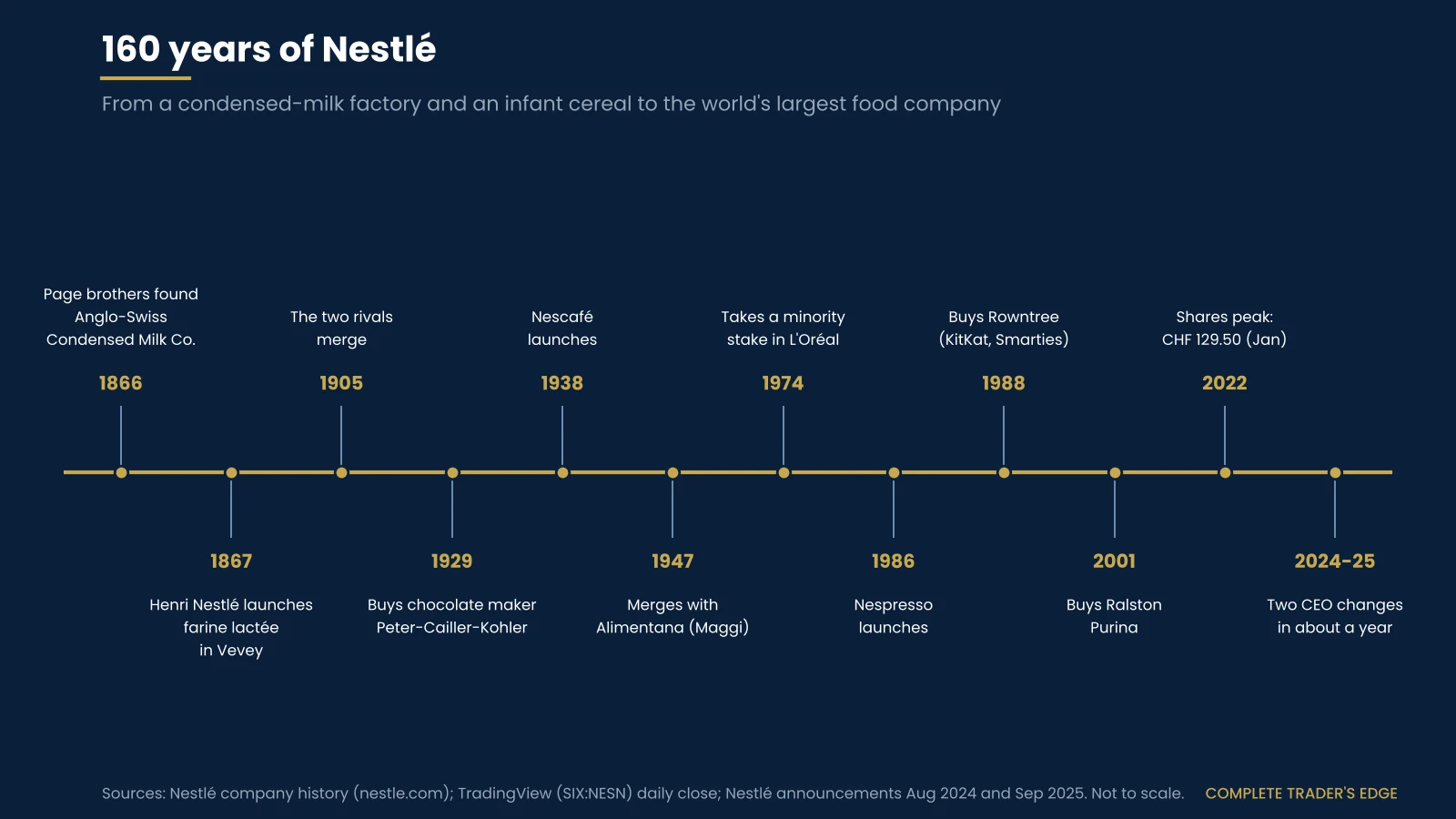
Nestle’s story begins with a human problem: infant mortality. In 1867, in the Swiss town of Vevey, a pharmacist named Henri Nestle created a milk-based food, Farine Lactee, designed to nourish babies who could not be breastfed. It was a genuine breakthrough, and it saved lives, building the foundation of a company on a product that met a deep and universal need.
A year earlier, in 1866, brothers Charles and George Page had founded the Anglo-Swiss Condensed Milk Company, using Switzerland’s abundant fresh milk to make condensed milk that could last without refrigeration, a precious quality in that era. The two companies became fierce rivals, each eventually selling versions of the other’s products and competing across a long price war. Finally, in 1905, they did what rivals sometimes wisely do: they merged, combining infant food and condensed milk, and forming the foundation of the modern Nestle.
Growth Through Brands and Distribution
From that merger, Nestle grew into something without real precedent: a portfolio empire. Rather than betting everything on a single product, Nestle expanded relentlessly, into chocolate, into coffee, into countless categories of food and drink, both inventing products and, increasingly, acquiring them. The launch of Nescafe instant coffee in 1938 gave it a global staple. Over the following decades it bought or built an enormous stable of brands across coffee, bottled water, pet care, confectionery, frozen food, and nutrition.
The genius was in combining two things. First, a portfolio of brands that consumers trust and reach for out of habit, the kind of everyday purchases that are made again and again without much thought. Second, a distribution and marketing machine of staggering scale, able to get those brands onto shelves in nearly every country on Earth. A trusted brand is valuable; a trusted brand backed by the world’s most extensive distribution is a fortress. Nestle could take a promising product and, almost overnight, make it available to billions of people.
Trust Times Reach. Nestle’s moat is two halves of one fortress: hundreds of brands consumers trust, and a distribution network that places them within reach of nearly every person on Earth. A rival can copy a recipe overnight. Copying a century of brand trust and a globe-spanning distribution system is another matter entirely.
Decision Point
The Decision Point. Consider the strategic choice that has defined Nestle for over a century. It could have remained a focused company, mastering one category, say dairy, or coffee, and defending it deeply. Instead, again and again, it faced the question of whether to expand into yet another category, buy yet another brand, enter yet another market. The road forks at every turn.
A. Stay narrow and specialized, building deep expertise in a single field.
B. Grow only organically, inventing its own products and resisting the complexity of constant acquisition.
C. Pursue the portfolio strategy: buying and building a vast range of brands, accepting the complexity, and leaning on its distribution to carry them all.
Nestle consistently chose breadth, assembling one of the largest collections of consumer brands in the world and pushing them through its unrivaled distribution. The strategy traded focus for resilience: no single product or market could sink a company spread across so many. The discipline was not in narrowing but in managing vast breadth without losing control. This is a thought experiment about the power and the burden of scale, not investment advice.
What Everyone Gets Wrong
Mistake #1: Thinking Nestle is a single brand. People picture Nescafe, or KitKat, or the Nestle name itself. Reality: Nestle is a portfolio of hundreds of brands, many of which consumers do not even realize belong to it. Its strength is not one famous name but the breadth and trust of the whole collection, spread across nearly every aisle of the store.
Mistake #2: Believing its moat is its products. The individual foods can be copied or substituted. Reality: Nestle’s deepest moat is its distribution and its brand trust, the ability to place a familiar, trusted product within reach of almost every consumer on Earth. A rival can copy a recipe; copying a century of brand trust and a globe-spanning distribution network is far harder.
Mistake #3: Assuming such a giant must grow slowly and dully. It looks like a sleepy staple. Reality: Nestle has compounded for over a century by steadily acquiring and growing brands, entering new markets, and pushing into premium categories like high-end coffee. Its growth is quiet and steady rather than explosive, but quiet, steady compounding over a very long time is one of the most powerful forces in business.
Mistake #4: Ignoring the ethical weight of its scale. Nestle is often seen as just a maker of familiar foods. Reality: Operating at a global scale brings real and serious controversy, most famously the long-running scandal over the marketing of infant formula, as well as disputes over water sourcing and supply chains. Nestle’s size is its strength and also the source of its gravest reputational risks.
The Power of the Everyday
What makes Nestle so durable is the nature of what it sells: the ordinary, the everyday, the repeatedly purchased. People do not buy a Nestle product once in a lifetime, as they might a car or a house. They buy coffee, chocolate, water, and pet food week after week, year after year, often without conscious thought, reaching for the familiar name out of habit and trust. This is the quiet power of consumer staples: demand that is steady, predictable, and remarkably resistant to recessions and disruptions.
Multiply that everyday habit across hundreds of brands and nearly two hundred countries, and you have one of the most reliable profit engines ever built. Nestle does not need to win a dramatic battle each year; it needs only for billions of people to keep reaching, as they always have, for the brands they trust. That steady, compounding consumption, unglamorous as it is, has made Nestle one of the most valuable companies in Europe and a model of durability that investors prize precisely because it is so predictable.
The Honest Present
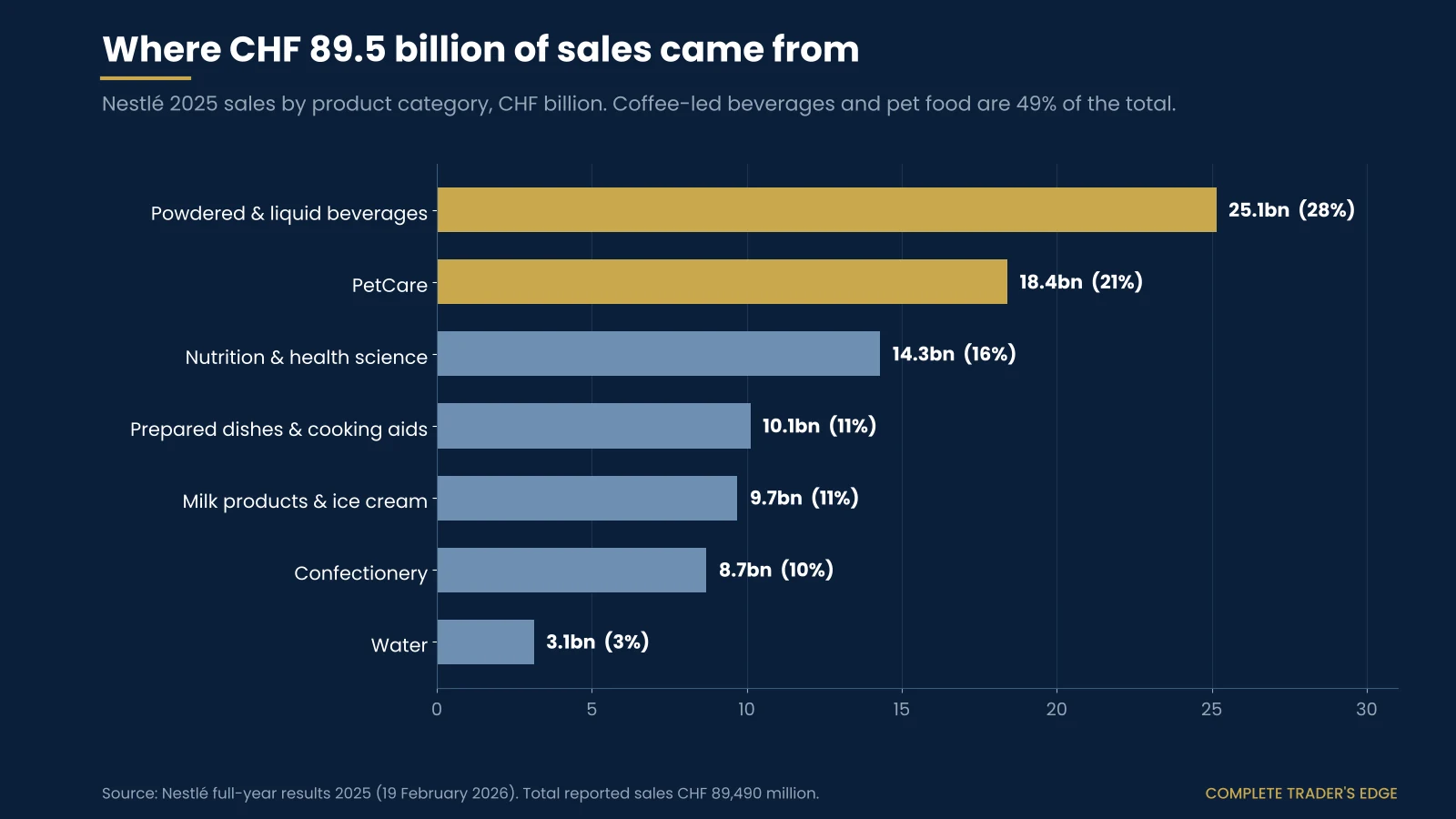
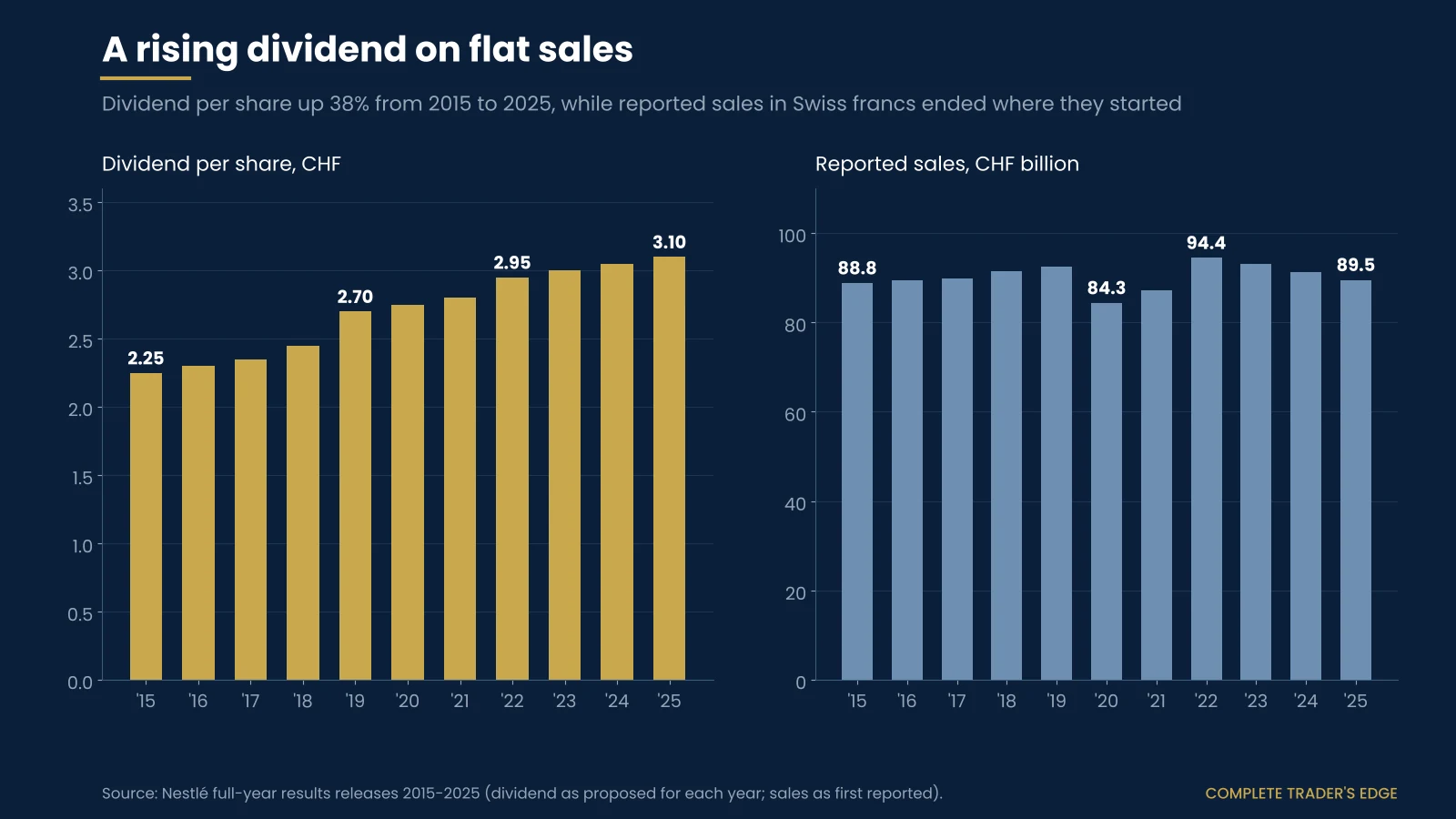
Today Nestle is the largest food and beverage company in the world, with annual revenue around ninety billion Swiss francs and a portfolio spanning coffee, water, pet care, confectionery, nutrition, and far more, sold in nearly every country. It also owns about 20% of L’Oréal, the French cosmetics group, a stake it first took in 1974, a reminder of how far its capital reaches. Its scale, its brands, and its distribution remain a formidable and durable moat.
But scale brings burdens as well as power. Nestle has faced sustained criticism and controversy over the years, most notably the long-running scandal over the aggressive marketing of infant formula in developing countries, along with disputes over water extraction and the sustainability of its supply chains. It also faces the modern challenge of shifting consumer tastes, toward healthier, fresher, and less processed foods, which pressures a company built substantially on packaged goods. The colossus must keep adapting, balancing the steady power of its everyday brands against the ethical and cultural expectations of a changing world.
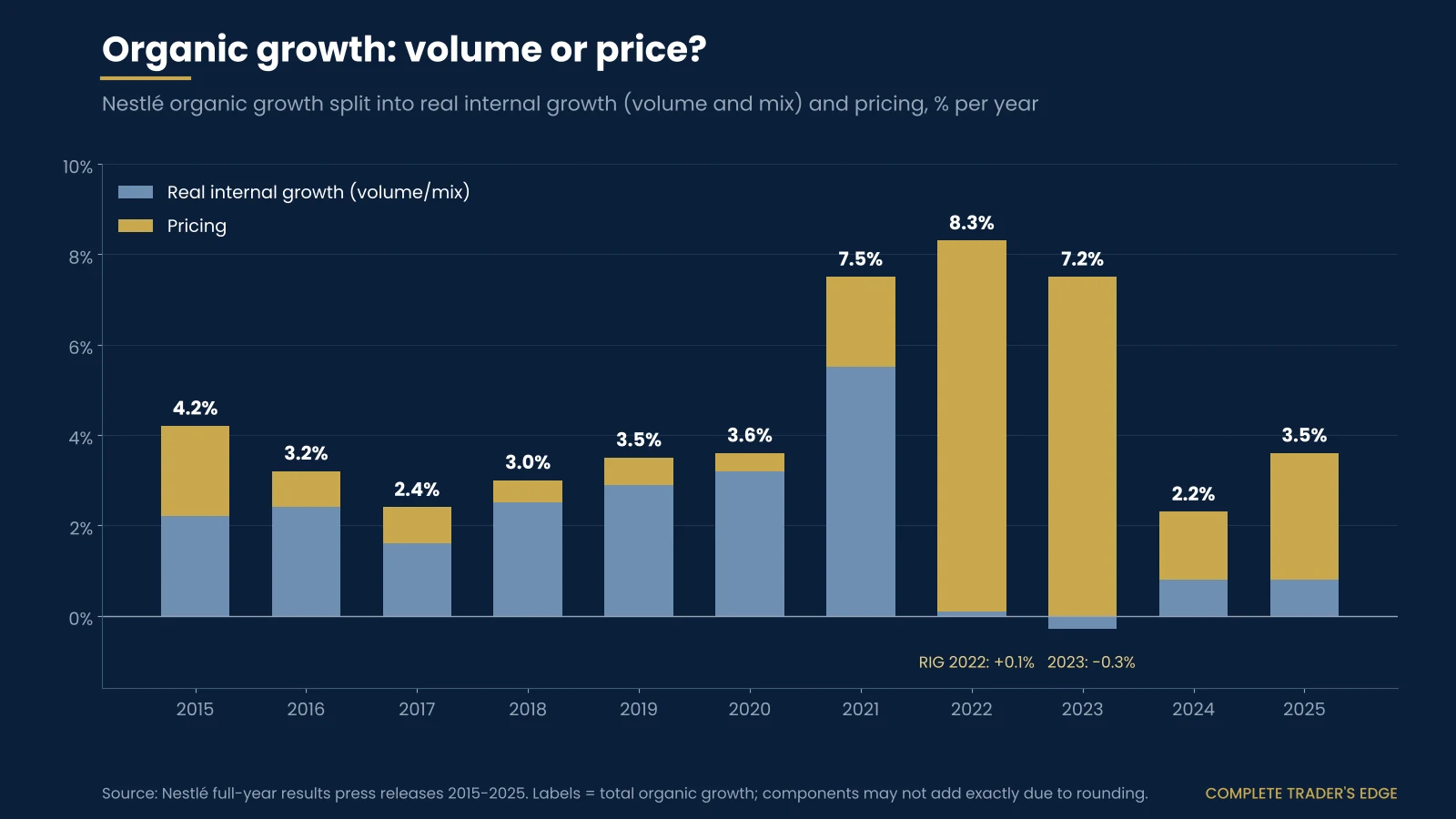
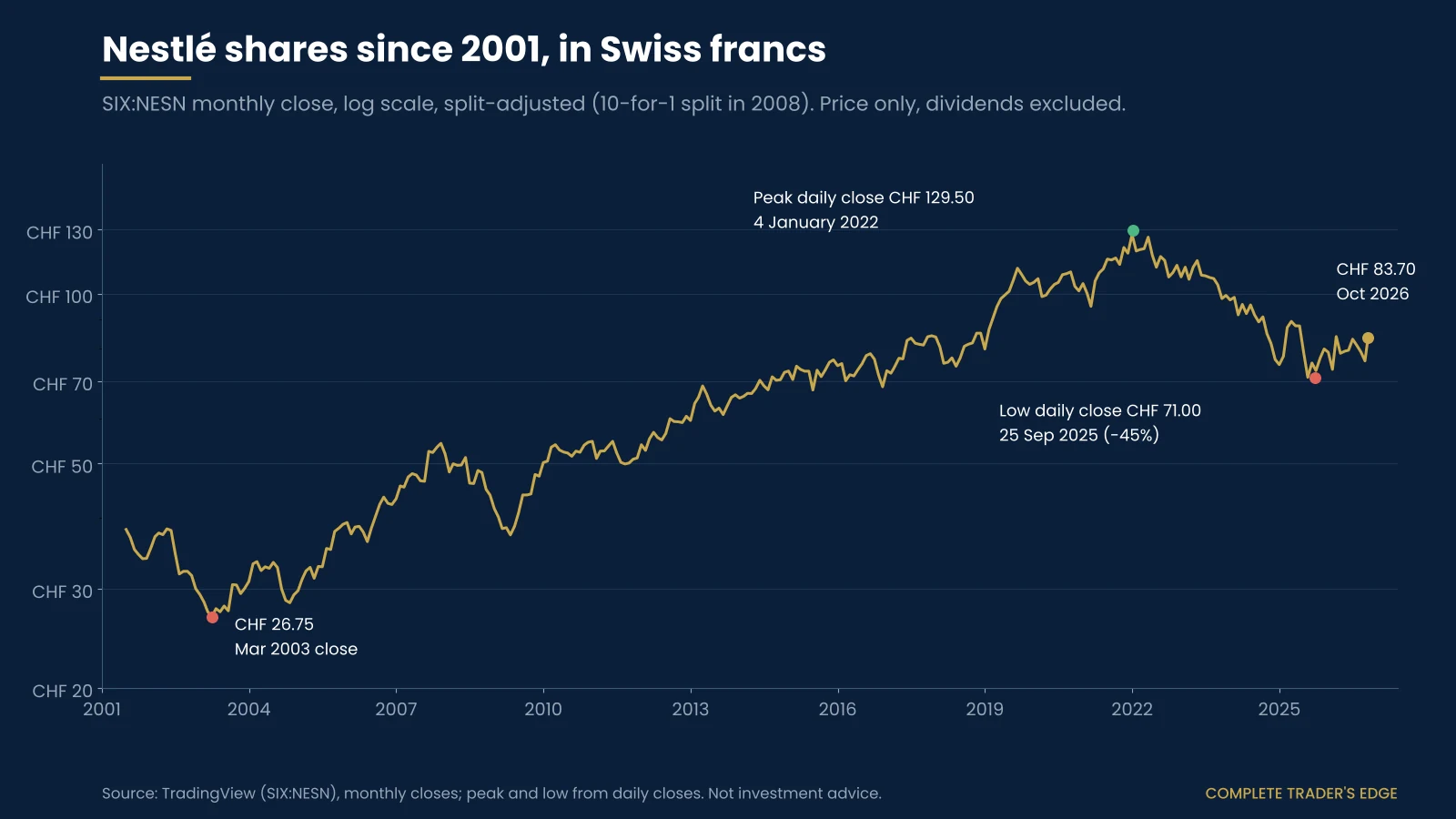
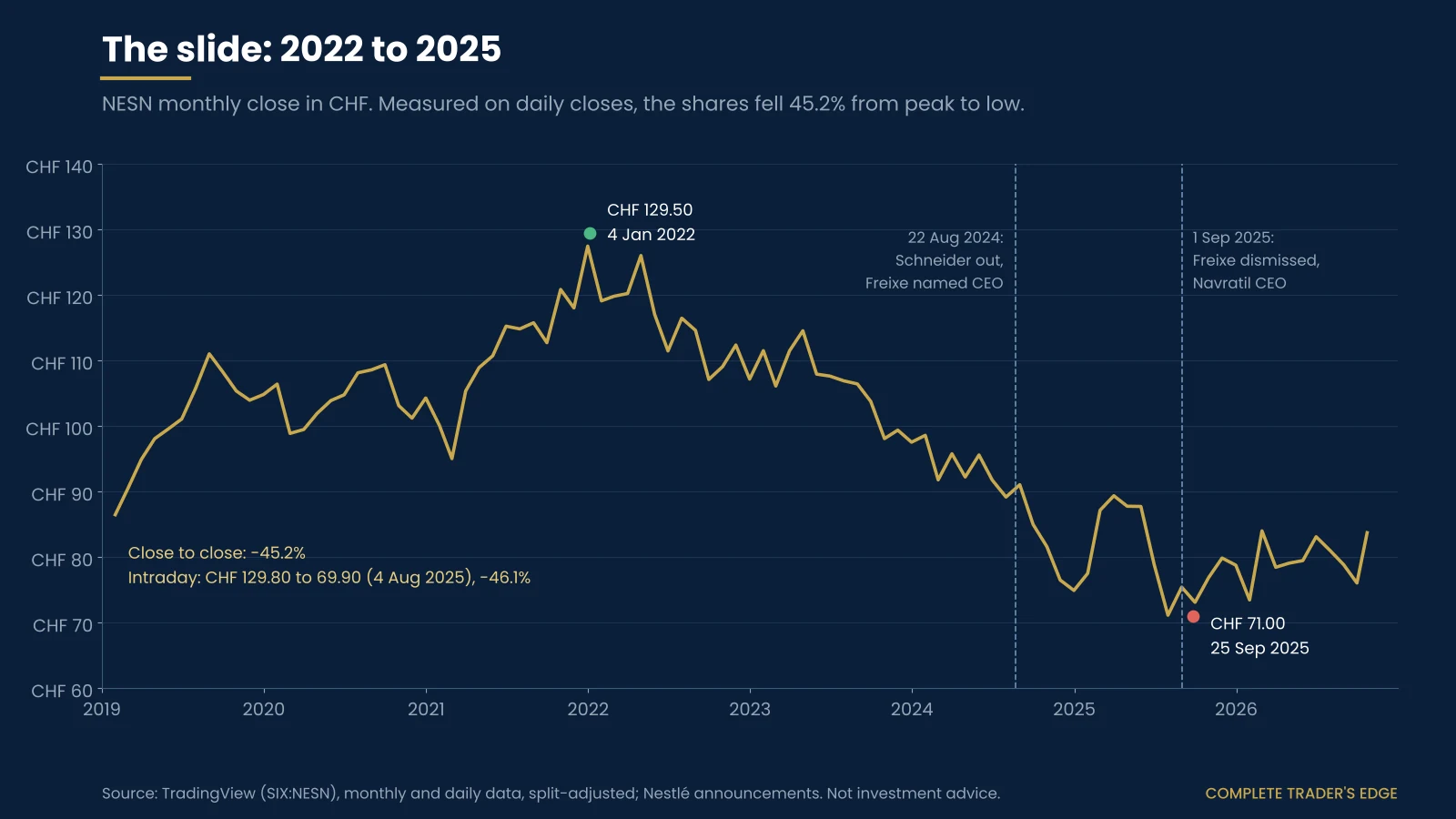
The shares show the strain. From a peak daily close of CHF 129.50 on 4 January 2022 to a low of CHF 71.00 on 25 September 2025, NESN fell 45.2%, as growth came mostly from price increases rather than volume and the company changed chief executive twice in about a year: Mark Schneider was replaced by Laurent Freixe (announced 22 August 2024), who was dismissed on 1 September 2025 over an undisclosed relationship with a direct subordinate and succeeded by Philipp Navratil.
Nestlé and consumer-staples peers at 23 October 2026
| Company | Listing | Market value (local currency) | P/E (trailing) | Dividend yield | 2026 YTD |
|---|---|---|---|---|---|
| Nestlé | SIX:NESN | CHF 217.0bn | 29.0 | 3.7% | +7.0% |
| Procter & Gamble | NYSE:PG | $374.2bn | 24.3 | 2.6% | +12.6% |
| Unilever | LSE:ULVR | £107.2bn | 22.1 | 3.3% | +1.8% |
| Mondelez | NASDAQ:MDLZ | $81.2bn | 23.3 | 3.1% | +17.9% |
| Danone | EURONEXT:BN | €40.1bn | 20.6 | 3.6% | -18.3% |
| General Mills | NYSE:GIS | $18.4bn | n/m (net loss) | 6.9% | -25.9% |
Source: TradingView, 23 October 2026. Market values are in each company’s trading currency and are not converted. Price data only; not investment advice.
Why This Matters to Investors
The Greatest Companies Thesis
Every legendary company begins with an idea that looks improbable.
Every one survives a stretch where failure looks inevitable.
Every one eventually reaches a point where success looks obvious.
The opportunity exists only in the space between the second and third.
Nestle is the clearest case study in this collection of the combined power of brands and distribution, and of the quiet strength of everyday consumption. Its lesson is that a vast portfolio of trusted brands, backed by unmatched reach, can produce some of the most durable and predictable profits in all of business, not through drama or breakthrough, but through the steady, repeated, almost unconscious choices of billions of consumers. The Greatest Companies thesis is that durable competitive advantage builds lasting wealth, and Nestle’s advantage, brand trust multiplied by global distribution, is among the most durable of all. The investor’s lesson is twofold. First, respect the extraordinary power of the ordinary: businesses built on steady, repeated, habitual demand can compound with a reliability that flashier companies cannot match. Second, weigh the responsibilities of scale, because a company large enough to touch billions of lives carries ethical burdens that can become real risks, and the discipline to see both the strength and the shadow of size is part of judging any giant honestly. None of this is investment advice; it is a way of reading history.
Lessons in Order of Depth
Method: combine trusted brands with unmatched distribution
Nestle’s method is to assemble a vast portfolio of brands that consumers know and trust, and to carry them through a distribution network that reaches almost everywhere. The method is to see that a brand and the ability to deliver it are two halves of one moat: trust creates the demand, distribution satisfies it everywhere at once. The skill to study is the patient building of both, a collection of trusted names and the global machine that places them within reach of nearly every consumer alive.
Money: the quiet compounding of everyday demand
Nestle’s profits come not from dramatic wins but from the steady, repeated purchase of ordinary goods by billions of people, week after week, for generations. The money lesson is the power of predictable, recurring demand: a business built on habitual everyday consumption enjoys remarkably stable cash flow, resistant to recessions and shocks. Steady compounding from the ordinary, multiplied across a vast scale and a long time, is one of the most reliable paths to durable wealth.
Mind: patience and breadth over drama and focus
Nestle’s mindset is the patient management of vast breadth: hundreds of brands, nearly two hundred markets, more than a century of steady expansion, without the drama of a single bet-the-company moment. The mindset lesson is that durability often comes from breadth and patience rather than from boldness and focus, that a wide, well-managed portfolio can outlast a narrow, brilliant one. For a trader, it echoes the power of diversification and the long horizon: survival and steady compounding over spectacular, fragile wins.
The deepest question: does great scale carry a duty equal to its power?
Nestle’s size lets it touch billions of lives, which is the source of both its profits and its gravest controversies, from infant-formula marketing to water and sourcing disputes. The deepest question Nestle poses is whether a company with such vast reach bears a responsibility proportional to its power, and whether the pursuit of steady profit from everyday consumption can be squared with the ethical weight of operating at a planetary scale. The answer matters not just for Nestle but for every giant whose ordinary products reach into billions of lives, and it asks whether durability and responsibility can, in the end, be made to compound together.
The Legendary Scorecard
| Founder Vision | 8 |
| Innovation | 6 |
| Execution | 9 |
| Moat | 9 |
| Capital Allocation | 8 |
| Wealth Creation | 8 |
| Durability | 10 |
| Historical Importance | 8 |
| Overall | 8.0 |
The overall figure is an editorial verdict, not a weighted average. Nestle earns a perfect score for durability, because its model, trusted brands carried by global distribution and bought out of everyday habit, is one of the most resilient ever built, having compounded steadily for over a century and a half. It earns high marks for moat and execution. It scores lower on innovation, because its growth comes more from acquisition, distribution, and brand management than from breakthrough invention, and its historical importance, while real, is the quiet kind, woven into daily life rather than dramatically transformative.
At a Glance
| Origins | Anglo-Swiss Condensed Milk Company (1866) and Henri Nestle’s infant food (1867) |
| Founders | Henri Nestle, and brothers Charles and George Page |
| Merged | 1905, forming the foundation of the modern Nestle |
| Headquarters | Vevey, Switzerland |
| Core moat | A portfolio of trusted brands plus unmatched global distribution |
| Famous brands | Nescafe, KitKat, and many others, including pet care and water |
| Scale | The world’s largest food and beverage company, near 90 billion Swiss francs in revenue |
| Reach | Products sold in nearly 200 countries |
| Status | Operating, listed as SIX: NESN |
Timeline
- 1866: brothers Charles and George Page found the Anglo-Swiss Condensed Milk Company in Switzerland
- 1867: the pharmacist Henri Nestle creates an infant food, Farine Lactee, to nourish babies who cannot be breastfed
- 1905: Nestle and the Anglo-Swiss Condensed Milk Company merge, forming the foundation of the modern company
- early 1900s: Nestle expands worldwide and into chocolate and other foods, growing through acquisition
- 1938: Nescafe instant coffee launches and becomes a global staple
- late 1900s to 2000s: Nestle acquires a vast range of brands across coffee, water, pet care, confectionery, and nutrition
- 2024 to 2025: two chief executive changes in about a year, from Mark Schneider to Laurent Freixe (September 2024) to Philipp Navratil (September 2025)
- 2025: Nestle is the world’s largest food and beverage company, with revenue around ninety billion Swiss francs and brands in nearly every country
Key Numbers
1866 and 1867 the two foundings, of Anglo-Swiss and of Henri Nestle’s infant food
1905 the year the two rivals merged to form the modern Nestle
1938 the year Nescafe launched and became a global staple
Around 90 billion Swiss francs Nestle’s annual revenue
Nearly 200 the number of countries in which Nestle sells its products
Hundreds the number of brands in Nestle’s portfolio
Related Reading
Nestle is best understood among the great builders of brands and durable advantage. Read about 3M, another diversified giant, whose moat is a culture of invention rather than a portfolio of consumer brands. See how Coca-Cola built one of the deepest single-brand moats in history, the focused counterpart to Nestle’s vast portfolio. And study how LVMH assembled a portfolio of brands at the opposite end of the market, in luxury rather than the everyday. For the full collection, see our Greatest Companies of All Time hub.
Go Deeper
Nestle is a study in the power of brands and distribution, in the quiet compounding of everyday demand, and in the responsibilities that come with vast scale. Those are the same forces that separate investors who respect durable, predictable businesses from those who chase only the dramatic, and the book teaches you the discipline to value brand trust and distribution as a genuine moat, to respect the steady power of habitual demand, and to weigh honestly both the strength and the ethical weight that come with great size.
★ Now in Kindle, Paperback & Hardcover
Greatest Companies
This story is one of fifty-one. The full book reads every legendary company through a single lens — Moat, Meltdown, Machine — from Standard Oil to SpaceX. Fifty-one companies, eight kinds of moat, one framework.
Kindle · $9.99 →
Paperback · $24.99 →
Hardcover · $34.99 →
Explore the Book →
This article is part of the Greatest Companies series, adapted from the book Greatest Companies, now available on Kindle.
Frequently Asked Questions
How did Nestle begin?
Nestle traces to two origins. In 1866, brothers Charles and George Page founded the Anglo-Swiss Condensed Milk Company in Switzerland. In 1867, a pharmacist named Henri Nestle created an infant food called Farine Lactee to nourish babies who could not be breastfed. The two companies became rivals and then, in 1905, merged to form the foundation of the modern Nestle.
What makes Nestle’s business so durable?
Nestle’s durability comes from selling everyday, repeatedly purchased goods, coffee, chocolate, water, pet food, through a portfolio of trusted brands and a global distribution network. People buy these products habitually, week after week, which makes demand steady and resistant to recessions. Trusted brands combined with unmatched reach create one of the most reliable and durable business models in the world.
What are some brands owned by Nestle?
Nestle owns a vast portfolio of brands across many categories, including Nescafe and Nespresso in coffee, KitKat in confectionery, Purina in pet care, Gerber in baby food, Maggi in culinary products, and Perrier and S.Pellegrino in water, among hundreds of others. Many consumers do not realize how many familiar products belong to the single company.
Why has Nestle been controversial?
Nestle’s vast scale has brought serious controversy. The most famous is the long-running scandal over the aggressive marketing of infant formula, particularly in developing countries, which critics argued discouraged breastfeeding. Nestle has also faced disputes over water extraction practices and the sustainability and ethics of its supply chains. Its size is the source of both its strength and its gravest reputational risks.
What is Nestle’s competitive moat?
Nestle’s moat is the combination of brand trust and global distribution. It owns hundreds of brands that consumers know and reach for out of habit, and it can place them on shelves in nearly two hundred countries through a distribution network few can rival. A competitor might copy a single product, but copying a century of brand trust plus a globe-spanning distribution system is extraordinarily difficult.
 The Complete Trader's Edge
The full Mind · Method · Money framework. 70 chapters.
View on Amazon →
 Market Mayhem
400 years of bubbles, crashes, and the pattern that keeps repeating.
Buy on Amazon →
 Greatest Companies
How the world's greatest companies were built — and what traders learn from them.
View on Amazon →
 Greatest Traders
Eighty-six lives that explain the markets — Livermore to Madoff, told with the losses left in.
View on Amazon →