
Most technology companies tell a story about invention. A founder dreams up a product, builds it in a garage, and changes the world. Broadcom’s story is different, and in its own way just as powerful. Broadcom is, more than almost any other company in this collection, a story about capital allocation: about a chief executive who treats a public technology company as if it were a private-equity fund, buying mission-critical businesses, stripping out everything that is not essential, optimizing the survivors for cash, and compounding the result at a rate that has made his shareholders extraordinarily rich.
The man at the center is Hock Tan, and the philosophy is so distinctive that Wall Street simply calls it the Tan playbook. Find a franchise business, one with sticky customers and a deep moat. Buy it. Cut the costs and the projects that do not earn their keep. Raise prices where the customers cannot easily leave. Pay down the debt fast, and use the cash to do it again, bigger. It is a machine, and over two decades it has turned a middling chip unit into one of the most valuable technology companies on Earth.
📄 Free Download · Company Research Sheet
Broadcom Research Sheet (PDF)
The moat, the meltdown, the Legendary Scorecard, the timeline, and the Move, Money and Mind lessons from this story. Free, no email required.
From a Hewlett-Packard Division to a Buyout
Broadcom’s roots run improbably deep, back to a semiconductor division of Hewlett-Packard formed in 1961. That unit was carried into Agilent Technologies when HP spun off its instrument business in 1999. Then, in 2005, the private-equity firms KKR and Silver Lake bought the chip operation and renamed it Avago Technologies. It was a classic buyout: take an unloved division out of a big company and run it for cash and growth.
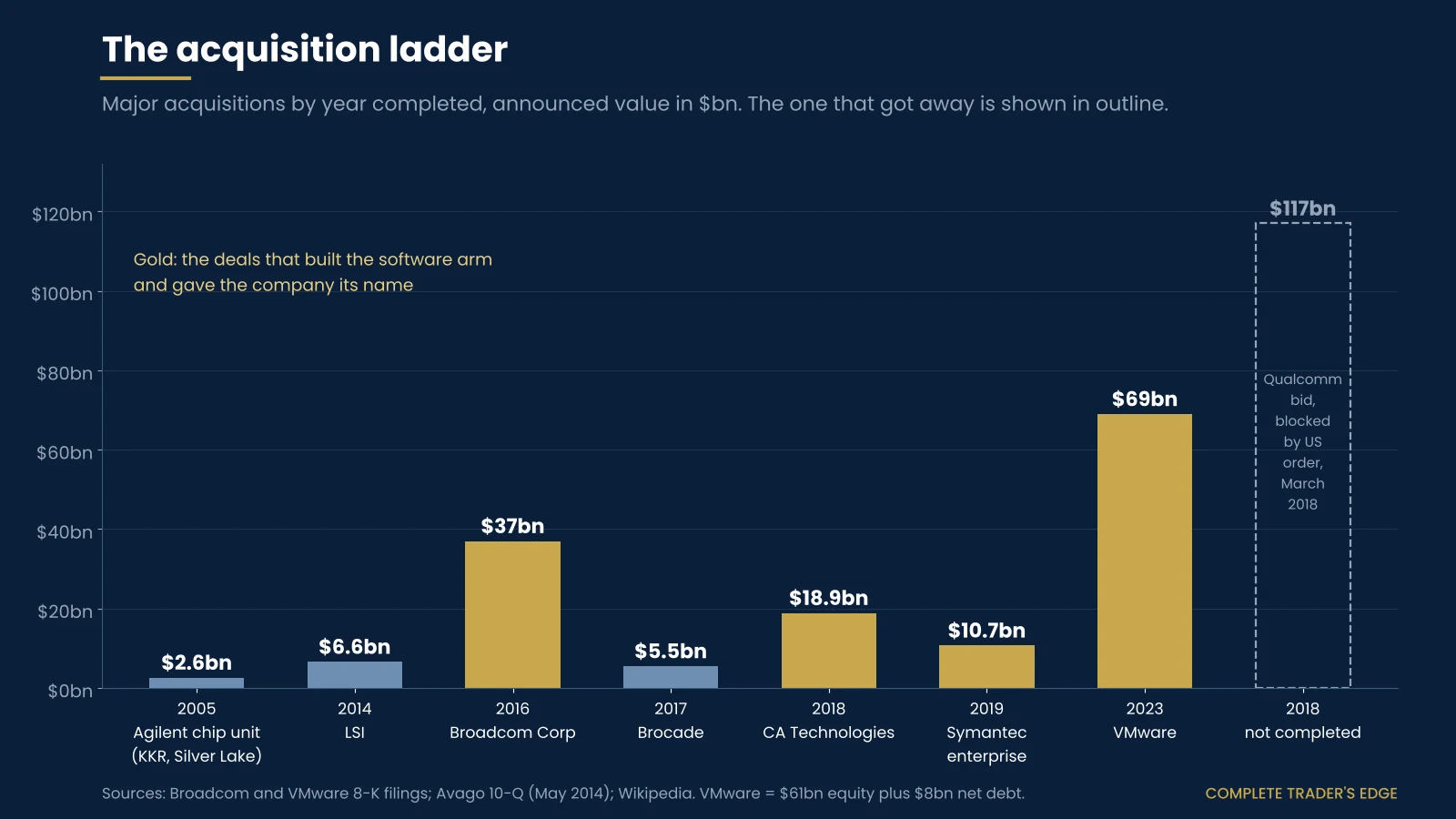
The turning point came in 2006, when Hock Tan was appointed chief executive. Tan, an engineer by training but a financier by instinct, saw that the real opportunity was not just to run Avago well, but to use it as a platform to buy other companies. He began acquiring, methodically, businesses like the chip maker LSI, agreed in December 2013 for about $6.6 billion and completed in May 2014. And then, in 2016, came the audacious move that defined the company: Avago, the smaller company, bought the original Broadcom Corporation for about thirty-seven billion dollars, and adopted its more famous name while keeping its own ticker.
The Pivot Into Software
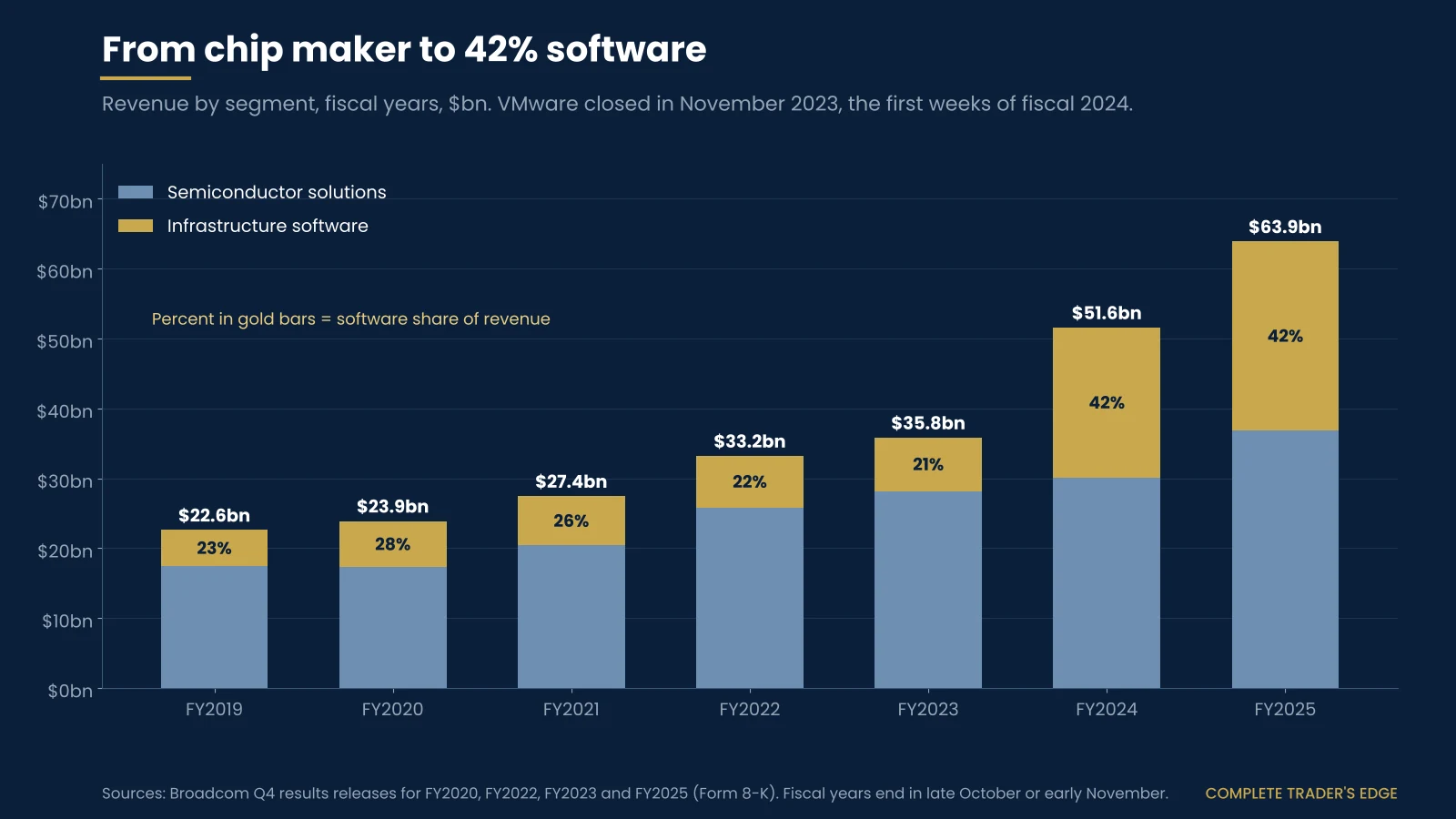
For most acquirers, swallowing a company larger than yourself would be the end of the story. For Hock Tan it was the beginning. Having built a semiconductor powerhouse, he turned to an entirely different field, infrastructure software, reasoning that the same playbook would work: buy a franchise with sticky enterprise customers, cut the non-core spending, and harvest the cash. In 2018 Broadcom bought the software company CA Technologies for about eighteen point nine billion dollars, and in 2019 it bought Symantec’s enterprise security business for about ten point seven billion.
The strategy reached its peak in 2023, when Broadcom closed its acquisition of VMware, the virtualization software giant, for about sixty-nine billion dollars, one of the largest technology deals in history. Tan applied the playbook without mercy: he collapsed VMware’s sprawling product line into a handful of bundles, raised prices sharply, and focused on the largest, stickiest enterprise customers, infuriating many smaller clients but driving a surge in profitable, recurring software revenue. The cyclical chip maker had remade itself into a hybrid hardware-and-software fortress.
The Tan Playbook. Find a franchise business with sticky customers. Buy it, often with debt. Cut the costs and projects that do not earn their keep. Raise prices where customers cannot easily leave. Repay the debt fast, and recycle the cash into the next, bigger deal. A repeatable machine, run like a private-equity fund inside a technology company.
Decision Point
The Decision Point. It is 2022. Broadcom is a hugely successful semiconductor company, but the chip business is cyclical, and Hock Tan wants more durable, recurring revenue. VMware, whose virtualization tools run inside most of the world’s data centers, is available, but buying it would cost about sixty-nine billion dollars, require enormous debt, and invite intense regulatory scrutiny worldwide. The road forks.
A. Stay focused on chips, avoid the debt and the regulators, and accept the cyclicality.
B. Make a smaller, safer software acquisition.
C. Bet the company on VMware, take on a mountain of debt, fight regulators on three continents, and trust the playbook to turn it into a cash machine.
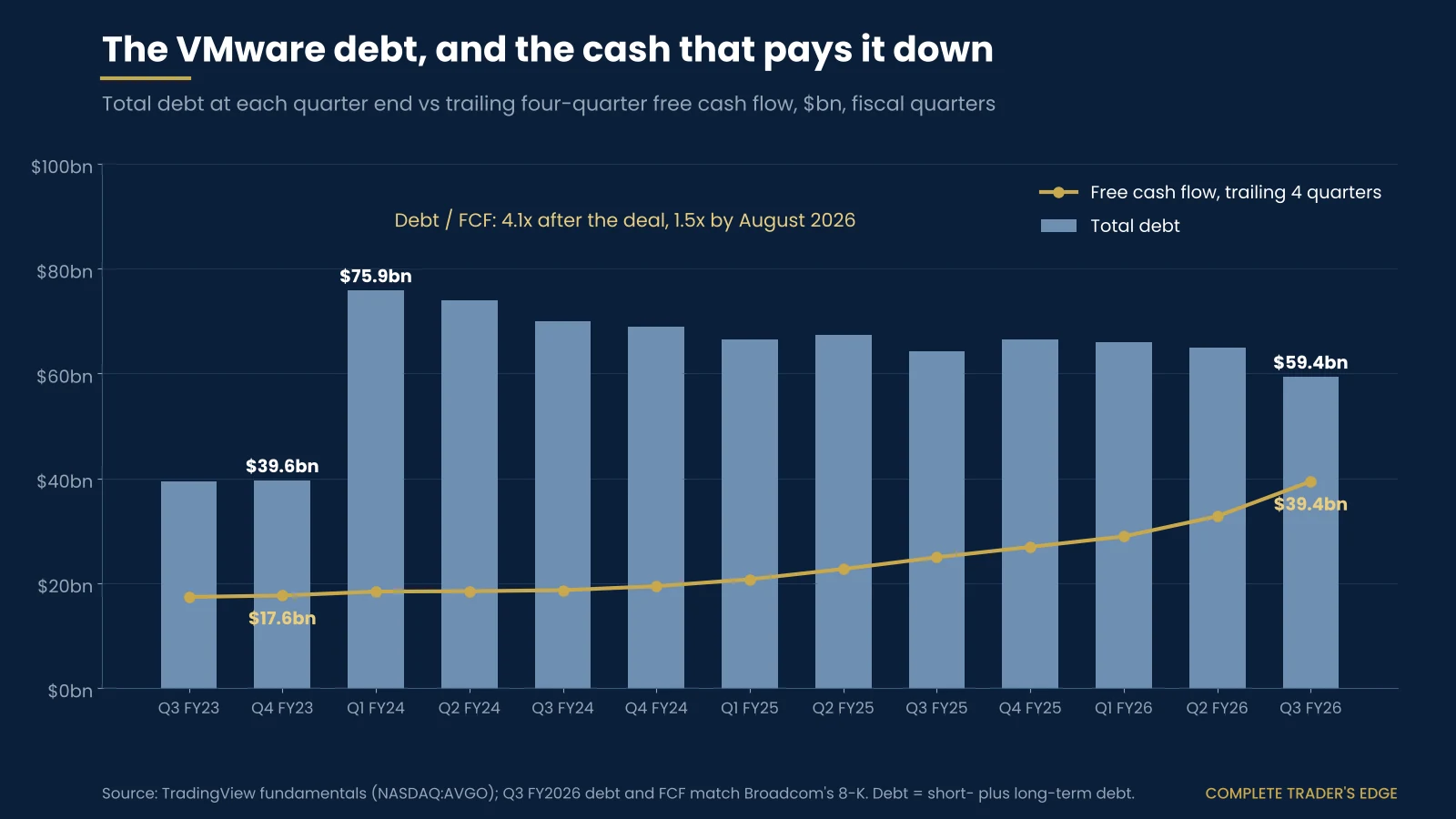
Broadcom chose C, closed the deal in 2023, and then paid the debt down steadily as VMware’s optimized cash flows poured in: total debt fell from a peak of $75.9 billion in early 2024 to $59.4 billion by August 2026, while annual free cash flow more than doubled. The willingness to use enormous leverage on a franchise asset, and the discipline to repay it fast, is the engine of the whole model. This is a thought experiment about disciplined, aggressive capital allocation, not investment advice.
What Everyone Gets Wrong
Mistake #1: Thinking Broadcom is mainly a chip inventor. Its name sits inside countless devices. Reality: Broadcom’s defining skill is not invention but acquisition and optimization. It is, in effect, a superbly run buyout firm wearing the clothes of a technology company, and a large share of its value comes from buying and improving businesses rather than inventing them.
Mistake #2: Believing the debt makes Broadcom fragile. It borrows enormous sums. Reality: The debt is a deliberate tool, not a weakness. Broadcom takes on huge loans to buy franchises, then uses their reliable cash flows to repay the debt with remarkable speed, exactly as a disciplined private-equity fund does. The leverage is aggressive but tightly controlled.
Mistake #3: Assuming aggressive price hikes will drive customers away. Broadcom is famous for raising prices. Reality: It targets mission-critical products that customers cannot easily replace, so the switching costs absorb the price increases. The strategy looks customer-hostile, and sometimes is, but it works precisely because the products are so deeply embedded.
Mistake #4: Seeing Broadcom as a passenger on the AI boom. It looks like one of many chip names riding the wave. Reality: Broadcom is one of the central arms suppliers of the AI era, designing the custom chips and the networking silicon that connect vast clusters of processors. For many of the largest AI builders, Broadcom is not optional; it is infrastructure.
The Machine in Motion
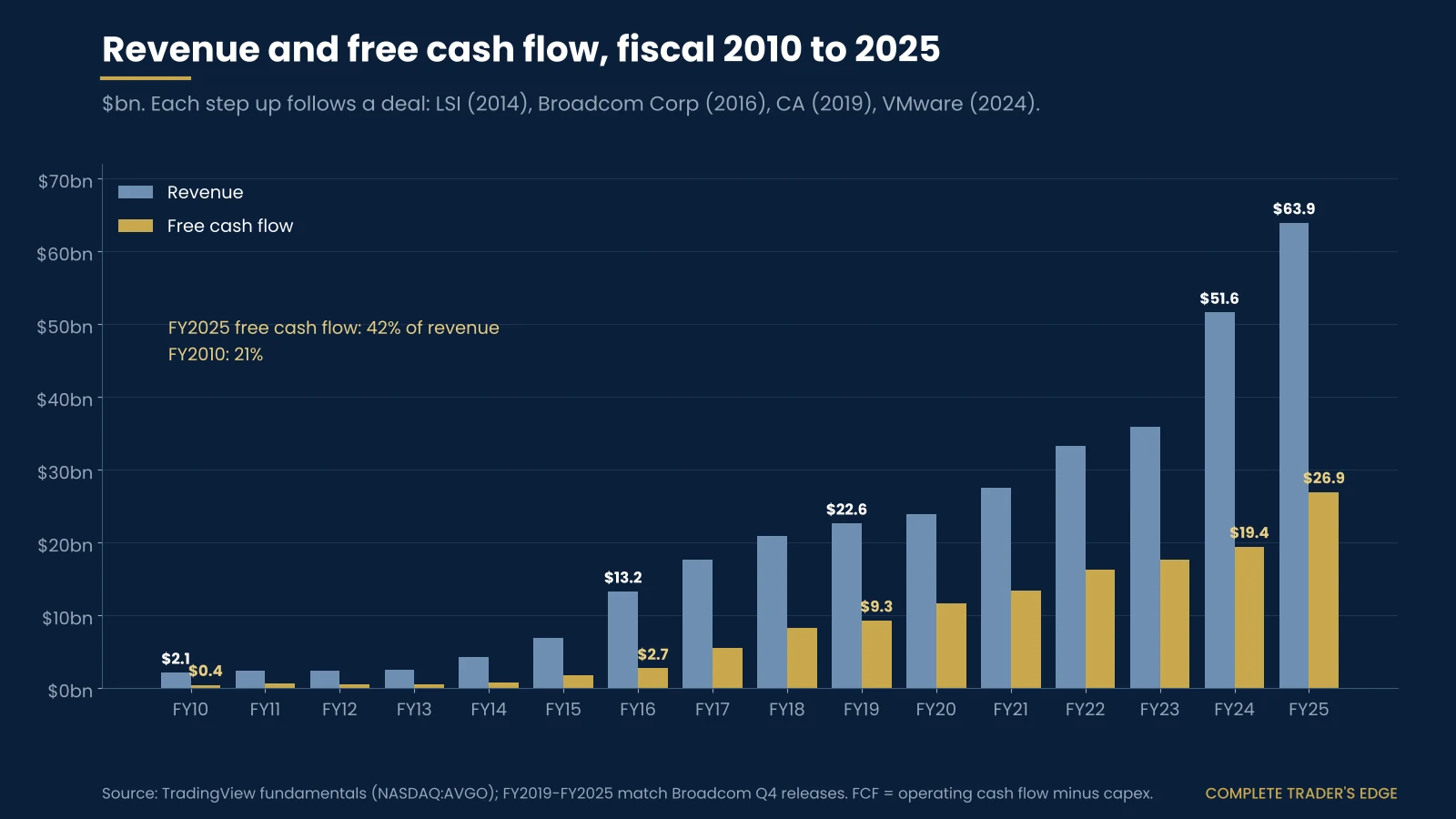
What makes Broadcom remarkable is the repeatability. This is not a company that got lucky with one great product. It is a system, applied again and again, each time larger than the last. Identify a business with a deep moat and sticky customers. Buy it, often with debt. Ruthlessly cut the costs, the research projects, and the customers that do not earn their keep. Concentrate on the high-margin core. Use the resulting flood of cash to repay the debt and to fund the next, bigger acquisition. Return roughly half of the free cash flow to shareholders along the way.
It is, in spirit, the same engine that drives a great capital allocator like Berkshire Hathaway or a disciplined acquirer like Danaher, expressed in the language of technology. The product is almost incidental; the genius is in the allocation of capital, the relentless focus on cash returns, and the discipline to walk away from anything that does not clear the bar. Broadcom proves that in business, how you buy, cut, and compound can matter more than what you make.
The Honest Present
Today Broadcom is one of the most valuable technology companies in the world, generating $26.9 billion of free cash flow in fiscal 2025 and $39.4 billion over the four quarters to August 2026, with software-like margins across much of the business. It has emerged as one of the indispensable suppliers of the artificial-intelligence build-out, designing custom AI accelerators for the largest cloud companies and the high-speed networking chips that stitch together enormous computing clusters. Its AI revenue has become one of the fastest-growing lines in technology: AI semiconductor revenue was $16.7 billion in the quarter to 2 August 2026 alone, up 221% on a year earlier.
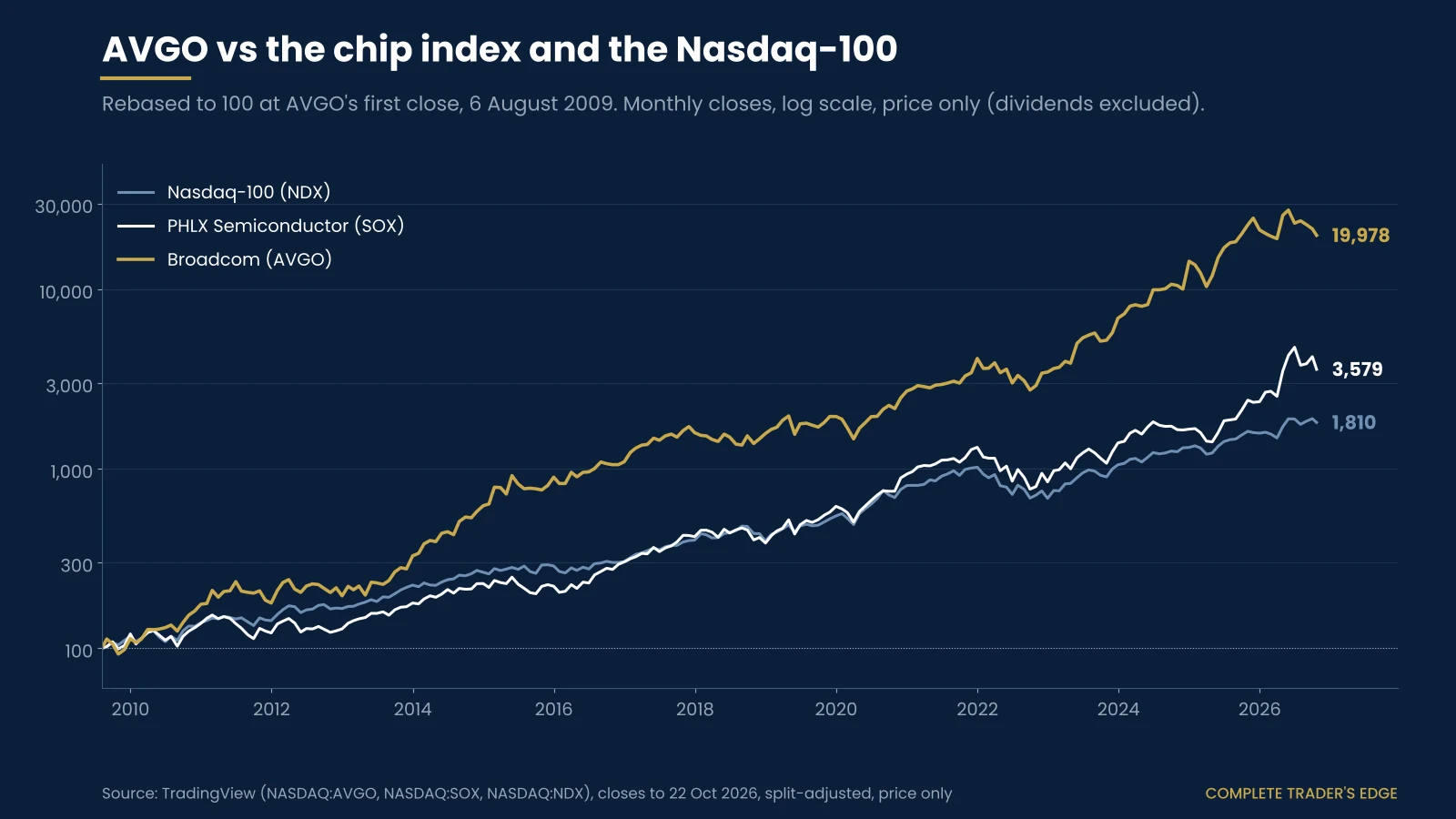
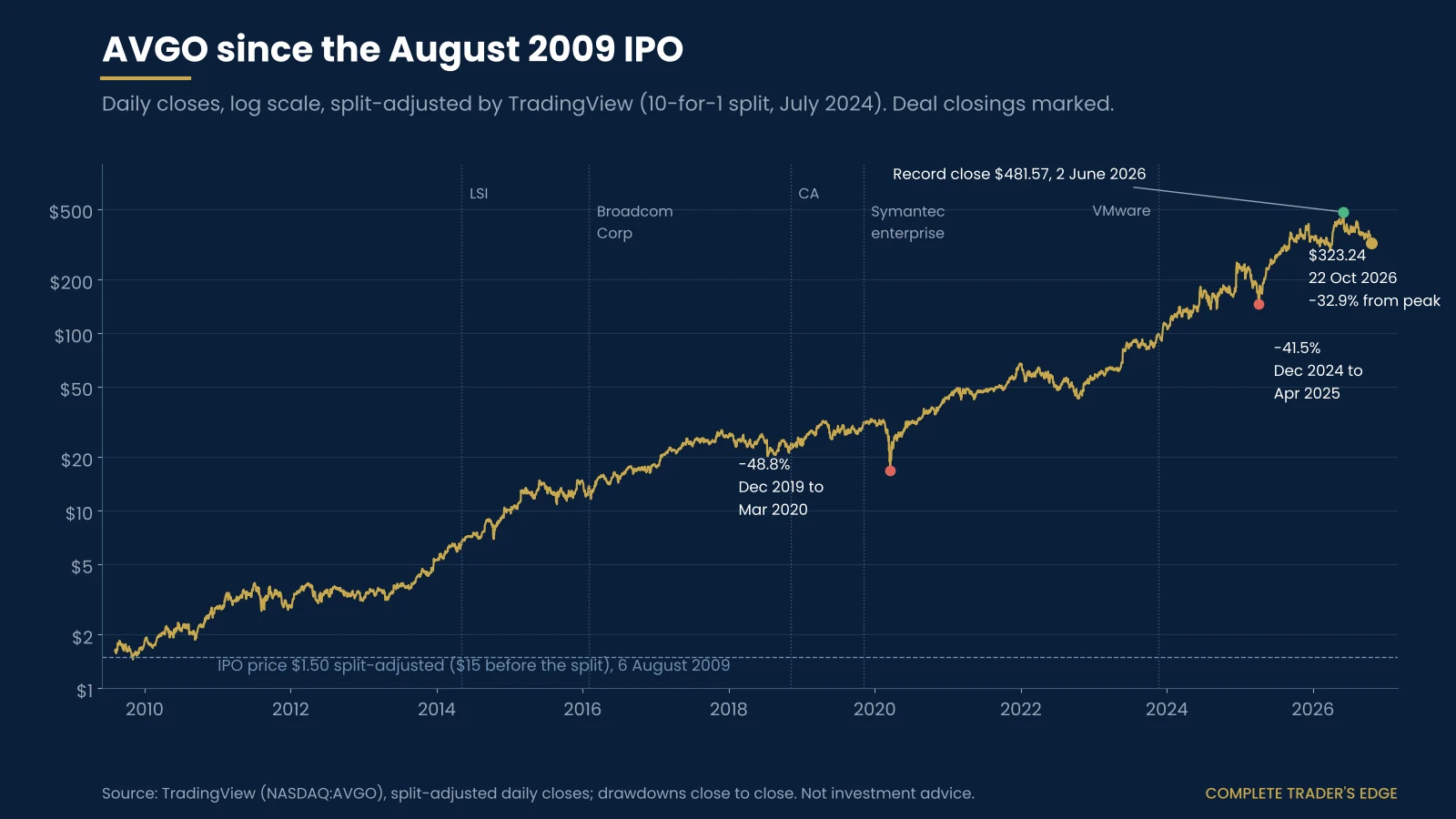
The risks are the mirror image of the strengths. The model runs on debt, and a sharp downturn or a badly chosen acquisition could strain it. The business is increasingly concentrated in a handful of giant customers for both its AI chips and its software, so the loss of even one would sting. And Broadcom’s hard-nosed treatment of acquired customers has earned it real enemies, which could eventually invite competition or regulation. But for now, the machine runs, and Hock Tan, his contract extended to the end of the decade, keeps feeding it.
Broadcom and the chip majors at 23 October 2026
| Company | Market value | Revenue (TTM) | Net margin (TTM) | P/E (TTM) | 2026 YTD | Dividend yield |
|---|---|---|---|---|---|---|
| Nvidia (NVDA) | $5.11tn | $303.0bn | 64% | 27 | +12% | 0.2% |
| TSMC (TSM, ADR) | $1.90tn | $156.4bn | 52% | 27 | +34% | 0.7% |
| Broadcom (AVGO) | $1.55tn | $89.1bn | 43% | 41 | −8% | 0.8% |
| AMD (AMD) | $847bn | $41.3bn | 16% | 133 | +137% | none |
| Intel (INTC) | $461bn | $57.0bn | −20% | n/m (loss) | +131% | none |
| Texas Instruments (TXN) | $260bn | $20.8bn | 34% | 37 | +63% | 2.0% |
| Marvell (MRVL) | $201bn | $9.5bn | 28% | 75 | +164% | 0.1% |
| Qualcomm (QCOM) | $186bn | $44.1bn | 21% | 20 | 0% | 2.1% |
Source: TradingView, 23 October 2026 (intraday). Net margin = trailing net income divided by trailing revenue. Broadcom is the only stock in the group down for the year, about 33% below its 2 June 2026 record close. Figures go stale quickly; not investment advice.
Why This Matters to Investors
The Greatest Companies Thesis
Every legendary company begins with an idea that looks improbable.
Every one survives a stretch where failure looks inevitable.
Every one eventually reaches a point where success looks obvious.
The opportunity exists only in the space between the second and third.
Broadcom is the clearest case study in this collection of capital allocation as the primary engine of value. Its lesson is that a company can compound at an extraordinary rate not by inventing the future but by buying the right pieces of it, optimizing them with discipline, and recycling the cash relentlessly. The product is the raw material; the allocation of capital is the craft. The Greatest Companies thesis is that durable competitive advantage builds lasting wealth, and Broadcom’s advantage is twofold: a portfolio of mission-critical franchises with deep switching costs, and a management system for buying and optimizing them that few can match. The investor’s lesson is to study how capital is allocated, because a superb allocator can turn even unglamorous businesses into a compounding machine, and to weigh that engine against its risks, the debt and the customer concentration that are the price of the model. None of this is investment advice; it is a way of reading history.
Lessons in Order of Depth
Method: treat acquisition and optimization as a repeatable system
Broadcom’s method is to run a public company like a buyout fund: identify franchise businesses with sticky customers, acquire them, strip out everything non-essential, and optimize the core for cash. The method is to see that growth need not come only from invention; it can come from the disciplined, repeatable purchase and improvement of businesses others run loosely. The skill to study is not a product but a process, applied consistently and at ever-larger scale.
Money: capital allocation can outproduce the products themselves
Broadcom’s returns come less from what it makes than from how it deploys capital: buying with debt, cutting costs, repaying fast, and recycling the cash into the next deal. The money lesson is that the allocation of capital, where it is invested, how aggressively, and how the cash is returned, is itself one of the most powerful drivers of long-term wealth, often more powerful than the underlying operations. A great allocator is a compounding force.
Mind: the discipline to cut without sentiment
The hardest and most controversial part of the Tan playbook is the ruthlessness: cutting research projects, shedding customers, and raising prices without sentiment, keeping only what earns its keep. That unsentimental discipline is rare and uncomfortable, and it is central to the model’s success. The mindset lesson is that disciplined capital allocation often requires the willingness to be unpopular, to cut what is comfortable but unproductive, and to judge every asset coldly by its return.
The deepest question: is a machine built on debt and concentration as durable as one built on invention?
Broadcom’s model is brilliant, but it rests on two things invention-led companies do not need so heavily: large debt and a concentrated set of giant customers. A company like TSMC or Nvidia is protected by an irreplaceable capability; Broadcom is protected by its franchises and its discipline, but exposed to leverage and to the loss of a key customer. The deepest question Broadcom poses is whether a compounding machine built on financial engineering and customer concentration can prove as durable, across decades and downturns, as one built on a moat of pure capability. The answer will test whether the greatest capital allocators can outlast the greatest inventors.
The Legendary Scorecard
| Founder Vision | 8 |
| Innovation | 7 |
| Execution | 10 |
| Moat | 8 |
| Capital Allocation | 10 |
| Wealth Creation | 10 |
| Durability | 7 |
| Historical Importance | 8 |
| Overall | 8.5 |
The overall figure is an editorial verdict, not a weighted average. Broadcom earns perfect marks for execution, capital allocation, and wealth creation, because the Tan playbook is one of the most effective compounding machines in modern business and has created staggering shareholder value. It scores lower on innovation, durability, and founder vision, because its genius is acquisition rather than invention, and because the reliance on heavy debt and a concentrated customer base makes its long-run durability less certain than that of companies protected by an irreplaceable capability.
At a Glance
| Origins | A 1961 Hewlett-Packard chip division, later part of Agilent |
| Modern company | Formed when KKR and Silver Lake created Avago in 2005 |
| Defining leader | Hock Tan, CEO since 2006, architect of the acquire-and-optimize model |
| Name | Adopted in 2016 when Avago bought Broadcom Corp for about $37 billion |
| Software pivot | CA Technologies (2018), Symantec enterprise (2019), VMware (2023) |
| Core moat | Switching costs on mission-critical franchises, plus scale |
| Cash engine | $26.9 billion of free cash flow in fiscal 2025; $39.4 billion in the four quarters to August 2026 |
| Current role | A central supplier of custom AI chips and networking |
| Status | Operating, listed as NASDAQ: AVGO |
Timeline
- 1961: Hewlett-Packard forms the semiconductor division that is the company’s distant ancestor
- 1999: the division becomes part of the Agilent spinoff from HP
- 2005: the private-equity firms KKR and Silver Lake buy the chip unit and name it Avago
- 2006: Hock Tan becomes CEO and begins the acquire-and-optimize strategy
- 2016: Avago buys Broadcom Corp for about $37 billion and takes its name
- 2018: Broadcom buys CA Technologies for about $18.9 billion, pivoting into software
- 2019: Broadcom buys Symantec’s enterprise security business for about $10.7 billion
- 2023: Broadcom closes its $69 billion acquisition of VMware
- 2025: Broadcom is a central supplier of custom AI chips and networking, generating roughly $27 billion in free cash flow
Key Numbers
2006 the year Hock Tan took charge and the machine began
About $37 billion the price Avago paid to buy and rename itself Broadcom in 2016
About $69 billion the price of the 2023 VMware acquisition
$26.9 billion Broadcom’s free cash flow in fiscal 2025 ($39.4 billion in the four quarters to August 2026)
About half the share of free cash flow Broadcom returns to shareholders
Trillions the order of Broadcom’s market value during the AI boom
Related Reading
Broadcom belongs in the company of the great capital allocators. Read about Danaher, the patient, decades-long serial acquirer whose Danaher Business System is the gentler cousin of the Tan playbook. See how Berkshire Hathaway built the original compounding machine through disciplined capital allocation. And study how Blackstone turned the buying and optimizing of businesses into one of the world’s great fortunes. For the full collection, see our Greatest Companies of All Time hub.
Go Deeper
Broadcom is a study in capital allocation as a craft, in the disciplined use of debt, and in the unsentimental focus on cash returns. Those are the same forces that separate investors who think like owners and allocators from those who chase stories, and the book teaches you the discipline to judge a business by how it deploys its capital, to respect the power of a repeatable system over a single lucky product, and to weigh a compounding engine honestly against the risks that power it.
★ Now in Kindle, Paperback & Hardcover
Greatest Companies
This story is one of fifty-one. The full book reads every legendary company through a single lens — Moat, Meltdown, Machine — from Standard Oil to SpaceX. Fifty-one companies, eight kinds of moat, one framework.
Kindle · $9.99 →
Paperback · $24.99 →
Hardcover · $34.99 →
Explore the Book →
This article is part of the Greatest Companies series, adapted from the book Greatest Companies, now available on Kindle.
Frequently Asked Questions
What does Broadcom actually do?
Broadcom is a semiconductor and infrastructure-software company. It designs a vast range of chips, including custom AI accelerators and the high-speed networking silicon used in data centers, and it owns major enterprise-software businesses such as VMware. But its defining activity is acquisition: buying franchise technology businesses and optimizing them for cash flow.
Who is Hock Tan and why does he matter?
Hock Tan has been Broadcom’s chief executive since 2006 and is the architect of its strategy. He is widely regarded as one of the most effective capital allocators in technology, famous for an acquire-and-optimize playbook: buying franchise businesses, cutting non-core costs, raising prices on sticky products, repaying debt quickly, and recycling the cash into the next acquisition.
How did Avago become Broadcom?
The modern company began as a Hewlett-Packard chip division, which passed into Agilent and was then bought by private-equity firms KKR and Silver Lake in 2005 to form Avago. Under Hock Tan, Avago acquired companies steadily, and in 2016 it bought the original Broadcom Corporation for about thirty-seven billion dollars, adopting the better-known Broadcom name while keeping its own stock ticker.
Why was the VMware acquisition so important?
The 2023 purchase of VMware, for about sixty-nine billion dollars, completed Broadcom’s transformation from a cyclical chip maker into a hybrid hardware-and-software company with large, recurring, high-margin software revenue. Broadcom applied its playbook, simplifying VMware’s products, raising prices, and focusing on big customers, which lifted profits sharply even as it angered some smaller clients.
What are the main risks to Broadcom?
The biggest risks are the flip side of its model. It relies on large amounts of debt to fund acquisitions, so a downturn or a poor deal could strain it. Its revenue is increasingly concentrated in a handful of very large customers for both AI chips and software. And its aggressive treatment of acquired customers has created ill will that could eventually invite competition or regulatory attention.
 The Complete Trader's Edge
The full Mind · Method · Money framework. 70 chapters.
View on Amazon →
 Market Mayhem
400 years of bubbles, crashes, and the pattern that keeps repeating.
Buy on Amazon →
 Greatest Companies
How the world's greatest companies were built — and what traders learn from them.
View on Amazon →
 Greatest Traders
Eighty-six lives that explain the markets — Livermore to Madoff, told with the losses left in.
View on Amazon →