

Explore all 80 books in the Trader’s Library →
Most currency books are written by people who explain the foreign exchange market for a living. This one was written by someone who spent decades being wrong in it with real money, at size, in front of colleagues, and had to come back the next morning and do it again.
The difference shows up on the first page and never stops showing up. Brent Donnelly traded spot FX at major banks for most of his career, which means his day job was quoting prices to people who knew more than he did about the trade they were putting on and surviving that arrangement year after year. He now runs a market intelligence firm and writes a daily FX note that a meaningful slice of the professional currency world reads before it does anything else.
What he produced is the best available answer to a question the rest of the forex shelf does not ask: not how does this market work, but what is it actually like to take risk in it, and why do intelligent people with correct opinions lose money here so reliably?
At a Glance
| Author | Brent Donnelly |
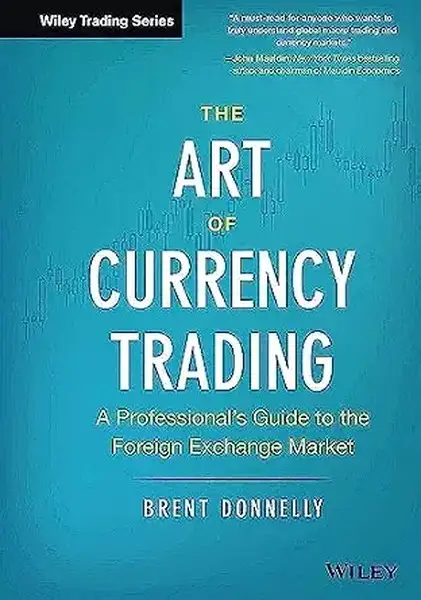
| Full Title | The Art of Currency Trading: A Professional’s Guide to the Foreign Exchange Market |
| Published | 2019 (Wiley) |
| Pages | ~350 |
| Difficulty | Moderate. Easy to read, but assumes you know what a currency pair is. |
| Best For | Anyone serious about FX who already understands the mechanics. The best FX trading book available. |
| Skip If | You do not know how currencies trade yet. Get the structure first, then come back. |
OVERALL RATING: 8.7 / 10
Who Should Read This Book
| Reader | Verdict | Why |
|---|---|---|
| Serious FX trader | Essential | The best book on trading currencies that exists. Nothing else is close on this shelf. |
| Macro trader | Yes, whatever you trade | The positioning and crowded-trade material applies to any macro instrument, not just FX |
| FX beginner | Not yet | Read Lien’s structural chapters first. This assumes you already know how the market is built. |
| Trader who is right and losing | Read it this week | This is the book about that exact condition. Correct view, wrong outcome, and the reasons why. |
| Prop-firm FX challenger | Yes, with adjustment | The process and risk material transfers directly. The information set does not; read the gap honestly. |
| Equity-only trader | Worth it anyway | The chapters on being wrong, on process and on crowded positioning are instrument-agnostic and very good |
The Book in Context
Donnelly’s career was spent on bank FX desks, trading spot currencies through the periods when that was a genuinely brutal way to earn a living. Lehman. The financial crisis. The years when the machines took over the business of quoting prices. He came out of it running a market intelligence operation and writing a daily currency note that professionals actually read, which is a harder credential to fake than most.
The importance of this is not the pedigree. It is what the pedigree makes him write about. An analyst writes about what should happen. Donnelly writes about the gap between what should happen and what does, because that gap was where his profit and loss lived for twenty years and he has no illusions left about it.
Read this immediately after Kathy Lien and the contrast is the most instructive thing on the forex shelf. Lien explains the machine beautifully. Donnelly explains what happens when you put your hand in it. Both are necessary. Only one of them is written by someone who has been hurt.
The Core Argument: Being Right Is Not the Job
The book’s organising insight is one that separates professionals from everyone else, and it is unwelcome enough that most books avoid it.
You can be completely correct about a currency’s fundamental story and lose money on it for a year. The central bank does exactly what you predicted. The data prints exactly where you expected. And the pair goes the other way, because everyone else already had that trade on and the flow that mattered was them getting out of it, not the fundamentals arriving.
The market does not pay you for being right. It pays you for being right at a moment when other people are positioned to be wrong.
— The book’s central and least comfortable claim
This is why Donnelly’s treatment of positioning and sentiment is the heart of the book. A view that everyone already holds is not an edge; it is a queue. If the entire market is long a currency because the rate story is obvious, the rate story arriving changes nothing, because it is in the price. What moves the pair is the moment those holders decide to leave, and that has almost nothing to do with whether they were right.
The practical consequence is a habit of mind that retail traders almost never develop: before taking a position, asking not “is this correct” but “who else has this on, how much do they own, and what makes them sell it.” The first question is analysis. The second is trading. This book is about the second one throughout.
The Analyst’s Question vs the Trader’s Question
| Stage | The analyst asks | The trader asks |
|---|---|---|
| The view | Is this correct? | Is this correct and not already owned by everyone? |
| The catalyst | What will prove me right? | What makes the other side capitulate, and when? |
| The data print | Did the number confirm my thesis? | Was the number already in the price before it printed? |
| Being wrong | The market is being irrational | My position is a fact and my opinion is not. Reduce. |
| Getting paid | Eventually the thesis works | Eventually is a word for people who are not marked to market |
Every row is a place where an intelligent person with a correct opinion loses money.
How Donnelly Built the Book
He writes like a person, not like a textbook. This sounds like a small thing and it is worth a full point of the rating. The prose is funny, direct, self-deprecating and completely unpretentious. Trading books are overwhelmingly written in a register of borrowed authority; this one sounds like a colleague explaining something at the desk, and the readability score of 9 is the highest on the entire forex shelf.
He is honest about losing. The single rarest quality in the genre. Donnelly discusses his own bad trades, his own errors of process, his own periods of being wrong, without converting them into parables where he emerges wise. Most trading authors write losses as a setup for the lesson. He writes them as what they were, which is considerably more useful and much harder to do.
He covers a lot of ground, which costs him depth. Fundamentals, technicals, positioning, event trading, risk, psychology, career. It is a broad book, and breadth means some sections are a solid overview rather than the definitive treatment. This is the main structural argument against it and it is a fair one.
Five Ideas Worth Carrying With You
A view everyone already holds is not an edge. It is a queue.
If the fundamental story is obvious, it is owned, and owned means priced. The story arriving does nothing. What moves the market is the holders leaving, and the timing of that has almost no relationship to whether they were right. Consensus and correctness are not opposites, and they are not the same thing either.
Your position is a fact. Your opinion is a hypothesis. Do not confuse their status.
The position exists, is marked to market, and is consuming your capital and attention right now. The opinion is a guess about the future that you happen to be fond of. Traders in trouble almost always got there by defending the second at the expense of the first.
“Eventually” is a word used by people who are not marked to market.
The thesis may well be correct on a two-year view. You do not have a two-year view; you have a drawdown limit, a risk manager, or a prop-firm rule. Being right after you have been stopped out is indistinguishable from being wrong, and the market charges the same either way.
The good news is already in the price. The question is what happens when it arrives anyway.
This is the whole logic of event trading and it is why currencies so often fall on good data. The number that confirms consensus removes the reason to hold rather than supplying a reason to buy. Trading the news requires knowing what the news was expected to be, which is a different and much harder question than what it is.
Twenty years in, it is still hard. Anyone telling you otherwise is selling something.
The most valuable thing in the book is the posture rather than any technique. A career professional saying plainly that this remains difficult, that he still gets it wrong, and that the difficulty is the permanent condition rather than a phase you graduate from. That is the honest baseline, and almost nothing else in the genre offers it.
What the Book Tells You to Do (and Why Most Readers Skip It)
The instruction is process before prediction, and it is concrete: know what is already priced before you take a view. Ask who owns the trade you are about to put on. Keep a journal that records your reasoning rather than your results, because results are noisy and reasoning is auditable. Size so that being wrong is survivable, because you will be wrong roughly as often as you are right and the difference between traders is what happens in those instances. Separate the quality of the decision from the quality of the outcome, permanently.
Readers skip it because it is unglamorous and because it reallocates effort away from the enjoyable part. Forming a view about the euro is interesting. Interrogating whether your view is already consensus, and then writing down why you took the trade so that a future version of you can grade the reasoning honestly, is homework. The market rewards the homework and pays nothing at all for the interesting part.
Common Misreadings of the Book
Misreading #1: “I can trade like a bank trader”
The most important caveat and the one this review will not soften. Donnelly spent his career with an information set retail simply does not have: he saw flow, he knew what the desk was carrying, he had a sense of where positioning sat because clients told him. Much of the professional’s intuition described in this book was built on inputs you cannot buy. The reasoning transfers. The raw material does not, and any reader who ignores that gap will misapply the book.
Misreading #2: “Positioning data is available, so I can do this”
Retail proxies for positioning exist and they are proxies. They are lagged, partial, and cover a slice of the market. They are better than nothing and they are not what a bank desk sees. Use them with an accurate sense of their resolution rather than treating them as the thing Donnelly is describing.
Misreading #3: “The honesty about losing means he wasn’t good”
Inverted. The confidence of a book is not correlated with the competence of its author, and in this genre the relationship may run the other way. Donnelly’s willingness to describe being wrong without redemption arcs is the strongest available signal that he actually did the job, because people who did the job know how much of it is being wrong.
Misreading #4: “It’s a fundamentals book”
It is a book about the distance between fundamentals and profit. Donnelly covers macro drivers competently, but the point of the coverage is to show why knowing them is insufficient. A reader who extracts the fundamental analysis and discards the positioning material has taken the least valuable part.
Misreading #5: “Broad means shallow means skip it”
The breadth is a real limitation and it is not disqualifying. No single section here is the definitive text on its subject; the book’s contribution is the integration, showing how the fundamental view, the positioning, the risk and the trader’s own psychology are one problem rather than four. That integration is exactly what specialists’ books cannot deliver.
Where the Book Falls Short
- The information asymmetry is never fully resolved. The most important honest counterweight. Donnelly’s edge was built partly on flow and positioning insight available on a bank desk and nowhere else. He does adapt the material for a wider audience, but a retail reader is being taught to think like someone with inputs he cannot obtain, and that gap is real.
- Broad rather than deep. Fundamentals, technicals, positioning, events, risk, psychology and career in one book means no section is the last word. The integration is the value; the depth is not.
- 2019, and the regime turned. Written before the inflation shock and the hiking cycle that transformed currency markets. The reasoning is durable and several specific market illustrations are of their moment.
- Assumes the mechanics. Not a flaw so much as a prerequisite, but worth stating: this is not a first FX book. A reader who does not already understand market structure will get less from it than he should.
- Technical analysis section is the weakest. Competent, unremarkable, and clearly not where the author’s conviction lives. It is there for completeness rather than because he has something new to say.
- Cannot give you the reps. The book describes judgement built over twenty years of daily decisions with money at risk. Reading about that judgement is not acquiring it, and Donnelly is honest enough to say so, which does not make it less true.
How the Book Fits the Mind · Method · Money Framework
| Pillar | Contribution | What the Book Delivers |
|---|---|---|
| MIND | STRONG | Separating decision quality from outcome, the honest account of being wrong, and the discipline of not defending an opinion with capital |
| METHOD | PRIMARY | Positioning, crowded trades, what is already priced, event trading. The professional’s actual analytical stack. |
| MONEY | STRONG | Sizing so that being wrong is survivable, and treating “eventually” as the luxury of someone not marked to market |
One of the very few books on this shelf that scores across all three pillars, which is precisely because Donnelly refuses to treat them as separate problems. The view, the size and the trader’s willingness to be wrong are one system, and it fails as a system. Read against the Mind · Method · Money framework and The Complete Trader’s Edge.
Read This Instead Of / Read This After
| Relationship | Book | Why |
|---|---|---|
| Read after | Day Trading and Swing Trading the Currency Market | Lien gives you the machine, Donnelly tells you what it does to your hands. The order matters. |
| Read instead of | Every retail forex book | This is a professional writing about the actual job. The genre it sits in is mostly not that. |
| Read alongside | Alpha Trader by the same author | The companion volume, wider than FX. Same voice, same honesty, more on the trader than the market. |
| Pair with | Thinking in Bets | Duke supplies the formal architecture for separating decision from outcome. Donnelly shows it running in a live market. |
| Pair with | What I Learned Losing a Million Dollars | Both are about defending an opinion with capital. Donnelly avoided that fate; Dennis Jones did not. |
Final Verdict: Should You Read This Book in 2026?
Yes. If you trade currencies at all, this is the book on the shelf.
The 8.7 makes it the highest-rated book in the forex section by a wide margin, and the reason is simple: it is the only one written by someone whose job was taking the risk rather than explaining it. Everything follows from that. The focus on positioning rather than fundamentals, the insistence that being right is not the job, the honesty about losing, the refusal to separate psychology from method from sizing. These are not stylistic choices. They are what the market taught him, and the book is the transcript.
The 1.3 points it gives up are real and worth naming plainly. It is broad rather than deep, which means no chapter is the final word. It is from 2019 and the regime has turned since. And most seriously, the professional’s intuition it teaches was assembled from flow and positioning information that a bank desk sees and you will not. Donnelly is honest about this and honesty does not close the gap. A retail reader must translate rather than copy, and the book cannot do that translation for him.
What remains after those deductions is still the best thing available. Read Lien first for the structure, then read this, and understand that the second book is the one about the actual job. The most valuable page in it is the one where a twenty-year professional says the work is still hard and he still gets it wrong. Believe him. Everyone in this genre who tells you otherwise is selling something, and he is the one who isn’t.
CTE Rating Breakdown
8.7/10
Highly Recommended
| Readability | 9 | |
| Actionability | 8 | |
| Timelessness | 8 | |
| Beginner-Friendly | 6 | |
| Modern Relevance | 9 |
Frequently Asked Questions
What is The Art of Currency Trading about?
It is a professional FX trader’s account of what taking risk in currency markets is actually like. Its central argument is that being right about fundamentals is not the job, because a correct view that everyone already holds is priced in and pays nothing.
Who is Brent Donnelly?
A career spot FX trader who spent decades on bank trading desks before moving into market intelligence. He writes a widely-read daily currency note and is one of the few authors in this genre whose credential is having taken the risk rather than having explained it.
Is this book good for FX beginners?
Not as a first book. It assumes you already know how currencies trade. Read the structural chapters of Kathy Lien’s primer first, then come to this one, which is where the actual trading is.
Can retail traders actually use this?
The reasoning transfers; the information set does not. Donnelly’s intuition was built partly on flow and positioning data available on a bank desk. Retail proxies are lagged and partial. Read it to think like a professional, not to replicate one.
Donnelly or Lien?
Both, in that order. Lien is an analyst explaining the machine and she does it very well. Donnelly is a trader explaining what happens when you put money into it. The contrast between them is the most useful thing on the forex shelf.
Why does positioning matter more than fundamentals?
Because fundamentals that everyone knows are in the price already. The move comes from holders exiting, and the timing of that has little to do with whether they were right. A consensus view is a queue, not an edge.
Art of Currency Trading or Alpha Trader?
This one is about the currency market specifically. Alpha Trader is broader and more about the trader than the instrument. Same voice and same honesty in both; start here if FX is your market.
Is the 2019 material still relevant?
The reasoning is durable and modern relevance scores a 9 for that reason. Some specific market illustrations predate the inflation shock and hiking cycle that reshaped currency markets, but nothing central depends on the regime it was written in.
Why is the honesty about losing significant?
Because it is nearly absent from the genre. Most trading authors write losses as setups for a lesson in which they emerge wise. Donnelly describes being wrong without the redemption arc, which is both more useful and a strong signal that he actually did the job.
What is the single most important takeaway from the book?
Before you take a position, stop asking whether you are right and start asking who else already owns this trade and what would make them sell it. The first question is analysis. The second is trading.
About the Author
Brent Donnelly
Brent Donnelly spent the bulk of his career trading spot foreign exchange on bank desks, through the financial crisis and through the years when electronic market-making rewrote the business. He now runs a market intelligence firm and writes a daily currency note that a large share of the professional FX world reads before the session starts.
Why this matters for the book: his credential is not that he can explain currencies. It is that he was marked to market on his explanations every single day for twenty years. That arrangement removes illusions at a rate no amount of study can match, and the book is essentially a report from the far side of it.
The honest caveat, which he acknowledges and this review will not bury: the intuition he is teaching was built on a professional’s information set. Retail readers get the reasoning, not the raw material. That is still the best deal available on this shelf.
Continue Learning
- Day Trading and Swing Trading the Currency Market Book Review (2026)
- Thinking in Bets Book Review (2026)
- What I Learned Losing a Million Dollars Book Review (2026)
- The Top Trading Books Explorer
- Recommended Reading for Traders
- The Mind · Method · Money Framework
- The Complete Trader’s Edge — The Book
 The Complete Trader's Edge
The full Mind · Method · Money framework. 70 chapters.
View on Amazon →
 Market Mayhem
400 years of bubbles, crashes, and the pattern that keeps repeating.
Buy on Amazon →
 Greatest Companies
How the world's greatest companies were built — and what traders learn from them.
View on Amazon →
 Greatest Traders
Eighty-six lives that explain the markets — Livermore to Madoff, told with the losses left in.
View on Amazon →