

Explore all 80 books in the Trader’s Library →
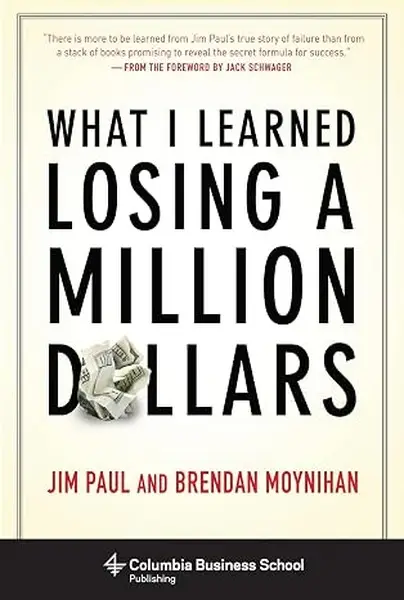
Every trading book on your shelf is about how to win. This is the only one built on the opposite premise: that winning is unteachable and losing is not.
Jim Paul made it from rural Kentucky to the board of the Chicago Mercantile Exchange. He was a governor of the exchange and an executive at Morgan Stanley. Then, over roughly seventy-five days in 1983, he lost about $1.6 million in soybean oil futures. Most of it was his. Some of it was borrowed from friends. He was fired.
What he did next is why the book exists. He did not write a redemption story. He went looking for the reason, read every trading book he could find, and noticed something that should have been obvious and somehow was not: the successful traders all contradicted each other. Fundamentalists and technicians. Long-term and intraday. Discretionary and systematic. Every one of them profitable, every one of them convinced their way was the way.
The losers, though, all sounded identical. That asymmetry is the entire book, and it is the sharpest single idea in trading literature.
At a Glance
| Author | Jim Paul and Brendan Moynihan |
| First Published | 1994, reissued by Columbia Business School Publishing in 2013 |
| Pages | ~230 |
| Genre | Trading psychology, memoir |
| Difficulty | Beginner-friendly — half memoir, half analysis, no maths |
| Best For | Any trader who has just had their best month, and any trader who has just had their worst |
| Skip If | You want setups. There is not a single chart in the book. |
OVERALL RATING: 9.0 / 10
Who Should Read This Book
| Reader | Verdict | Why |
|---|---|---|
| New trader (0–1 year) | Read it early | It inoculates you against the story you are about to tell yourself after your first good run |
| Intermediate (1–3 years) | Read it now | This is the window where traders confuse a bull market for talent. Paul did exactly that. |
| Advanced / professional | Re-read after every winning streak | The book’s warning fires during success, not failure. That is when you cannot hear it. |
| Prop firm / funded trader | Required reading | Every blown challenge is a version of this book compressed into a fortnight |
| Algo / quant trader | Read for the taxonomy | The betting / gambling / speculating / investing / trading distinction is worth the price alone |
| Anyone holding a loser right now | Read it before you average down | Paul names the exact mental move you are about to make, and where it ends |
The Book in Context
The book first appeared in 1994 and quietly went out of print. For years it circulated as a cult object, passed between traders, changing hands on the secondhand market for absurd prices. Columbia Business School Publishing reissued it in 2013 with a foreword by Jack Schwager, and it found the audience it should have had two decades earlier.
Brendan Moynihan, Paul’s co-author, is the reason the book is not just a war story. Paul supplied the wreckage. Moynihan supplied the structure that turns it into an argument. The result is a book in two halves that read almost like different genres, and the join between them is where the value sits.
Its position in the canon is unusual. Trading in the Zone tells you what to believe. Market Wizards shows you what winners have in common. This book does the thing neither attempts: it takes one specific, well-documented catastrophe and dissects it until the mechanism is visible.
The Core Argument: Study Loss, Because Success Has No Pattern
Paul’s central claim is a piece of clean logic that almost nobody in trading education has been willing to follow to its conclusion.
There are countless ways to make money in markets, and they contradict each other. A trend follower and a mean-reversion trader are running opposite logic and both can be profitable. A value investor holding for years and a scalper holding for seconds are doing incompatible things and both can be right. If you try to extract “the way to win” from the population of winners, you get noise, because success is idiosyncratic.
Losing is different. The ways to lose money are finite, and they repeat. Every blow-up runs through the same short list of mental errors regardless of market, instrument, era, or account size. Loss is uniform. Which means loss is the only part of this business that can actually be taught.
So Paul stops asking how to make money and starts asking how not to lose it. The book is the answer to the second question, and it turns out the second question is the useful one, because if you subtract the finite list of ways to lose, whatever remains is a positive expectancy.
Winners have nothing in common. Losers are all the same person.
— The book’s argument, compressed
The Five Stages of Loss
The book’s most-cited artefact is its adaptation of Elisabeth Kübler-Ross’s stages of grief to a losing position. Paul’s insight is that a trader in a bad trade is not making a series of bad decisions. He is grieving, and grief has a script. Once you see the script, you can see yourself reading from it.
The Five Stages, Applied to a Losing Trade
| # | Stage | What It Sounds Like at the Screen |
|---|---|---|
| 1 | Denial | “It’s just noise. The level is still valid. I’ll give it room.” |
| 2 | Anger | “They hunted my stop. This market is rigged. Whoever’s on the other side is an idiot.” |
| 3 | Bargaining | “Just get me back to breakeven and I’m out. I’ll never do this again.” |
| 4 | Depression | “I’m not built for this. I’ve never been any good at it.” |
| 5 | Acceptance | “It’s gone.” Arrives after the money does, which is the whole problem. |
The stages are not the error. Running the stages instead of running your stop is the error.
The uncomfortable part is stage three. Bargaining is where the account dies, because bargaining is the stage that generates activity. Averaging down is bargaining with a position size attached. Widening a stop is bargaining with a chart attached. Turning a day trade into a swing trade, then into a long-term hold, is bargaining with a timeframe attached. In every case the trader is not analysing. He is negotiating with a market that is not listening.
The Distinction Almost Nobody Makes
Before the stages, Paul does something more fundamental. He separates the five activities that everyone in markets treats as interchangeable and shows that mixing them is how positions get out of control.
| Activity | The defining feature |
|---|---|
| Betting | A stake on an outcome you have no influence over and no way to exit |
| Gambling | Betting, plus entertainment as part of the motive |
| Speculating | A position taken on price movement, with a defined exit |
| Investing | Ownership of an asset for income or long-horizon appreciation |
| Trading | Repeated, short-horizon speculation treated as a business process |
The point is not taxonomy for its own sake. The point is that the activity is defined at entry, and changing it midstream is always a loss-avoidance move dressed as a strategy change. The trader who says “I’m just going to hold this as a long-term investment now” has not become an investor. He has become a bettor, because he has removed his exit. The label changed. The risk did not.
Every trader reading this has done it. That is why the section lands.
How Paul and Moynihan Built the Book
The book’s structure is doing more work than it appears to. Three choices give it a durability that most trading memoirs never reach.
The story first, the theory second. Part one is Paul’s rise and detonation, told straight and at pace. Part two is the analysis. This ordering matters. By the time Moynihan starts explaining the mechanism, you have already watched it operate on a specific human being with a name and a family and a seat on the exchange. The theory arrives with a body attached. Most psychology books ask you to accept the abstraction first and supply your own examples. This one refuses to let you stay abstract.
The author is the specimen. Paul is not writing about traders who blow up. He is the exhibit. There is no distance and no defensiveness. He shows himself borrowing money from friends to hold a position that was already dead, and he does not soften it. That absence of self-protection is rare enough that it functions as evidence in its own right.
A negative thesis, held to the end. The book never tells you how to make money, and it is disciplined about it. That restraint is the reason it has aged so well. Every book that told you how to make money in 1994 is now a period piece. This one is not, because the mechanism it describes is a property of people, not of markets.
Five Ideas Worth Carrying With You
Five of the book’s load-bearing ideas, stated plainly, each with a 2026 reading.
Losing money is not the problem. Personalising the loss is the problem.
The distinction the whole book turns on. A loss is an event. It costs what it costs and then it is over. But the moment the position becomes a statement about whether you are clever, the loss stops being an event and becomes a threat to your identity, and identity does not have a stop loss. This is why traders who cheerfully accept a planned loss will fight a loss that arrived after they told someone about the trade.
Paul made his early fortune by luck and filed it under skill.
He was in the right pit in the right market at the right time, and the money that arrived felt like a verdict on him rather than on the conditions. The account grew, and so did the certainty, and the certainty is what he was actually risking by 1983. Any trader whose first eighteen months coincided with a trending market has run this exact experiment and does not know it yet.
Decide what you are doing before you do it, then do not redefine it.
A speculation has an exit. Once you remove the exit, you are betting, whatever you call it. The most expensive sentence in trading is “I’ll just hold it long term,” because it converts a bounded risk into an unbounded one using nothing but vocabulary. Write down which of the five activities each position is, at entry, and the reclassification becomes visible the moment you attempt it.
You cannot copy winners, because winners disagree with each other.
This is quietly devastating for the entire trading education industry, this site included. Every profitable trader you follow is describing a method that works for them, in their market, at their temperament, and half of them are running logic that directly contradicts the other half. The only transferable knowledge in the whole field is the list of ways to lose. Everything else you have to derive yourself.
The crowd is not outside you. You are capable of being a crowd of one.
Paul’s treatment of crowd behaviour is the book’s most underrated stretch. He argues that the psychological state of a mob, the loss of individual judgement, the emotional contagion, the abandonment of prior rules, can be produced inside a single trader sitting alone at a desk. You do not need other people to stampede. You only need a position and enough time.
What the Book Tells You to Do (and Why Most Readers Skip It)
The instruction is almost insultingly simple, and it is the reason readers close the book feeling profound and change nothing.
Decide the exit before the entry. Not the target, the exit. Define, in advance and in writing, the price or condition at which the position is wrong and therefore over. Then treat that decision as having been made by someone else, someone who was calm, who had no money on the line, and who is no longer available for consultation.
That is it. That is the entire prescription. It is unglamorous, it is what every risk chapter in every book says, and it does not work for most people, which is precisely Paul’s point. The rule is not the hard part. The hard part is that the person who set the rule and the person being asked to obey it are in different emotional states, and the second one always thinks he has new information. He does not. He has a loss.
The deeper instruction, the one that actually costs something, is the second half: separate the money from the self. Stop reporting your trades to other people. Stop building an identity out of a P&L curve. Stop letting a position mean anything about your intelligence. Paul lost $1.6 million because the soybean oil trade had stopped being a trade and had become a referendum on whether Jim Paul was the man he thought he was. No stop loss protects against that. Only structure does.
Common Misreadings of the Book
Misreading #1: “It’s a cautionary tale”
It is not, and reading it that way is how you extract nothing from it. A cautionary tale positions you as the observer and the subject as the fool. That framing is a defence mechanism. The book only works if you read part one as autobiography rather than as someone else’s disaster, and the tell is simple: if you finished the soybean oil chapters thinking “I would never,” you did not read it, you watched it.
Misreading #2: “The lesson is to cut your losses”
Everyone already knows to cut losses. Paul knew to cut losses. He was a governor of the Chicago Mercantile Exchange, and he did not cut the loss. The book is not arguing that you lack the information. It is arguing that the information is irrelevant once the position has been personalised, because at that point you are not managing a trade, you are defending a self-image. Reducing the book to “cut your losses” is like reducing a book on addiction to “drink less.”
Misreading #3: “It has no practical value because it teaches nothing about making money”
This is the objection Paul anticipated and pre-emptively destroyed. If the ways to lose are finite and the ways to win are infinite and contradictory, then removing the losses is the only systematic intervention available. A method with a positive edge and an unmanaged psychology produces a blown account. The same method with the losses controlled produces a business. The book targets the only variable you can actually operate on.
Misreading #4: “This applies to big-money traders, not to my small account”
The mechanism is scale-invariant. A funded trader torching a $50,000 challenge over a long weekend is running an identical process to Paul in 1983, in the same order, with the same internal dialogue, and usually faster. The zeroes change. The five stages do not. If anything the small account is more exposed, because the small account is more likely to be carrying the trader’s hopes about escaping his job, which is exactly the personalisation Paul is warning about.
Misreading #5: “I’ve never lost a million dollars, so this isn’t about me”
The amount is not the subject. The amount is the marketing. Paul’s loss is large enough to command attention and specific enough to be documented, but the book is about a process that runs identically at every size, and most traders execute it dozens of times a year in miniature. You have run the five stages this month. You just did not lose enough for it to register as an event worth examining.
Where the Book Falls Short
An honest review names the weaknesses.
- The two halves are tonally mismatched. Part one is propulsive narrative. Part two is closer to a lecture, and the prose stiffens noticeably. Readers who came for the story often stall in the analysis, which is where the actual content lives.
- The Kübler-Ross framework is borrowed, not tested. The five stages map onto trading beautifully as a descriptive device, but the underlying grief model has been substantially challenged in psychology since. The metaphor earns its place. It is not evidence.
- No engagement with position sizing. For a book about loss, there is remarkably little on the arithmetic of loss. Risk of ruin, expectancy, and sizing are effectively absent. Tharp owns that territory and Paul does not enter it.
- The taxonomy section can read as pedantry. The betting / gambling / speculating / investing / trading breakdown is one of the book’s best ideas, and it is delivered in its driest register. Many readers skim exactly the pages they most needed.
- It is a single case study. One trader, one market, one era, one detonation. The argument that loss is uniform is asserted persuasively rather than demonstrated across a sample. You either find the mechanism recognisable or you do not.
- Nothing on the modern context. Written before online retail broking, before prop firm challenges, before 24/7 crypto and mobile trading apps engineered to trigger exactly the impulses Paul describes. The principles port completely. The environment they now operate in is far more hostile than anything in the book.
How the Book Fits the Mind · Method · Money Framework
This is a Mind-pillar book that keeps reaching into Money and deliberately refuses to touch Method.
| Pillar | Contribution | What the Book Delivers |
|---|---|---|
| MIND | PRIMARY | Personalising the loss, the five stages, the crowd of one, ego as the true position, success attributed to skill when it was luck |
| METHOD | ABSENT BY DESIGN | Argues explicitly that method cannot be transferred, since profitable methods contradict each other. Not a gap. A thesis. |
| MONEY | SECONDARY | The exit-before-entry rule and the five-activity taxonomy are risk architecture, but the arithmetic of sizing is missing |
If you have read The Complete Trader’s Edge, this book is the case file behind the Mind pillar. We argue that the trader is the variable. Paul is what happens when nobody checks that variable for twenty successful years, and the reason his story belongs in every trader’s education is that he was not careless, not lazy, and not stupid. He was accomplished, and the accomplishment was the delivery mechanism. Read it alongside the Mind · Method · Money framework and the complete guide to trading psychology.
Read This Instead Of / Read This After
| Relationship | Book | Why |
|---|---|---|
| Read before | Trading in the Zone | Paul shows you the disease. Douglas gives you the treatment. In that order the treatment actually lands, because you have seen what it is for. |
| Read alongside | Reminiscences of a Stock Operator | Livermore ran the same process to the same end, ninety years earlier and repeatedly. Two independent detonations, one mechanism. |
| Read after | Fooled by Randomness by Nassim Taleb | Taleb supplies the statistical argument for why Paul mistook luck for skill. Paul supplies the corpse Taleb is describing. |
| Read after | When Genius Failed by Roger Lowenstein | The same story at institutional scale, with Nobel laureates instead of one Kentucky trader. Identical stages, four billion dollars. |
| Read instead of | Any “how I made millions” trading memoir | Those books are the exact survivorship bias Paul spent a decade dismantling. This one is the antidote to the genre it belongs to. |
Final Verdict: Should You Read This Book in 2026?
Yes, and read it on the way up rather than on the way down.
Most traders find this book in the wreckage, which is the wrong time. Read after a blow-up it is consoling and largely useless, because by then the lesson has already been purchased at full price. Read during a winning streak it is almost unbearable, and that is when it does its work. The book is a warning about competence, not incompetence. Paul was not a novice who got unlucky. He was a professional at the top of his exchange, and the twenty good years were the setup.
The rating reflects a book that does one thing and does it better than anything else in the literature. It is the only serious treatment of the failure side of trading written from the inside by someone with nothing left to protect. It will not give you an edge. It will tell you, in unsparing detail, exactly how you are going to lose the one you have.
Ten hours of reading against the cost of learning this the way Paul did. That is not a close call.
CTE Rating Breakdown
9.0/10
Essential Reading
| Readability | 9 | |
| Actionability | 8 | |
| Timelessness | 10 | |
| Beginner-Friendly | 9 | |
| Modern Relevance | 9 |
Frequently Asked Questions
What is What I Learned Losing a Million Dollars actually about?
It argues that the ways to make money in markets are infinite and contradictory, while the ways to lose money are finite and identical. Therefore loss is the only teachable part of trading. The book uses Jim Paul’s own $1.6 million loss in soybean oil futures as the case study and dissects the psychology that produced it.
Who was Jim Paul?
A trader who rose from rural Kentucky to become a governor of the Chicago Mercantile Exchange and an executive at Morgan Stanley. He lost roughly $1.6 million over about seventy-five days in 1983 and was fired. The book is his attempt to understand why, written with co-author Brendan Moynihan.
Is it still relevant in 2026?
More than when it was written. The mechanism it describes is a property of human psychology, not of 1980s futures markets, and the modern environment of prop firm challenges, mobile apps, 24/7 crypto and public P&L on social media is engineered to trigger exactly the personalisation Paul warns about.
Is the book good for complete beginners?
Yes. There is no maths, no charts, and no jargon. The first half reads as narrative. A beginner will understand every page. Whether a beginner can act on it is a different question, since the book’s warning is aimed at the confidence that success produces, and beginners have not yet had the success.
How long does it take to read?
Around 230 pages, roughly 6 to 8 hours. The first half moves quickly. The second half is slower and denser and is where the actual content is, so budget more time than the page count suggests.
What are the five stages of loss?
Denial, anger, bargaining, depression and acceptance, adapted from Elisabeth Kübler-Ross’s stages of grief and applied to a losing position. Paul’s argument is that a trader in a bad trade is not analysing, he is grieving, and the bargaining stage is where accounts die because bargaining is the stage that generates activity such as averaging down and widening stops.
What is the difference between betting, gambling, speculating, investing and trading?
Paul defines them by structure rather than by asset. Betting is a stake with no exit. Gambling is betting with entertainment attached. Speculating is a position on price movement with a defined exit. Investing is ownership for income or long-horizon appreciation. Trading is repeated speculation run as a business. His point is that switching category mid-position is always loss avoidance dressed as strategy.
Why was the book out of print for so long?
It was first published in 1994 and went out of print, circulating as a cult title among traders and reselling at high prices. Columbia Business School Publishing reissued it in 2013 with a foreword by Jack Schwager, which is the edition most readers now own.
Does the book teach any trading strategy?
None at all, and deliberately. Paul’s thesis is that strategy cannot be transferred, since profitable traders run contradictory methods. He restricts himself entirely to the failure side, which he argues is the only genuinely transferable knowledge in the field.
What is the single most important takeaway from the book?
That losing money is survivable and personalising the loss is not. Once a position becomes a statement about who you are, you have removed your own stop loss, because identity does not have one. Everything else in the book supports that single point.
About the Authors
Jim Paul and Brendan Moynihan
Jim Paul grew up in rural Kentucky and worked his way onto the floor of the Chicago Mercantile Exchange, eventually serving as a governor of the exchange and holding an executive position at Morgan Stanley. In 1983 he lost approximately $1.6 million trading soybean oil futures over roughly seventy-five days, including money borrowed from friends, and lost his job. Rather than attempt a comeback narrative, he spent years studying why he had failed, and the conclusion he reached became this book.
Brendan Moynihan is a writer and editor who has worked across financial journalism and publishing, and is the co-author who gave Paul’s story its analytical structure. The book’s two-part architecture, narrative followed by dissection, is what separates it from the memoir genre it superficially resembles.
The 2013 Columbia Business School Publishing reissue carries a foreword by Jack Schwager, author of the Market Wizards series, whose own work on successful traders sits in direct and deliberate contrast to Paul’s thesis.
Continue Learning
- The Three Pillars: Mind, Method, Money
- Trading Psychology: The Complete Guide
- Trading in the Zone Book Review (2026)
- Reminiscences of a Stock Operator Book Review (2026)
- The Top Trading Books Explorer
- The Complete Trader’s Edge — The Book
 The Complete Trader's Edge
The full Mind · Method · Money framework. 70 chapters.
View on Amazon →
The Complete Trader's Edge
The full Mind · Method · Money framework. 70 chapters.
View on Amazon →
 Market Mayhem
400 years of bubbles, crashes, and the pattern that keeps repeating.
Buy on Amazon →
Market Mayhem
400 years of bubbles, crashes, and the pattern that keeps repeating.
Buy on Amazon →
 Greatest Companies
How the world's greatest companies were built — and what traders learn from them.
View on Amazon →
Greatest Companies
How the world's greatest companies were built — and what traders learn from them.
View on Amazon →
 Greatest Traders
Eighty-six lives that explain the markets — Livermore to Madoff, told with the losses left in.
View on Amazon →
Greatest Traders
Eighty-six lives that explain the markets — Livermore to Madoff, told with the losses left in.
View on Amazon →