

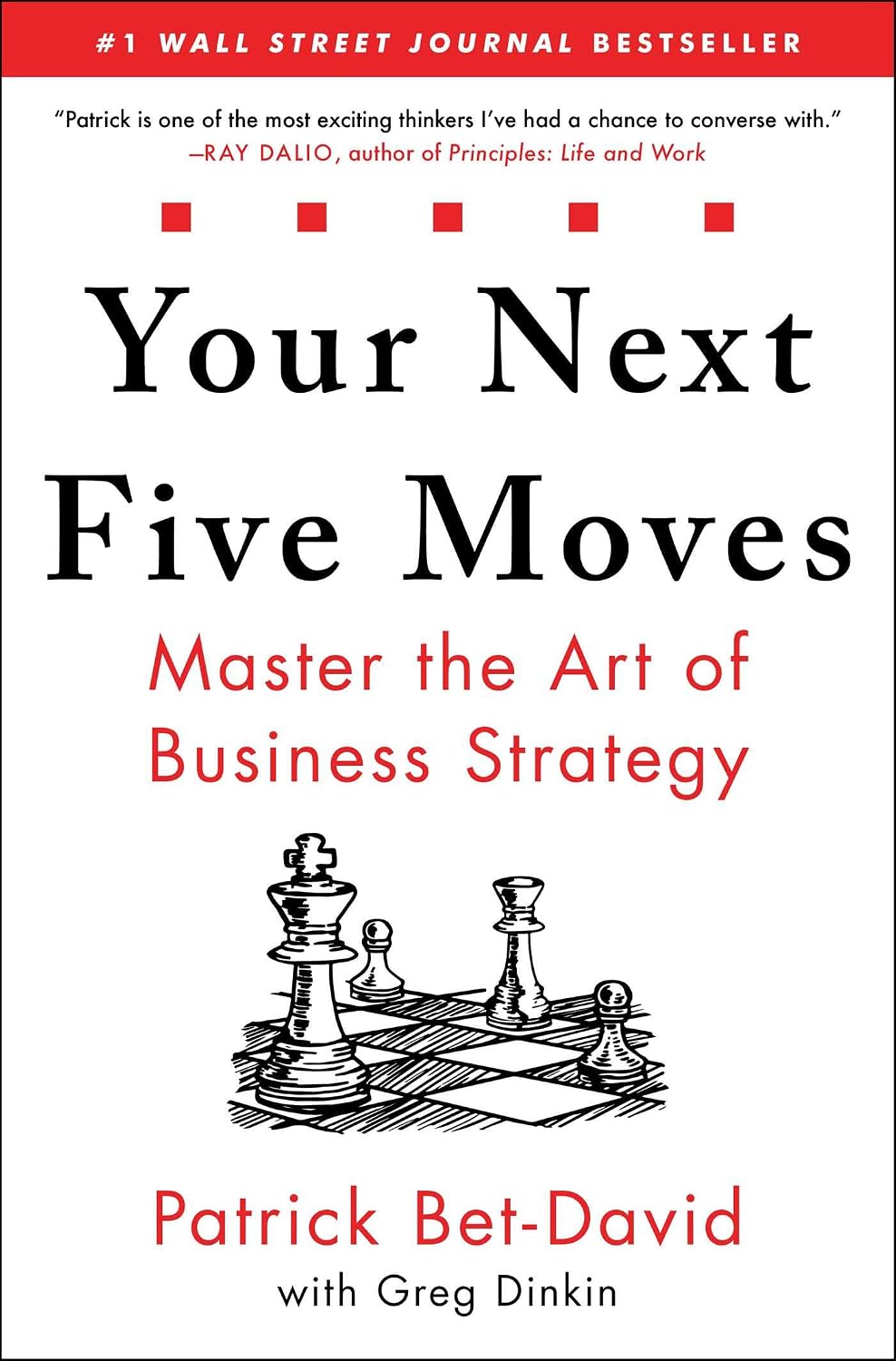
Most traders think one move ahead. They see a setup, take the trade, and react to whatever happens next. Patrick Bet-David would say they are playing checkers in a chess game. His book Your Next Five Moves is built on a single premise: the person who thinks further ahead wins. Not because they can predict the future, but because they have prepared for more outcomes than their opponent.
| Key Concept | Original Context | Trading Translation |
|---|---|---|
| Think five moves ahead | Chess-like strategic thinking for every decision | Before entering: what if it hits target? What if stopped? What is my next trade in each scenario? Plan the sequence. |
| Know yourself | Self-awareness determines which strategies align with your personality | Are you patient (swing) or intense (day trading)? Your style must match your psychology, not your aspirations. |
| Master one thing | Specialists outperform generalists in competitive fields | Master one setup on one instrument in one Kill Zone. Expand only after consistent profitability. |
| Speed of trust | Trust in your system accelerates execution and reduces hesitation | Backtested data builds trust. Trust enables faster execution. Faster execution captures better fills. |
PBD, as he is known to his millions of Valuetainment followers, is an Iranian-born entrepreneur who fled revolution as a child, served in the US military, and built a financial services empire worth hundreds of millions. His approach combines strategic thinking with direct, no-excuses execution. He does not deal in vague motivational platitudes. He deals in frameworks, decision trees, and the ruthless prioritisation of what actually moves the needle.
For traders, PBD’s strategic thinking framework addresses a gap that most trading education ignores: the ability to think beyond the current trade and see how today’s decisions compound into tomorrow’s position. This is not about predicting markets. It is about building a trading career with the same strategic rigour that a chess grandmaster applies to a game or a CEO applies to a business.
Written for founders rather than traders, but the self-audit and five-move planning transfer directly.
Your Next Five Moves: Strategic Trading Planning
PBD’s framework asks: before you make any decision, think five moves ahead. What is the immediate action? What are the likely consequences? What will you do in response to each consequence? And then what?
Applied to a single trade, this looks like:
Move 1: I enter the trade at my level with 1% risk and a 1:3 R target.
Move 2: If price moves to 1R in my favour, I move my stop to breakeven.
Move 3: If price reaches 2R, I take partial profit (50%) and trail the rest.
Move 4: If the trade gets stopped at breakeven after partial, I am up 1.5R net and I move to the next setup.
Move 5: If price hits my full 3R target, I close, journal, and assess whether the session is complete.
Now compare this to how most traders operate: they enter the trade and then make every subsequent decision reactively, based on whatever emotion the price action triggers. PBD’s framework pre-decides the responses so that the live session requires execution, not improvisation.
Applied to a trading career, the five moves become longer-term:
Move 1: Spend six months learning and paper trading a single methodology.
Move 2: Go live with minimum size for six months, focusing on execution quality.
Move 3: If execution is consistent, increase size incrementally over the next year.
Move 4: Once averaging 3-5% monthly for twelve consecutive months, evaluate full-time transition.
Move 5: Build the capital base, diversify income (teaching, content, affiliate revenue), and create the lifestyle the trading supports.
The trader who has mapped their five moves does not panic during a drawdown in Move 2 because they know it is part of the plan. They do not quit after a bad month because the month exists within a multi-year trajectory. Strategic planning converts anxiety into patience because every current experience has already been anticipated.
Know Thyself: The Self-Audit
PBD’s first “move” in any strategic process is a ruthless self-audit. Before you can plan where you are going, you must know exactly where you are. Not where you wish you were. Not where you tell people you are. Where you actually are.
For traders, the self-audit means answering these questions with brutal honesty:
What is my actual win rate over the last 100 trades? What is my actual risk-reward ratio? What is my actual expectancy per trade? How many times did I break my rules last month? What is my actual maximum drawdown? How many hours per week do I actually spend on deliberate trading education versus passive screen time?
Most traders cannot answer these questions because they do not track the data. PBD would say: you are operating a business with no financial statements. No business succeeds without knowing its numbers. No trader succeeds without knowing theirs. The trading journal is your financial statement. If it is incomplete, your strategic planning is built on fantasy rather than data.
The “Processing Speed” Concept
PBD teaches that strategic advantage comes from processing speed: the ability to gather information, analyse it, and make decisions faster and more accurately than your competition. In business, this means the CEO who spots a market shift and pivots first wins. In chess, the grandmaster who sees the implications of a move faster gains an advantage.
In trading, processing speed is the ability to read market structure, identify your setup, confirm it against your criteria, and execute, all within the window that the setup provides. This is not about reaction time. It is about preparation quality. The trader who has done thorough pre-session work and knows exactly what they are looking for processes the live market faster because they are pattern-matching against a prepared template rather than analysing from scratch.
PBD would connect this to the Brian Tracy principle of doing the hard work first: the preparation is what creates the processing speed that the live session demands.
The Operator vs. Owner Mindset
PBD distinguishes between operators (people who work in their business) and owners (people who work on their business). Most traders are pure operators: they execute trades, manage positions, and react to markets. Very few are owners: people who step back, analyse their overall operation, optimise their systems, and build a trading practice that improves structurally over time.
The owner mindset means: scheduling weekly reviews that evaluate not just trades but the entire trading operation. Are the pre-session routines working? Is the journal capturing the right data? Is the risk management actually being followed? Are the right setups being prioritised? Is the trading schedule sustainable? Is there a plan for scaling the account?
The trader who only operates will plateau at whatever level their current skills support. The trader who also owns will systematically identify bottlenecks, remove them, and build a practice that compounds in capability over time. This is trading as a business in its most strategic form.
Bet-David and the Mind · Method · Money Framework
Mind: PBD’s self-audit and five-move thinking replace reactive emotion with strategic planning. The trader who has mapped their next five moves does not panic during adversity because adversity was anticipated. His processing speed concept connects preparation quality to execution quality, reinforcing the discipline of pre-session routines.
Method: The five-move framework applied to individual trades creates complete if-then decision trees that eliminate the need for real-time improvisation. This is Jocko’s decentralised command expressed as strategic planning: the plan is made before the session, and the session is pure execution.
Money: The operator-versus-owner distinction ensures that risk management and capital allocation are reviewed systematically rather than managed reactively. The owner mindset treats drawdowns as operational data, not emotional events, and builds structural improvements that prevent recurring mistakes.
Continue Reading: The Inner Edge
▶ Alex Hormozi: The $100M Framework for Traders
▶ Jocko Willink: Extreme Ownership for Traders
▶ Tim Ferriss: The 80/20 Principle for Traders
The Complete Trader’s Edge
This article is part of The Inner Edge series. The psychology principles explored here are covered in depth across the 22 chapters of the Mind pillar in The Complete Trader’s Edge.
Frequently Asked Questions
How does “Your Next Five Moves” apply to trading?
PBD’s framework pre-plans responses to every likely outcome before execution. For a single trade: entry, breakeven move, partial profit, trail, and final exit are all decided before the trade is placed. For a career: learning phase, live minimum-size phase, scaling phase, consistency phase, and lifestyle design phase are all mapped in advance. This eliminates reactive decision-making under pressure.
What is the self-audit for traders?
A brutal, data-driven assessment of where you actually are: real win rate, real expectancy, real rule adherence, real drawdown numbers. Most traders operate on assumptions about their performance rather than measured reality. The self-audit, conducted through journal analysis, reveals the truth that strategic improvement requires.
What is processing speed in trading?
Processing speed is the ability to recognise setups and execute decisions quickly and accurately during live sessions. It is not about fast reactions; it is about thorough preparation. The trader who has marked levels, determined bias, and defined exact setups before the session processes live price action faster because they are pattern-matching against a prepared template.
What is the difference between operator and owner mindset in trading?
The operator works in the trading (executing trades, managing positions). The owner works on the trading (reviewing systems, optimising routines, analysing performance data, building structural improvements). Most traders are pure operators who plateau. Adding the owner mindset creates systematic improvement that compounds over time.
How does strategic thinking prevent emotional trading?
When every likely scenario has been anticipated and planned for, the emotional charge of live events diminishes dramatically. A losing trade is not a shock because it was one of the pre-planned outcomes. A drawdown is not a crisis because it was mapped in the five-move career plan. Strategic thinking converts surprise into expectation, and expectation is calm where surprise is reactive.
 The Complete Trader's Edge
The full Mind · Method · Money framework. 70 chapters.
View on Amazon →
The Complete Trader's Edge
The full Mind · Method · Money framework. 70 chapters.
View on Amazon →
 Market Mayhem
400 years of bubbles, crashes, and the pattern that keeps repeating.
Buy on Amazon →
Market Mayhem
400 years of bubbles, crashes, and the pattern that keeps repeating.
Buy on Amazon →
 Greatest Companies
How the world's greatest companies were built — and what traders learn from them.
View on Amazon →
Greatest Companies
How the world's greatest companies were built — and what traders learn from them.
View on Amazon →