

Order blocks are one of the most important concepts in the ICT methodology and the broader Smart Money framework. They represent areas where large institutional orders were placed — and because institutions often return to these levels to add to their positions, order blocks create some of the highest-probability trading setups available to the retail trader.
What Is an Order Block?
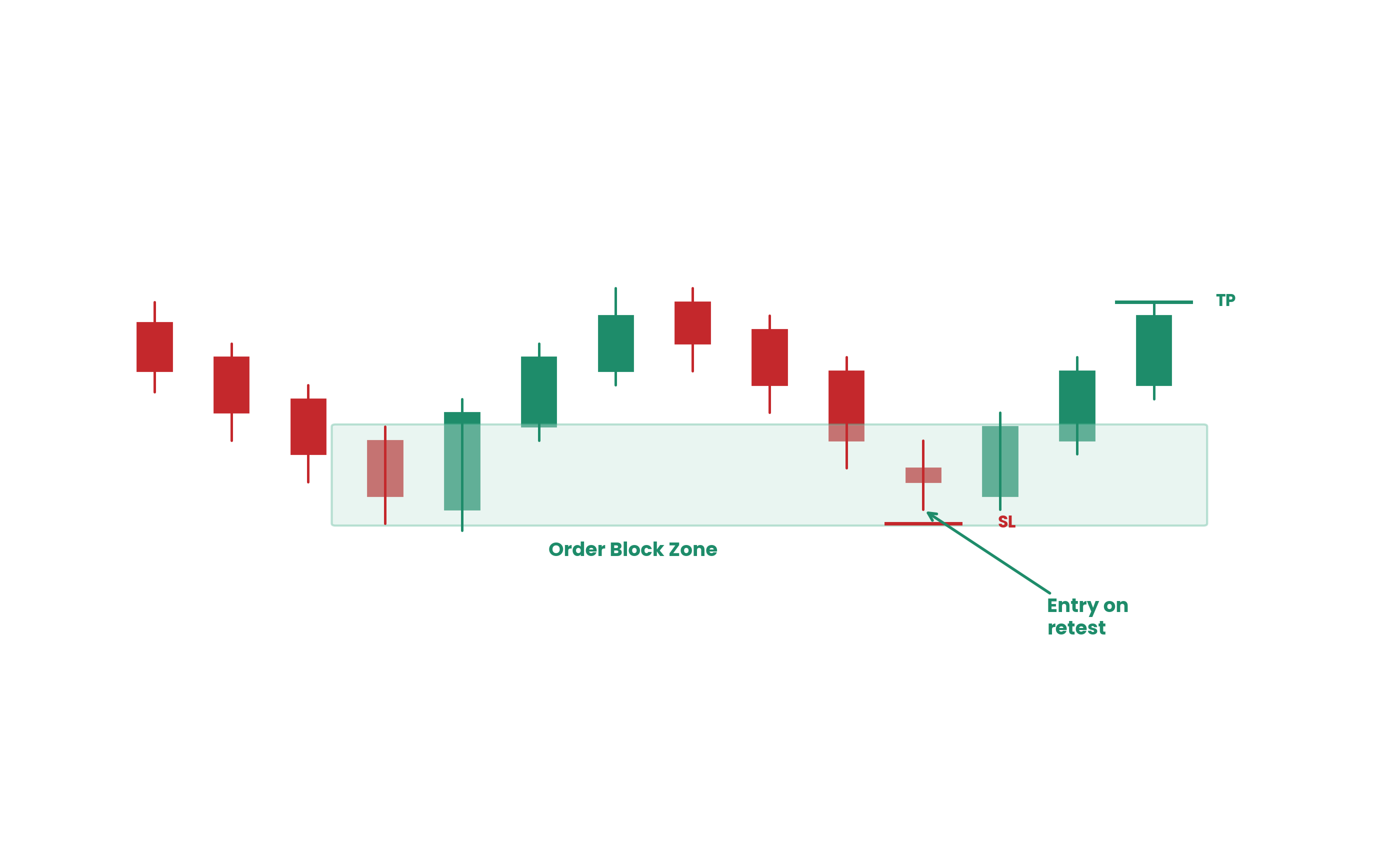
An order block is the last opposing candle before a significant, impulsive move in price. When a bank or large institution needs to build a large position, they cannot simply enter all at once — the size of their order would move the market against them. Instead, they accumulate their position over time, leaving behind a footprint in the chart in the form of an order block.
When price returns to the order block level, the institution often re-enters to add to their existing position — which is why order blocks act as powerful support and resistance zones.
How to Identify a Bullish Order Block
- Look for a significant bullish move — a strong, impulsive rally with momentum.
- Find the last bearish candle before that rally began. This is the potential order block.
- The order block zone is typically the body of that last bearish candle (open to close).
- When price retraces back into this zone, it becomes a high-probability long entry.
How to Identify a Bearish Order Block
- Find a significant bearish move — a strong, impulsive sell-off.
- Identify the last bullish candle before that sell-off.
- The bearish order block zone is the body of that last bullish candle.
- When price rallies back into this zone, it becomes a high-probability short entry.
Confirmation Factors That Increase Probability
- Higher timeframe confluence — an order block coinciding with a daily or weekly support/resistance level is far more powerful.
- Fair Value Gap (FVG) within the order block — the presence of an imbalance within the order block zone increases its significance.
- Clean liquidity sweep before the return — when price sweeps a recent low before returning to a bullish order block, it suggests smart money has taken liquidity before the real move begins.
- Alignment with the higher timeframe trend — bullish order blocks in uptrends have higher probability than counter-trend trades.
Key Lessons
- An order block is the last opposing candle before a significant impulsive move — it represents where institutional orders were placed.
- Institutions return to order block levels to add to their positions, making them high-probability support/resistance zones.
- Bullish order blocks = last bearish candle before a bullish impulse. Bearish order blocks = last bullish candle before a bearish impulse.
- Higher timeframe confluence, FVG presence, and liquidity sweeps all increase probability.
Frequently Asked Questions
What is the difference between an order block and support/resistance?
Traditional support and resistance identifies where price reacted. Order blocks identify the specific candle where institutional orders were placed before an impulsive move that broke structure. Order blocks are a more precise, directional version of S/R with stricter qualifying criteria.
How many order blocks should I mark on my chart?
Focus on the 2 to 3 most significant OBs above and below current price on your intermediate timeframe. Remove any that have been tested and failed (mitigated). If your chart is covered in OB zones, you have not been selective enough.
Should I use the candle body or full range for the OB zone?
Use the candle body as the primary entry zone and the wicks as your stop loss buffer. The body is where the majority of orders were filled. For entries, look for reactions at the body. For stops, go beyond the wick.
What happens when an order block fails?
When price trades through an OB without a strong reaction, it becomes a breaker block that acts as a level in the opposite direction. The old bullish OB becomes bearish resistance (and vice versa). Failed OBs provide high-probability setups in the new direction.
Do order blocks work on all instruments?
Yes. Order blocks reflect institutional accumulation and distribution, which occurs in every liquid market: forex, Gold, BTC, indices, and stocks. The patterns are most reliable on instruments with high institutional participation and sufficient liquidity.
 The Complete Trader's Edge
The full Mind · Method · Money framework. 70 chapters.
View on Amazon →
The Complete Trader's Edge
The full Mind · Method · Money framework. 70 chapters.
View on Amazon →
 Market Mayhem
400 years of bubbles, crashes, and the pattern that keeps repeating.
Buy on Amazon →
Market Mayhem
400 years of bubbles, crashes, and the pattern that keeps repeating.
Buy on Amazon →