

You do not rise to the level of your goals. You fall to the level of your systems. That single sentence from James Clear’s Atomic Habits explains more about why traders fail than most trading psychology books ever manage. The trader who sets a goal to “become profitable this year” and the trader who builds a system of daily habits that make profitability inevitable are playing entirely different games.
Clear’s framework is built on a simple but powerful insight: outcomes are a lagging measure of habits. Your account balance is a lagging measure of your trading process. Your consistency is a lagging measure of your daily routines. If you want different results, you do not need a different strategy. You need different habits. And habits, as Clear demonstrates with extraordinary precision, can be engineered.
This article maps Clear’s core frameworks directly onto trading. Not as abstract motivation, but as a practical system for building the kind of discipline that separates professionals from everyone else.
Habit stacking, the two-minute rule and identity-based habits all come from Clear’s book. This article applies them to a trading routine.
Identity-Based Habits: The Trader You Believe You Are
Clear teaches that there are three layers of behaviour change. The outermost layer is outcomes: what you get. The middle layer is processes: what you do. The deepest layer is identity: what you believe about yourself. Most people try to change from the outside in. They set outcome goals (“I want to make $5,000 this month”) and hope the behaviour follows. Clear argues the opposite: lasting change works from the inside out. You decide who you want to be, then prove it to yourself with small wins.
| Key Concept | Original Context | Trading Translation |
|---|---|---|
| Definite major purpose | A clear, written goal with a deadline | Annual trading targets: monthly R goal, process adherence score, maximum drawdown limit. |
| Mastermind alliance | Surround yourself with people who elevate your thinking | Trading peers, accountability partners, and mentors who challenge your rationalisations. |
| Autosuggestion | Repeated affirmation reprograms the subconscious | Read your trading plan before every session. The rules become automatic through repetition. |
| Persistence through temporary defeat | Every failure contains the seed of equivalent success | Drawdowns are data, not verdicts. The journal reveals what the drawdown is teaching you. |
For traders, this distinction is transformative. The trader who says “I want to stop revenge trading” is focused on an outcome. The trader who says “I am the kind of trader who walks away after two consecutive losses” is building an identity. Every time they actually walk away, they cast a vote for that identity. Every vote strengthens the belief. The belief makes the next decision easier.
This is exactly what building your trader identity means in practice. You do not become disciplined by deciding to be disciplined. You become disciplined by performing disciplined actions, one at a time, until the evidence is overwhelming. Clear calls each action a “vote” for your desired identity. Enough votes, and the identity becomes self-reinforcing.
The Identity Question Every Trader Should Ask
Before your next trading session, ask yourself: “What would a professional, disciplined trader do right now?” Not “What setup looks good?” Not “How can I make back yesterday’s loss?” But: what would the trader I am becoming do in this exact situation?
If the answer is “wait for an A+ setup,” then wait. You just cast a vote. If the answer is “skip this session because the market is choppy,” then skip it. Another vote. Each vote is tiny. Each vote compounds.
The Four Laws of Behaviour Change Applied to Trading
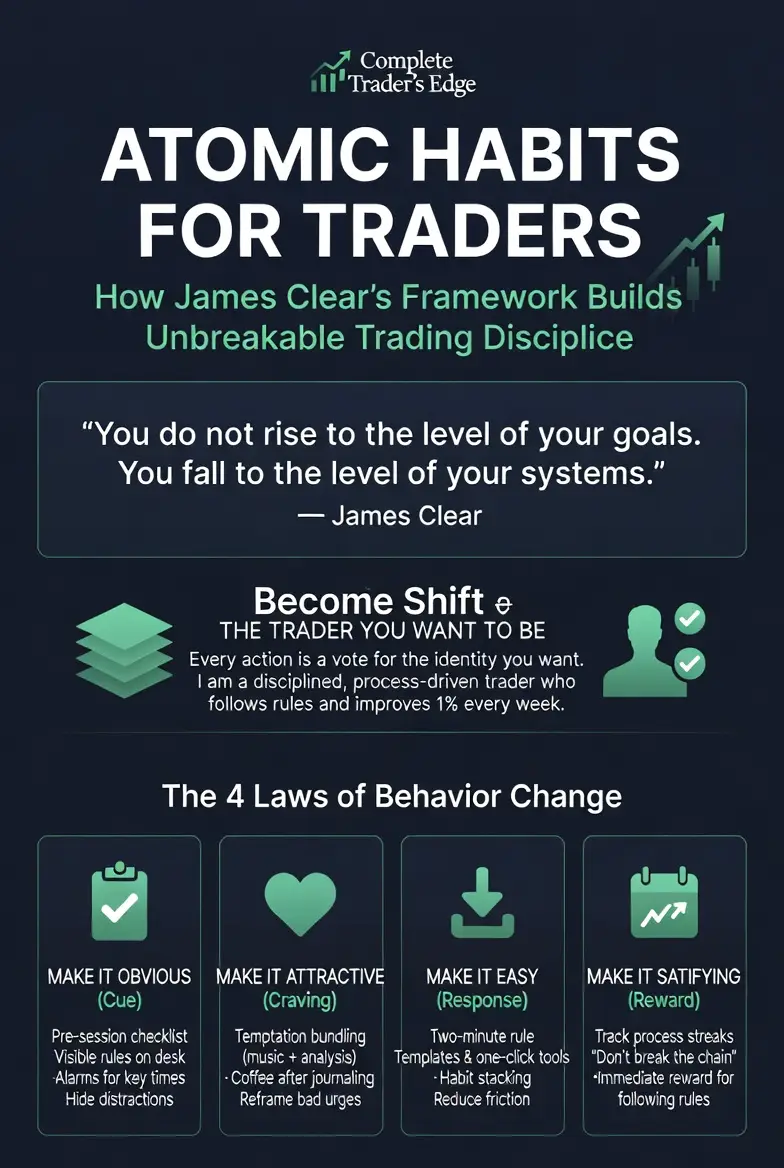
The core of Atomic Habits is Clear’s Four Laws of Behaviour Change. Every habit follows a loop: cue, craving, response, reward. To build a good habit, you make it obvious, attractive, easy, and satisfying. To break a bad one, you invert each law. This framework is devastatingly effective for trading habits.
Law 1: Make It Obvious (Cue)
For building good habits: Design your trading environment so the right behaviours are impossible to forget. Put your pre-session checklist on your desk where you cannot open your charts without seeing it. Set a phone alarm for 30 minutes before the London open labelled “Priming + Levels.” Write your maximum daily loss on a sticky note attached to your monitor.
For breaking bad habits: Make the cue invisible. If you overtrade during the Asian session, close your platform after New York close and do not reopen until your pre-session routine the next day. If checking P&L mid-trade causes you to cut winners early, hide the account balance from your platform view. Remove the cue, and the habit loses its trigger.
Law 2: Make It Attractive (Craving)
For building good habits: Clear introduces “temptation bundling,” pairing something you need to do with something you enjoy. Listen to your favourite music only during your pre-session analysis. Allow yourself a good coffee only after completing your trading journal entry. Pair the discipline with a reward, and the discipline becomes something you look forward to.
For breaking bad habits: Reframe the craving. The urge to revenge trade feels like “I need to win this back.” Reframe it: “This urge is my brain trying to destroy my account. Recognising it means I am already ahead of 90% of traders.” The same craving, reframed, becomes evidence of professional awareness rather than a command to act.
Law 3: Make It Easy (Response)
For building good habits: Reduce friction. Create a pre-session template that takes two minutes to fill in rather than twenty. Use a one-click position size calculator rather than doing the maths manually. Save your key level markups as chart templates so preparation takes five minutes instead of thirty. The easier the habit, the more likely you perform it on the days when motivation is low.
For breaking bad habits: Add friction. If you overtrade, require yourself to write a full justification paragraph before any trade that was not in your pre-session plan. If you move stops, set your stop loss and then physically leave the room for ten minutes. The two-minute rule works in reverse: make the bad habit take enough effort that the impulse fades before you complete it.
Law 4: Make It Satisfying (Reward)
For building good habits: Track your process streaks, not your P&L. Mark a calendar with an X for every day you followed your rules perfectly, regardless of whether you made or lost money. Clear calls this “don’t break the chain,” and the visual streak becomes its own reward. After 20 consecutive X’s, the thought of breaking the chain hurts more than any single trade.
For breaking bad habits: Make the bad habit immediately painful. Set a rule: every time you deviate from your plan, you donate $50 to a cause you dislike. Or you must sit out the next trading session entirely. The immediate cost makes the impulsive behaviour less attractive than the temporary emotional relief it provides.
The 1% Rule: Compounding Improvement in Trading
Clear’s most famous concept is that getting 1% better each day leads to being 37 times better after one year. The maths is real, but the principle matters more than the number: small, consistent improvements compound into extraordinary results over time.
For traders, this reframes the entire development journey. You do not need to transform your trading overnight. You need to improve one small thing this week. This week, maybe you refine your entry criteria by adding one confluence filter. Next week, you improve your journal template to track emotional state. The week after, you tighten your pre-session routine by five minutes.
None of these changes will show up in your P&L this month. All of them will show up in your P&L this year. This is why consistency beats intensity every time. The trader who improves 1% per week for a year is unrecognisable compared to the trader who tries to overhaul everything in January and burns out by March.
The Plateau of Latent Potential
Clear describes the “Plateau of Latent Potential,” the frustrating period where you are doing everything right but results have not caught up yet. This maps directly to the trading learning curve. You might journal for three months, follow your rules for 50 trades, refine your process weekly, and still not see improvement in your equity curve.
This is normal. Clear compares it to ice melting: the temperature rises from 25 degrees to 31 degrees and nothing visible happens. Then at 32 degrees, everything changes. The work was not wasted. It was being stored. Most traders quit at 31 degrees, one degree away from the breakthrough, because they cannot see the progress accumulating beneath the surface.
This is exactly what Chapter 20 of The Complete Trader’s Edge describes as the continuous improvement cycle. The traders who survive the plateau are the ones who trust the process when the results are invisible.
Habit Stacking: Building Your Trading Routine
Clear’s “habit stacking” formula is one of the most practical tools in the book: “After [CURRENT HABIT], I will [NEW HABIT].” You anchor a new behaviour to an existing one, creating a chain that runs automatically.
Applied to a trading morning routine:
After I pour my coffee, I will open my journal and review yesterday’s trades for two minutes.
After I review yesterday’s trades, I will mark my key levels for today on the daily chart.
After I mark my key levels, I will write my three A+ setups for the session.
After I write my setups, I will set my maximum loss for the day and write it on the sticky note.
After I set my max loss, I will do my 10-minute priming routine.
After priming, I will open my charts and wait for my setup.
Each habit triggers the next. No decisions required. No willpower needed. The chain carries you through the preparation automatically. This is the foundation of the unbreakable trading routine.
Environment Design: Your Trading Setup as a Habit Machine
Clear argues that environment is the invisible hand that shapes behaviour. People who display fruit on their kitchen counter eat more fruit. People who leave their running shoes by the door run more often. The environment makes the behaviour frictionless.
Your trading workspace is an environment. Design it deliberately:
Your desk should have your trading rules visible at all times. Not in a folder. On the wall, on a card next to your monitor, somewhere your eyes land naturally.
Your screens should show only what your strategy requires. Remove the news ticker. Remove the social media tab. Remove the chat room. Every distraction is a cue for an off-plan behaviour. The environment should make it easy to follow your plan and hard to deviate from it.
Your phone should be in another room during trading sessions. Or at minimum, face down with notifications off. Every notification is a cue that competes with your focus on the chart.
This is the practical application of Chapter 22 of The Complete Trader’s Edge: your workspace is performance infrastructure. Design it for the trader you are becoming, not the trader you have been.
The Two-Minute Rule: Start Smaller Than You Think
Clear’s Two-Minute Rule says: when you start a new habit, it should take less than two minutes. Want to journal every trade? Start by writing one sentence. Want a pre-session routine? Start by marking one key level. Want to meditate before trading? Start with three breaths.
This sounds absurd until you realise the purpose: the hardest part of any habit is starting. Once you have started, momentum carries you further. The trader who commits to “write one sentence in my journal after each trade” will, within weeks, be writing paragraphs. The one who commits to “journal every trade with full screenshots and analysis” will do it for three days and then stop.
The trading journal is the most recommended and most abandoned tool in trading. The Two-Minute Rule is how you actually build the habit that sticks.
Decisive Moments: Where Trading Sessions Are Won and Lost
Clear introduces the concept of “decisive moments,” the small choices that determine the trajectory of everything that follows. A trading session has several decisive moments:
The moment you sit down: did you do your pre-session preparation, or did you skip it?
The moment your first trade hits your stop: did you honour it, or did you move it?
The moment you take a loss: did you follow your post-loss protocol, or did you immediately scan for the next trade?
The moment you hit your daily loss limit: did you close the platform, or did you take “one more”?
Each decisive moment is a fork. One path leads to process adherence. The other leads to emotional trading. Clear’s insight is that these moments are where habits are built or destroyed. You do not need to be disciplined for eight hours. You need to be disciplined at five or six decisive moments. The rest takes care of itself.
Never Miss Twice: The Rule That Saves Accounts
Clear’s most practical rule for maintaining habits: “Never miss twice.” Missing one day is human. Missing two consecutive days is the start of a new habit. Applied to trading:
You skip your journal one day? Acceptable. Skip it two days in a row? Unacceptable. You revenge trade once? It happens. Revenge trade two sessions in a row? You have a problem that needs immediate intervention.
The “never miss twice” rule is powerful because it gives you grace without giving you an exit. It acknowledges that perfection is impossible while maintaining that the standard must hold. One bad trade does not define you. Two bad trades in a row without corrective action is a pattern, and patterns compound in the wrong direction just as reliably as they compound in the right one.
This connects directly to managing drawdowns professionally: the protocol for when things go wrong is what separates survivors from casualties.
Putting It All Together: Your Atomic Habits Trading System
Identity statement: “I am a process-driven trader who follows rules, journals every trade, and improves 1% every week.”
Habit stack (pre-session): Coffee, journal review, mark levels, write setups, set max loss, priming, open charts.
Environment design: Rules on the wall, clean screens, phone in another room, journal template open before the session starts.
Four Laws applied:
- Make good habits obvious (checklist on desk, alarms set)
- Make good habits attractive (pair with enjoyable rituals)
- Make good habits easy (templates, calculators, two-minute starts)
- Make good habits satisfying (track streaks, not P&L)
Weekly 1% improvement: Pick one element of your process to refine each week. Journal it. Measure it. Stack the gains.
Never miss twice: Grace for one slip. Zero tolerance for two.
Why Systems Beat Goals in Trading
Clear writes that goals are good for setting a direction, but systems are what make progress. Goal-oriented traders celebrate when they hit a target and feel miserable when they do not. System-oriented traders feel satisfied every day they run their process, regardless of the market’s verdict.
The trader with a goal says: “I’ll be happy when I’m profitable.” The trader with a system says: “I followed my process today. That is enough.” The second trader is not only happier; they are more likely to become profitable, because they are focused on the only variable they control.
This is the essence of the Mind, Method, and Money framework. The Mind pillar is not about willpower. It is about building systems that make disciplined execution the default rather than the exception. James Clear has provided the blueprint. Your job is to build the habits, one atomic action at a time.
Continue Reading: Mindset Masters for Traders
▶ Tony Robbins & Trading Psychology: Peak Performance for Traders
▶ The Professional Trader Mindset: How the Best Think Differently
▶ Building Your Trader Identity: Who You Are Shapes How You Trade
The Complete Trader’s Edge
This article is part of the Mindset Masters for Traders series. The habit-building principles explored here are covered across the Mind pillar in The Complete Trader’s Edge.
Frequently Asked Questions
How does Atomic Habits apply to trading?
James Clear’s Atomic Habits framework applies directly to trading because trading success depends on repeatable processes, not individual decisions. The Four Laws of Behaviour Change (make it obvious, attractive, easy, and satisfying) can be used to build good trading habits like journalling, pre-session preparation, and rule adherence while simultaneously breaking destructive habits like overtrading, revenge trading, and moving stop losses.
What is the best way to build a consistent trading routine?
The most effective approach is habit stacking: anchor each new habit to an existing one in a chain. For example, “After I pour my coffee, I review yesterday’s trades. After reviewing, I mark today’s key levels.” This removes the need for willpower or motivation. The chain carries you through the routine automatically, even on days when you do not feel like trading well.
How does identity-based change improve trading performance?
Instead of setting outcome goals like “make $5,000 this month,” identity-based change asks you to decide who you want to become: “I am a disciplined, process-driven trader.” Every time you follow your rules, you cast a vote for that identity. Over time, the accumulated evidence makes the identity self-reinforcing, and disciplined behaviour becomes your default rather than something you have to force.
What is the 1% rule in trading improvement?
The 1% rule means focusing on small, consistent improvements rather than dramatic overhauls. Improve one element of your trading process each week: refine an entry criteria, tighten your journal template, add a pre-session step. Individually these changes seem insignificant. Compounded over months and years, they produce transformational results. This approach avoids the burnout that comes from trying to change everything at once.
How do I stop revenge trading using habit science?
Apply Clear’s inversion of the Four Laws. Make revenge trading invisible (close the platform after hitting your loss limit), unattractive (reframe the urge as “my brain trying to destroy my account”), difficult (require a written justification before any unplanned trade), and unsatisfying (impose an immediate cost like sitting out the next session). Adding friction to the bad habit and removing friction from the alternative behaviour changes the decision architecture.
 The Complete Trader's Edge
The full Mind · Method · Money framework. 70 chapters.
View on Amazon →
The Complete Trader's Edge
The full Mind · Method · Money framework. 70 chapters.
View on Amazon →
 Market Mayhem
400 years of bubbles, crashes, and the pattern that keeps repeating.
Buy on Amazon →
Market Mayhem
400 years of bubbles, crashes, and the pattern that keeps repeating.
Buy on Amazon →
 Greatest Companies
How the world's greatest companies were built — and what traders learn from them.
View on Amazon →
Greatest Companies
How the world's greatest companies were built — and what traders learn from them.
View on Amazon →
 Greatest Traders
Eighty-six lives that explain the markets — Livermore to Madoff, told with the losses left in.
View on Amazon →
Greatest Traders
Eighty-six lives that explain the markets — Livermore to Madoff, told with the losses left in.
View on Amazon →