

Futures are the instruments that institutions actually trade. When a hedge fund takes a position in the S&P 500, they are not buying an ETF on Robinhood. They are trading ES futures on the CME. When a central bank hedges its gold reserves, it uses COMEX gold futures. When a commodity trading advisor manages a trend-following portfolio, every position is a futures contract. Understanding how futures work is not optional knowledge for serious traders. It is the foundation of how institutional markets actually function.
If you currently trade forex, CFDs, or spot instruments through a retail broker, you are already trading instruments that derive their pricing from the futures market. The spot gold price you see on your MT4 chart is derived from COMEX gold futures. The NQ price on your CFD platform mirrors the E-mini NASDAQ 100 futures contract. Learning futures is not learning something new. It is understanding the source of the prices you are already trading.
What Is a Futures Contract?
A futures contract is a standardised agreement to buy or sell a specific asset at a predetermined price on a specific future date. Unlike stocks, where you buy ownership in a company, or forex, where you exchange one currency for another, a futures contract is a binding obligation between a buyer and a seller, cleared and guaranteed by a central exchange.
Every futures contract specifies four things: the underlying asset (crude oil, gold, the S&P 500 index), the contract size (how much of that asset one contract represents), the expiration date (when the contract settles), and the tick size (the minimum price increment the contract can move).
The critical difference between futures and spot instruments is that futures are exchange-traded. This means every transaction is matched, recorded, and guaranteed by a clearinghouse (the CME Clearing House for US futures). There is no counterparty risk in the way there is with an OTC forex broker. When you trade ES futures, your counterparty is the CME itself, not your broker.
The Major Futures Contracts Every Trader Should Know
The CME Group operates the world’s largest futures exchange and lists hundreds of contracts. For retail traders transitioning from forex and CFDs, three categories dominate: equity index futures, commodity futures, and currency futures. Here are the contracts that matter most.
| Contract | Symbol | Exchange | Tick Size | Tick Value | Point Value |
|---|---|---|---|---|---|
| E-mini S&P 500 | ES | CME | 0.25 | $12.50 | $50.00 |
| E-mini NASDAQ 100 | NQ | CME | 0.25 | $5.00 | $20.00 |
| Micro E-mini S&P 500 | MES | CME | 0.25 | $1.25 | $5.00 |
| Micro E-mini NASDAQ 100 | MNQ | CME | 0.25 | $0.50 | $2.00 |
| Gold Futures | GC | COMEX | 0.10 | $10.00 | $100.00 |
| Micro Gold Futures | MGC | COMEX | 0.10 | $1.00 | $10.00 |
| Crude Oil (WTI) | CL | NYMEX | 0.01 | $10.00 | $1,000.00 |
| Micro Crude Oil | MCL | NYMEX | 0.01 | $1.00 | $100.00 |
The micro contracts (MES, MNQ, MGC, MCL) were introduced specifically for retail traders. They are one-tenth the size of the standard E-mini contracts, which means one-tenth the risk per tick. For traders transitioning from forex with accounts under $10,000, micros are the appropriate starting point.
How Futures Differ from Forex and CFDs
Understanding these differences matters because they affect your execution, your costs, and your risk management calculations.
| Feature | Futures | Spot Forex / CFDs |
|---|---|---|
| Execution venue | Centralised exchange (CME) | OTC (your broker is counterparty) |
| Price transparency | One price, visible order book | Broker-set spreads, no visible book |
| Volume data | Real, exchange-reported | Tick volume (broker-specific) |
| Spreads | Typically 1 tick on ES/NQ | Variable, broker-dependent |
| Commissions | Per-contract ($0.50-$2.50 per side) | Built into spread or per-lot |
| Leverage | Set by exchange (margin-based) | Set by broker (up to 1:500) |
| Counterparty risk | Clearinghouse guaranteed | Your broker |
| Expiration | Quarterly (roll required) | No expiration (continuous) |
| Overnight costs | None (built into contract price) | Daily swap/rollover fee |
| Order flow tools | Full DOM, footprint, delta | Limited or unavailable |
The most significant practical advantage of futures for serious traders is real volume data. On futures, you can see the actual number of contracts traded at each price, the depth of market (DOM) showing resting limit orders, and footprint charts that reveal buying and selling aggression inside every candle. This is the data that professional order flow traders use, and it is only available on exchange-traded instruments.
Understanding Margins: Initial, Maintenance, and Day Trading
Futures use a margin system that is fundamentally different from forex leverage. In forex, your broker extends you leverage (50:1, 100:1, etc.) and you can calculate your maximum position from your account balance. In futures, the exchange sets specific margin requirements per contract, and your broker may add additional requirements on top.
Initial margin is the amount required to open a position. For one ES contract, the CME currently requires approximately $13,000 in initial margin. For one MES micro contract, it is approximately $1,300. These numbers change based on market volatility; the exchange raises margins when volatility increases.
Maintenance margin is the minimum balance you must maintain while holding the position. If your account drops below this level due to adverse price movement, you receive a margin call and must either deposit more funds or close the position. Maintenance margin is typically 80-90% of the initial margin.
Day trading margin is a reduced margin offered by most futures brokers for positions that are opened and closed within the same session. Many brokers offer day trading margins of $500 per MES contract and $2,000-$4,000 per ES contract. This allows day traders to trade with significantly less capital, but the risk per point is identical to overnight positions. Lower margin does not mean lower risk. It means you can lose a larger percentage of your account on a single trade if you are not careful with position sizing.
Session Timing: RTH vs ETH
Futures trade in two distinct session types, and understanding the difference is essential for applying ICT concepts correctly.
Electronic Trading Hours (ETH) run from Sunday 6:00 PM to Friday 5:00 PM Eastern (with a daily 60-minute maintenance break from 5:00 PM to 6:00 PM ET). This is the near-continuous session that most charting platforms display as a single unbroken chart.
Regular Trading Hours (RTH) are the primary exchange session: 9:30 AM to 4:00 PM Eastern for equity indices (ES, NQ). This is when the most volume trades, when the NYSE and NASDAQ cash markets are open, and when the highest-probability setups form.
The distinction matters because gaps form between sessions. When the RTH session closes at 4:00 PM and the ETH session continues trading overnight, price can move significantly. The gap between the RTH close and the next RTH open is a tradeable event. CME gaps between Friday’s close and Sunday’s open carry an even higher fill probability. These gaps are high-probability setups that are unique to exchange-traded futures and do not exist in the same form on continuous CFD charts.
| Session | Hours (ET) | Volume | Best For |
|---|---|---|---|
| Globex Overnight | 6:00 PM – 9:30 AM | Low-Medium | Identifying overnight range, pre-market bias |
| RTH Open (Kill Zone) | 9:30 AM – 11:00 AM | Very High | Primary trading window, highest probability |
| RTH Midday | 11:00 AM – 2:00 PM | Low | Lunch chop, generally avoid |
| RTH Close | 2:00 PM – 4:00 PM | High | Institutional rebalancing, MOC orders |
For ICT traders on ES and NQ, the RTH open from 9:30 AM to 11:00 AM Eastern is the equivalent of the New York Kill Zone. This is where the opening range forms, where the initial balance is established, and where the Judas Swing pattern plays out on index futures. Mark the overnight high and low before RTH opens, just as you would mark the Asian range on gold or forex.
How to Apply ICT Concepts to Futures
Every ICT concept that works on forex and gold works on futures, often more precisely because the volume data is real and the institutional participation is visible.
Liquidity and Stop Hunts on ES and NQ
Index futures build liquidity at the same structural levels as all markets: equal highs, equal lows, previous session highs and lows, round numbers, and the overnight high and low. The RTH open is the primary liquidity-seeking event. Price frequently sweeps the overnight high or low during the first 30 minutes of RTH, collects the stop orders resting at those levels, and reverses into the real daily direction.
Fair Value Gaps and Order Blocks
FVGs on the 5-minute and 15-minute ES and NQ charts fill with high reliability. Because futures volume data is real, you can confirm whether an FVG was created with genuine institutional displacement (high delta, volume spike) or whether it was a thin-volume gap that may not attract price back. This confirmation layer does not exist on CFD charts.
Order blocks on futures should be validated with volume. A true institutional order block on ES will show elevated volume at that price level on the footprint chart. If the candle you are marking as an OB has low volume, it is less likely to hold when price returns to it.
Volume Profile on Futures
Volume Profile is most powerful on futures because the volume is exchange-reported and real. The previous day’s POC (Point of Control), VAH (Value Area High), and VAL (Value Area Low) are institutional reference levels that ES and NQ respect consistently. Many professional futures traders use nothing more than Volume Profile levels combined with order flow analysis to generate their edge.
Contract Expiration and Rolling
Unlike forex positions that can be held indefinitely (subject to swap costs), futures contracts expire quarterly. The front-month ES contract expires on the third Friday of March, June, September, and December. Before expiration, you must close your position or roll it to the next quarterly contract.
Rolling is straightforward: close your position in the expiring contract and open an equivalent position in the next contract. Most active traders roll during “roll week,” which is typically 7-10 days before expiration when volume shifts from the front month to the next contract. Your broker’s platform usually displays the most actively traded contract by default.
The contract naming convention uses letters for months: H (March), M (June), U (September), Z (December). So ESZ26 is the December 2026 E-mini S&P 500 contract.
Getting Started: What You Need
Transitioning to futures requires a few specific steps that differ from opening a forex account.
A futures broker. You cannot trade futures through a standard forex broker. You need a broker that provides access to the CME. Popular options for retail traders include NinjaTrader, AMP Futures, Tradovate, Interactive Brokers, and TradeStation. Commission rates vary from $0.09 per micro contract (AMP with NinjaTrader) to $2.25+ per contract at full-service brokers.
A futures-capable platform. Most futures traders use NinjaTrader, Sierra Chart, Quantower, ATAS, or TradingView (which now supports futures data). If you want order flow tools like footprint charts and DOM, NinjaTrader and Sierra Chart are the most common choices.
Sufficient capital. For micro contracts (MES, MNQ), a minimum of $2,000-$5,000 allows you to trade responsibly with proper risk management. For standard E-mini contracts, $15,000-$25,000 is a more appropriate starting point. Remember that day trading margins are lower, but the risk per point is the same.
Data feed subscription. Real-time CME futures data requires a monthly subscription, typically $3-15/month depending on your broker and whether you qualify as a non-professional subscriber.
Futures and Prop Firms
Many of the major prop firms now offer futures evaluations alongside forex. Apex Trader Funding, Topstep, and others allow you to trade NQ, ES, GC, and CL futures on funded accounts. The advantage of futures prop firms is that they typically have simpler rules than forex prop firms: a trailing drawdown, a profit target, and a minimum number of trading days. The instruments available are the same CME contracts discussed here, which means the volume data, session timing, and ICT applications all carry over directly.
5 Frequently Asked Questions About Futures Trading
Can I trade futures with a small account?
Yes. Micro contracts (MES, MNQ, MGC) were designed specifically for smaller accounts. One MES contract has a point value of $5.00, which means a 10-point move is $50. With day trading margins as low as $50-100 per micro contract at some brokers, you can trade futures with $2,000 or less. The key is sizing appropriately so that a normal adverse move does not breach your 1% risk per trade.
What is the difference between ES and SPY?
ES is the E-mini S&P 500 futures contract traded on the CME. SPY is the S&P 500 ETF traded on stock exchanges. They track the same index but differ in structure. ES trades nearly 23 hours per day, has no pattern day trader rule, offers higher leverage through margin, and provides real volume data. SPY is limited to stock market hours, is subject to the PDT rule for US accounts under $25,000, and does not offer the same level of order flow transparency.
Do I need order flow tools to trade futures?
No. You can trade futures using the same price action, ICT concepts, and chart-based analysis you use on forex. However, the availability of real volume data is one of the primary advantages of futures. Starting with standard chart analysis and adding order flow tools as you develop is a reasonable progression path. Many profitable futures traders use only price action and Volume Profile without footprint or DOM analysis.
How much does it cost to trade one ES contract?
The direct cost is the commission, which ranges from $1.00 to $4.50 per round turn (buy and sell) depending on your broker. There is no spread in the traditional forex sense; the bid-ask spread on ES during RTH is typically one tick ($12.50). There are no overnight swap fees. Exchange fees add approximately $1.18 per contract per side. For an active day trader doing 5 round turns per day on ES, total daily costs might be $30-50.
Should I switch from forex to futures or trade both?
There is no requirement to choose one over the other. Many serious traders trade gold spot (XAU/USD) through a forex broker during the London session and then switch to ES or NQ futures during the New York RTH session. The skills transfer directly. If your primary interest is US equity indices or commodities with institutional-grade data, futures are the natural home. If you trade primarily forex pairs, staying with a forex broker may be simpler. The most important thing is not the instrument; it is whether your process and risk management are sound.
▶ Continue Reading
▸ CME Gaps Explained: How Weekend and Session Gaps Create High-Probability Setups
▸ Volume Profile Trading: VPOC, Value Area, and How Institutions Map the Market
▸ Order Flow Trading: How to Read the Tape Like Institutions
▸ Trading Sessions Explained: London, New York, and Asian Session Breakdown
The Complete Trader’s Edge
This article is adapted from The Complete Trader’s Edge by Louw van Riet. The book covers futures, forex, crypto, and the complete Mind · Method · Money framework across 70 chapters.
 The Complete Trader's Edge
The full Mind · Method · Money framework. 70 chapters.
View on Amazon →
The Complete Trader's Edge
The full Mind · Method · Money framework. 70 chapters.
View on Amazon →
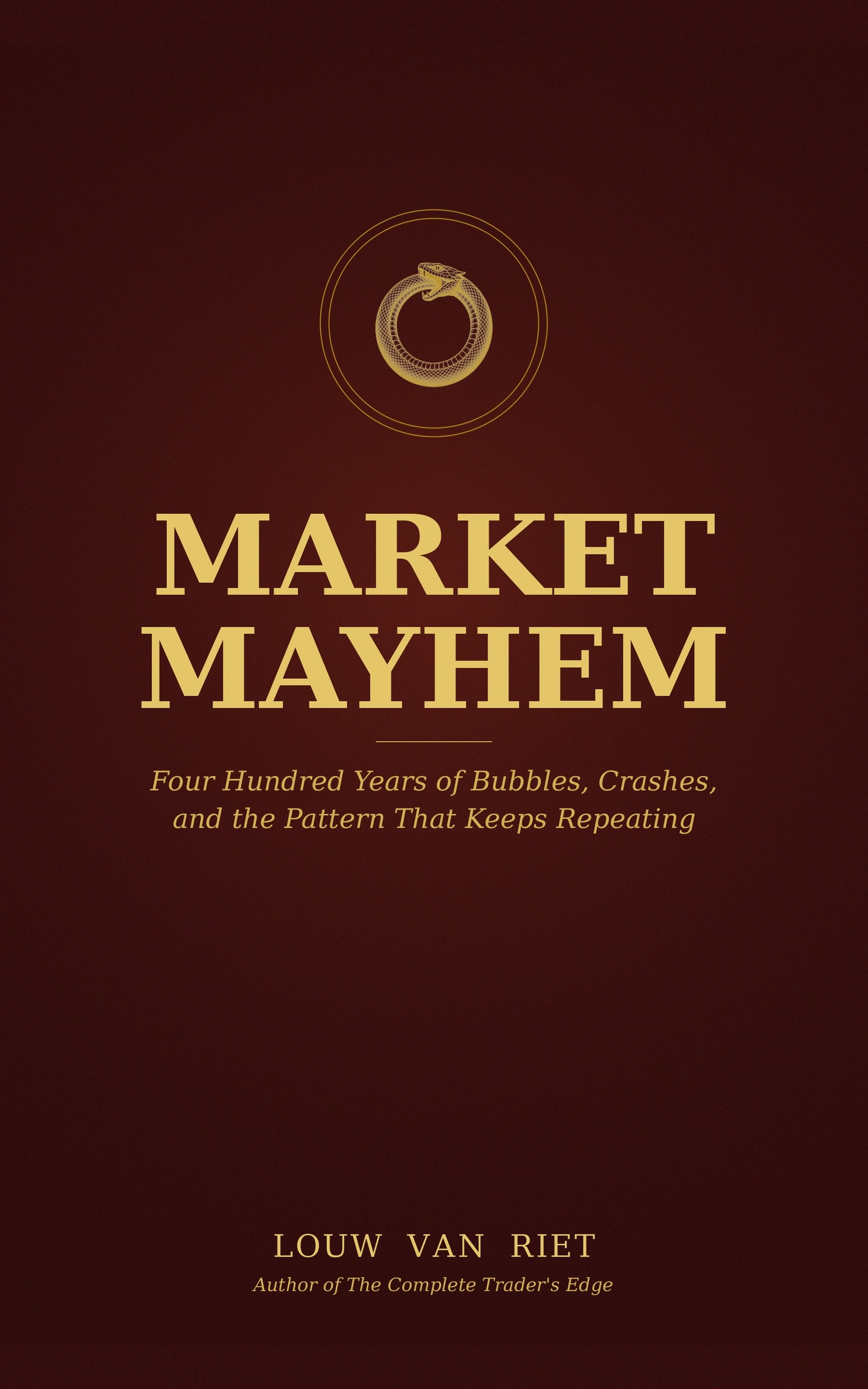 Market Mayhem
400 years of bubbles, crashes, and the pattern that keeps repeating.
Buy on Amazon →
Market Mayhem
400 years of bubbles, crashes, and the pattern that keeps repeating.
Buy on Amazon →
 Greatest Companies
How the world's greatest companies were built — and what traders learn from them.
View on Amazon →
Greatest Companies
How the world's greatest companies were built — and what traders learn from them.
View on Amazon →