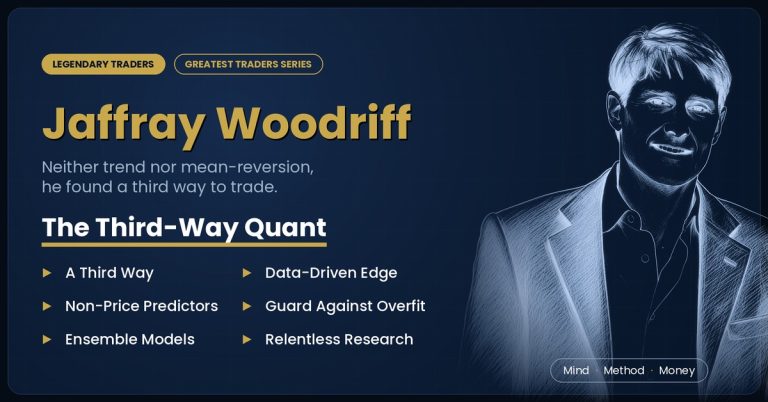


Greatest Traders is out. Eighty-six chapters, roughly 300,000 words, covering 130 years of markets from Jesse Livermore reading a chalkboard in 1892 to the traders still working from those ideas today. It is available now on Kindle at $11.99, and in print as two paperback volumes at $27.99 and $29.99.
This is the fourth book in the Complete Trader’s Edge collection, and the one that turns the Mind · Method · Money framework on the people who built it.
Why this book exists
There is a particular kind of trading book that circulates quotations nobody has ever traced. A line gets attributed to Livermore. It appears in a blog post, then a book, then a hundred more posts, and by the time it reaches you it has been repeated so often that it feels like a fact. Follow it back and there is frequently nothing at the end. No transcript. No letter. No printed page. Just the repetition.
That bothered me enough to build the whole book around fixing it.
Every one of the 48 quotations in Greatest Traders was traced to a source: a transcript, a regulatory filing, a shareholder letter, or a printed page. Where the wording could not be verified, the quotation marks came off and the substance was carried into the prose as reported speech. Three chapters were corrected during the final pass because a quotation turned out to have been built from a paraphrase rather than the document it was paraphrasing.
The 100 endnotes exist mainly where sources disagree, where the record is thin, or where the book is inferring rather than reporting. Several of them say, in plain terms, that the answer could not be established.
What is actually in it
The book is organised into eight Parts, arranged not by fame or fortune but by what each group of traders proves about the framework.
- Part I – The Origins (Chapters 1–7). Livermore, Wyckoff, Graham, Darvas, Thorp, Bogle, Hetty Green.
- Part II – The Mind (Chapters 8–20). Mark Douglas, Buffett, Munger, Schwartz, Taleb, Housel, Marks, Dalio and others.
- Part III – The Method (Chapters 21–41). Seykota, Dennis, O’Neil, Tudor Jones, Druckenmiller, Soros, Simons, Burry, Griffin.
- Part IV – The Money (Chapters 42–53). Lipschutz, Steinhardt, Tepper, Gross, Icahn, Singer, Paulson.
- Part V – The Globals (Chapters 54–63). Kotegawa, Jhunjhunwala, Allan Gray, Kostolany, Damani, Watsa, Li Lu.
- Part VI – The Modern Voices (Chapters 64–74). Cathie Wood, Saylor, Keith Gill, Brandt, Braga, Terry Smith, Einhorn.
- Part VII – The Cautionary Tales (Chapters 75–82). Chanos, Leeson, Kerviel, Hwang, Madoff, Hamanaka, Bankman-Fried, LTCM.
- Part VIII – The Operators (Chapters 83–86). Ackman, Batista, Loeb, Peltz.
Every chapter closes under the same three headings. Mind is what the trader could bear. Method is what the trader actually did. Money is how the position was held, sized and financed.
The failures get the same three headings as the successes, because the same framework explains both. That is the entire argument of the book. Bernie Madoff and Warren Buffett are read through identical questions, and the questions are what separate them.
Eighty-six engraved medallions
Each chapter opens with an engraved medallion drawn for that trader, and each one carries a single line. Livermore’s is a stock ticker under glass: reading the tape. Wyckoff’s reads quiet hands inside the range. Hetty Green’s is lending into the panic.
Nobody outside the book had seen those captions, so I have put all 86 on the book page as a filterable wall. You can hover any medallion to read its line, or filter by Part to see how the structure holds together. It works as a table of contents you can actually read.
Formats
The Kindle edition carries the complete text, all 86 chapters in one volume, no DRM, at $11.99.
The print edition runs to two volumes, because 86 chapters will not physically bind into one book. Volume I is 452 pages and covers Chapters 1–41, Parts I to III. Volume II is 526 pages and covers Chapters 42–86, Parts IV to VIII, along with the closing essay and the epilogue. They are $27.99 and $29.99 respectively.
What this book is not
It is not a how-to. There is no system in it, no setups, no entry rules, no backtest. If you want the method taught from the ground up, that is The Complete Trader’s Edge, and this is not a substitute for it.
The endnote density is uneven, and deliberately so. Wyckoff carries 29 notes and Hamanaka 23, because both are cases where the historical record genuinely fights back. Many chapters carry none, because nothing in them needed qualifying. The Note on Sources says as much, but it is worth knowing before you open it expecting an academic apparatus.
The Further Reading list closing Part VIII is thin: three primary documents. That is a consequence of the rule that each Part may only recommend books, memoirs and documentaries actually named inside its own chapters. Activist investing has not produced many first-person accounts worth sending you to. I would rather the list be short and honest than padded.
Two small things remain open. A Graham quotation was cut from the final text because I could not get to the physical 1934 edition to confirm a page number, and a Leeson quotation carries no venue. Both are recorded rather than papered over, and both will be resolved in a second edition.
Where to start
If you have never read a trader biography, start with Part I and read it in order. The Origins chapters set up every idea the rest of the book leans on.
If you already know the canon, go straight to Part VII. The Cautionary Tales are the chapters that took the longest to write and the ones most likely to change how you size a position.
And if you want to know whether the thing is any good before spending anything, the Legendary Traders archive on this site is free and runs to well over a hundred profiles. The book is the deeper, sourced, structured version of that work, but the archive will tell you quickly enough whether the writing is for you.
The collection
Greatest Traders is Volume IV. The Complete Trader’s Edge teaches the framework. Market Mayhem covers four centuries of bubbles and crashes that prove why it matters. Greatest Companies turns it on 51 businesses. This one turns it on the people.
Full details, the eight Parts in depth, and the medallion wall are on the Greatest Traders book page.
 The Complete Trader's Edge
The full Mind · Method · Money framework. 70 chapters.
View on Amazon →
The Complete Trader's Edge
The full Mind · Method · Money framework. 70 chapters.
View on Amazon →
 Market Mayhem
400 years of bubbles, crashes, and the pattern that keeps repeating.
Buy on Amazon →
Market Mayhem
400 years of bubbles, crashes, and the pattern that keeps repeating.
Buy on Amazon →
 Greatest Companies
How the world's greatest companies were built — and what traders learn from them.
View on Amazon →
Greatest Companies
How the world's greatest companies were built — and what traders learn from them.
View on Amazon →
 Greatest Traders
Eighty-six lives that explain the markets — Livermore to Madoff, told with the losses left in.
View on Amazon →
Greatest Traders
Eighty-six lives that explain the markets — Livermore to Madoff, told with the losses left in.
View on Amazon →