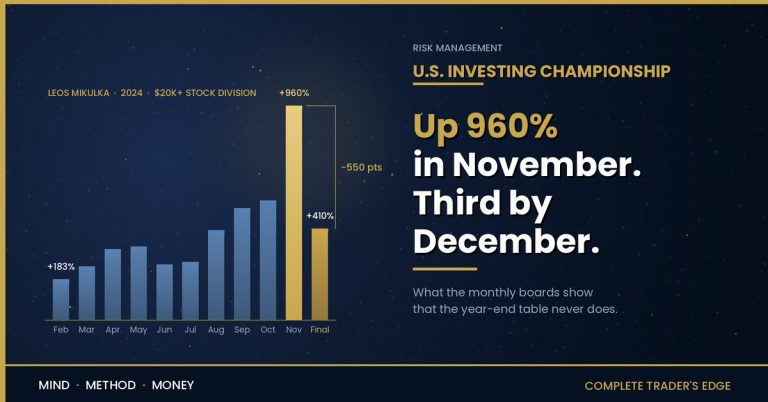


Put ten thousand people in a room. None of them can trade. Not one has an edge, an insight, or a system. Each year, a coin decides whether their account goes up or down.
Run it for ten years. Then find everyone who won every single year.
There will be about ten of them.
Simulated, the answer comes out at 9.74. Computed, it is 10,000 × 0.5 to the tenth power, which is 9.77. The arithmetic and the simulation agree, as they must, because nothing is happening here except coins.
Those ten people have a ten-year unbroken track record. They will be interviewed. They will explain their process, and their explanations will be coherent, because human beings are extraordinarily good at constructing coherent explanations for things that happened to them. They will write books. The books will sell, and the books will be good, and every word in them will be false.
The filter you cannot see
Taleb calls it silent evidence. The graveyard does not publish.
You never meet the 9,990. They did not fail dramatically; most of them just drifted below the line at some point in year four and stopped being interesting. They are not in the interviews, not on the podcasts, not in the comparison tables. They exist only as the denominator, and the denominator is never printed.
| Unbroken winning years | Chance for any one person | Expected among 10,000 |
|---|---|---|
| 3 | 12.5% | 1,250 |
| 5 | 3.13% | 313 |
| 7 | 0.78% | 78 |
| 10 | 0.098% | 10 |
Seventy-eight people with seven straight winning years, produced from pure noise. That is more than enough to fill a conference. It is more than enough to fill your feed.
And notice the shape of the deception. Nobody lied. Each of the seventy-eight genuinely did win seven years running. The record is accurate. The record is also completely uninformative about the eighth year, because it was never evidence of anything.
Where this hides, specifically
The backtest
You test a strategy on a universe of stocks. The universe is the stocks that exist today. The ones that were delisted, acquired, or went to zero are not in your data, and they were disproportionately the ones your strategy would have bought.
The survivorship has already happened, upstream, in the data vendor’s database, before you wrote a line of code. Your backtest is not measuring your strategy. It is measuring your strategy applied to a set of companies pre-selected for not having died.
The prop firm success story
A firm shows you a funded trader who withdrew forty thousand dollars. True, verifiable, and worthless without the number of challenges sold. If ten thousand people paid for the attempt, the arithmetic of a coin already predicts a handful of forty-thousand-dollar stories, and the challenge fees paid for the payouts.
This is not an accusation. It is a request for a denominator, and the denominator is the one number the marketing page never contains.
The strategy that has “never had a losing month”
Some strategies genuinely have this property, and it is a property of the payoff shape, not of skill. Sell options, collect small premiums, win nearly every month, and then hand back several years of gains in a fortnight. The unbroken record is not evidence of an edge. In a great many cases it is the signature of a hidden tail, which has not yet arrived, and which is the reason the returns exist at all.
The books
Including, and this is uncomfortable, the good ones. Every trading memoir is written by someone who survived long enough to write it. The market wizards were interviewed because they had already won. Their lessons may be true, and several of them are, but the selection procedure that put them in front of you cannot distinguish a true lesson from a lucky one, because the selection procedure only looked at the outcome.
The awkward corollary. This site reviews fifty trading books. Every one of them was written by a survivor. The correct response is not to stop reading them. It is to read them for mechanisms, which can be tested, and to distrust outcomes, which cannot.
Why your brain cannot see it
Because absence has no representation. You can picture a trader who made ten million. You cannot picture the nine thousand nine hundred and ninety who did not, because there is nothing to picture. They are not a vivid image with a small probability attached. They are simply not there.
And the winner comes with a story. The story is causal, specific, and satisfying: he cut his losses, he waited for the setup, he had conviction. Those may all be true statements about what he did. They cannot be evidence for why it worked, because the nine thousand others were doing very similar things and are not available for comment.
This is the difference between an explanation and a cause, and the market never distinguishes them for you.
Four questions that restore the denominator
Ask these before you believe anything
1. How many started? A track record without a cohort size is an anecdote with a spreadsheet.
2. Where are the failures? If the answer is “they didn’t follow the system,” the system is unfalsifiable and you are being sold a religion.
3. Would noise produce this? Compute it. Ten years of winning from ten thousand people is ten winners. If the claim sits inside what a coin can do, it is not evidence.
4. Was the mechanism stated in advance? A rule written before the data is tested is evidence. A rule extracted from the winners afterwards is a description of the winners.
The fourth question is the one that separates a strategy from a story.
The version of this that will actually hurt you
Everything above is about other people’s records. Now turn it around.
You are also a sample of one, drawn from your own distribution, and you have survived so far. Your winning quarter is in your memory with a cause attached. Your process feels vindicated. And you cannot tell, from the inside, whether you are the trader with an edge or one of the seventy-eight.
You have exactly one defence, and it is not confidence.
Sample size, and a mechanism specified in advance. Enough trades that noise has had time to average out, and a written rule that made a prediction before you knew the answer. Neither is exciting. Together they are the only thing that distinguishes a trader from a lucky person, and the distinction is invisible to both of them until it is far too late.
The nine thousand nine hundred and ninety all felt fine in year three.
Ask for the denominator. Including your own.
A hundred logged trades is a sample. A memorable quarter is a story.
 The Complete Trader's Edge
The full Mind · Method · Money framework. 70 chapters.
View on Amazon →
The Complete Trader's Edge
The full Mind · Method · Money framework. 70 chapters.
View on Amazon →
 Market Mayhem
400 years of bubbles, crashes, and the pattern that keeps repeating.
Buy on Amazon →
Market Mayhem
400 years of bubbles, crashes, and the pattern that keeps repeating.
Buy on Amazon →
 Greatest Companies
How the world's greatest companies were built — and what traders learn from them.
View on Amazon →
Greatest Companies
How the world's greatest companies were built — and what traders learn from them.
View on Amazon →
 Greatest Traders
Eighty-six lives that explain the markets — Livermore to Madoff, told with the losses left in.
View on Amazon →
Greatest Traders
Eighty-six lives that explain the markets — Livermore to Madoff, told with the losses left in.
View on Amazon →