

EUR/USD is the most traded currency pair in the world. It accounts for approximately 23% of all daily forex volume, which translates to over $1.5 trillion changing hands every single day. More institutional orders flow through EUR/USD than any other pair, which means it produces the cleanest price action, the tightest spreads, the most reliable technical levels, and the most consistent session patterns of anything you can trade in forex.
If you are learning to trade forex, EUR/USD should be your first pair. If you are an experienced trader looking to add a new instrument, EUR/USD offers structural clarity that is difficult to match. This guide covers everything you need to trade it professionally: what drives it, when it moves, how to apply ICT concepts to it, and the specific nuances that separate EUR/USD from other pairs.
What Is EUR/USD and Why Does It Matter?
EUR/USD represents the exchange rate between the Euro and the US Dollar. When EUR/USD is at 1.0850, it means one Euro costs 1.0850 US Dollars. If you buy EUR/USD (go long), you are buying Euros and selling Dollars, betting that the Euro will strengthen relative to the Dollar. If you sell EUR/USD (go short), you are selling Euros and buying Dollars, betting on Dollar strength.
The pair matters to every trader, even those who do not trade it directly, because it is the primary expression of the Dollar-Euro relationship. The Euro is the currency of 20 European nations. The US Dollar is the world’s reserve currency. Together, they represent the two largest economic blocs on earth. Movements in EUR/USD ripple through every other market: gold, commodities, emerging market currencies, and even equity indices are all influenced by the Dollar’s strength or weakness, and EUR/USD is the most liquid barometer of that strength.
What Drives EUR/USD: The Fundamental Drivers
You do not need to be a macroeconomist to trade EUR/USD. But understanding the forces behind the trends helps you identify which side of the market has the structural tailwind.
Interest Rate Differentials
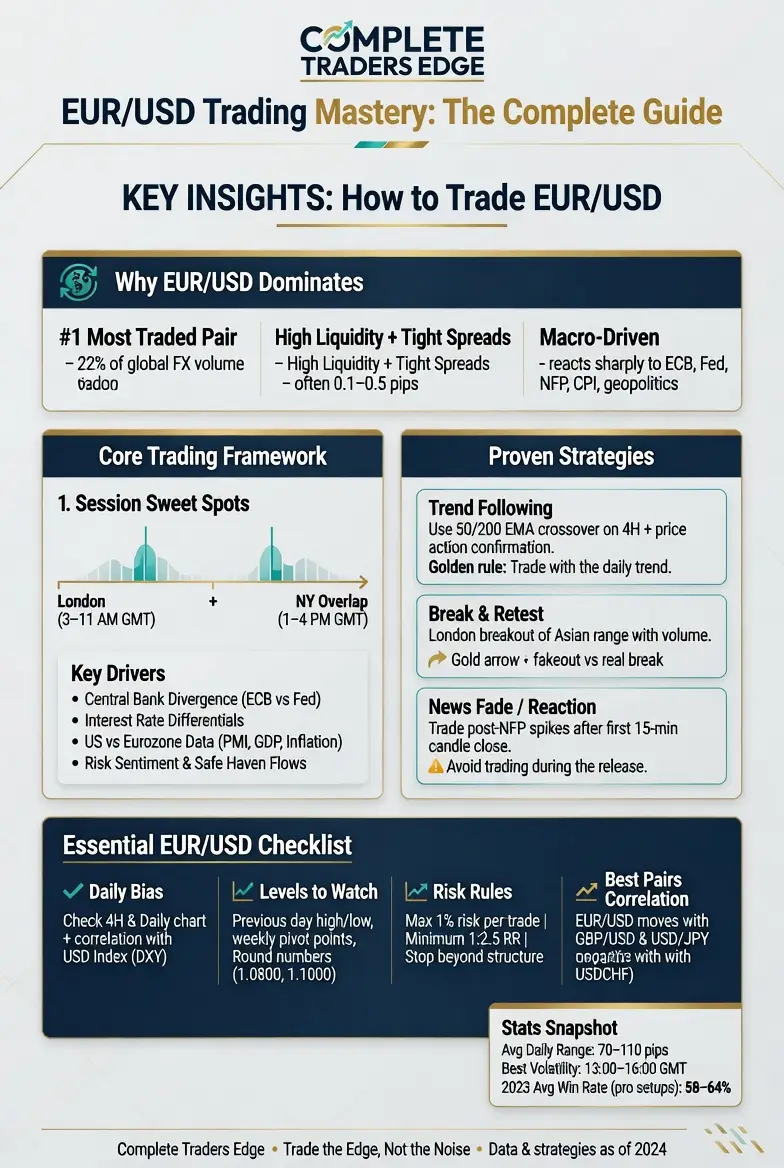
The single most important driver of EUR/USD over any timeframe longer than a day is the interest rate differential between the European Central Bank (ECB) and the US Federal Reserve. When the Fed raises rates and the ECB holds steady, the Dollar strengthens and EUR/USD falls. When the ECB raises rates and the Fed pauses, the Euro strengthens and EUR/USD rises. The carry trade, where investors borrow in the lower-yielding currency and invest in the higher-yielding one, amplifies these moves over weeks and months.
Economic Data Releases
EUR/USD reacts to scheduled economic data from both sides. The most impactful releases are:
| Release | Source | Typical Impact on EUR/USD | When (ET) |
|---|---|---|---|
| US Non-Farm Payrolls (NFP) | BLS | Strong NFP = USD up, EUR/USD down | First Friday, 8:30 AM |
| US CPI (Inflation) | BLS | Hot CPI = USD up, EUR/USD down | Mid-month, 8:30 AM |
| FOMC Rate Decision | Federal Reserve | Hawkish = USD up; Dovish = USD down | 8x/year, 2:00 PM |
| ECB Rate Decision | ECB | Hawkish = EUR up; Dovish = EUR down | 6-8x/year, 8:15 AM |
| EU/German PMI | S&P Global | Above 50 = EUR supportive | Monthly, 3:45-4:00 AM |
| US GDP | BEA | Strong GDP = USD up | Quarterly, 8:30 AM |
Check the economic calendar every morning before you trade EUR/USD. Knowing which releases are scheduled, at what time, and what the consensus expectations are prevents you from being blindsided by sudden volatility.
DXY and Intermarket Context
EUR/USD and the DXY (US Dollar Index) are deeply inversely correlated because the Euro represents approximately 57% of the DXY basket. In practical terms, if you are analysing the DXY, you are largely analysing the inverse of EUR/USD. A DXY breakout to new highs is bearish for EUR/USD. A DXY breakdown is bullish for EUR/USD. Always check DXY before taking a EUR/USD position; if your EUR/USD bias conflicts with the DXY structure, one of them is wrong.
When to Trade EUR/USD: Session Timing
EUR/USD is a 24-hour market from Monday to Friday, but the quality of trading opportunities varies dramatically by session. The pair is most active when the economies it represents are actually open for business.
| Session | Hours (ET) | EUR/USD Behaviour | Tradeable? |
|---|---|---|---|
| Asian Session | 7:00 PM – 2:00 AM | Tight range, low volume, builds liquidity | Avoid for entries |
| London Open (Kill Zone) | 2:00 AM – 5:00 AM | Primary directional move, highest EUR liquidity | Best session for EUR/USD |
| London-NY Overlap | 8:00 AM – 12:00 PM | Peak volume, US data releases, widest ranges | Excellent, especially around data |
| US Afternoon | 12:00 PM – 5:00 PM | Consolidation, mean reversion, lower volume | Caution; tighter stops needed |
The London Kill Zone (2:00 AM to 5:00 AM ET) is the single best window for EUR/USD trading. This is when European banks open, when the majority of EUR-denominated institutional orders execute, and when the classic ICT Judas Swing pattern appears most reliably on this pair. The London open sweeps one side of the Asian range, collects liquidity, and reverses into the true daily direction.
Applying ICT Concepts to EUR/USD
EUR/USD is the pair that many ICT practitioners consider the cleanest for the methodology. The institutional participation is so deep that smart money footprints, order blocks, fair value gaps, and liquidity sweeps appear with textbook clarity.
The Judas Swing on EUR/USD
The Judas Swing is the false opening move of the London session. On EUR/USD, it works as follows: during the first 30-60 minutes of the London Kill Zone, price sweeps either the Asian session high or the Asian session low. This move traps retail traders who entered in the direction of the sweep. Then price reverses sharply and moves in the true daily direction, often running 50-80 pips before the New York session even opens.
The setup is simple to identify in hindsight and becomes increasingly readable in real time with practice. Mark the Asian high and low before London opens. Identify which side has more resting liquidity (equal highs, equal lows, or proximity to a previous day’s high/low). Wait for the sweep. Wait for the displacement candle in the opposite direction. Enter on the pullback to the FVG or OB.
Order Blocks and FVGs on EUR/USD
EUR/USD respects order blocks cleanly on the 15-minute and 1-hour timeframes. The 5-minute chart is viable for entries on EUR/USD because the pair is less volatile than gold, so the noise-to-signal ratio is manageable. Fair value gaps on EUR/USD fill with high consistency, particularly during the London and New York sessions when institutional volume is present.
One EUR/USD-specific nuance: the pair often consolidates tightly during the London-New York overlap before a US data release, then displaces sharply after the release. The FVGs created by that displacement are among the highest-probability re-entry zones, because the institutional orders that caused the move were the largest of the session.
Key Levels: Round Numbers and Handles
EUR/USD has strong reactions at psychological round numbers, known as “handles” or “big figures.” Levels like 1.0800, 1.0900, 1.1000, and 1.1100 act as magnets for price and barriers to further movement. These round numbers attract option expiries, institutional orders, and retail stop losses, making them natural liquidity pools.
The “double zeros” (1.0800, 1.0900) are the most significant. The “fifties” (1.0850, 1.0950) act as secondary levels. When planning your trades, note which round numbers are nearby, whether price is approaching them from above or below, and whether a liquidity sweep of a round number could be the setup trigger you are waiting for.
EUR/USD-Specific Technical Characteristics
| Characteristic | EUR/USD | Implication for Traders |
|---|---|---|
| Average daily range | 60-100 pips (varies by regime) | Tighter stops than gold; 15-30 pip stops typical for intraday |
| Spread (ECN) | 0.1-0.5 pips during London/NY | Near-zero spread cost; scalping viable |
| Pip value (standard lot) | $10.00 per pip | A 50-pip move = $500 per standard lot |
| Trend behaviour | Trends for weeks/months; mean-reverts intraday | Swing trades with HTF trend; intraday mean reversion to VWAP |
| Correlation | Inverse to DXY (~-0.95); loose positive with gold | Always check DXY before entering |
| Swap cost | Varies by rate differential | Check swap direction before swing trades; can add or erode profits |
EUR/USD Position Sizing and Risk Management
EUR/USD is more forgiving than gold in terms of pip-to-dollar risk, but the 1% rule applies equally. A typical intraday stop loss on EUR/USD is 15-30 pips. On a $10,000 account with 1% risk ($100), a 20-pip stop allows you to trade 0.50 standard lots (5 mini lots). This is significantly larger than the position you would take on gold for the same dollar risk, which is why EUR/USD feels “easier” to manage from a risk perspective.
For swing trades, stops widen to 50-100 pips, which means your position size decreases proportionally. A 100-pip stop with $100 risk means 0.10 lots (1 mini lot). The key is always starting with the stop distance, calculating the correct lot size, and never adjusting the stop to fit a desired position.
EUR/USD Trading Strategies That Work
London Open Reversal (Judas Swing)
Mark the Asian range before London opens. Wait for a sweep of the Asian high or low during 2:00-3:00 AM ET. Confirm with a displacement candle in the opposite direction. Enter on the pullback to the FVG. Stop beyond the sweep. Target the opposite side of the Asian range, then the previous day’s high or low. Typical R:R: 1:2 to 1:3.
News Fade After US Data
Wait for a major US data release (NFP, CPI). Let the initial 15-minute reaction play out. Identify the FVG or OB created by the displacement. Enter on the pullback. This strategy works because the initial reaction often overshoots, and the pullback to fill the FVG before continuation is one of the most reliable patterns on EUR/USD.
Daily Pivot Bounce
Calculate the daily pivot point before the session. If price opens above the pivot, the intraday bias is bullish. Look for demand zones and long setups. If below, bearish. Look for supply zones and short setups. When price tests the pivot itself during the session, the reaction often provides a low-risk entry with the pivot as your invalidation.
Common EUR/USD Trading Mistakes
Overtrading during the Asian session. EUR/USD during Asian hours ranges 10-20 pips. Taking trades in this window produces commissions and frustration, rarely profit. Wait for London.
Ignoring the ECB and Fed calendar. Trading EUR/USD without knowing when the next central bank decision is scheduled is like crossing a road without looking. These events move EUR/USD 100-200 pips and will obliterate a position that is on the wrong side.
Correlation stacking. If you are long EUR/USD and also long GBP/USD, you effectively have two correlated positions against the Dollar. A Dollar rally hits both simultaneously. Treat correlated pairs as a single exposure for risk calculation purposes.
Fighting the macro trend. EUR/USD trends persist for months. If the Fed is hiking and the ECB is cutting, the trend is down. Taking long positions against this macro bias requires exceptional timing and tight risk. The higher-probability approach is always to trade with the rate differential, not against it.
5 Frequently Asked Questions About Trading EUR/USD
Is EUR/USD the best pair for beginners?
Yes. EUR/USD has the tightest spreads, the highest liquidity, the most predictable session patterns, and the cleanest technical structure of any forex pair. It is less volatile than GBP/JPY or gold, which means mistakes are less expensive. Start with EUR/USD, learn the mechanics of forex trading on it, and then diversify to other pairs once your process is consistent.
What is the best timeframe for EUR/USD?
For intraday trading: the 15-minute chart for entries, the 1-hour for structure, and the 4-hour for bias. For swing trading: the 4-hour for entries and the daily for direction. The 5-minute chart is viable on EUR/USD because the pair is liquid enough to produce clean signals at that granularity, but the 15-minute is generally more reliable.
How many pips can I expect per day on EUR/USD?
The average daily range is 60-100 pips, but that does not mean you should expect to capture all of it. A realistic target for a competent intraday trader is 20-40 pips per session from one or two high-quality setups. Trying to capture the entire daily range leads to overtrading and revenge trading after missed moves.
Does EUR/USD work for scalping?
EUR/USD is one of the few pairs where scalping is viable because the spread-to-movement ratio is favourable. With ECN spreads of 0.1-0.5 pips, a 10-pip scalp has minimal spread drag. However, scalping requires fast execution, strict discipline, and the ability to cut losses instantly. It is a higher-skill, higher-frequency approach that is not recommended for beginners.
Should I trade EUR/USD or GBP/USD?
EUR/USD is more stable, more liquid, and more predictable. GBP/USD is more volatile, produces wider ranges, and can deliver larger R:R but with more noise and wider stops. Many traders start on EUR/USD for reliability and add GBP/USD once their process is refined. Trading both simultaneously increases your Dollar exposure, so manage your total risk across correlated positions.
▶ Continue Reading
▸ Intermarket Analysis: How DXY, Bonds, and Correlations Give You an Institutional Edge
▸ How to Read a Forex Economic Calendar Like a Professional
▸ Trading Sessions Explained: London, New York, and Asian Session Breakdown
▸ Forex Trading for Beginners: How the Currency Market Works
The Complete Trader’s Edge
This article is adapted from The Complete Trader’s Edge by Louw van Riet. The book covers forex, ICT methodology, session timing, and the complete Mind · Method · Money framework across 70 chapters.
 The Complete Trader's Edge
The full Mind · Method · Money framework. 70 chapters.
View on Amazon →
The Complete Trader's Edge
The full Mind · Method · Money framework. 70 chapters.
View on Amazon →
 Market Mayhem
400 years of bubbles, crashes, and the pattern that keeps repeating.
Buy on Amazon →
Market Mayhem
400 years of bubbles, crashes, and the pattern that keeps repeating.
Buy on Amazon →
 Greatest Companies
How the world's greatest companies were built — and what traders learn from them.
View on Amazon →
Greatest Companies
How the world's greatest companies were built — and what traders learn from them.
View on Amazon →
 Greatest Traders
Eighty-six lives that explain the markets — Livermore to Madoff, told with the losses left in.
View on Amazon →
Greatest Traders
Eighty-six lives that explain the markets — Livermore to Madoff, told with the losses left in.
View on Amazon →