

In the spring of 1999, a Stanford business student named Marcos Galperin gave a billionaire investor a ride to the airport, and deliberately missed the exit.
The investor was John Muse, a prominent financier who had come to campus to lecture, and Galperin, an Argentine with an idea, had engineered the chance to drive him to his plane. As Muse listened to the pitch, a Latin American version of eBay, the auction marketplace then soaring in the dot-com boom, Galperin sensed his interest and, rather than end the conversation, missed the highway exit on purpose to buy himself another twenty minutes. By the time they reached the airstrip, Muse had heard enough. He wanted in. That drive helped secure Mercado Libre’s seed funding, and in August of 1999 the company launched from a garage in Buenos Aires, with Galperin joined by co-founders including Hernán Kazah and Stelleo Tolda, who would run the crucial Brazilian operation.
The premise was simple and, on its face, derivative: clone eBay for a continent of five hundred million people just beginning to come online. But the simplicity of the premise concealed a problem so large that it would either sink the company or become the source of its greatest strength. Latin America was not the United States. The infrastructure that made American e-commerce possible simply did not exist.
It is worth pausing on the founder, because his temperament shaped everything. Galperin had learned early to recognize and seize an opportunity; he liked to tell of once sitting beside Warren Buffett for ten minutes without realizing who he was, a lesson in not letting a chance pass unnoticed that he would never repeat. He built Mercado Libre with the discipline of someone who understood the region’s fragility from the inside. The company was incorporated in the United States rather than Argentina, would later base its headquarters in Uruguay, and raised its capital and listed its shares in dollars on a US exchange, deliberate choices that insulated the enterprise from the currency crises, capital controls, and political upheavals that have repeatedly devastated Latin American businesses. Galperin was building a company native to the region’s opportunity but armored against the region’s chaos.
📄 Free Download · Company Research Sheet
Mercado Libre Research Sheet (PDF)
The moat, the meltdown, the Legendary Scorecard, the timeline, and the Move, Money and Mind lessons from this story. Free, no email required.
The Problem That Became the Moat
Consider what an online marketplace actually requires, and what Latin America lacked.
It requires a way to pay. In the United States, nearly everyone had a credit card, and a service like eBay could lean on existing payment rails. In Latin America at the turn of the century, credit-card penetration was low, much of the population was unbanked entirely, and there was no trusted way to send money to a stranger over the internet. It requires delivery. American sellers could drop a package into a reliable postal or courier system and trust it would arrive. In much of Latin America, the mail was slow, unreliable, or unsafe, and there was no dependable national logistics network a small seller could plug into. And it requires trust, the willingness of a buyer to pay a stranger for goods sight unseen, which is hard enough anywhere and far harder in economies with histories of instability and fraud.
A lesser company would have treated these as reasons the business could not work, or waited for someone else to fix them. Mercado Libre treated them as the work itself. Over the following two decades it set out, piece by piece, to build the missing infrastructure of Latin American commerce. To solve payments, it created Mercado Pago in 2003, a digital-payments system that let buyers and sellers transact safely, held funds in escrow until goods arrived, and eventually grew into a sprawling financial-services arm offering digital wallets, QR-code payments accepted far beyond Mercado Libre’s own marketplace, consumer and merchant credit, and savings products, becoming for tens of millions of people their first real bank. To solve delivery, it built Mercado Envíos, a logistics network of warehouses and shipping operations that gave sellers the reliable fulfillment the region’s postal systems could not. And around these it layered an advertising business, a marketplace for everyday merchants, and more.
It did not sit on the rails. It became the rails.
Mercado Libre did not merely connect buyers and sellers on top of existing infrastructure; it became the infrastructure. And infrastructure, once built, is extraordinarily hard to dislodge.
A competitor cannot win by launching a nicer-looking marketplace, because it would still have to solve payments, logistics, credit, and trust across a dozen countries, the very things that took Mercado Libre twenty years and billions of dollars to build. The pieces reinforce one another: the marketplace generates payment volume, which builds the fintech business, which funds credit, which makes buyers shop more, which feeds the logistics network, which makes the marketplace better. A flywheel of interlocking services no single-product rival can match.
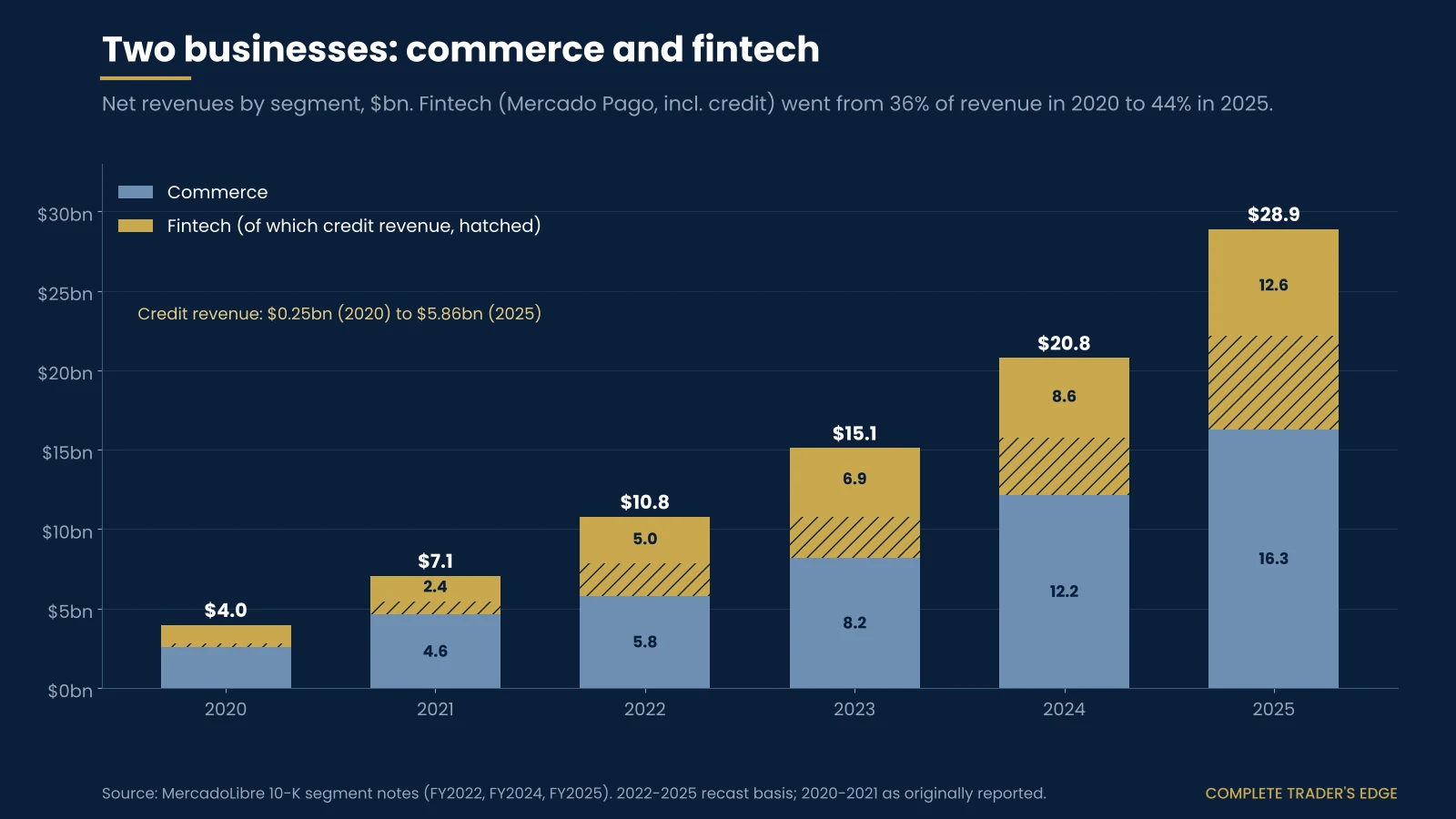
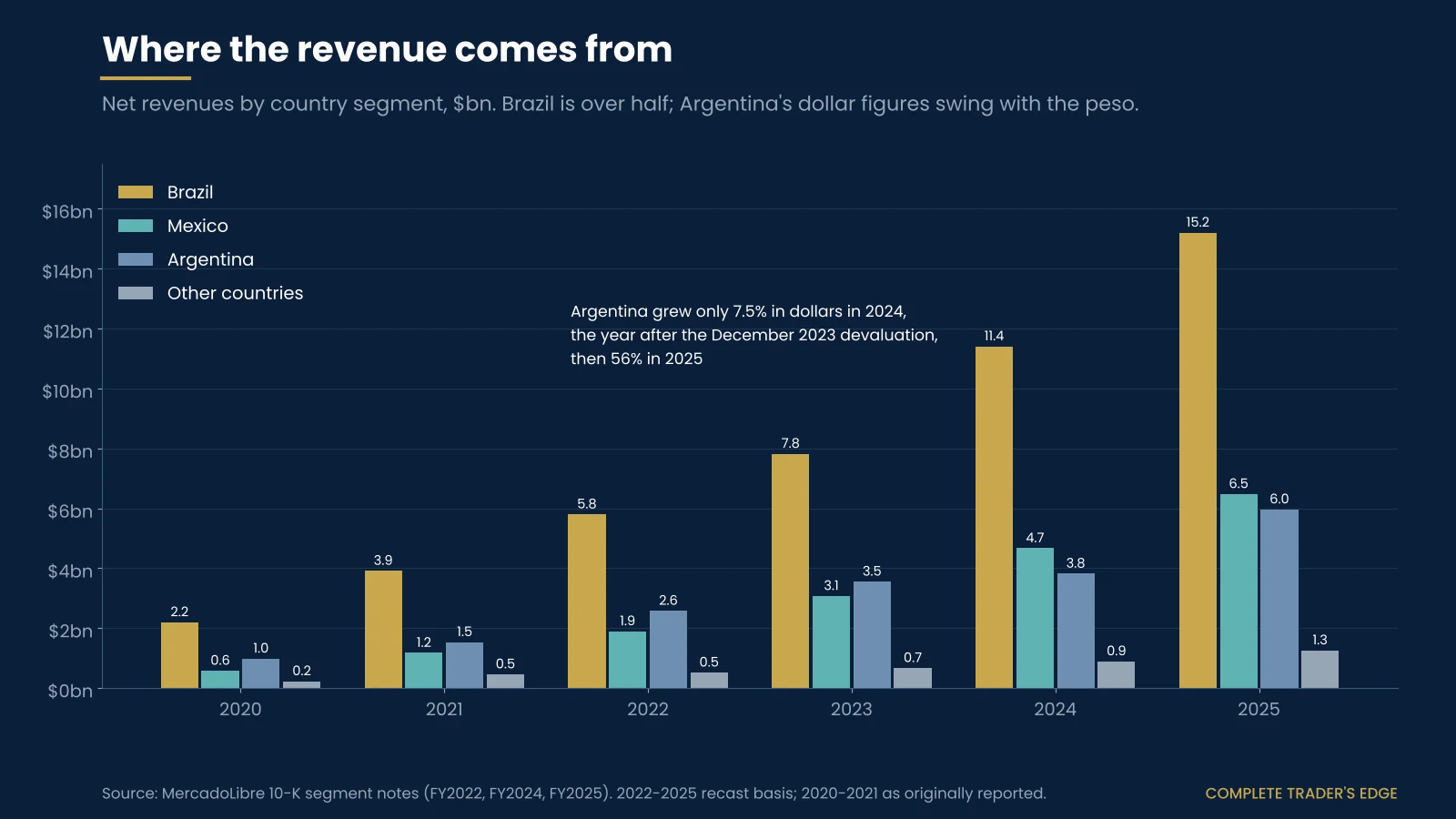
The filings show how far the second business has caught up with the first. In 2020 fintech, meaning Mercado Pago’s payments, credit and related services, was 36% of revenue. By 2025 it was 44%, and credit revenue alone had grown from $246 million to $5.9 billion.
The Collapse That Proved the Company
Mercado Libre’s first and most dangerous test came almost immediately, and surviving it is what separated it from the crowd.
The company launched at the height of the dot-com mania and was barely a year old when the bubble burst in 2000 and 2001. The collapse was brutal everywhere, but it was lethal in Latin American e-commerce, where, by some accounts, more than eighty competitors had sprung up to chase the same opportunity, all of them now starved of the easy capital that had funded the frenzy. One after another, they died. Mercado Libre very nearly joined them. What saved it was a combination of disciplined cash management, the conviction of its founders, and a pivotal stroke: in 2001, eBay, the very company Mercado Libre had been built to imitate, bought a stake of roughly a fifth of the business. The deal brought capital when capital was scarce and impossible to raise, lent the young company enormous credibility, and gave it access to eBay’s hard-won operational playbook. It was the lifeline that carried Mercado Libre through the storm that drowned its rivals.
The lesson of that survival echoes through every story in this collection: that the company which lives through the collapse, when the weak are washed away and the capital dries up, often emerges into a landscape it suddenly owns. Mercado Libre came out of the dot-com bust as the last marketplace standing in much of the region, with the field largely cleared of competitors and a decade of growth ahead before it would face a serious challenger again.
The Empire, and the Decision It Now Faces
The company went public on the Nasdaq in 2007 at eighteen dollars a share, and from there it compounded into one of the great growth stories of the emerging-market era. It rode the slow, then sudden, adoption of the internet across Latin America, deepened its ecosystem, and during the pandemic surge of 2020 became, for a time, the most valuable company in all of Latin America, worth more than the great commodity giants that had long dominated the region’s markets. By the mid-2020s it was generating tens of billions of dollars in annual revenue and growing, remarkably, at close to forty percent a year even at enormous scale (39% in 2025, about 49% in the first half of 2026 and 45% in the third quarter), with its fintech arm on a path to becoming one of the largest financial institutions on the continent.
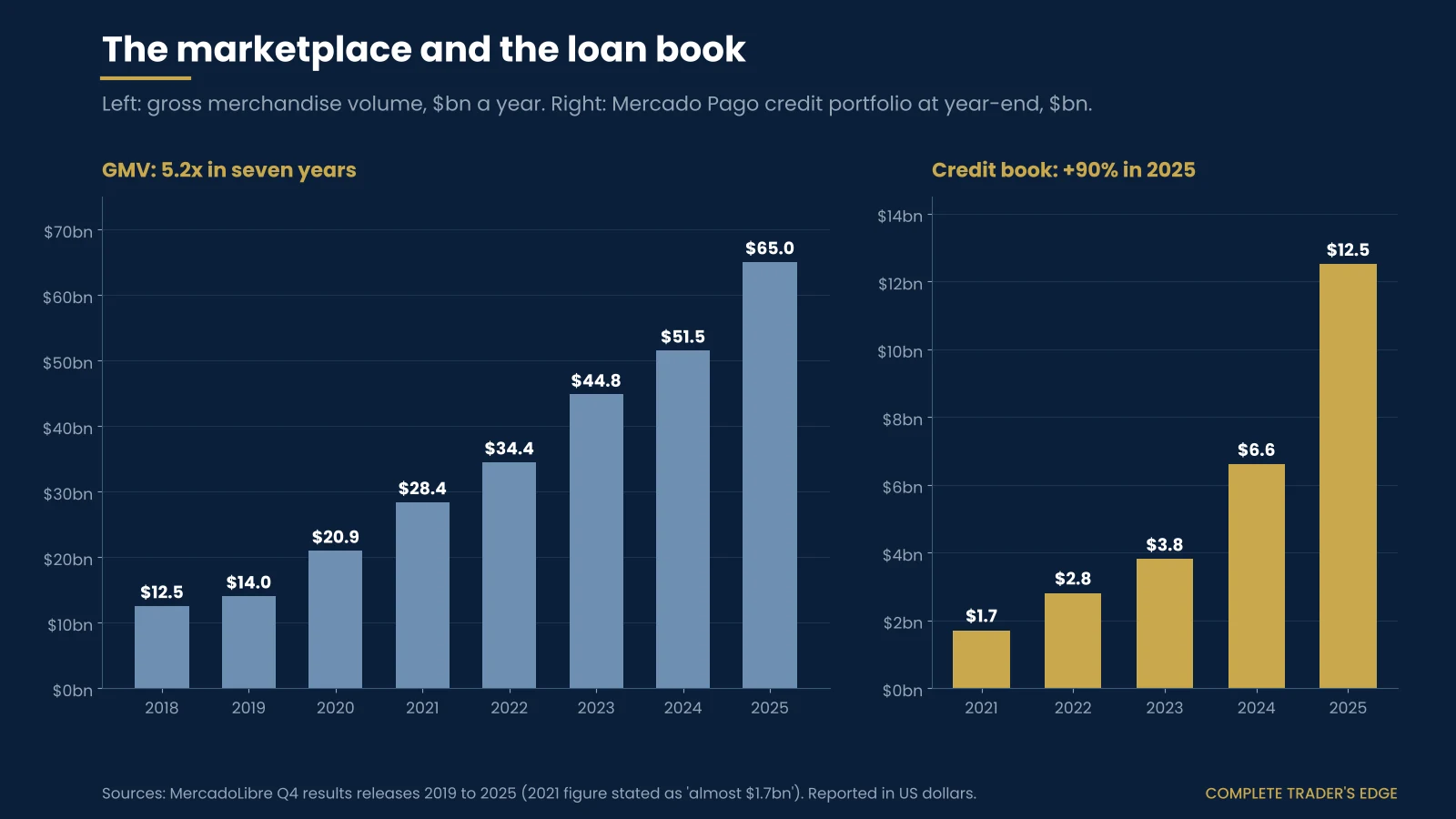
The most consequential recent layer of the ecosystem has been credit, and it captures the whole strategy in miniature. In a region where vast numbers of people and small merchants have no credit history and no access to traditional bank lending, Mercado Libre sits on something the banks lack: a detailed record of how millions of buyers and sellers actually transact, what they sell, what they earn, how reliably they pay. That data lets it extend loans and credit cards to people the formal banking system cannot or will not assess, and the results compound through the ecosystem in a way a standalone lender could never match. A merchant given credit sells more on the marketplace; a buyer given a card shops more often and in larger installments. Credit is both a large profit pool in its own right and an accelerant for everything else, the newest spoke in a flywheel that began with a simple auction site. It is also the riskiest, because a credit book that grows fast in a volatile region is a book that can sour fast.
The third quarter of 2026 showed both sides. The credit portfolio reached $17.9 billion, up 62% on a year earlier, with the credit-card book at $8.5 billion, and originations grew 70%. The company put its 15 to 90 day non-performing loan ratio at 7.0%, which it described as close to historical lows. The cost of that growth sits in the same filing: the provision for doubtful accounts rose 64.6% to $1.34 billion.
But dominance attracts attack, and Mercado Libre now faces the defining competitive question of its maturity. The same prize that drew eighty competitors in 1999 now draws the most formidable companies on Earth. Amazon has pushed hard into Mexico and the broader region. Global fast-fashion and discount platforms are flooding in with rock-bottom prices. And a wave of fintech challengers is attacking the payments and credit business that has become so central to Mercado Libre’s value.
Decision Point: you run the dominant commerce-and-fintech ecosystem in a vast, fast-growing region.
The largest and best-funded companies in the world are coming for it. You face a choice:
A. Defend your margins, harvest the profits of your dominance, and reward shareholders now, risking being slowly out-invested by deeper-pocketed rivals.
B. Plow your profits relentlessly back in, more warehouses, more credit, higher deposit yields to win banking customers, accepting thinner near-term margins to own the market that emerges when the region’s digital economy fully matures.
C. Try to do both at half measure, and risk winning neither the margins nor the market.
This is a thought experiment about reinvesting through a competitive onslaught, not investment advice. Mercado Libre has chosen B, and the margin pressure it creates is exactly what makes some investors nervous.
The third quarter of 2026 put a price on option B. Revenue grew 45% to $10.75 billion, yet income from operations was $676 million, a margin of 6.3% against 9.8% a year earlier. Management put the squeeze down to fulfilment capacity that grew almost 20% in a single quarter, the cost of more free shipping, and heavier marketing in Brazil. Net income rose 6.4% to $448 million. Chief financial officer Martín de los Santos summed up the company’s view in four words: “Our investments are working.”
What Everyone Got Wrong
The doubters of Mercado Libre have been wrong in a consistent pattern.
Mistake #1: “Serious e-commerce can’t work in a region too poor, unbanked, and logistically broken.” Reality: The brokenness was the opportunity. Building the missing rails became the moat.
Mistake #2: “It will die in the dot-com bust like the rest.” Reality: It survived, aided by eBay’s 2001 stake, while 80+ rivals failed, and emerged dominant.
Mistake #3: “When Amazon comes for Latin America, it’s over.” Reality: The local champion’s infrastructure, regional knowledge, and fintech ecosystem have so far held the giant at bay.
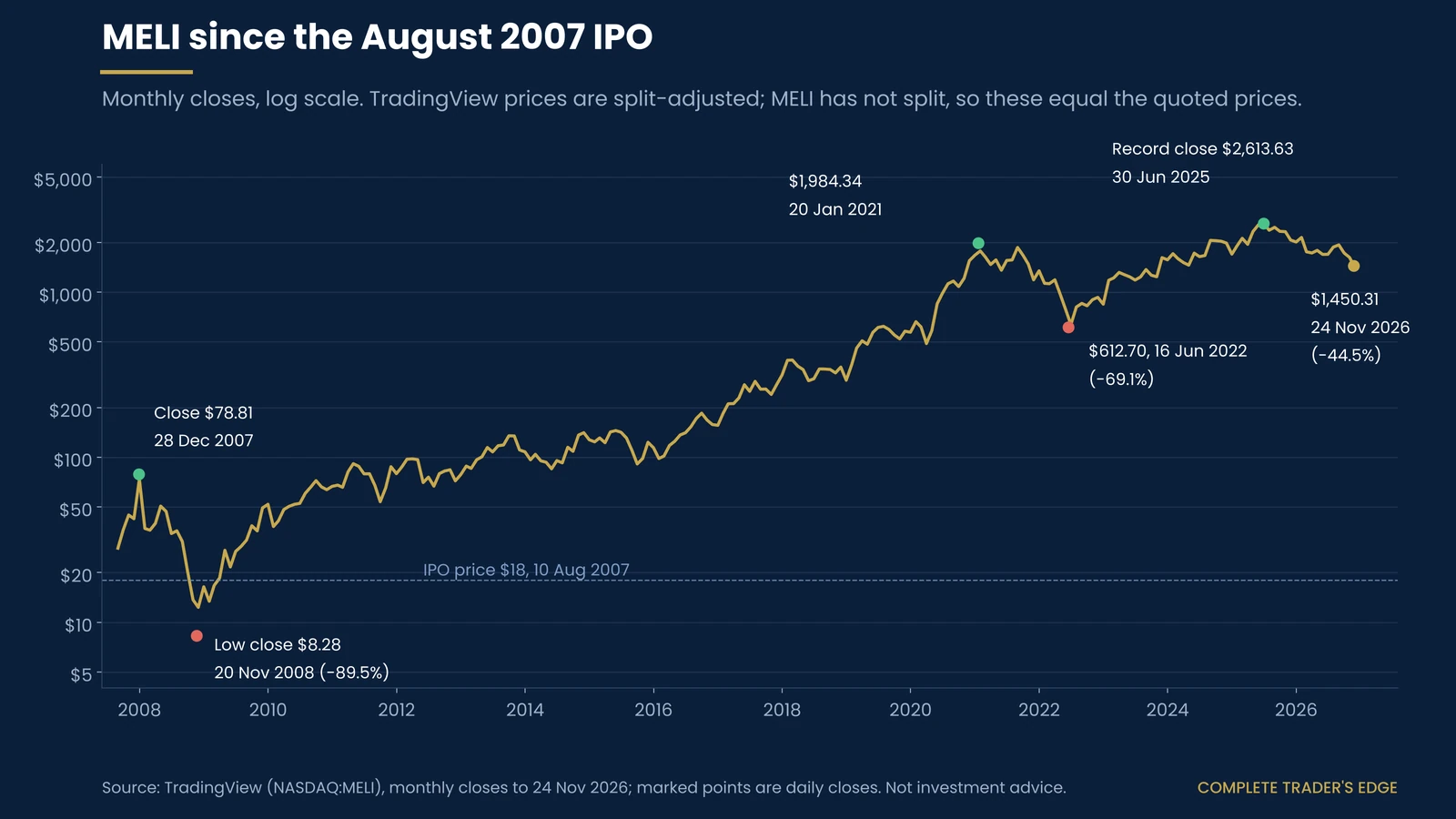
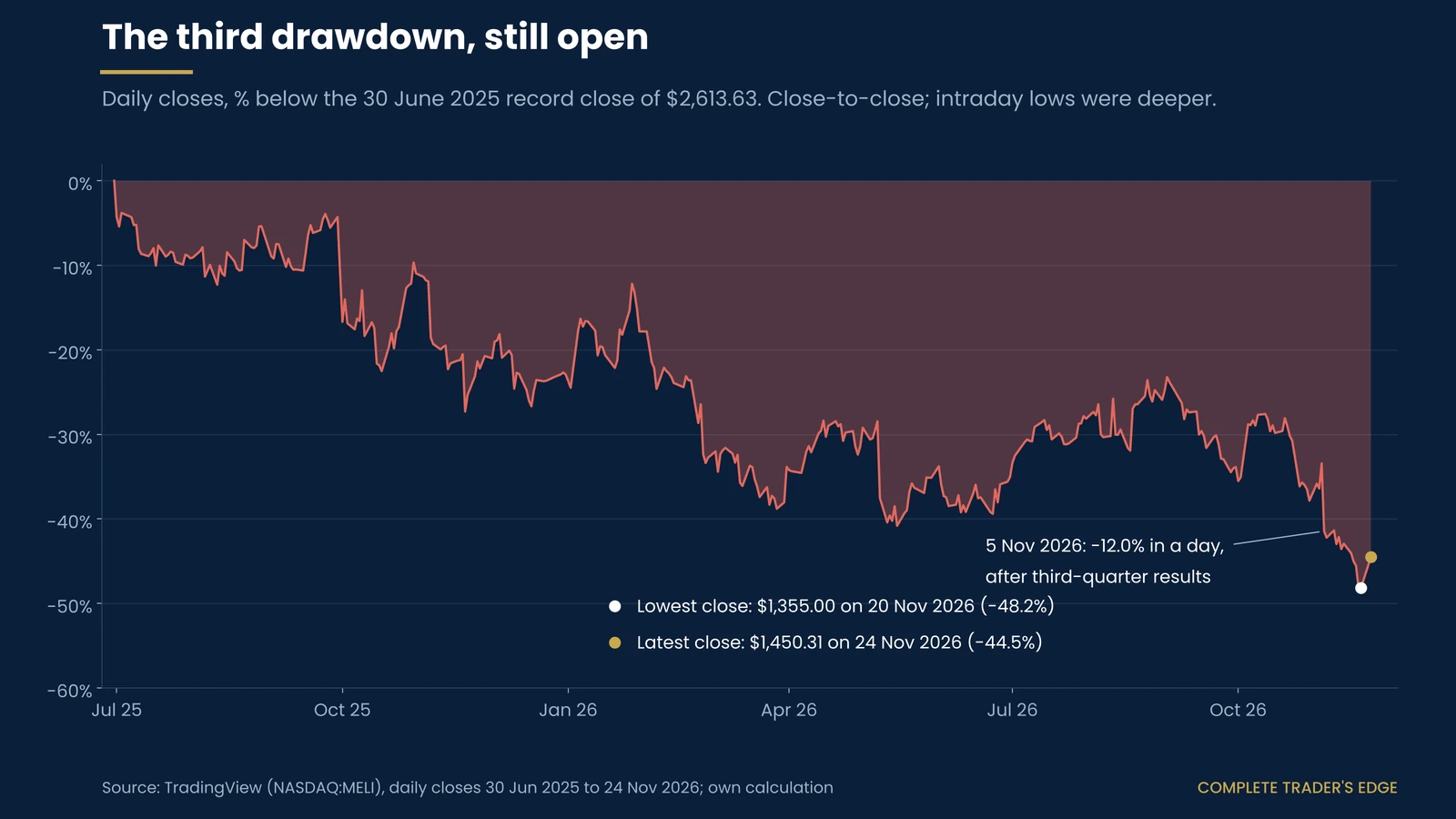
Mistake #4: “A booming business means a booming stock.” Reality: On 24 November 2026 the stock closed 44.5% below its June 2025 record, weeks after a quarter in which revenue grew 45%. Business performance and share price can diverge for years.
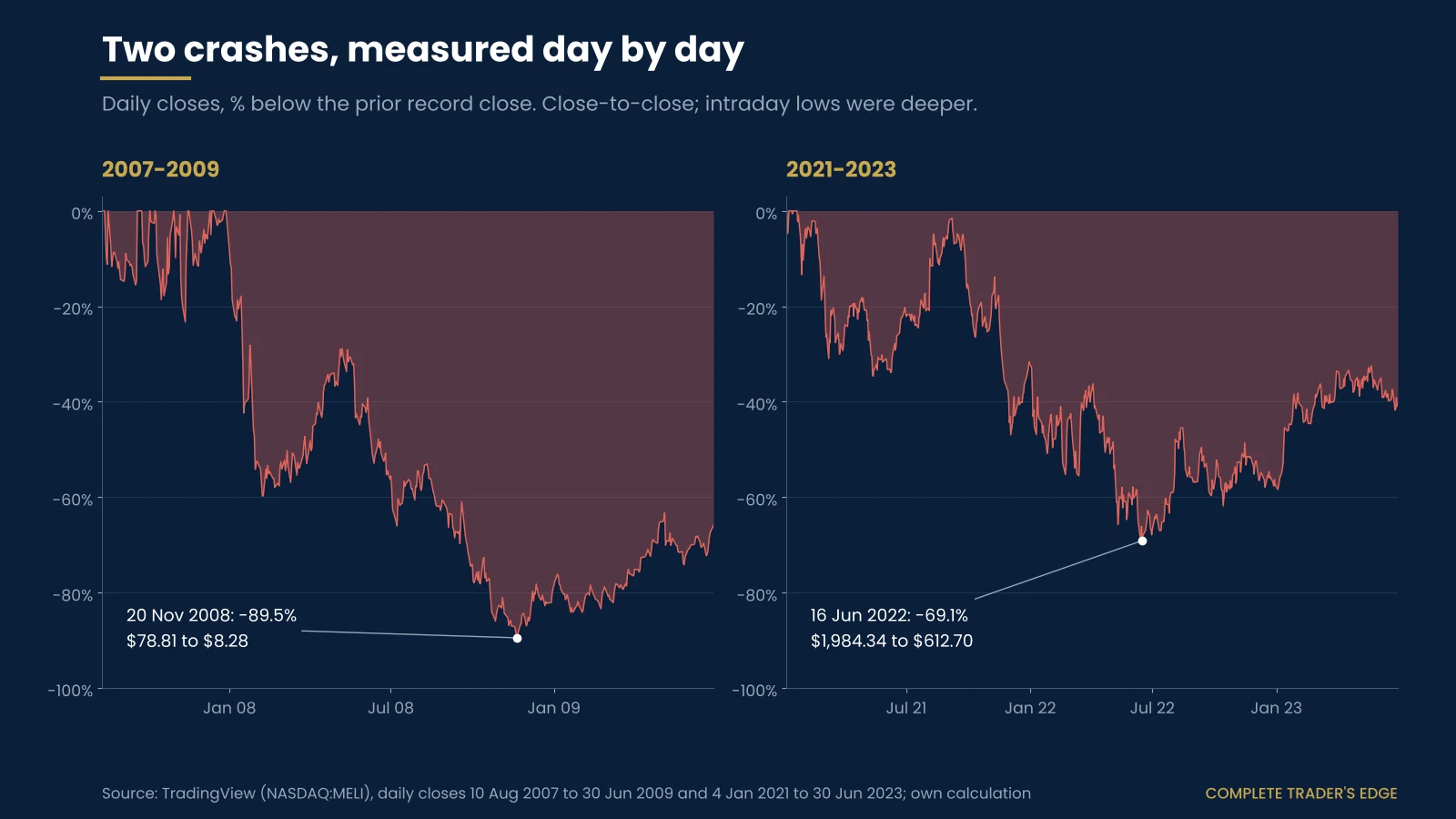
A third drawdown is still open. From the record close of $2,613.63 on 30 June 2025 the shares fell to $1,355.00 on 20 November 2026, a decline of 48.2% close to close, with an intraday low of $1,333.54 the same day. The largest single step came on 5 November 2026, the session after third-quarter results, when the stock lost 12.0%, from $1,739.88 to $1,530.28. At the 24 November close of $1,450.31 it stood 44.5% below the record. The 2008 and 2022 falls can be measured from peak to trough; this one has no confirmed trough yet.
The Honest Present
The framework demands honesty about the present, and the present holds a striking tension between a soaring business and a wary stock. As a company, Mercado Libre in 2026 is performing spectacularly, growing revenue and payment volume at rates most companies its size can only dream of, its ecosystem deepening, its fintech arm becoming a genuine banking force, its founder handing the chief-executive role to a successor in a planned transition from a position of strength. And yet the stock, after peaking above a hundred billion dollars in value, has pulled back substantially, off its highs even as the underlying numbers accelerate, a reminder that a wonderful business and a soaring stock are not the same thing.
The third-quarter report on 4 November 2026 sharpened that tension. Commerce revenue grew 47% to $6.1 billion and Mercado Pago revenue 42% to $4.6 billion. Goods sold on the marketplace came to about $23 billion, up 38% in dollars; items sold rose 36% to 867 million; payment volume rose 53% to $109 billion; Mercado Pago’s monthly active users reached about 93 million; advertising revenue grew 58%. Profit still missed analyst estimates as the operating margin fell to 6.3%, and the shares dropped 12.0% the next day.
Opinion since then has split. Scotiabank, Cantor Fitzgerald, J.P. Morgan, UBS and BofA Securities each cut their price targets in November, to between $1,600 and $2,300, while leaving their ratings unchanged. On the other side, Michael Burry was reported to have added to his holding below $1,500, and a regulatory filing showed Tiger Global raised its stake by 59.8%, to 244,626 shares, during the third quarter. The selling was not confined to one company: in the month to 24 November Nu Holdings lost 19.3% and Shopify 20.9%, and the Nasdaq-100 was down 7.6% for November. At $1,450.31 a share Mercado Libre is valued at about $73.5 billion, against trailing twelve-month revenue of about $38.5 billion (own calculation).
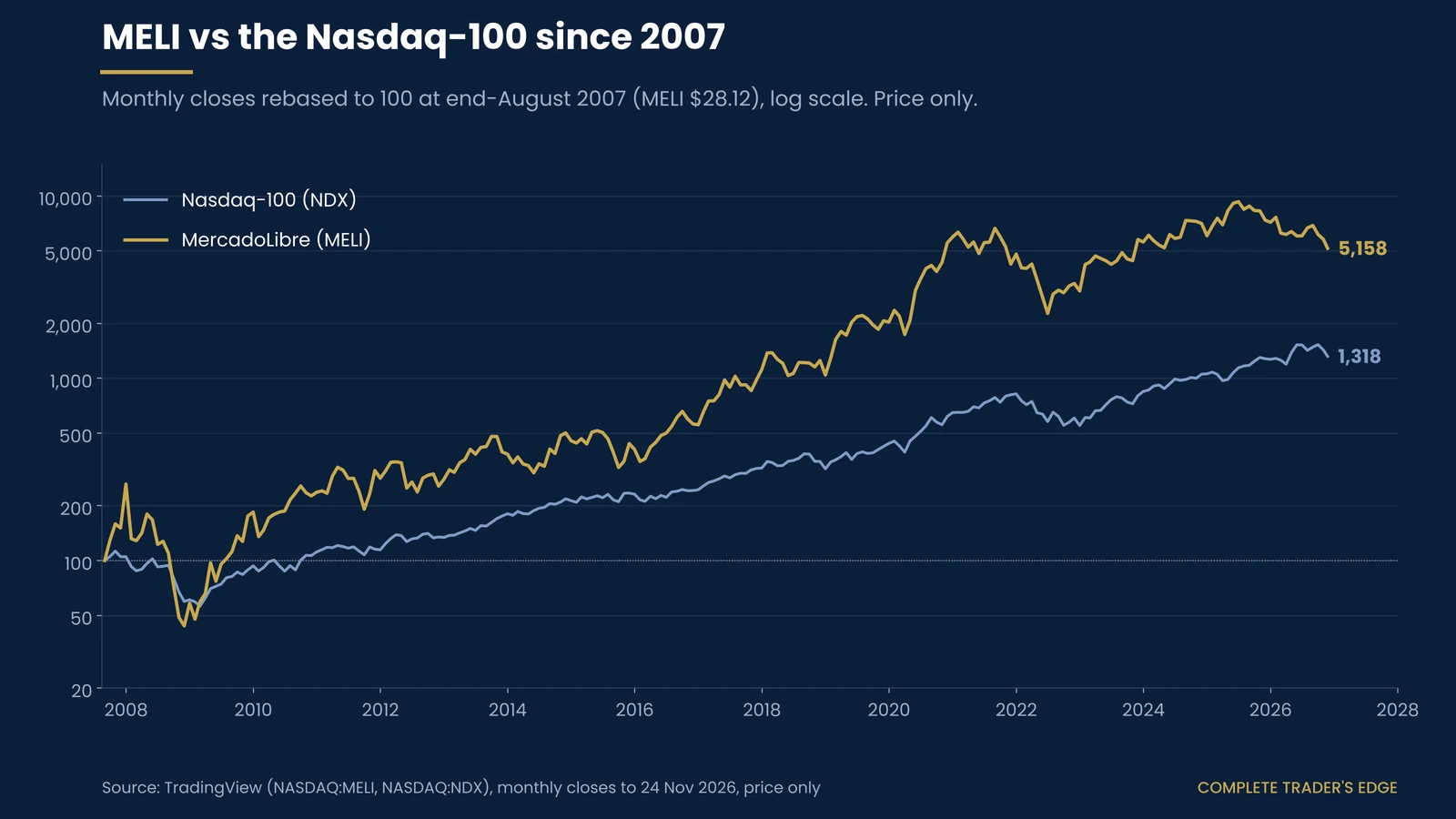
The risks behind that caution are real and worth naming: the relentless competition from the world’s biggest companies, the heavy reinvestment that compresses margins, the currency and political volatility endemic to the region, where a devaluation or a crisis in a major market can hammer results, and a credit business whose growth carries the ever-present risk of bad loans. The bull case is that Mercado Libre is still early in digitizing a continent and owns the rails to do it; the bear case is that competition and macro fragility will cap the returns. The company that built the roads is, for now, still the one collecting the tolls, but the traffic is getting crowded.
Currency risk is visible in the reported numbers. Mercado Libre reports in US dollars, and since 1 July 2018 it has treated Argentina as a highly inflationary economy for accounting, with its Argentine subsidiaries using the dollar as functional currency, so peso moves flow straight into reported results. Argentine revenue grew only 7.5% in dollars in 2024, the year after the December 2023 devaluation, then 56% in 2025.
Share prices: Mercado Libre against e-commerce and fintech peers, at the 24 November 2026 close
| Company | Share price | 1 month | Year to date | 1 year | From 52-week high |
|---|---|---|---|---|---|
| MercadoLibre (MELI) | $1,450.31 | -19.5% | -28.5% | -26.4% | -38.1% |
| Amazon (AMZN) | $252.29 | +1.4% | +9.1% | +13.4% | -12.2% |
| Sea Ltd (SE) | $64.97 | -13.6% | -50.6% | -51.0% | -56.2% |
| Nu Holdings (NU) | $11.86 | -19.3% | -30.5% | -25.9% | -37.5% |
| PDD Holdings (PDD) | $87.22 | +10.2% | -24.9% | -24.2% | -30.4% |
| Shopify (SHOP) | $132.31 | -20.9% | -18.4% | -11.2% | -26.9% |
| PayPal (PYPL) | $56.17 | -1.3% | -4.3% | -7.3% | -12.1% |
Source: TradingView, closing prices and performance figures on 24 November 2026; 52-week highs are intraday, last column own calculation. Figures move daily; not investment advice.
Why This Matters to Investors
The Greatest Companies Thesis
Every legendary company begins with an idea that looks improbable.
Every one survives a stretch where failure looks inevitable.
Every one eventually reaches a point where success looks obvious.
The opportunity exists only in the space between the second and third.
Mercado Libre is a masterclass in two ideas an investor can use anywhere. The first is that the deepest moats are often built by doing the hard, unglamorous infrastructure work that rivals avoid, payments, logistics, credit, rather than skimming the easy surface. The second is the painful gap between a great business and its stock: Mercado Libre has compounded its fundamentals relentlessly while putting shareholders through violent drawdowns, amplified by the currency and political risk of its region. The discipline it teaches is to judge the enterprise and the price separately, to recognize that emerging-market exposure magnifies every swing, and that holding a genuine compounder through such volatility demands conviction strong enough to survive the moments when the price insists you are wrong. None of this is investment advice.
Lessons in Order of Depth
On the surface: the Method
When you enter a market that lacks the basic infrastructure your business depends on, the missing infrastructure is not a reason to stay out; it is the deepest opportunity available. Mercado Libre’s rivals saw the absence of payments and logistics as an obstacle. Mercado Libre saw it as the thing to build, and in building it created a moat far wider than any marketplace alone could ever have. Look hard at what is broken or missing in a market, because the company willing to do the hard, expensive, unglamorous work of fixing it captures a position that those who merely skim the surface never can.
Below the surface: the Money
Mercado Libre is a case study in the divergence between a business and its stock, and in the patience emerging-market investing demands. The company has grown its fundamentals relentlessly, and yet its share price has put investors through gut-wrenching drawdowns, swinging far more violently than the steady business beneath it, buffeted by growth-stock sentiment and the currency and political risks of its region. The performance of a business and the performance of its stock can diverge enormously over years, emerging-market exposure amplifies every swing, and holding a great compounder through such volatility requires a conviction in the underlying enterprise strong enough to survive the moments when the price says you are wrong.
Below that: the Mind
Mercado Libre’s origin holds a lesson about the relationship between opportunity and the will to seize it. Galperin did not stumble into his company; he engineered the moment, missing the airport exit to extend a pitch, refusing to waste a chance most people would have let slip. And then he and his colleagues did the far harder thing: they committed to a decades-long project of building infrastructure in a region everyone else considered too difficult, and held that conviction through a collapse that destroyed nearly all their peers. Great enterprises are built less on brilliant ideas, the eBay-for-Latin-America concept was not novel and dozens copied it, than on the combination of seizing the opening and then possessing the patience and nerve to do the long, hard, unglamorous work the idea actually requires, through the years when survival itself is in doubt.
At the deepest level: the question it leaves us
Mercado Libre forces us to think about what it means for a single private company to become the essential infrastructure of an entire society’s economic life. The company did something of real and democratizing value: it brought commerce, payments, credit, and a measure of financial inclusion to hundreds of millions of people whom the traditional banks and retailers had ignored, genuinely expanding the economic possibilities of a continent. And in doing so it has also concentrated enormous power, becoming the marketplace, the bank, the lender, and the delivery network all at once for a huge share of a region’s population. The deepest question is the one that recurs whenever a company succeeds in building essential infrastructure: that the same concentration which makes the service so powerful and so useful also makes the society profoundly dependent on a single commercial actor, and that the line between an indispensable public good and an unaccountable private monopoly is one that a company this central to a continent’s economy will be navigating, and being judged on, for as long as it endures.
The Legendary Scorecard
Eight fixed categories, each scored out of ten. The overall is an editorial verdict, a judgment, and explicitly not a weighted average.
| Category | Score | Note |
|---|---|---|
| Founder Vision | 9 | Saw that the region’s missing infrastructure was the opportunity, not the obstacle |
| Innovation | 9 | Built payments, logistics, and credit from scratch where none existed |
| Execution | 9 | Survived the dot-com bust and out-built every rival over two decades |
| Moat | 8 | A deep ecosystem flywheel, though under assault from the world’s biggest companies |
| Capital Allocation | 8 | Relentless reinvestment into infrastructure; margin pressure is the deliberate cost |
| Wealth Creation | 9 | One of the great emerging-market compounders since the 2007 IPO |
| Durability | 7 | Resilient, but exposed to currency, political, and credit risk inherent to the region |
| Historical Importance | 8 | Brought e-commerce and financial inclusion to a continent |
| Overall Legendary | 8.0 | Editorial verdict: a great builder and emerging-market champion, with real macro risk |
At a Glance
| Origin | Marcos Galperin’s eBay-for-Latin-America, founded in a Buenos Aires garage in 1999 |
| The founding pitch | Galperin missed an airport exit to extend his pitch to investor John Muse, securing seed funding |
| The hard problem | Latin America lacked the credit cards, logistics, and trust that online commerce requires |
| The moat | It built the missing rails itself: Mercado Pago (payments/fintech), Mercado Envíos (logistics), and credit |
| The survival | Lived through the dot-com bust that killed 80+ rivals, aided by eBay’s 2001 stake |
| The IPO | Went public on the Nasdaq in 2007 at $18 a share |
| The peak | Became the most valuable company in Latin America during the 2020 pandemic surge |
| The present | $28.9B revenue in 2025 (+39%); Q3 2026 revenue $10.75B (+45%) on a 6.3% operating margin; stock 44.5% below its record close at 24 Nov 2026 |
| Status | Public (Nasdaq: MELI), based in Montevideo; founder Galperin moving to Executive Chairman in 2026 |
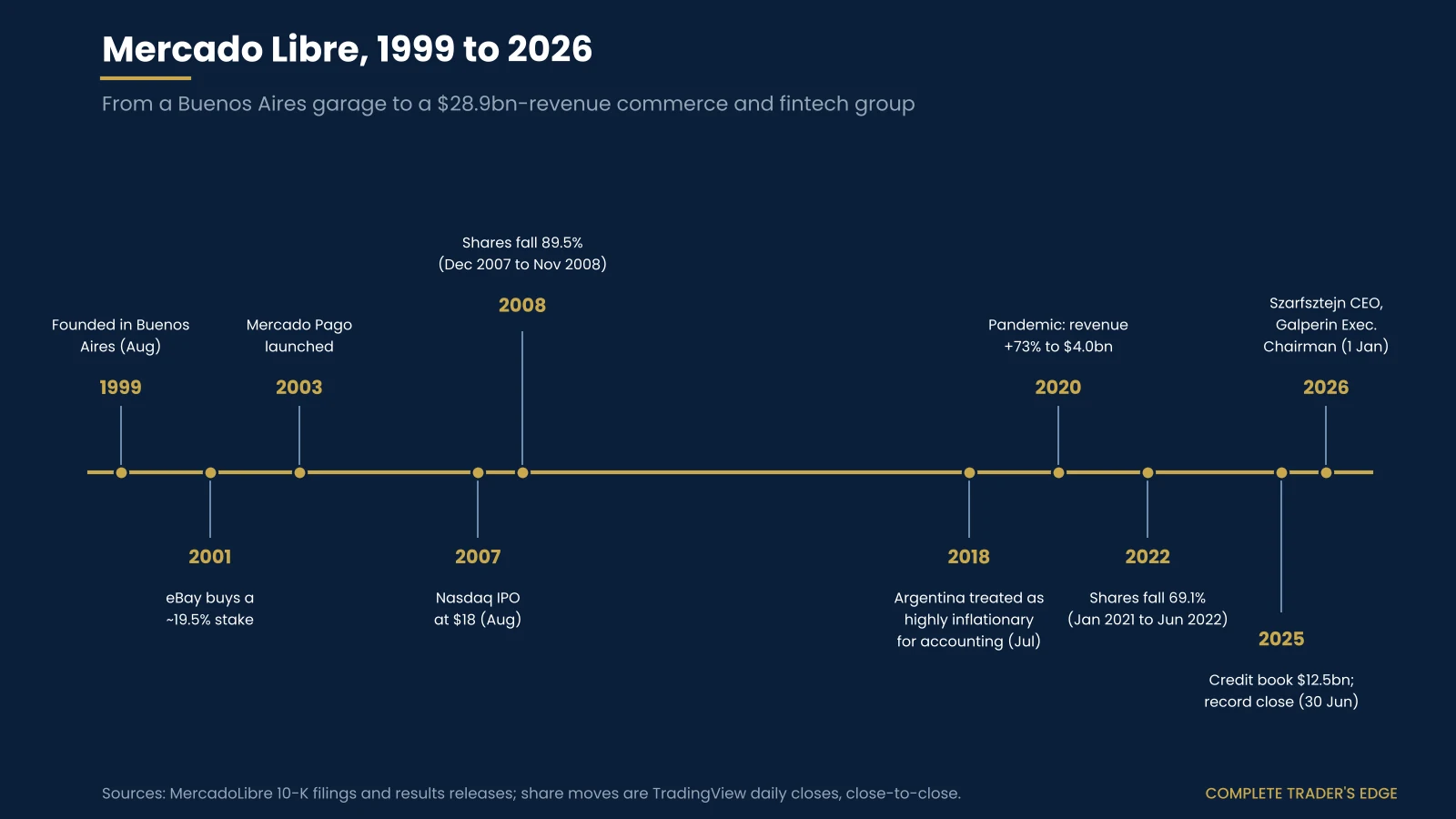
The Mercado Libre Timeline
- 1999: Marcos Galperin, a Stanford MBA student, pitches the idea and founds Mercado Libre on August 2 in a Buenos Aires garage, backed by ~$7.6M in seed capital.
- 2000: The company expands across the region just as the dot-com bubble bursts.
- 2001: eBay buys a ~19.5% stake, providing capital and credibility that help Mercado Libre survive while most rivals fail.
- 2003: It launches Mercado Pago to solve the region’s low credit-card penetration.
- 2007: Mercado Libre goes public on the Nasdaq at $18 a share.
- 2010s: It builds Mercado Envíos logistics and expands the fintech ecosystem (credit, advertising).
- 2020: It becomes the most valuable company in Latin America during the pandemic e-commerce surge.
- 2025: Revenue reaches ~$28.9 billion as it fends off Amazon and other rivals.
- 2026: Marcos Galperin steps up to Executive Chairman and Ariel Szarfsztejn becomes CEO; third-quarter revenue reaches $10.75 billion (+45%) on a 6.3% operating margin, and the shares close at $1,450.31 on 24 November, valuing the company at about $73.5 billion.
Key Numbers
Founded: 1999 (Buenos Aires) | eBay stake: ~19.5% (2001) | Mercado Pago: launched 2003 | IPO: 2007 at $18/share | FY2025 revenue: ~$28.9B | Q3 2026 revenue: $10.75B (+45% YoY) | Countries: 18 | 24 Nov 2026: share price $1,450.31, market value ~$73.5B, 44.5% below the record close. Current figures are fast-moving and should be checked against live data.
Related Reading
Mercado Libre is best read against Amazon, the global giant whose marketplace model it adapted and whose full-scale entry into Latin America it has so far held off, the rare case of a local champion defending its turf. Read it with Shopify, another commerce platform that chose to build for merchants rather than herd them, and with Visa, the payments network whose toll-bridge economics echo what Mercado Pago has built across a continent. For the underlying principle, visit our hub on network and ecosystem moats and why building the rails beats renting them.
Go Deeper
The Complete Trader’s Edge book builds the full Mind, Method, and Money framework that turns stories like this into a repeatable way of reading any company. Mercado Libre teaches you to find the moat in the infrastructure rivals refuse to build, and to separate a soaring business from a stumbling stock; the book teaches you the discipline to act on both.
★ Now in Kindle, Paperback & Hardcover
Greatest Companies
This story is one of fifty-one. The full book reads every legendary company through a single lens — Moat, Meltdown, Machine — from Standard Oil to SpaceX. Fifty-one companies, eight kinds of moat, one framework.
Kindle · $9.99 →
Paperback · $24.99 →
Hardcover · $34.99 →
Explore the Book →
This article is part of the Greatest Companies series, adapted from the book Greatest Companies, now available on Kindle.
Frequently Asked Questions
Who founded Mercado Libre, and when?
Mercado Libre was founded on August 2, 1999, in Buenos Aires by Marcos Galperin, then a Stanford MBA student, along with co-founders including Hernán Kazah and Stelleo Tolda. Galperin famously secured early backing by pitching investor John Muse during a car ride to the airport, deliberately missing the exit to extend the conversation.
What is Mercado Libre’s real competitive moat?
Its ecosystem of self-built infrastructure. Because Latin America lacked reliable credit cards, logistics, and trust for online commerce, Mercado Libre built those rails itself: Mercado Pago for payments and fintech, Mercado Envíos for logistics, and a credit business. These interlocking services reinforce one another into a flywheel that a single-product competitor cannot easily replicate.
How did Mercado Libre survive the dot-com crash?
It launched at the peak of the dot-com bubble and was barely a year old when it burst. While more than 80 regional competitors failed, Mercado Libre survived through disciplined cash management and, crucially, a 2001 investment from eBay, which bought roughly a fifth of the company, providing capital and credibility when funding had dried up everywhere.
Can Mercado Libre fend off Amazon in Latin America?
So far, yes. Amazon has invested heavily in Mexico and the region, but Mercado Libre’s deep local infrastructure, payments and logistics built for Latin American realities, regional knowledge, and fintech ecosystem have allowed it to defend its lead, a rare example of a homegrown company holding off the global disruptor on its own turf. Competition remains intense.
Is Mercado Libre a strong company in 2026?
As a business, it is thriving: roughly $28.9 billion in 2025 revenue, up 39% on 2024, with growth of about 49% in the first half of 2026 and 45% in the third quarter, when revenue reached $10.75 billion. Its stock tells a different story: at $1,450.31 on 24 November 2026 it was 44.5% below its June 2025 record close, after the third-quarter operating margin fell to 6.3% from 9.8% a year earlier. The risks include intense competition, heavy reinvestment that pressures margins, and the currency and political volatility of its region. None of this is investment advice.
 The Complete Trader's Edge
The full Mind · Method · Money framework. 70 chapters.
View on Amazon →
 Market Mayhem
400 years of bubbles, crashes, and the pattern that keeps repeating.
Buy on Amazon →
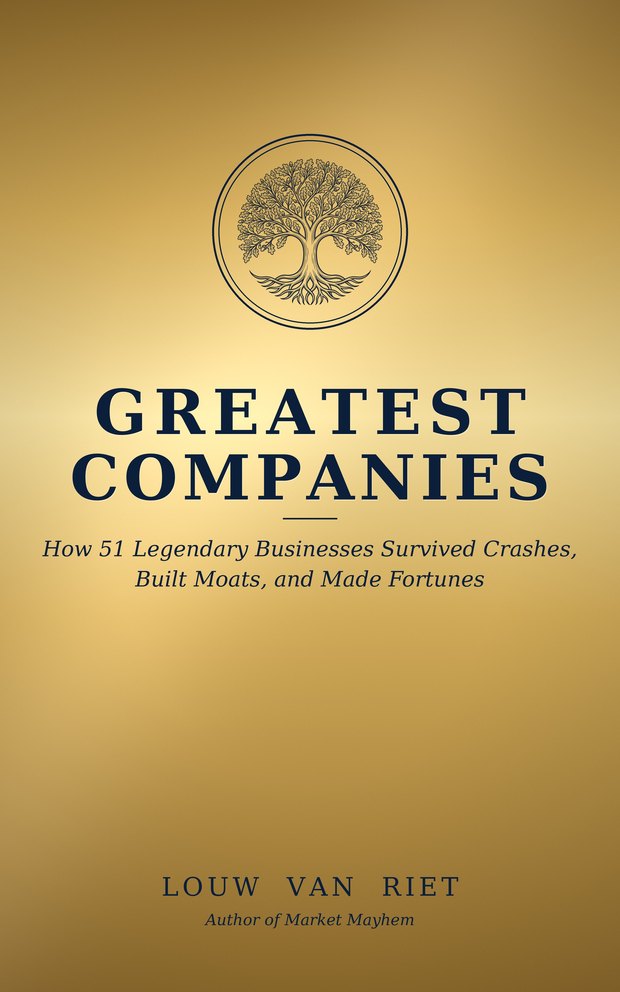 Greatest Companies
How the world's greatest companies were built — and what traders learn from them.
View on Amazon →
 Greatest Traders
Eighty-six lives that explain the markets — Livermore to Madoff, told with the losses left in.
View on Amazon →