

Greatest Companies · Episode 21 · Shopify
▶ Watch on YouTube🎵 Listen on Spotify
Also available on Apple Podcasts · Amazon Music · iHeart Radio
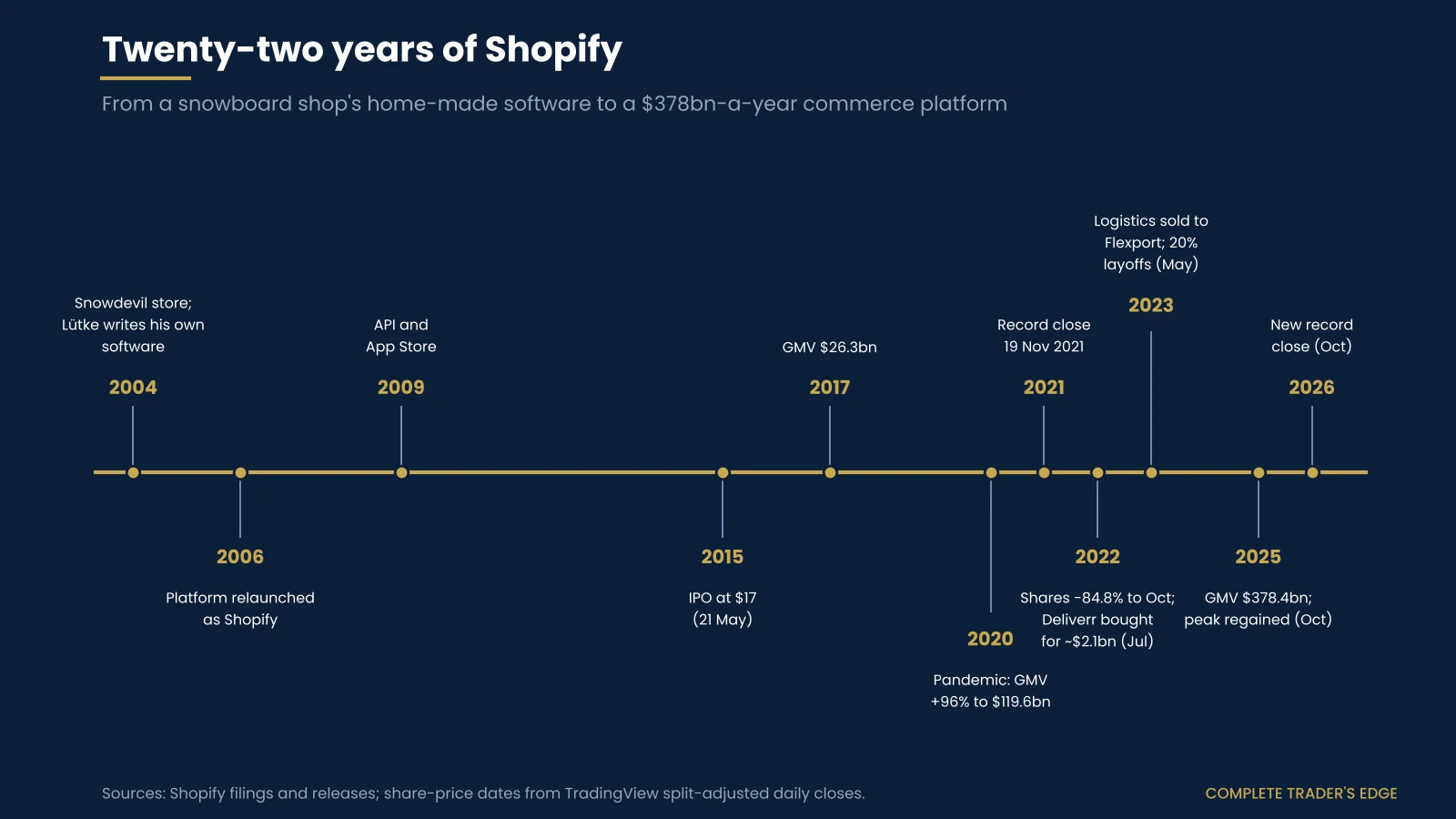
In 2004, a young German programmer living in Ottawa tried to open an online store to sell snowboards, and discovered that the software to do it was terrible.
His name was Tobias Lütke, Tobi to everyone, and he was a coder by instinct and training, a disciple of the elegant systems-design philosophy he had absorbed from the world of video-game programming. He and a partner, Scott Lake, wanted to sell snowboarding gear online through a store they called Snowdevil. But the e-commerce tools available in 2004 were, to a craftsman like Lütke, unusable: clunky, expensive, inflexible, clearly built by people who did not care. So Lütke did the thing that programmers do. Rather than suffer the bad tool, he built his own, using a then-new and unproven web framework called Ruby on Rails, which he helped develop and which gave him the power to create something clean and flexible in a matter of months.
The snowboard store opened. And then something happened that changed everything, though it took the founders a while to see it. Other merchants, looking at Snowdevil, did not ask about the snowboards. They asked about the software. They wanted to know if they could use the thing Lütke had built to run their own online stores. And slowly the realization dawned, the realization that is the hinge of the entire story: the tool was worth more than the business it was built to serve. The snowboards were a footnote. The software was the company. In 2006 the founders relaunched the platform itself, under the name Shopify, and set out to sell not snowboards but the ability to sell anything.
📄 Free Download · Company Research Sheet
Shopify Research Sheet (PDF)
The moat, the meltdown, the Legendary Scorecard, the timeline, and the Move, Money and Mind lessons from this story. Free, no email required.
The Bet: Arm the Rebels
To understand why Shopify matters, you have to understand the choice it made about how to win, because it was the opposite of the choice almost everyone else was making.
The dominant force in online commerce was the great marketplace, the model perfected by Amazon: a single colossal destination where hundreds of millions of customers came to buy, and where merchants were tenants, renting access to that traffic in exchange for fees, for the surrender of the customer relationship, and for the constant risk that the marketplace would study their best-selling products and simply make its own. The marketplace owned everything: the customer, the data, the relationship, the brand. The merchant was a commodity, interchangeable and disposable, feeding a giant that could turn on it at any moment.
Shopify bet on the rebels. Its premise was that many merchants did not want to be tenants in someone else’s empire; they wanted to own their own stores, their own brands, their own relationships with their own customers, and they simply lacked the technical means to build the infrastructure that independence required. So Shopify would provide that infrastructure, the storefront, the shopping cart, the payment processing, the inventory and shipping tools, everything a merchant needed to run an independent business, as easy-to-use software anyone could rent for a modest monthly fee. The company’s own people came to describe the mission in exactly these terms: while the great marketplace was building an empire, Shopify was arming the rebels who wanted no part of it. It would help the small and the independent stand on their own, and it would make its money not by extracting value from them but by enabling them. This was not charity; it was a profoundly clever alignment of incentives, and it became the source of the moat.
It is worth pausing on the founder, because Shopify is in large part an expression of one man’s temperament. Lütke was, and remained, a builder above all, a programmer who thought in systems and prized craft, and he stamped that sensibility on the company. The decisive early move that turned Shopify from a product into a platform flowed directly from this builder’s instinct: in 2009 the company opened an API and launched an App Store, inviting outside developers to extend the platform in ways Shopify itself never could. That single decision, trusting a community of builders to add what merchants needed, is what seeded the ecosystem that became the moat.
The Moat: Profiting Only When the Merchant Profits
Shopify’s genius was to tie its own fortunes directly to the success of its merchants, and to do it in a way that grew stronger as the platform grew larger.
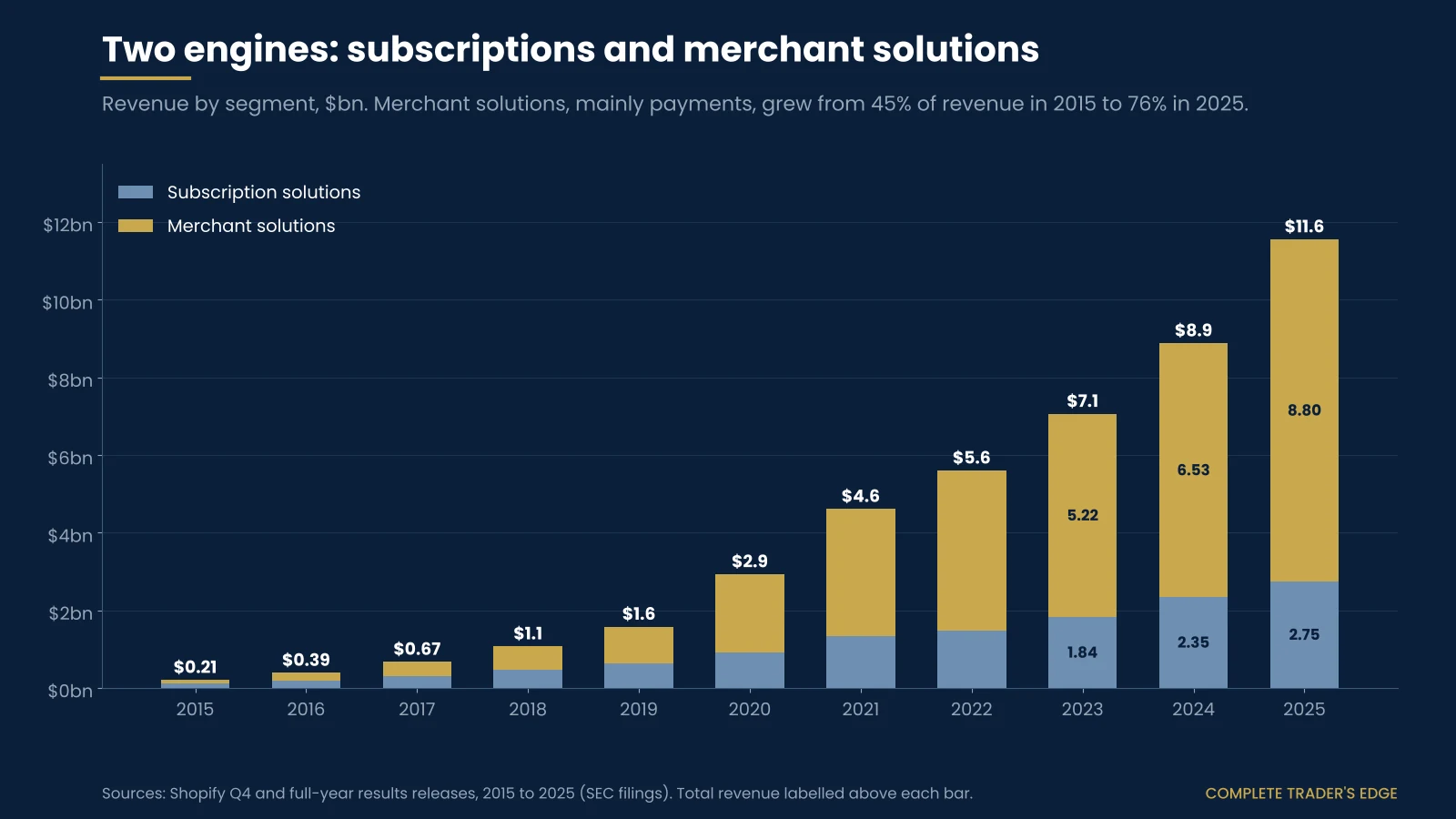
The model had two engines. The first was subscription software: merchants paid a recurring fee for the platform, predictable revenue that grew with every new store. But the second engine was the deeper one. Shopify made an increasing share of its money from what it called merchant solutions, above all from payment processing, taking a small slice of every transaction that flowed through its merchants’ stores. This meant that Shopify prospered precisely and only when its merchants prospered. When a Shopify store sold more, Shopify earned more. The company sat not as a landlord extracting rent regardless of the tenant’s fortunes but as a partner whose income rose and fell with the success of the businesses it served.
The flywheel of an ecosystem
As Shopify grew, it attracted developers building apps and themes, agencies offering services, and payment and shipping partners, all of which made the platform more valuable to merchants, which attracted more merchants, which attracted more developers. Round and around.
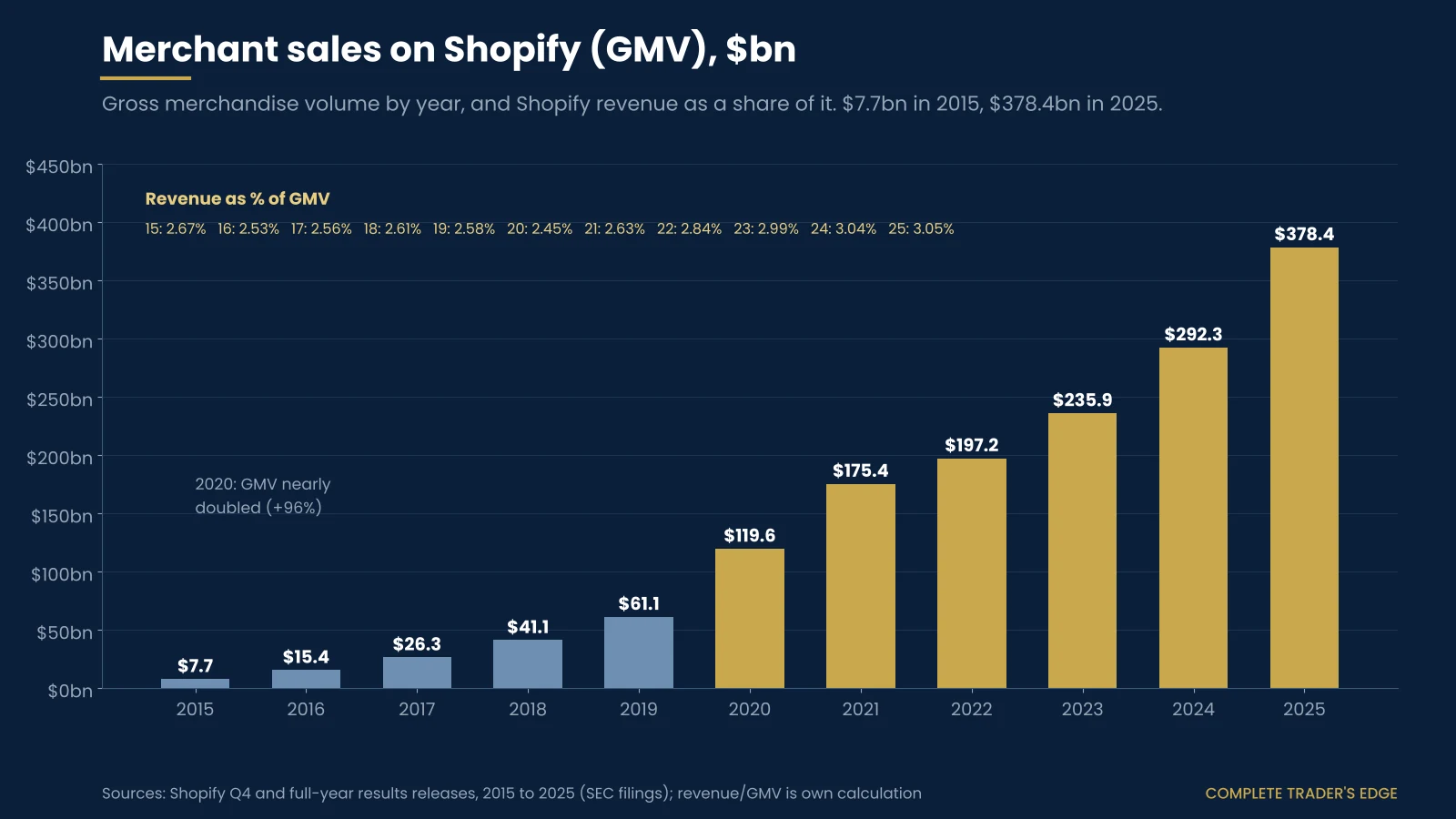
And once a merchant had built its entire business on Shopify, its store, operations, customer data, and installed apps, the cost of ripping all of that out and moving elsewhere became prohibitive. The merchant stayed not because it was trapped but because leaving meant rebuilding everything. In 2025 alone merchants sold $378 billion of goods through the platform, and from 2015 to 2025 the total came to more than $1.5 trillion, an ecosystem a newcomer simply could not replicate.
The Rocket, and the Bubble
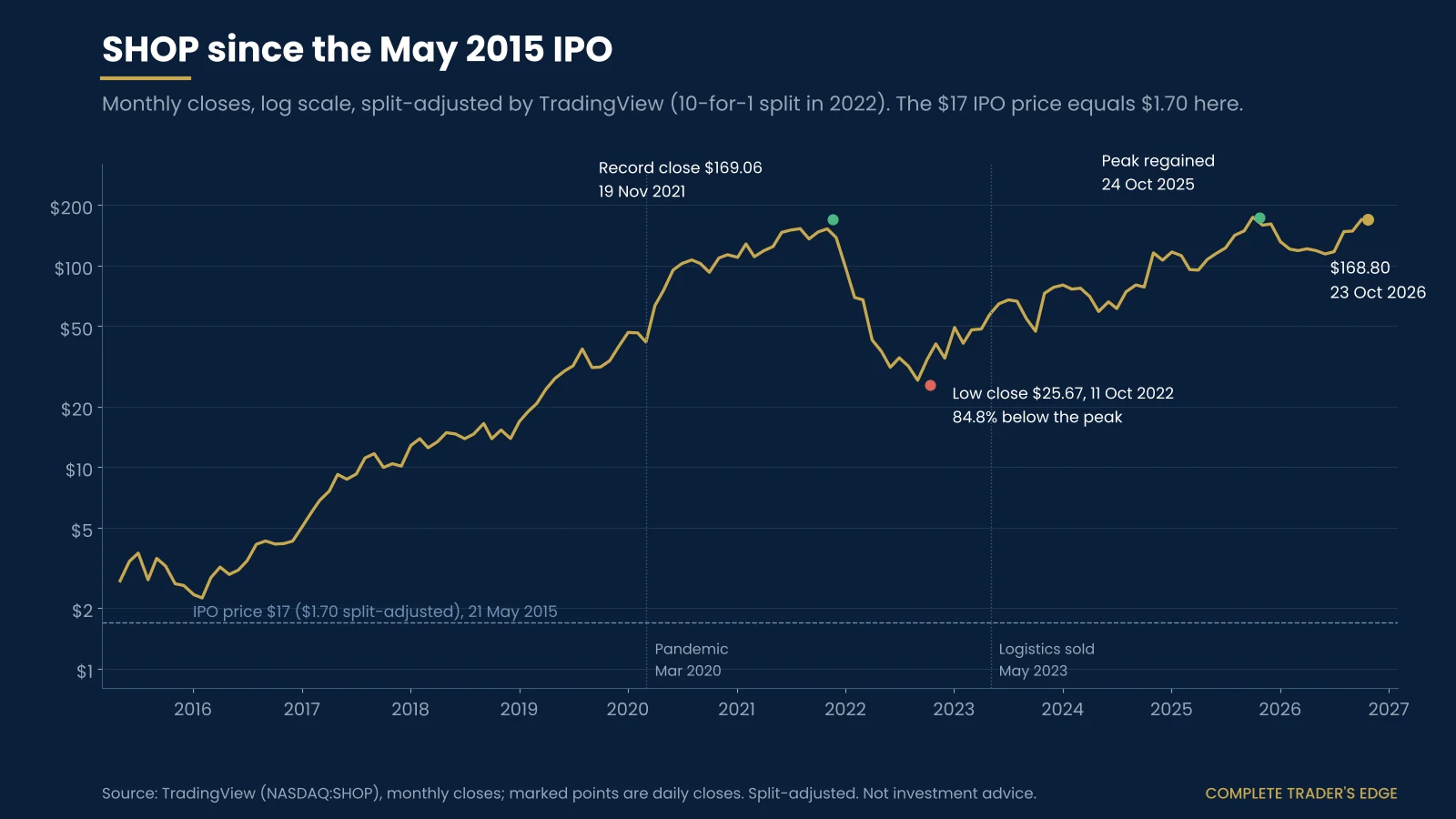
For years Shopify grew quietly and impressively. It went public in 2015 at seventeen dollars a share, valuing the company at a little over a billion dollars, and it compounded from there as more and more merchants discovered they could build real businesses on it. Then came 2020, and the pandemic, and an event that looked at the time like a miracle and turned out to be a trap.
When the world locked down, commerce moved online almost overnight, at a scale and speed no one had forecast. Shopify was the infrastructure of independent online selling, and its business exploded. Merchants flooded in. Sales volumes soared. And the stock, swept up in the broader mania for pandemic-era technology winners and the era of near-zero interest rates, went vertical, rising to a peak that valued the company at more than two hundred billion dollars and made it, briefly, the most valuable company in Canada. The narrative was that the pandemic had permanently accelerated the future, that the explosive growth was the new baseline, and that Shopify would compound from this height forever. It was, in significant part, a bubble.
The Crash, and the Wrong Turn
In 2021 and 2022, as the pandemic eased and interest rates rose sharply, the entire edifice of high-growth, high-valuation technology stocks collapsed, and few fell harder than Shopify. The pandemic surge in online selling reversed as shoppers returned to physical stores. The growth rates the bubble valuation had assumed would continue forever decelerated sharply. And the stock, which lives and dies on expectations of future growth, was annihilated, falling 84.8 percent from its record close in November 2021 to its low close in October 2022, erasing well over a hundred billion dollars of value and devastating anyone who had bought into the euphoria near the top.
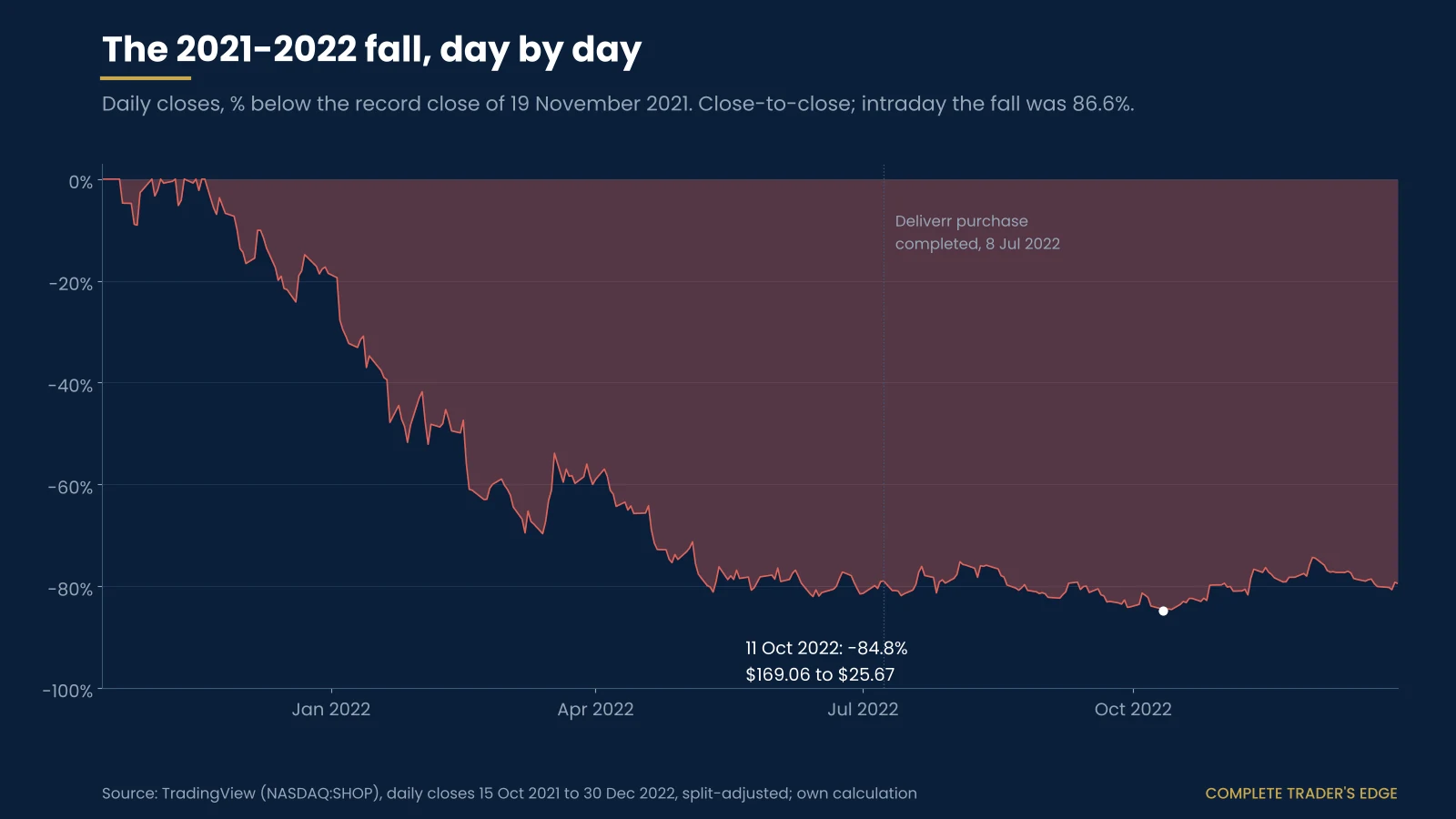
And then, in the middle of this, Shopify made a serious strategic mistake. Reading the pandemic boom as permanent, and seeking to compete more directly with Amazon’s formidable logistics, the company spent enormous sums building and buying its way into the warehousing and shipping business, most prominently through the roughly two-billion-dollar acquisition of a logistics company called Deliverr in 2022. It was a bet that Shopify needed to own the physical fulfillment of its merchants’ orders the way Amazon did. It was also a betrayal of the company’s entire logic, a capital-intensive, low-margin, operationally brutal business utterly unlike the elegant software platform that was Shopify’s true nature.
Decision Point: it is 2023, and you are the founder.
You made a large, expensive, public bet on logistics, and within a year it has become clear it was a mistake: you waded into a business that does not suit you and that is destroying value. You face a choice:
A. Defend the decision. Ego, sunk cost, and the fear of looking foolish all demand it. Pour in more money and make it work.
B. Admit publicly that you were wrong, reverse course, swallow the loss, and refocus on what you actually are.
C. Quietly wind it down over years to avoid the embarrassment of a sharp reversal.
This is a thought experiment about humility under sunk cost, not investment advice. The hardest thing in business is to abandon a course you have committed to publicly. Most leaders cannot do it.
The Reversal, and the Discipline of Knowing What You Are Not
Shopify chose humility, and it is to the company’s lasting credit. In 2023 it sold its logistics business, effectively writing off the better part of its expensive acquisitions, and laid off around a fifth of its workforce in a wrenching but decisive refocusing. Lütke framed it with unusual candor, calling the whole logistics adventure a side quest, a distraction from the main quest of building the best commerce software in the world, and declared that the company was returning to its true nature. It was an admission of error of a kind that most leaders and most companies cannot bring themselves to make, and it was exactly right.
The lesson here is one of the most underrated in business: that knowing what business you are not in is as important as knowing what business you are. Shopify’s near-fatal strategic wound was self-inflicted, the result of forgetting, in the intoxication of the boom, that it was a software company and not a logistics company. Its recovery began the moment it remembered. Freed of the logistics albatross, the company’s profitability and cash flow improved dramatically, the market’s confidence returned, and the stock recovered all of its lost ground, closing above its 2021 peak again in October 2025. The crash had been a story about valuation and the macro cycle, not about the company being broken. The wrong turn into logistics had been a story about discipline, and the company passed the test by reversing it.
What Everyone Got Wrong
Shopify has been misjudged from both directions.
Mistake #1: “The great marketplace will crush any platform for independent merchants.” Reality: Millions of businesses chose, and paid for, independence. The rebels did not need to beat the empire; they needed to opt out of it.
Mistake #2: “Pandemic growth is the new permanent baseline.” (2020-21) Reality: The surge reversed, the bubble burst, and the stock fell ~85%.
Mistake #3: “Shopify should own logistics like Amazon does.” Reality: It was a costly betrayal of the company’s software nature, written off and reversed within a year.
Mistake #4: “An 85% crash means the company is broken.” Reality: The business was healthy throughout; the crash was a verdict on the price, not the platform. The stock recovered strongly once the macro turned and focus returned.
The Honest Present
The framework demands honesty about the present, and the present is a company that has matured impressively but faces a real and open question. By 2026 Shopify is thriving as a business, with annual revenue around eleven and a half billion dollars growing at roughly thirty percent, processing hundreds of billions in merchant sales, generating strong cash flow, and having proven its model resilient. It powers a vast share of independent online commerce across more than a hundred and seventy countries. But it trades at a rich valuation that once again prices in years of continued strong growth, leaving it vulnerable to the same sentiment swings that savaged it before. The shares took almost four years to win back their losses, first closing above the November 2021 peak on 24 October 2025, and set a new record close on 12 October 2026.
Shopify and e-commerce peers at 23 October 2026
| Company | Market value | P/E (TTM) | Revenue (TTM) | Share price YTD |
|---|---|---|---|---|
| Shopify (SHOP) | $217bn | 116 | $12.9bn | +4% |
| Amazon (AMZN) | $2,690bn | 20 | $775.7bn | +8% |
| Alibaba (BABA) | $247bn | 24 | $149.5bn | -35% |
| PDD Holdings (PDD) | $113bn | 9 | $64.5bn | -32% |
| MercadoLibre (MELI) | $92bn | 49 | $35.2bn | -11% |
| eBay (EBAY) | $54bn | 25 | $12.1bn | +39% |
| Sea Ltd (SE) | $46bn | 28 | $27.7bn | -43% |
Source: TradingView, 23 October 2026 (intraday). Revenue for non-US-dollar reporters is converted to US dollars by TradingView. Figures change daily. Not investment advice.
And it now faces the defining question of the next era: artificial intelligence is beginning to change how people discover and buy things, with shoppers increasingly starting their searches inside AI assistants rather than on the open web, and Shopify is racing to make itself the commerce layer of that new world, structuring its merchants’ product data so AI agents can surface and sell it. Whether AI becomes Shopify’s greatest opportunity, extending its arm-the-rebels mission into a new medium, or a threat that disintermediates its merchants, is the unresolved question on which its next decade depends. The platform that armed the rebels of the web must now arm them for the age of the machine.
Why This Matters to Investors
The Greatest Companies Thesis
Every legendary company begins with an idea that looks improbable.
Every one survives a stretch where failure looks inevitable.
Every one eventually reaches a point where success looks obvious.
The opportunity exists only in the space between the second and third.
Shopify is a uniquely instructive case because its great drawdown was not a verdict on the company at all, but on the price. The business was excellent throughout the 85% crash; what failed was the bubble valuation that had priced in an impossible future. Studying Shopify trains the single most important discipline in investing: separating the quality of a business from the price of its stock, and remembering that even a wonderful company can be a ruinous investment if bought in a euphoria. It also teaches the rarer lesson of the reversal, that the willingness to admit a costly mistake and undo it is itself a sign of a company worth trusting. Watch what leaders do when they are wrong; it tells you more than what they do when they are right.
Lessons in Order of Depth
On the surface: the Method
There is more than one way to win a market, and the most obvious, owning the customer directly, is not the only one. Shopify won by enabling rather than controlling, by giving its customers independence rather than capturing them, and by aligning its profit completely with theirs. In any ecosystem there is often as much value, and sometimes a deeper position, in being the indispensable supplier of tools to a thousand competitors as in trying to beat them all directly. Arm the rebels, and you profit whichever rebel wins.
Below the surface: the Money
Shopify is a vivid lesson in the brutal relationship between a great company and a great price. The business was genuinely excellent throughout, and yet an investor who bought at the 2021 peak had lost about 85 percent of their money by the October 2022 low, because the price already embedded a future too optimistic to be met. The drawdown was not a verdict on the company; it was a verdict on the valuation. Separate the quality of a business from the price of its stock, remember that even a wonderful company can be a terrible investment if bought at the wrong moment, and respect that the macro cycle and the prevailing euphoria can matter as much in the medium term as the underlying merit.
Below that: the Mind
Shopify’s defining psychological moment was not the crash but the reversal, the founder’s willingness to stand up and say, in public, that he had made an expensive mistake and was undoing it. The hardest thing in business, and in life, is to abandon a course you have committed to publicly, because ego, sunk cost, and the fear of looking foolish all conspire to make you double down on error. The temperament that wins is the one that can hold a strong conviction and still change its mind fast when the facts demand it, that prizes being right over having been right.
At the deepest level: the question it leaves us
Shopify poses the question of identity, of knowing what you truly are, which turns out to be one of the deepest disciplines in any endeavor. The company’s worst wound came from forgetting its own nature, from being seduced, in a moment of triumph, into trying to be something it was not. Its salvation came from remembering. Much of wisdom consists in knowing your own essential nature and refusing the constant temptation to betray it for something that looks, in a heady moment, more impressive. The deepest thing Shopify teaches is that strength comes not from doing everything but from knowing, with clarity and discipline, what is yours to do and what is not, and that the courage to say “this is not who we are” and walk away from a costly mistake is, in the end, a rarer and more valuable trait than the ambition that made the mistake.
The Legendary Scorecard
Eight fixed categories, each scored out of ten. The overall is an editorial verdict, a judgment, and explicitly not a weighted average.
| Category | Score | Note |
|---|---|---|
| Founder Vision | 9 | Saw that the tooling was the business, and bet on merchant independence against the marketplace |
| Innovation | 9 | Built the dominant independent-commerce platform and its developer ecosystem |
| Execution | 8 | Largely excellent; the logistics misadventure was a real but corrected stumble |
| Moat | 8 | Network effects and switching costs; strong but facing AI-era disruption questions |
| Capital Allocation | 7 | The Deliverr error dents the record; the fast, honest reversal partly redeems it |
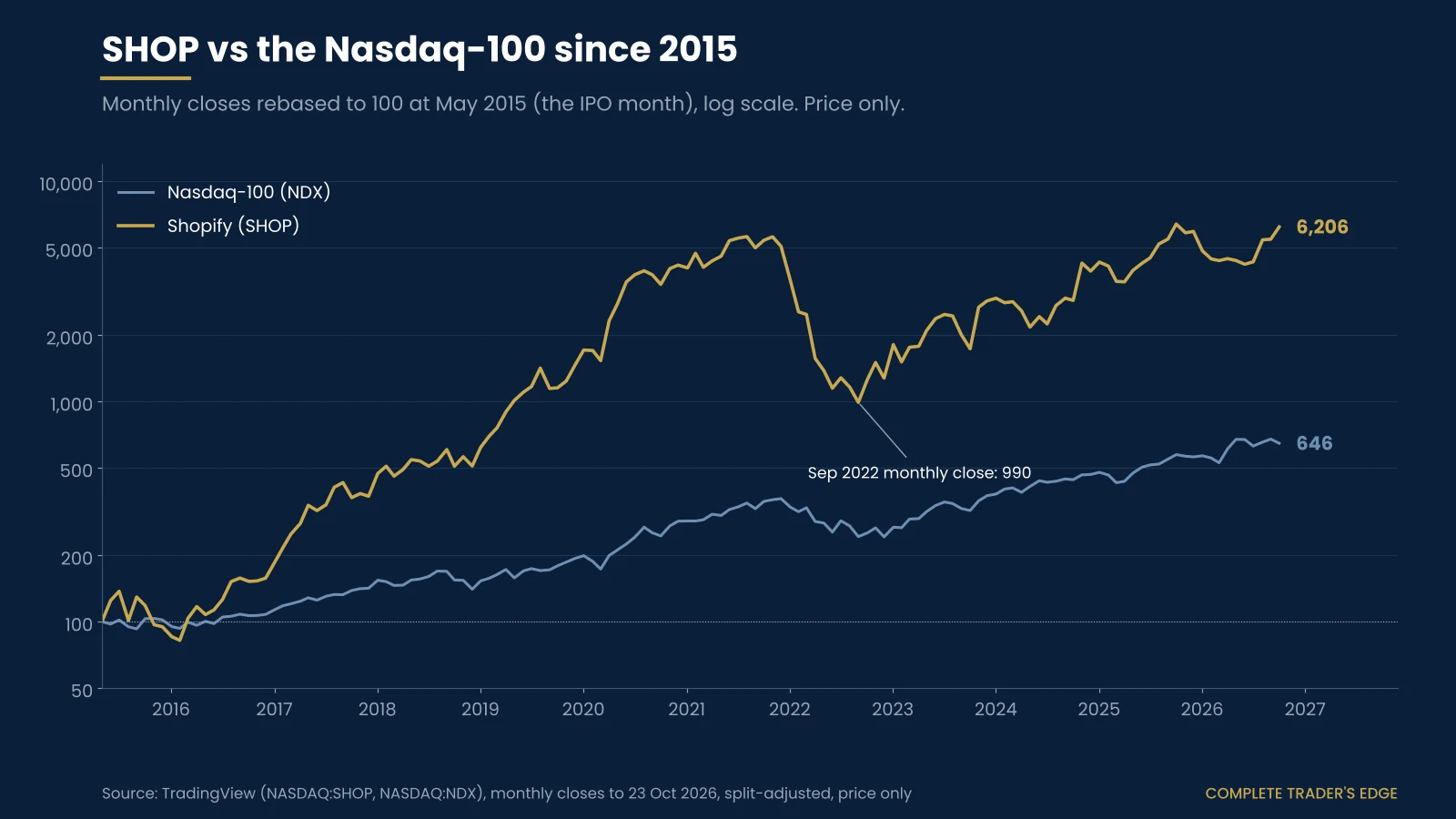
| Wealth Creation | 8 | Enormous returns since the 2015 IPO, through a brutal ~85% round trip |
| Durability | 7 | Resilient and profitable, but younger and less battle-tested than the oldest legends |
| Historical Importance | 8 | Democratized online commerce and enabled a generation of independent merchants |
| Overall Legendary | 8.0 | Editorial verdict: a genuinely great platform; a younger legend still being written |
At a Glance
| Origin | Grew out of Tobi Lütke’s frustration building the Snowdevil snowboard store (2004); launched as Shopify in 2006 |
| The realization | The software to run the store was worth more than the store itself |
| The bet | “Arm the rebels”: give independent merchants the tools to own their own stores rather than rent space in a marketplace |
| The moat | A platform that profits only when its merchants profit; network effects and switching costs |
| The IPO | Went public in 2015 at $17 a share |
| The bubble | Pandemic-era growth drove the value above ~$200B by 2021 |
| The crash | The stock fell ~85% (close to close, Nov 2021 to Oct 2022) as the bubble burst and rates rose |
| The wrong turn | A ~$2.1B push into logistics (Deliverr, 2022), reversed and sold within a year as a “side quest” |
| The present | ~$11.6B revenue growing ~30%, ~$378B in merchant sales, racing to become the commerce layer of the AI era |
| Status | Public (Nasdaq/TSX: SHOP); Ottawa, Canada; Tobi Lütke still CEO |
The Shopify Timeline
- 2004: Tobi Lütke, frustrated by the available software, builds his own platform to run an online snowboard store called Snowdevil.
- 2006: The founders launch the platform itself as Shopify.
- 2009: Shopify opens an API and App Store, becoming a true platform.
- 2015: Shopify goes public at $17 a share.
- 2020: The pandemic drives an explosion in online selling and the stock soars.
- 2021: Shopify’s value peaks above ~$200 billion in the bubble.
- 2022: The bubble bursts and the stock falls ~85% from its November 2021 peak by October; Shopify buys the logistics company Deliverr for ~$2.1 billion.
- 2023: It reverses course, sells its logistics business, calls it a “side quest,” and lays off ~20% of staff.
- 2025: Revenue reaches ~$11.6 billion (up ~30%) on ~$378 billion of merchant sales, with strong free cash flow.
- 2026: The shares set a new record close on 12 October; Shopify is worth about $217 billion (23 October) and is positioning itself for the AI-commerce era.
Key Numbers
Founded: 2006 (from Snowdevil, 2004) | IPO: 2015 at $17/share | Bubble peak: above ~$200B (2021) | Crash: ~85% (2021-22) | Deliverr: ~$2.1B (2022), sold 2023 | FY2025 revenue: ~$11.6B (~30% growth) | GMV: ~$378B in 2025, >$1.5T over 2015-2025 | 2026: market value about $217B (23 October 2026). Current figures are fast-moving and should be checked against live data.
Related Reading
Shopify is best read against Amazon, the great marketplace whose empire-building model it defined itself in opposition to, arming the rebels who wanted no part of being tenants. For the same lesson Shopify’s crash teaches, that even a great company can be a terrible buy at the wrong price and demands the nerve to hold through brutal drawdowns, see Nvidia and Tesla, whose investors faced the same test of separating business quality from stock price through violent swings. For the underlying principle, visit our hub on surviving drawdowns and why valuation and the macro cycle matter as much as the story.
Go Deeper
The Complete Trader’s Edge book builds the full Mind, Method, and Money framework that turns stories like this into a repeatable way of reading any company. Shopify teaches you to separate a great business from a great price, and to value the humility to reverse a costly mistake; the book teaches you the discipline to act on both.
★ Now in Kindle, Paperback & Hardcover
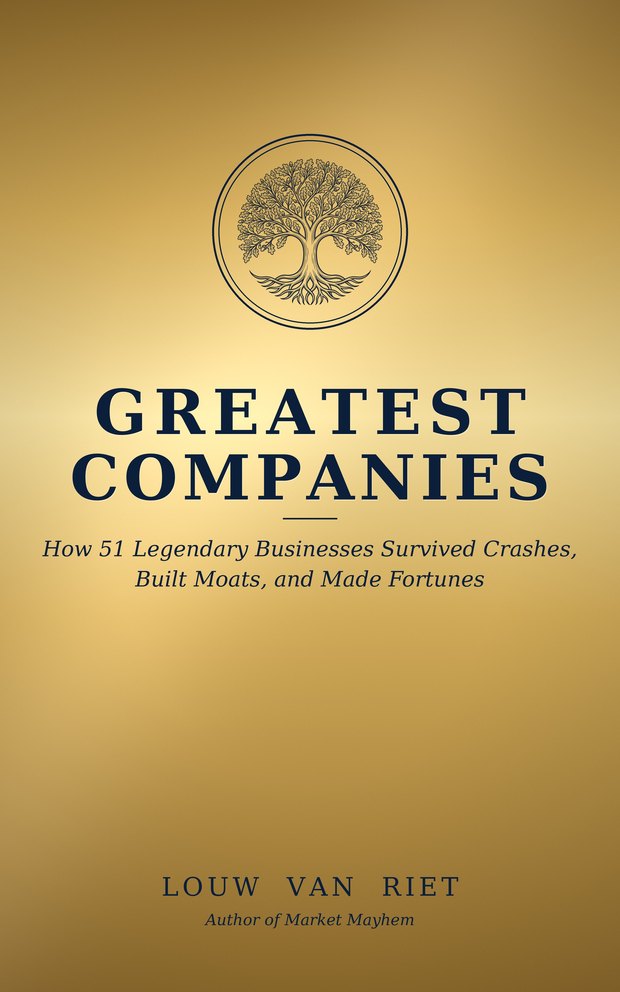
Greatest Companies
This story is one of fifty-one. The full book reads every legendary company through a single lens — Moat, Meltdown, Machine — from Standard Oil to SpaceX. Fifty-one companies, eight kinds of moat, one framework.
Kindle · $9.99 →
Paperback · $24.99 →
Hardcover · $34.99 →
Explore the Book →
This article is part of the Greatest Companies series, adapted from the book Greatest Companies, now available on Kindle.
Frequently Asked Questions
How did Shopify start?
Shopify grew out of a snowboard store. In 2004, programmer Tobi Lütke wanted to sell snowboards online but found the available e-commerce software terrible, so he built his own using Ruby on Rails. Other merchants wanted the software more than the snowboards, and in 2006 the founders relaunched the platform itself as Shopify.
What does “arm the rebels” mean for Shopify?
It captures Shopify’s strategy of opposing the marketplace model. Rather than herding merchants into one giant destination as tenants, the way Amazon does, Shopify gives independent merchants the software to build and own their own stores, brands, and customer relationships. It profits when its merchants profit, chiefly through subscriptions and payment processing.
Why did Shopify stock crash so hard in 2022?
Shopify’s stock soared during the 2020-21 pandemic boom to a valuation above $200 billion that assumed explosive growth would continue forever. When the pandemic surge reversed and interest rates rose, that valuation collapsed, and the stock fell roughly 85% between November 2021 and October 2022. The business remained healthy; the crash was a verdict on the inflated price, not the company.
What was Shopify’s logistics mistake?
Around 2022, Shopify spent heavily to build and buy a warehousing and shipping operation, including the roughly $2.1 billion acquisition of Deliverr, to compete with Amazon’s fulfillment. It proved a costly mismatch for a software company. In 2023 Shopify reversed course, sold the logistics business, laid off about 20% of staff, and CEO Tobi Lütke called the episode a “side quest.”
Is Shopify a good business in 2026?
As a business it is strong: roughly $11.6 billion in 2025 revenue growing about 30%, hundreds of billions in merchant sales, and solid cash flow. The open questions are its rich valuation, which leaves the stock sensitive to sentiment, and how artificial intelligence will reshape online shopping, an opportunity and a risk it is racing to address. None of this is investment advice.
 The Complete Trader's Edge
The full Mind · Method · Money framework. 70 chapters.
View on Amazon →
 Market Mayhem
400 years of bubbles, crashes, and the pattern that keeps repeating.
Buy on Amazon →
 Greatest Companies
How the world's greatest companies were built — and what traders learn from them.
View on Amazon →
 Greatest Traders
Eighty-six lives that explain the markets — Livermore to Madoff, told with the losses left in.
View on Amazon →